

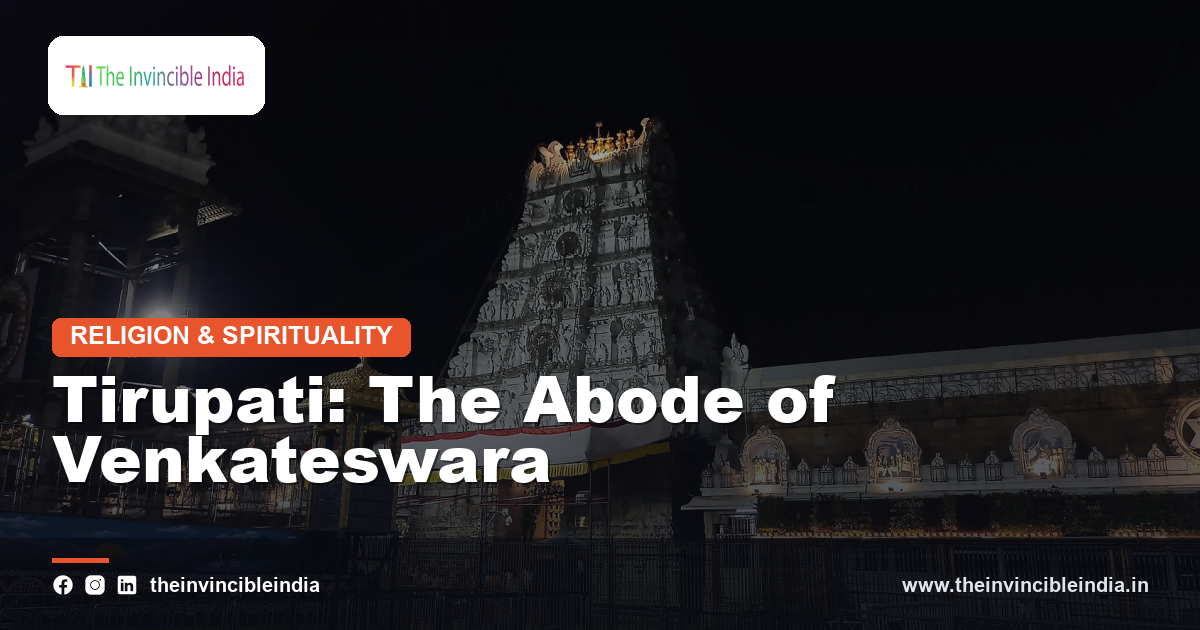
Perched atop the Tirumala hills in Andhra Pradesh, the temple of Tirupati is dedicated to Lord Venkateswara, a form of Vishnu, and stands among the most visited places of worship anywhere in the world. For generations, the shrine has drawn devotees from every corner of India and beyond, many undertaking the journey as an expression of vows, gratitude, or lifelong devotion within the wider Hindu temple tradition. Its distinctive rituals, from the daily rhythm of temple worship to the well-known practice of hair offering, reflect a devotional culture that has remained remarkably consistent even as the scale of pilgrimage has grown enormously. Tirupati today stands as both a spiritual anchor for Vaishnava devotion and a testament to the enduring pull of India’s hill shrines.
Quick Facts
| Detail | Information |
|---|---|
| Location | Tirumala hills, Andhra Pradesh |
| Deity | Lord Venkateswara (a form of Vishnu) |
| Tradition | Vaishnavism within Hinduism |
| Managing Body | Tirumala Tirupati Devasthanams |
| Known For | Hair-offering tradition and laddu prasadam |
| Status | Among the most visited temples in the world |
A Shrine Atop the Seven Hills
The temple of Tirupati sits at Tirumala, a hill site traditionally described as part of a range known as the Seven Hills, in the state of Andhra Pradesh. Its elevated location has long contributed to the shrine’s aura of sanctity, requiring pilgrims to make a deliberate ascent, whether by road or on foot, before reaching the temple precincts.
This hilltop setting places Tirupati within a broader Indian tradition of sacred sites associated with elevated, naturally striking landscapes. The physical journey upward has itself become woven into the devotional meaning of the pilgrimage, symbolizing effort and aspiration on the path toward the divine.
Venkateswara and the Vaishnava Tradition
The presiding deity of the temple, Venkateswara, is worshipped as a form of Vishnu, one of the principal deities of Hindu tradition. This places Tirupati firmly within the broader Vaishnava devotional current, which emphasizes loving surrender and service to Vishnu in his many manifestations across Indian sacred geography.
Devotees regard Venkateswara as a protector and benefactor accessible through sincere devotion, a belief that has sustained the temple’s popularity across many centuries. The deity’s association with this particular hill has made Tirupati one of the most significant centers of Vaishnava worship in the country.
Legendary Accounts of the Shrine
Devotional literature and oral tradition associate the origins of the Tirupati shrine with accounts of the deity choosing to reside upon the hill, stories that have been retold and cherished by generations of pilgrims. As with many ancient temples, these narratives serve primarily a devotional rather than strictly historical purpose.
Such stories emphasize themes of divine grace, protection, and the accessibility of the sacred to sincere devotees. Regardless of their historical specifics, these accounts continue to shape how pilgrims understand and approach the temple, reinforcing the emotional significance of their visit.
Architecture of the Main Temple
The main temple at Tirumala reflects South Indian temple architectural traditions, featuring a prominent gateway tower, layered enclosures, and a sanctum housing the central image of the deity. Successive generations of patronage have contributed to the structure’s development, adding halls, gateways, and decorative elements over time.
This layered architectural history is typical of major South Indian temples, which often grew incrementally through the support of various rulers and devotee communities. The result is a complex that reflects centuries of continuous religious use and architectural refinement rather than a single moment of construction.
The Sacred Image and Its Worship
At the heart of the temple stands the image of Venkateswara, richly adorned and central to the daily cycle of worship. The image is treated with the reverence and ritual care traditionally accorded to a living presence within Hindu temple practice, receiving regular offerings, decoration, and prayer throughout the day.
This mode of worship, in which the deity is cared for much as an honored guest or resident, is characteristic of Hindu temple tradition generally and finds one of its most elaborate expressions at Tirupati, where ritual attention to the deity follows a detailed and continuous daily schedule.
Daily Rituals and Sevas
The temple follows an extensive daily schedule of rituals, known as sevas, which include waking the deity, ceremonial bathing, decoration, and multiple rounds of prayer offered throughout the day and evening. Each ritual follows established sequences maintained by trained temple priests.
This structured rhythm of worship reflects the broader South Indian temple tradition of treating the deity’s daily routine as a sacred cycle to be honored with precision and devotion. For pilgrims, awareness of this rhythm often deepens their sense of participating in a living, continuously maintained devotional practice.
The Tirumala Tirupati Devasthanams
The temple and its associated institutions are administered by the Tirumala Tirupati Devasthanams, a body responsible for managing rituals, pilgrim facilities, and the temple’s extensive charitable and educational activities. This organization plays a central role in sustaining the temple’s daily functioning at a very large scale.
Beyond temple administration, the Devasthanams also support a range of educational and welfare initiatives, reflecting a broader tradition in which major Hindu temples serve as centers of community benefit alongside their religious functions.
The Hair-Offering Tradition
One of the most widely recognized customs associated with Tirupati is the offering of hair by devotees as an act of humility and surrender to the deity. This practice, carried out by pilgrims of many backgrounds, has become closely identified with the temple in popular understanding.
The tradition reflects a broader concept within Hindu devotional practice in which personal sacrifice, however modest, is offered as a gesture of gratitude or in fulfillment of a vow. Dedicated facilities at the temple complex accommodate this practice for the very large number of pilgrims who choose to participate.
The Tradition of Laddu Prasadam
Tirupati is also closely associated with its distinctive laddu prasadam, a sweet offering prepared within the temple and distributed to pilgrims as a blessed gift following worship. This prasadam has become emblematic of a visit to the temple and is cherished by devotees well beyond the immediate region.
The preparation and distribution of prasadam on such a large scale reflects the temple’s broader role in extending a tangible token of blessing to its enormous number of visitors, reinforcing the personal, sensory dimension of the pilgrimage experience.
Pilgrimage Routes and Access
Pilgrims reach Tirumala from the town of Tirupati below, either by road or via a traditional walking path up the hill, which many devotees choose specifically for its devotional significance. This choice between modern access and traditional pilgrimage on foot reflects the varied ways devotees engage with the journey.
Facilities along both routes support the steady flow of visitors, reflecting careful planning necessary to accommodate a pilgrimage of this scale. For many devotees, the ascent itself, regardless of the method chosen, remains an essential part of the overall spiritual experience.
Managing an Immense Flow of Pilgrims
Tirupati receives an extraordinarily large number of visitors throughout the year, requiring sophisticated systems of queue management, accommodation, and logistical planning to ensure an orderly and safe experience for pilgrims. These systems have been refined over time to handle sustained, high volumes of daily visitors.
The scale of this operation places Tirupati among the most logistically complex religious sites in the world, illustrating how ancient devotional practice and modern administrative systems have come together to sustain a pilgrimage tradition of remarkable size and continuity.
Festivals at Tirumala
The temple calendar includes a number of significant festivals throughout the year, during which special rituals, processions, and celebrations draw even larger crowds than usual. These occasions heighten the devotional atmosphere across the temple complex and surrounding town.
Such festivals reinforce the temple’s role as a living center of continuous worship rather than a static monument, with each occasion adding its own layer of ritual richness to the broader devotional life sustained at Tirupati throughout the year.
Charitable and Educational Contributions
Revenue and offerings received by the temple support a wide range of charitable, educational, and welfare initiatives administered through its governing body. These contributions extend the temple’s influence well beyond its immediate religious functions into broader social benefit.
This pattern reflects a long-standing tradition among major Hindu temples of channeling devotional offerings toward public good, reinforcing the idea that religious institutions in India have historically played a significant role in community welfare and education.
Tirupati's Place in South Indian Culture
Beyond its religious significance, Tirupati holds an important place within the broader cultural identity of South India, symbolizing continuity of temple worship, architectural tradition, and devotional music and literature associated with Vaishnava practice in the region.
The temple’s prominence has also influenced art, literature, and regional cultural expression over centuries, making it not only a religious destination but also a touchstone for South Indian cultural heritage more broadly, recognized well beyond its immediate devotional community.
Influence on Temple Towns Elsewhere
The model of temple-centered urban life exemplified by Tirupati and its surrounding town has influenced the development of other temple towns across South India, where religious institutions similarly serve as focal points for commerce, hospitality, and community organization.
This pattern underscores the broader role that major temples have historically played in shaping the towns that grow around them, integrating religious, economic, and social life into a single interconnected urban and devotional fabric.
Vows, Offerings, and Personal Devotion
Many pilgrims travel to Tirupati specifically to fulfill a personal vow made in a moment of hardship, gratitude, or hope, a practice widely observed at major Hindu shrines across India. Such vows may involve the hair offering, a monetary donation, or simply the completion of the pilgrimage itself as a promised act of thanksgiving.
This dimension of personal devotion adds an intimate, individual layer to the temple’s vast collective pilgrimage, reminding observers that behind the scale of daily visitor numbers lies a continuous accumulation of private hopes and gratitude. Temple staff and long-standing custom accommodate this personal dimension carefully, ensuring that even amid enormous crowds, individual devotees are able to complete their vows with the attention and dignity the occasion is felt to deserve. For many families, a completed vow at Tirupati marks a significant milestone, often remembered and referred to for years afterward as a defining spiritual experience.
Tirupati Today
Today, Tirupati remains one of the most visited and revered pilgrimage destinations in the world, sustaining an unbroken tradition of daily worship alongside a vast, continuously managed pilgrim infrastructure. Its combination of ancient devotional practice and modern logistical organization is unmatched among Indian temples of comparable scale.
As the number of pilgrims continues to grow, the temple’s core identity, as the hilltop abode of Venkateswara and a living center of Vaishnava devotion, remains unchanged, ensuring that Tirupati continues to hold a central place in India’s religious and cultural life.
Sources & Further Reading
- Ministry of Culture, Government of India (indiaculture.gov.in).
- Ministry of Tourism, Government of India.
Frequently Asked Questions
Where is the Tirupati temple located?
The temple is located at Tirumala, part of a hill range in Andhra Pradesh, above the town of Tirupati.
Who is the presiding deity at Tirupati?
The presiding deity is Venkateswara, worshipped as a form of Lord Vishnu within the Vaishnava tradition of Hinduism.
What is the hair-offering tradition at Tirupati?
Many devotees offer their hair at the temple as an act of humility and surrender, a practice closely associated with the shrine and carried out at dedicated facilities.
What is Tirupati's laddu prasadam?
It is a sweet offering prepared within the temple and distributed to pilgrims following worship, widely regarded as a distinctive blessing associated with a visit to the shrine.
Who manages the Tirupati temple?
The temple and its associated institutions are administered by the Tirumala Tirupati Devasthanams, which also supports charitable and educational activities.


