

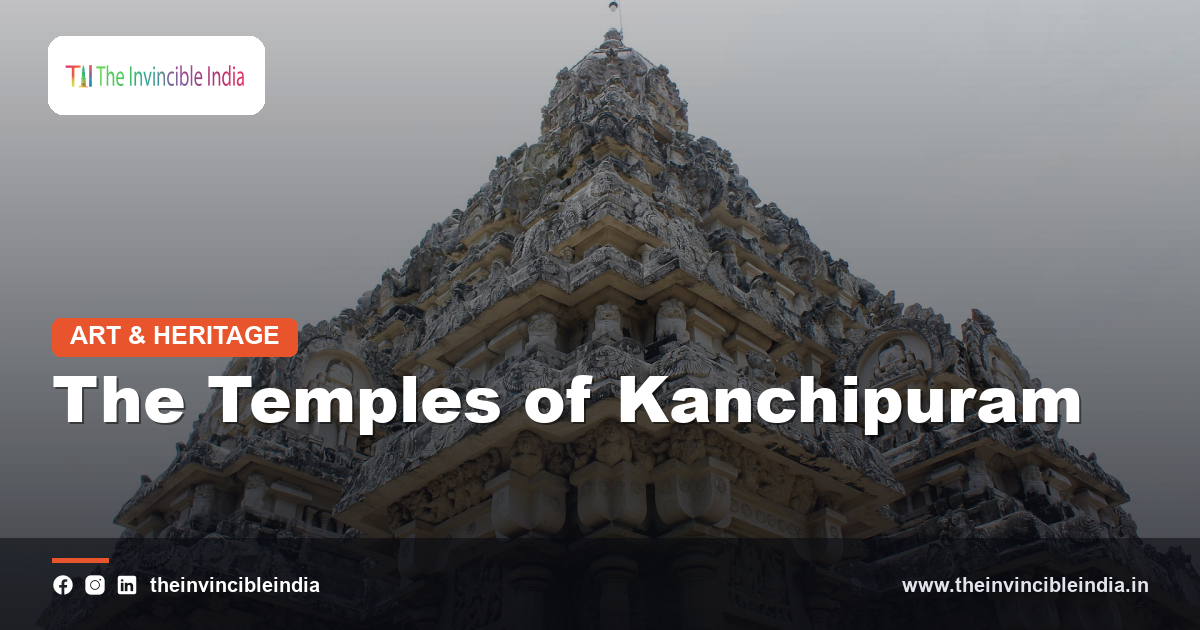
Kanchipuram in Tamil Nadu is among the most venerated cities of India, a place long celebrated as a city of temples and one of the seven sacred cities of Hindu tradition. Its shrines span a remarkable range, from the early stone temples raised under the Pallava dynasty to the vast gopuram-crowned complexes of later centuries, and they offer one of the clearest records of how southern Indian temple architecture evolved. Shaiva, Vaishnava, and Shakti worship all flourish here side by side, a coexistence that gives the city its distinctive religious character. The monuments described in the guide to Dravidian temple architecture find some of their earliest and most instructive expressions in Kanchipuram.
Quick Facts
| Detail | Information |
|---|---|
| Location | Kanchipuram, Tamil Nadu |
| Sacred status | One of the seven sacred cities (Sapta Puri) |
| Early patrons | Pallava dynasty |
| Key temples | Kailasanathar, Ekambareswarar, Kamakshi, Varadaraja Perumal |
| Style | Pallava and Dravidian architecture |
| Also known for | Silk weaving and learning |
A Sacred City of the South
Kanchipuram is counted among the seven cities that Hindu tradition regards as capable of granting liberation, and it is the only one of them located in the south of the country. Its reputation as a holy place has endured for many centuries, and religious literature often praises it as the finest of cities. The town lies on the plains of northern Tamil Nadu and is organised around a cluster of temple precincts that give the street plan its character. Shaiva temples occupy one part of the city and Vaishnava shrines another, with the Shakti temple standing in between, so that the sacred geography is balanced and layered. For pilgrims, a visit to Kanchipuram has always been regarded as an act of merit, and the many temples receive worshippers throughout the year. The city therefore stands as a rare example of a place where religion, art, and urban life have remained closely woven together.
The Pallava Capital and Its Legacy
The Pallava dynasty made Kanchipuram its capital and, in doing so, turned it into one of the principal cultural centres of early medieval South India. Under the Pallava rulers, the city attracted scholars, artists, poets, and religious teachers from many regions, and it became a centre of learning in which Sanskrit and Tamil traditions flourished. The rulers were generous patrons of religion and the arts, and their commissions established patterns that would shape southern temple building for centuries afterward. Although the dynasty eventually gave way to others, its imprint on the city never faded, and later dynasties continued to build and endow temples here. The Pallava heritage is most visible today in a handful of stone temples that survive from that era and that remain among the most admired monuments of the region, showing how a royal capital could also become a laboratory for architectural ideas.
The Kailasanathar Temple
The Kailasanathar temple is the finest surviving monument of the Pallava period in Kanchipuram and one of the great masterpieces of early Dravidian architecture. Dedicated to Shiva, it is built of sandstone and enclosed within a courtyard lined with a continuous series of small cells, each originally housing sculpted images. The main shrine rises as a stepped pyramidal tower, a form that would become the basic model for southern temple towers. The warm tone of the stone and the profusion of carved figures on its walls give the temple a sense of intimacy that contrasts with the monumental scale of later complexes. Many of the sculptures show forms of Shiva, including dynamic dancing figures, and the lion-based pillars typical of Pallava art appear throughout. The temple is an essential stop for anyone seeking to understand the beginnings of the Dravidian tradition and the artistic vision of the Pallava court.
Sculpture and Iconography at Kailasanathar
The walls and courtyard cells of the Kailasanathar temple carry a rich sculptural programme that reveals the religious imagination of the Pallava artists. Figures of Shiva appear in many aspects, from the serene to the fierce, and are accompanied by images of goddesses, attendants, and mythological scenes. The sculptors favoured a graceful, slender style, with elegant poses and carefully modelled forms. Distinctive to the Pallava manner is the use of the rearing lion, or yali, as a structural and decorative element, appearing at the base of columns and along the walls. The carving also includes fine pilasters, miniature shrine facades, and ornamental motifs that frame the larger panels. Because the stone used here is relatively soft, the surface detail has suffered with time, yet the overall impression remains powerful. The temple thus functions as a visual encyclopaedia of Shaiva iconography as it was understood in early medieval Tamil country.
The Vaikuntha Perumal Temple
Another important Pallava-era monument is the Vaikuntha Perumal temple, dedicated to Vishnu and built in the same stone tradition. Its design includes a distinctive multi-storeyed sanctum in which images of Vishnu appear in standing, seated, and reclining postures on successive levels. A circumambulatory passage around the main shrine allows devotees to walk around the sanctuary, and the surrounding cloister features rows of lion pillars and carved panels. The walls of the cloister preserve sculptural narratives that illustrate episodes from the history of the Pallava dynasty and from sacred tradition. These reliefs make the temple valuable not only as an architectural landmark but also as a document of the way rulers and religion were intertwined. Standing in the same city as the Kailasanathar, the temple allows visitors to compare Shaiva and Vaishnava expressions of one architectural language.
Ekambareswarar and the Element of Earth
The Ekambareswarar temple is one of the largest and most important Shiva shrines of Kanchipuram. Tradition holds that it is one of the five temples that represent the five elements, and that this particular shrine embodies the element of earth. According to local legend, the goddess worshipped Shiva beneath a mango tree, and an ancient tree standing within the temple precinct is revered in memory of that story. The temple is entered through an impressive gateway tower, and its outer courts lead to a large hall of many pillars. Successive dynasties added to the complex, so the architecture reflects layers of construction across different periods. The sanctum houses a lingam made of sand, which is treated with special ritual care. For devotees, the temple represents a deep connection between divinity and the natural world, and its atmosphere of quiet devotion offers a complement to the monumental character of its outer walls.
The Kamakshi Amman Temple
At the centre of the city stands the Kamakshi Amman temple, dedicated to the goddess in her form as Kamakshi and counted among the most important Shakti shrines of India. The temple is smaller in scale than some of its neighbours but holds a special place in the religious life of the city, since the goddess is regarded as the presiding spirit of Kanchipuram itself. Its courtyard, sanctum, and shrines are arranged around a sacred tank, and the golden-roofed sanctuary is a focus of intense devotion. Worship here emphasises the compassionate and creative aspects of the divine feminine, and the temple is a major pilgrimage destination for those seeking blessings. The Kamakshi temple also has a long connection with a revered monastic tradition based in the city. Its position between the Shaiva and Vaishnava quarters symbolises the harmony of the different strands of devotion that coexist in Kanchipuram.
Varadaraja Perumal and Vaishnava Worship
The Varadaraja Perumal temple, also known as Hastigiri, is the major Vaishnava shrine of the city and is counted among the holy places celebrated in the hymns of the Alvar saint-poets. Located on a rise in the eastern part of Kanchipuram, it is a large complex with several enclosures, towering gateways, and a magnificent hall of carved pillars. The temple is renowned for its sculpted columns, which show riders on rearing horses and intricate scenes that are typical of the later Vijayanagara and Nayaka building traditions. A famed feature is a stone chain carved from a single piece of rock, admired as a demonstration of the sculptors’ skill. The temple is especially busy during its large annual festivals, when the deity is carried in grand processions through the streets. Together with the other Vaishnava shrines of the city, it anchors the strong tradition of Vishnu worship in Kanchipuram.
Gopurams and the Dravidian Skyline
Many of the larger temples of Kanchipuram are entered through gopurams, the tall gateway towers that define the skyline of southern Indian temple towns. These structures rise in tiers, each level adorned with painted stucco figures of deities, mythical beings, and scenes from sacred stories. They grew taller and more elaborate over time, particularly during the centuries when the Vijayanagara and Nayaka rulers added monumental entrances to older complexes. The result is a layered architectural history, in which a modest early shrine may sit within a courtyard walled and gated by much later builders. The gopurams serve as landmarks for pilgrims approaching from afar and as thresholds that mark the transition from the secular world to the sacred. In Kanchipuram they combine with the earlier Pallava stone temples to present, within one city, the whole sweep of Dravidian temple development.
Learning, Philosophy, and Religious Institutions
Kanchipuram has long been known not only for its shrines but also for its intellectual life. The city was an important centre of Sanskrit learning, philosophy, and debate, and it drew teachers from different schools of thought, including Buddhist and Jain scholars as well as Hindu thinkers. Several religious institutions are located here, among them a famed monastic centre associated with the tradition of Advaita Vedanta. Great teachers of the Vaishnava tradition also lived and taught in the city and helped to shape its devotional culture. These institutions gave the temples a living intellectual context, since worship, study, and debate went hand in hand. Visitors who wander the lanes of the old quarter can still sense this atmosphere of scholarship in its schools, monasteries, and traditional houses. The union of learning and devotion remains one of the defining themes of Kanchipuram’s long history.
Buddhist and Jain Traces in Kanchi
Although it is best known for its Hindu temples, Kanchipuram also has a significant Buddhist and Jain past. Early accounts describe the city as a place where several religious communities lived and taught, and Buddhist scholars and monasteries once flourished here. The Jain heritage is still visible in a quarter of the town traditionally associated with Jain temples, where shrines and wall paintings preserve the memory of that community. These traces remind visitors that the religious life of the city was never uniform and that different traditions contributed to its cultural richness. The patronage of diverse faiths by rulers and merchants created a cosmopolitan environment in which ideas and artistic forms circulated freely. Recognising this plurality adds depth to the understanding of Kanchipuram, showing that its fame rests on a broad tradition of religious and intellectual exchange rather than on a single creed.
Festivals and Processions
The temples of Kanchipuram come alive during their festivals, when the deities leave the sanctum and travel through the streets in decorated vehicles. Large temple cars, drawn by devotees, move through the broad ceremonial avenues that surround the major temples, accompanied by music, chanting, and crowds of worshippers. The annual cycles of festivals follow the Tamil calendar and include celebrations of Shiva, Vishnu, and the goddess. Each temple has its own set of observances, and the timing of these events creates a rolling series of public spectacles across the year. Traditional musicians, dancers, and priests all take part, so that festivals serve as a stage for the performing arts as well as for worship. These events strengthen the bond between the temples and the community, reminding residents and visitors that the monuments of Kanchipuram are not relics of the past but active centres of devotion.
Kanchipuram Silk and the Temple Economy
The fame of Kanchipuram extends beyond its temples to its handwoven silk, which has become a symbol of South Indian craft. The weaving tradition is closely linked to temple culture, since local weavers have long produced cloth for ceremonial use and for the adornment of deities, and many of the borders and motifs draw inspiration from temple architecture, flora, and mythology. Weaving families live in neighbourhoods around the temple areas, and the craft has been passed down through generations. The relationship between temples and artisans illustrates how a sacred centre can support a wider economy of skills and trade. Visitors to the city often combine a tour of the shrines with a visit to the weaving workshops, experiencing two aspects of the same cultural heritage. The silk tradition thus enriches the story of Kanchipuram, showing how religion and craft sustained one another across the centuries.
Architectural Evolution Across the Centuries
Taken together, the temples of Kanchipuram form an open-air museum of architectural history. The earliest structures show the Pallava experiment with carved sandstone, compact towers, and lion-based pillars. Later shrines reveal the expanded ambitions of dynasties that followed, with larger courtyards, taller gateways, and elaborate pillared halls. The influence of the Vijayanagara and Nayaka periods is especially visible in the grand gopurams and sculpted corridors. By moving from one temple to another, a visitor can trace the gradual shift from the restrained elegance of the early style to the exuberant ornament of the later one. This continuity within a single city is rare and gives Kanchipuram special value for students of Indian art. It demonstrates that temple architecture was not static but evolved through a constant dialogue between inherited tradition and new artistic ideas, each generation adding its own layer to the sacred landscape.
Kanchipuram Today
Today Kanchipuram remains a living city of faith, learning, and craft, welcoming pilgrims and travellers throughout the year. Its temples continue to function as active centres of worship, and their rituals and festivals preserve traditions that have lasted for many centuries. The Pallava monuments are protected as heritage sites, while the larger temples remain under the care of their religious communities. The city’s weavers, priests, scholars, and artists all contribute to a cultural environment that has changed remarkably little in spirit. For those who wish to understand the development of Dravidian architecture or the religious diversity of South India, Kanchipuram offers an unmatched destination. Its shrines, from the early elegance of the Kailasanathar to the grandeur of Varadaraja Perumal, tell a continuous story of devotion and creativity, confirming the city’s enduring place among the great sacred centres of India.
Sources & Further Reading
- Archaeological Survey of India (asi.nic.in).
- Ministry of Culture, Government of India (indiaculture.gov.in).
Frequently Asked Questions
Why is Kanchipuram considered a sacred city?
Kanchipuram is counted among the seven sacred cities of Hindu tradition and is the only one located in the south. Its many temples dedicated to Shiva, Vishnu, and the goddess have drawn pilgrims for centuries.
Which is the oldest major temple in Kanchipuram?
The Kailasanathar temple, built in the Pallava period, is the best-known early monument of the city. It is celebrated as a masterpiece of early Dravidian architecture.
What is special about the Ekambareswarar temple?
It is revered as the temple of the element of earth among the five elemental Shiva shrines. A sacred mango tree and a lingam made of sand are central to its legends.
What role did the Pallavas play in Kanchipuram?
The Pallavas made the city their capital and fostered learning, art, and temple building. Their stone temples set patterns that influenced later southern architecture.
Is Kanchipuram famous for anything besides temples?
Yes, the city is also renowned for its handwoven silk and its long tradition of learning. Both are closely linked with the life of the temples.


