

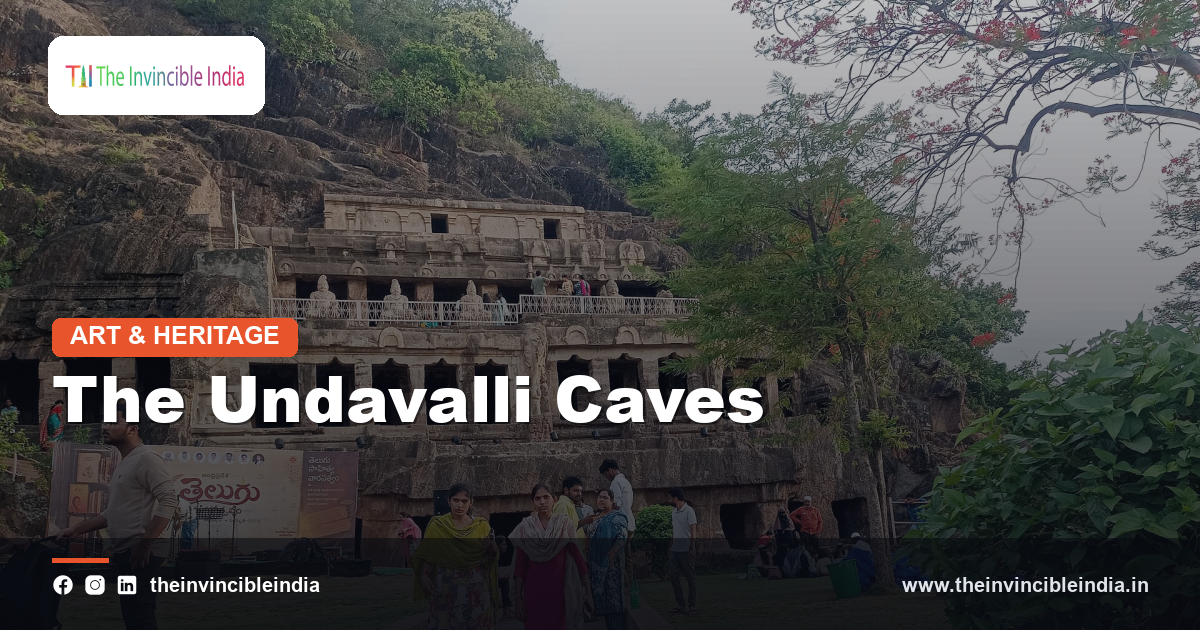
On a hillside above the Krishna River near Vijayawada, a tiered facade of carved pillars and cells marks one of the most distinctive rock-cut monuments of Andhra Pradesh. The Undavalli caves, cut into the living rock across several storeys, preserve a rare example of early cave architecture in which a single hillside was shaped into a monastery-like complex and later devoted to Hindu worship. Their most celebrated feature is a colossal reclining figure of Vishnu carved from a single mass of stone. Placed within the larger story of rock-cut architecture in India, Undavalli offers valuable evidence of how early builders adapted Buddhist-style excavation to new religious purposes. This guide examines its setting, architecture, sculpture and lasting importance.
Quick Facts
| Detail | Information |
|---|---|
| Location | Undavalli, near Vijayawada, Andhra Pradesh |
| Type | Rock-cut cave temple complex |
| Setting | Hillside above the Krishna River |
| Structure | Multi-storey excavated facade |
| Main Sculpture | Reclining Vishnu carved from one block |
| Period | Early medieval rock-cut tradition |
An Overview of the Undavalli Caves
The Undavalli caves form a compact but remarkable complex of excavated chambers cut into a hillside in the Guntur region of Andhra Pradesh. Unlike many cave groups that spread horizontally along a cliff, this complex rises through several levels, with each storey carved from the rock and supported by rows of pillars. The facade presents a stepped profile that reads almost like a built structure even though it was taken entirely from the hill. Inside, cells, halls and shrines are arranged around the central chambers, and the highest level houses the famous reclining figure of Vishnu. The caves are valued both for their architectural form and for the light they shed on the religious history of the region. Undavalli stands as one of the finest surviving examples of a multi-storey cave complex in the southern part of the country.
Location on the Krishna River
The caves stand on the western bank of the Krishna River, a short distance from the city of Vijayawada, in a landscape that has been important to the history of Andhra for many centuries. The Krishna valley was a corridor for trade, pilgrimage and the movement of ideas, and it supported the growth of Buddhist, Jain and Hindu communities at different times. Hills near the river offered ideal locations for cave monasteries, since the rock was workable, the sites were quiet and the river provided water and access. The caves at Undavalli share this setting with other ancient sites of the region, which together form a map of early religious life along the river. The position of the caves above the water also gives them a striking outlook across the valley. The Krishna setting helps explain why the site was chosen and why it endured.
Historical Background and Dating
The Undavalli caves are generally placed in the early medieval period and are commonly associated with the Vishnukundin dynasty, who ruled parts of Andhra after the decline of earlier powers. Scholars have long discussed the exact chronology of the site, and estimates depend on stylistic comparison with other cave monuments rather than on a single decisive inscription. What can be said with confidence is that the complex belongs to a phase when rock-cut architecture in the Deccan was shifting from the monastic caves of earlier centuries toward the temple-oriented excavations of later ones. The caves therefore sit at a transitional moment in Indian art and architecture. Their importance lies in this position between traditions, which allows students of history to observe change within a single monument. The historical background of Undavalli is best understood as a record of continuity and adaptation.
The Multi-Storey Design
The most striking architectural feature of Undavalli is its vertical organisation. The complex rises through several storeys, each cut back from the one below so that the facade forms a series of receding terraces. Rows of pillars support the upper levels, giving the rock the appearance of a constructed building, and the plan recalls the tiered monastery or vihara type known from earlier Buddhist sites. This design required the excavators to plan the entire structure from the top downward, since the upper levels had to be carved before the lower ones could be completed without disturbing the rock above. The finished complex shows a high degree of engineering and planning skill. Its staged, pillared elevation makes it one of the more unusual cave monuments in the country, and the design remains its defining architectural achievement.
From Monastery to Temple
The layout of the Undavalli caves suggests an original monastic function, with cells arranged around halls in the manner of a residence for monks. Over time the complex came to be used for Hindu worship, and the central chambers were dedicated to Vishnu and other deities. This shift from monastic to temple use is not unique to Undavalli, but the site preserves the change unusually clearly, because the older plan and the later dedications can still be read side by side. The adaptation reflects the changing religious landscape of the region, in which patronage moved between communities and established structures were reused rather than abandoned. Such reuse was a practical and respectful way of preserving buildings while meeting the needs of new devotees. The history of the caves therefore illustrates continuity across religious traditions as much as it illustrates change.
The Reclining Vishnu
The centrepiece of the complex is a large sculpture of Vishnu in his reclining form, known as Anantashayana, carved on the upper level from a single mass of the hillside. The deity lies on the coils of the serpent Ananta, with the hooded serpent rising above his head, in the posture associated with the cosmic rest between cycles of creation. The figure is impressive for its scale and for the calm, composed expression given to the face, and it is carved in the round with considerable attention to the crown, the ornaments and the flowing lines of the body. Smaller sculpted figures accompany the deity, completing the composition in the manner of the classical iconography of Vishnu. The reclining Vishnu is the emotional heart of the caves, and it stands among the most admired examples of monolithic sculpture in Andhra Pradesh.
The Iconography of Anantashayana
The reclining posture of Vishnu belongs to one of the best-loved themes in Hindu art, in which the deity rests upon the serpent Ananta, also called Shesha, afloat on the cosmic waters. The theme expresses the idea of a world at rest between one creation and the next, and it is treated in temples and caves across the country with regional variations. At Undavalli the image shows the characteristic features of this tradition, including the raised serpent hood and the relaxed reclining pose. The presence of attendant figures reinforces the narrative, and the carving invites meditation on cosmic order and divine repose. Understanding the iconography deepens an appreciation of the sculpture, because it reveals the theological meaning behind the form. The Anantashayana image at Undavalli is therefore both a work of art and a statement of religious philosophy.
Pillars, Halls and Cells
Beyond the famous sculpture, the caves contain a series of pillared halls and small chambers that show the working methods of the early excavators. The pillars are cut with square and octagonal sections and carry simple capitals, and the halls between them provide shaded spaces for assembly and worship. Smaller cells open off the main chambers, and their dimensions suggest a use for residence or quiet devotion. The interior is plain compared with the ornate temples of later centuries, yet this restraint gives the space a quiet dignity, and the play of light across the stone adds atmosphere. Careful observation reveals tool marks and finishing details that reveal how the rock was dressed. These features make Undavalli a valuable study site for anyone interested in early excavation techniques, because the spaces still show how a hillside can be converted into architecture.
Sculpture on the Lower Levels
The lower storeys of the caves contain additional sculpture, including figures of deities and attendants set into niches and beside doorways. These carvings belong to the same broad artistic tradition as the main image, and they display a steady, unhurried style in which form and proportion take priority over decoration. Some of the figures are worn by centuries of weathering, yet their outlines survive, and they contribute to the sense of a complex that was intended to be seen from several levels. Together they help to show how a single hillside could be planned as an integrated work, with architecture and sculpture developing in step. The presence of such figures also helps to confirm the later dedication of the caves to Hindu deities. The lower-level carvings complete the visual programme that culminates in the great reclining image above.
Connections to Buddhist and Jain Traditions
The Krishna valley was home to flourishing Buddhist communities, and the design of Undavalli reflects the influence of monastic architecture associated with that tradition. The tiered facade, the arrangement of cells and the use of pillared halls recall the viharas of earlier centuries, and some accounts have linked the site to Jain or Buddhist use before its later dedication to Hindu deities. The exact sequence of occupation remains a subject of scholarly discussion, and it is wise to treat any single account with caution. What is clear is that the site grew out of a shared architectural culture in which different religious communities used similar forms of excavation. This shared heritage is a reminder that Indian religious architecture developed through exchange rather than isolation. The caves preserve that overlap, and they illustrate the plural character of early Andhra culture.
Undavalli in the Rock-Cut Tradition
India has one of the richest traditions of rock-cut architecture in the world, stretching from early Buddhist excavations in the west to later temple caves in the south and east. Undavalli belongs to this larger story as a southern and eastern example that shows how the tradition travelled and adapted. Compared with the vast excavations of the Western Ghats, it is modest in scale, but it is distinguished by its vertical arrangement and by the quality of its central sculpture. It also provides a useful comparison with the southern cave shrines of the Pallavas and with the temples described in the guide to the Rockfort Temple of Tiruchirapalli, which preserve a similar early phase of carving. Seen together, these sites reveal a shared craft heritage. Undavalli therefore occupies a meaningful place within the wider chronicle of Indian cave architecture.
Other Shrines on the Hill
The hillside at Undavalli is not limited to the main excavated complex, and other shrines in the vicinity add to the sacred character of the place. A nearby cave temple dedicated to Narasimha, the lion-headed form of Vishnu, is a well-known companion to the main complex and draws its own devotees. These additional shrines show that the hill was a focus of worship across a broad area rather than a single isolated monument. The surrounding landscape of rock, scrub and village also preserves something of the quiet setting in which the caves were first cut. Together the shrines form a small pilgrimage circuit, and visitors often combine them in a single visit. The wider group of shrines strengthens the cultural importance of Undavalli, placing it within a continuing tradition of hillside devotion.
Materials and Techniques of Excavation
The caves were created by cutting directly into the rock of the hillside, using simple hand tools such as chisels, hammers and wedges, and the work required patience as well as skill. Excavators began at the top of the intended structure and worked downward, removing rock in stages and shaping pillars, walls and ceilings as they went. Because any error could not be undone, careful planning and measurement were essential, and the smooth, regular surfaces that survive show how well the craftsmen controlled the material. The rock itself had to be stable enough to support the open halls and the weight above, and the choice of this hillside shows a practical understanding of geology. The technique is slow but highly durable, which explains why such caves have survived so long. The methods of excavation are a quiet testimony to the craftsmanship of early builders.
Conservation and Protection
The Undavalli caves are a protected monument under the care of the national archaeological authorities, and their conservation is essential because the soft, weathered rock is vulnerable to rain, moisture, vegetation and the wear caused by visitors. Protective measures include regular inspection, the control of access in the most delicate areas and the maintenance of the surrounding ground to limit erosion. The complex also faces pressure from its position near a growing urban region, and careful management is needed to balance public access with the safeguarding of the carvings. Conservation work follows established principles of minimal intervention, since the aim is to preserve the monument in its authentic condition rather than to restore it to an imagined original state. Visitors can help by respecting restrictions and leaving the surfaces untouched. Protecting Undavalli safeguards a rare document of early Indian architecture for future generations.
Visiting the Undavalli Caves
The caves are easily reached from Vijayawada and make a rewarding half-day excursion for travellers interested in architecture, sculpture and regional history. Visitors climb a flight of steps to the upper levels, where the reclining Vishnu can be seen, and they are encouraged to move slowly and observe the details of the facade from several vantage points. The best times to visit are the cooler months and early morning, when the light is soft and the crowds are smaller. Modest clothing and quiet behaviour are appropriate, since the caves retain a religious character. Good walking shoes are useful, as the steps and floors can be uneven. A visit can be combined with other heritage sites around Vijayawada and the Krishna valley, allowing a broader appreciation of the area. The experience rewards those who take time to look closely.
The Undavalli Caves Today
Today the Undavalli caves remain one of the most important rock-cut monuments in Andhra Pradesh and a significant reference point for the study of early Indian architecture. The tiered facade, the quiet pillared halls and the monolithic reclining Vishnu continue to attract scholars, pilgrims and travellers, and the site serves as a reminder of the creativity of the craftsmen who shaped a hillside into a place of worship. Its history of adaptation, from monastic plan to Hindu sanctuary, reflects the layered religious character of the region. Alongside the great forts and temples described in the guide to the great forts of India, it shows the diversity of the country’s built heritage. The caves endure as a meeting point of art, faith and history on the banks of the Krishna.
Sources & Further Reading
- Archaeological Survey of India (asi.nic.in).
- Ministry of Culture, Government of India (indiaculture.gov.in).
Frequently Asked Questions
Where are the Undavalli caves located?
The caves are in the village of Undavalli on the bank of the Krishna River, close to the city of Vijayawada in Andhra Pradesh. They are easy to reach by road from the city and can be visited in a few hours.
What is the main attraction of the Undavalli caves?
The main attraction is a large reclining figure of Vishnu on the upper level, carved from a single mass of rock. The multi-storey pillared facade is also a notable architectural feature.
Who built the Undavalli caves?
The caves are commonly associated with the Vishnukundin period, although the exact dating is discussed by scholars. The complex appears to have begun with a monastic plan and was later used for Hindu worship.
Are the Undavalli caves Buddhist or Hindu?
The layout shows influence from earlier monastic architecture linked with Buddhist and possibly Jain traditions. In its present form the complex is dedicated to Hindu deities, especially Vishnu.
What is the best time to visit the caves?
The cooler months from late autumn to early spring are the most comfortable, and mornings offer the best light and fewer visitors. Sturdy shoes are recommended because the steps and floors can be uneven.


