

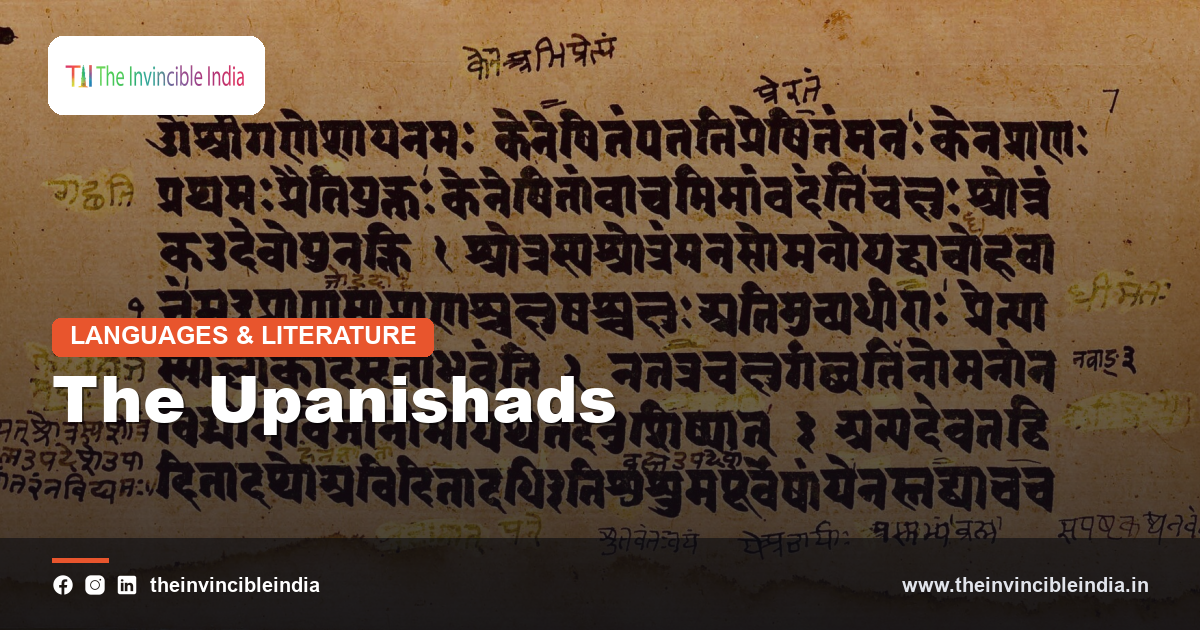
The Upanishads are a body of philosophical texts that form the concluding portion of Vedic literature, exploring questions about the nature of reality, the self and the universe. Composed in Sanskrit, the same classical tongue examined in our Sanskrit language guide, they mark a shift from the ritual hymns of earlier Vedic texts toward abstract, introspective inquiry. Traditionally transmitted through close dialogue between teacher and student, the Upanishads probe the relationship between the individual self and a universal reality, laying the intellectual groundwork for later schools of Hindu philosophy. Their teachings, expressed through dialogue, parable and metaphor, continue to be studied for their contribution to metaphysics and their influence on spiritual and philosophical traditions well beyond India. This guide surveys their origins, themes and continuing relevance.
Quick Facts
| Detail | Information |
|---|---|
| Category | Philosophical texts of the Vedic corpus |
| Language | Sanskrit |
| Position in Vedas | Concluding portion, also called Vedanta |
| Core Themes | Brahman (ultimate reality), Atman (self), liberation |
| Teaching Method | Dialogue between teacher and student |
| Legacy | Foundation of Vedanta philosophy and later Hindu thought |
What Are the Upanishads
The Upanishads are a collection of philosophical texts composed in Sanskrit that together form the culminating portion of the Vedic corpus, the ancient body of sacred literature that stands at the foundation of Hindu thought. Unlike the earlier hymns and ritual manuals of the Vedas, which are largely concerned with sacrifice and cosmic order, the Upanishads turn inward, asking searching questions about the nature of reality, consciousness and the self.
They are not a single unified work but rather a diverse collection of texts composed over an extended period, varying in length, style and emphasis. Despite this diversity, they share a common concern with metaphysical inquiry, making them less a set of religious instructions and more a sustained philosophical conversation carried out across generations of thinkers.
Place in Vedic Literature
Within the traditional four-fold structure of Vedic literature, the Upanishads occupy the final and most philosophical layer, following the hymns, ritual instructions and theological commentaries that precede them. For this reason, they are often referred to collectively as Vedanta, a term meaning the end or culmination of the Veda, indicating both their literal position and their role as the summation of Vedic thought.
This placement reflects a broader intellectual movement within ancient Indian tradition, one that progressed from external ritual observance toward internal contemplation and philosophical reasoning. The Upanishads thus represent a natural, if profound, evolution within Vedic literature rather than a wholesale departure from it, building upon earlier ideas while redirecting their focus toward the nature of ultimate reality.
Meaning of the Name
The word Upanishad is generally understood to derive from Sanskrit roots suggesting the idea of sitting down near someone, evoking the image of a student seated close to a teacher to receive instruction. This etymology captures the intimate, personal manner in which the knowledge contained in these texts was traditionally imparted, distinguishing it from more public or ceremonial forms of religious teaching.
The name also carries a secondary sense of secret or esoteric knowledge, teachings reserved for those who had shown sincere dedication and readiness to grasp difficult philosophical truths. Together, these layers of meaning point to a tradition of learning grounded in close mentorship, patient reflection and the gradual unfolding of subtle ideas.
Principal Upanishads
Although many Upanishads exist, a smaller group of principal texts is traditionally regarded as the most authoritative and philosophically significant, and it is these that later commentators drew upon most extensively when systematising Vedantic thought. These principal Upanishads vary considerably in length and literary style, ranging from extended prose dialogues to more compact verse compositions.
Each of these texts is associated with a particular Vedic school, reflecting the varied intellectual communities in which they were composed and preserved. Despite their differing origins, they are studied together as a coherent body of thought, their shared themes of self and ultimate reality allowing them to be read as complementary explorations of the same underlying philosophical questions.
Core Philosophical Themes
At the heart of the Upanishads lies a sustained inquiry into the nature of reality and the self, pursued through questions that recur across the different texts in various forms. Central among these is the relationship between the individual self and a universal, unchanging reality that underlies all existence, a question the Upanishads approach through dialogue, analogy and careful reasoning rather than dogmatic assertion.
Other recurring themes include the nature of consciousness, the causes of suffering and ignorance, and the possibility of liberation through direct knowledge of ultimate truth. This philosophical orientation, more interested in understanding than in prescribing ritual behaviour, gives the Upanishads a distinctly contemplative character within the wider Vedic tradition.
The Concept of Brahman
Brahman is the term used in the Upanishads to describe the ultimate, all-encompassing reality that underlies and unifies the entire universe. Described variously as infinite, unchanging and beyond ordinary sensory perception, Brahman is presented not as a deity in the conventional sense but as the fundamental ground of existence from which all things arise and to which all things ultimately return.
The Upanishads approach this concept through a variety of teaching methods, including negation, analogy and direct assertion, reflecting the difficulty of expressing something considered to transcend ordinary language and thought. This careful, exploratory treatment of Brahman is one of the most distinctive philosophical contributions of the Upanishadic texts.
The Concept of Atman
Alongside Brahman, the Upanishads devote considerable attention to Atman, generally understood as the innermost self or essence of an individual being. A central and recurring teaching across several Upanishads is the idea that Atman and Brahman are ultimately identical, meaning that the deepest reality within each individual is not separate from the universal reality underlying the cosmos as a whole.
This identification of self and ultimate reality forms one of the most influential philosophical claims in the entire Upanishadic corpus, shaping later Vedantic interpretation for centuries. The exploration of Atman, its nature, its relationship to the body and mind, and its ultimate identity with Brahman, remains among the most studied threads of Upanishadic thought.
Teacher-Student Tradition
The Upanishads are deeply shaped by the tradition of oral instruction passed from teacher to student, a relationship reflected throughout the texts in the form of dialogue and structured questioning. Many Upanishads present their philosophical content through the words of a teacher responding to a student’s earnest inquiries, modelling an ideal of patient, gradual instruction suited to difficult subject matter.
This pedagogical structure was not merely a literary device but reflected an actual method of transmission, in which philosophical insight was cultivated through sustained personal guidance rather than through solitary reading. The emphasis on dialogue underscores the Upanishads’ view of knowledge as something arrived at gradually through reasoned exchange rather than received passively.
Dialogues and Parables
A distinctive feature of the Upanishads is their frequent use of vivid dialogue and memorable parables to convey abstract philosophical ideas in accessible form. Conversations between sages, kings and students are used to explore difficult questions about reality and the self, often building gradually from simple observations toward more profound conclusions.
Alongside dialogue, the Upanishads employ striking analogies drawn from everyday experience, comparing subtle philosophical truths to familiar phenomena such as salt dissolving in water or the relationship between a tree and its seed. These literary techniques make the texts notably engaging, allowing complex metaphysical arguments to be communicated with clarity and lasting memorability.
Language and Style
The Upanishads are composed in Sanskrit, though their style differs considerably from the more formal, ritualistic language of earlier Vedic hymns. Many Upanishadic passages read as flowing philosophical prose or reflective verse, marked by a searching, exploratory tone quite distinct from the precise ceremonial instructions found elsewhere in Vedic literature.
This stylistic shift mirrors the change in subject matter, moving from external ritual toward internal contemplation, and it required a correspondingly flexible use of language capable of expressing abstract and often paradoxical ideas. The literary variety across different Upanishads, some terse and aphoristic, others expansive and narrative, reflects the range of authors and periods represented within the collection.
Influence on Later Hindu Philosophy
The philosophical ideas contained in the Upanishads became the foundation for Vedanta, one of the most influential schools of Hindu philosophy, which developed extensive commentaries and systematic interpretations of Upanishadic teaching over subsequent centuries. Different currents within Vedanta arrived at varying interpretations of the relationship between self and ultimate reality, generating rich philosophical debate.
Beyond Vedanta specifically, Upanishadic concepts of Brahman, Atman and liberation influenced broader currents of Hindu religious and philosophical thought, shaping devotional, yogic and ascetic traditions alike. This enduring influence illustrates how the Upanishads, though ancient, continued to generate active philosophical engagement long after their initial composition.
Influence Beyond India
As translations of the Upanishads became available to scholars and readers outside India in more recent centuries, their philosophical ideas attracted considerable interest among thinkers engaged with questions of metaphysics and comparative religion. Some Western philosophers and writers found in the Upanishads a distinctive approach to questions about consciousness and ultimate reality that complemented or contrasted with their own philosophical traditions.
This cross-cultural engagement contributed to a broader global interest in Indian philosophy during the modern period, with the Upanishads frequently cited as an entry point into Vedantic thought. Their continued study in comparative philosophy and religious studies programmes around the world reflects this lasting international reach.
Upanishads and Other Vedic Texts
The Upanishads are best understood in relation to the broader Vedic literature that precedes them, including hymns devoted to natural and cosmic forces and detailed manuals governing ritual sacrifice. Where these earlier texts emphasise correct ritual performance as a means of maintaining cosmic and social order, the Upanishads shift attention toward the inner meaning and philosophical justification behind such practices.
Rather than rejecting the ritual tradition outright, many Upanishadic passages reinterpret sacrificial symbolism in philosophical terms, suggesting that true understanding lies beneath the external form of ritual. This layered relationship between action and knowledge reflects a broader tension within Vedic tradition that the Upanishads sought thoughtfully to resolve.
Recitation and Oral Tradition
Like other Vedic literature, the Upanishads were preserved for a very long period through a rigorous oral tradition before being committed to writing, relying on precise memorisation techniques developed to guard against error over generations of transmission. Students trained under qualified teachers to recite these texts with careful attention to pronunciation and intonation.
This emphasis on exact oral preservation reflects the deep reverence accorded to the texts within Vedic culture, treating accurate transmission as essential to safeguarding their philosophical and spiritual value. Even after written manuscripts became available, oral recitation remained an important complementary practice, valued for its role in sustaining a living connection to the tradition.
Modern Study and Translations
In the modern period, the Upanishads have been the subject of extensive scholarly study, with translations produced in numerous languages to make their philosophical content accessible to a global readership. Academic institutions and independent scholars alike continue to examine the historical development, textual variations and philosophical implications of these ancient works.
This ongoing scholarship has helped clarify the diversity within the Upanishadic corpus while also highlighting shared philosophical concerns that unite the individual texts. Contemporary interest spans both academic philosophy departments and broader popular readership drawn to questions of consciousness, meaning and the nature of reality that the Upanishads continue to address.
The Upanishads Today
Today the Upanishads remain among the most widely studied texts of ancient Indian philosophy, valued both within living Hindu tradition and by scholars of comparative philosophy and religion worldwide. Their exploration of Brahman, Atman and the path to liberation continues to inform contemporary discussions of Vedanta and related philosophical schools.
The enduring appeal of the Upanishads lies in their willingness to ask fundamental questions about existence and consciousness without settling for easy answers, inviting each generation of readers to engage with their reasoning afresh. This combination of ancient origin and continuing philosophical relevance ensures the Upanishads a lasting place in the intellectual heritage of India and beyond.
Sources & Further Reading
- Sahitya Akademi.
- Ministry of Culture, Government of India (indiaculture.gov.in).
Frequently Asked Questions
What are the Upanishads?
The Upanishads are a collection of ancient Sanskrit philosophical texts forming the concluding portion of the Vedas, exploring the nature of reality, the self and liberation through dialogue and reasoned inquiry.
What does the word Upanishad mean?
The term is generally understood to suggest sitting close to a teacher, reflecting the tradition of intimate instruction through which their philosophical teachings were originally transmitted.
What is the relationship between Brahman and Atman?
A central Upanishadic teaching holds that Atman, the innermost self, is ultimately identical with Brahman, the universal reality underlying the entire cosmos.
How are the Upanishads different from earlier Vedic texts?
While earlier Vedic literature focuses on ritual hymns and sacrificial procedure, the Upanishads turn toward philosophical inquiry into consciousness, self and ultimate reality.
Why are the Upanishads also called Vedanta?
They are called Vedanta, meaning the end of the Veda, both because of their position at the close of Vedic literature and because they represent its philosophical culmination.


