

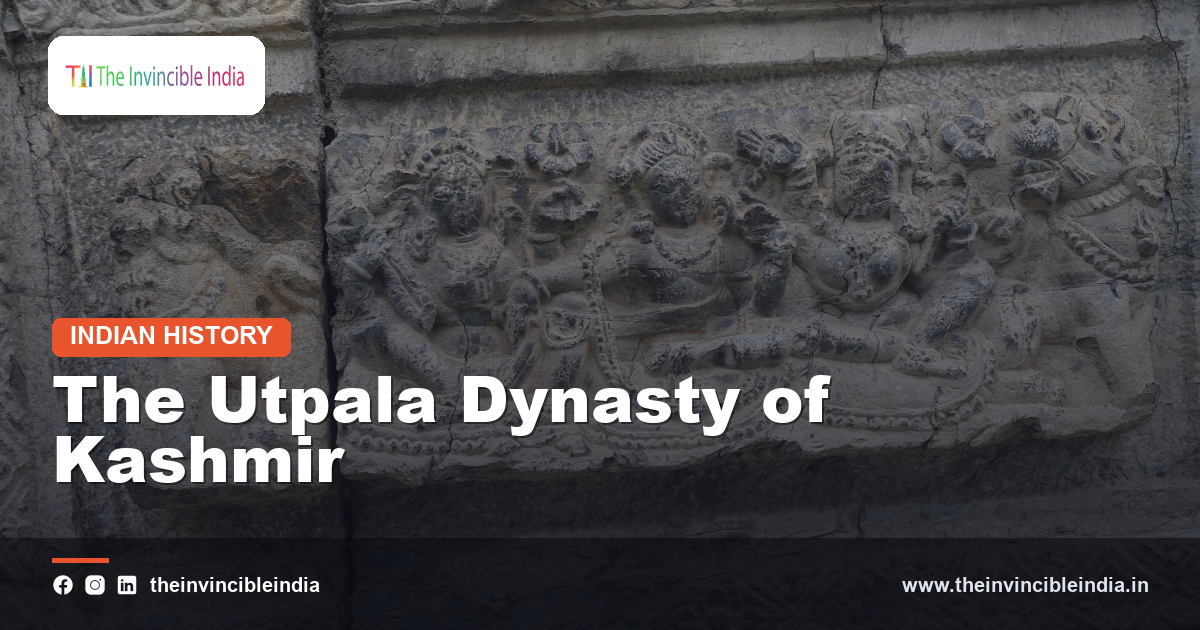
The Utpala dynasty ruled the valley of Kashmir during the ninth and tenth centuries, a period of administrative reform, monumental temple building, and extraordinary intellectual creativity. Succeeding the Karkota rulers, who had given Kashmir a place among the notable kingdoms of northern India, the Utpalas rose to power under Avantivarman, a king remembered for peace, patronage, and hydraulic engineering. The chief literary source for their history is the Sanskrit chronicle Rajatarangini, composed by Kalhana in a later century. Much like the other regional houses discussed among the great ruling families of India, the Utpalas left a legacy that combined statecraft with art, philosophy, and faith.
Quick Facts
| Detail | Information |
|---|---|
| Dynasty | Utpala, successors of the Karkotas |
| Region | The valley of Kashmir and surrounding hill territories |
| Period | Ninth to tenth century, with chronology debated in detail |
| Founder | Avantivarman |
| Main Source | The Rajatarangini of Kalhana |
| Cultural Legacy | Avantipur temples, Sanskrit poetics, and Kashmir Shaivism |
The Kashmir Valley Before the Utpalas
To understand the Utpala dynasty, one must begin with the Kashmir valley and its earlier rulers. The Karkota dynasty had governed Kashmir with considerable ambition, extending its influence beyond the mountains and patronizing temples and learning. By the ninth century, however, internal weaknesses, court rivalries, and financial strain had eroded its authority. The valley, ringed by high mountains and watered by the Vitasta, now known as the Jhelum, enjoyed natural protection but also suffered from seasonal floods and food shortages. These conditions shaped political life and set the stage for a new dynasty that would promise stability. The decline of the Karkotas created the opening through which the Utpalas rose, and it framed the challenges they would be called upon to solve.
Avantivarman and the Founding of the Dynasty
Avantivarman is traditionally regarded as the founder of the Utpala dynasty. According to the chronicle tradition, he came to the throne after a period of instability, with the support of influential figures at court. His accession marked a turn toward steadier governance and a return of confidence in the institution of kingship. Exact dates for his reign vary in modern scholarship, so it is wise to speak in broad terms about the ninth-century setting. He is generally remembered as a ruler who valued peace, learning, and public works over conquest. This reputation, preserved in the historical tradition, gave his reign an almost model character in later memory. Avantivarman established the dynasty on a foundation of stability that allowed culture and administration to flourish.
Suyya and the Taming of the Floods
One of the most celebrated stories associated with Avantivarman’s reign concerns his engineer-minister Suyya. According to the Rajatarangini, Suyya devised a remarkable system of flood control and drainage for the Vitasta, redirecting and regulating the river so that fields once ruined by water became productive. The account credits him with a transformation of the valley’s agricultural prospects and, with it, a fall in the price of grain. The precise details are known from a later literary source, and historians treat the narrative with some caution while acknowledging its basis in real hydraulic works. Whatever the specifics, the story reveals the importance of water management in Kashmir. The legend of Suyya remains a famous example of practical engineering in early Indian history.
Agriculture, Prosperity, and the Royal Economy
The agricultural revival associated with the Utpala period supported a stronger royal economy. Kashmir’s fertile valley, once protected from floods and carefully irrigated, produced rice and other crops that sustained a growing population and a prosperous court. Trade routes crossing the mountains linked the valley with the plains of northern India and with Central Asia, bringing merchants, pilgrims, and scholars. The wealth derived from agriculture and commerce paid for temples, schools, and monumental construction. Revenue collection and administration were carried out through officials responsible for villages and districts. The economic stability of the period created the conditions for artistic and intellectual achievement. Prosperity under the Utpalas, built on water control and trade, was the material basis of the valley’s remarkable cultural flowering.
The Avantipur Temples
The town of Avantipur, founded by the king and named after him, preserves the ruins of two great temples associated with his reign. One was dedicated to Vishnu and is known as Avantiswami, and the other, to Shiva, is called Avantishvara. Their remains reveal a distinctive Kashmiri architectural vocabulary, with a high plinth, a courtyard surrounded by colonnaded cells, and stonework that blends ideas from different regional traditions. Though now in ruins, the complexes still convey a sense of scale and grandeur. They are protected as monuments today, and their carved details continue to attract scholars and visitors. The Avantipur temples stand as the most visible architectural legacy of the Utpala dynasty and a reminder of the artistry of early medieval Kashmir.
Kashmiri Temple Architecture
Kashmir developed a temple style distinct from those of the plains. Its hallmarks include steep, pyramidal roofs, trefoil arches, fluted columns, and a sturdy use of locally available stone. These features reflect a creative blend of influences, including Gandharan, Gupta, and regional traditions, adapted to the demands of mountain weather. The temples of the Utpala period belong to this tradition and illustrate its maturity. Courtyards enclosed by cells gave the complexes a formal, monastic character. Some of the carved panels show deities, attendants, and decorative motifs executed with sensitivity. The architectural achievement of the Utpala era shows how a regional school could draw widely on other traditions while producing something unmistakably its own, a heritage still admired by historians of Indian art.
Anandavardhana and the Theory of Dhvani
The intellectual life of the Utpala court was exceptionally rich. The poet and theorist Anandavardhana, who is associated with Avantivarman’s time, composed a landmark work on literary theory known as the Dhvanyaloka. In it he developed the idea of dhvani, or suggestion, arguing that the highest poetry communicates meaning beyond the literal sense of words. This concept became one of the most influential ideas in the history of Indian aesthetics. Other poets, including Ratnakara, also found patronage in the period. The scholarly climate of the court encouraged debate and refinement of critical tools. The work of Anandavardhana remains a cornerstone of Sanskrit poetics and one of the enduring intellectual contributions associated with Utpala Kashmir.
Kashmir Shaivism and Philosophical Creativity
The ninth and tenth centuries saw the flowering of the non-dual Shaiva tradition now known as Kashmir Shaivism. Thinkers such as Vasugupta, Somananda, and later Utpaladeva developed schools of thought emphasizing the unity of consciousness and the divine. Their writings explored the nature of recognition, vibration, and freedom through rich philosophical argument. The tradition would reach its fullest expression in the work of Abhinavagupta in a subsequent age. The Utpala period provided a supportive environment in which such ideas could grow. Dates and relationships among these figures are the subject of specialist study, so general statements are safest. Kashmir Shaivism remains one of the most sophisticated philosophical systems of India, and its roots lie in the intellectual atmosphere of Utpala Kashmir.
Buddhism and Other Traditions in the Valley
Kashmir had long been a major center of Buddhism, and its monasteries and scholars continued to play a role during the Utpala era, even as Shaiva and Vaishnava traditions gained prominence. The valley had earlier hosted important Buddhist gatherings and sent teachers to Central Asia and Tibet. In the Utpala age, patronage was shared among many traditions, and the court generally accepted this diversity. Vaishnava worship, evident in the Avantiswami temple, thrived alongside Shaiva devotion. Pilgrimage sites across the valley drew devotees from many regions. The coexistence of religious communities enriched the cultural life of Kashmir and made it a crossroads of ideas. The religious pluralism of the era is one of the defining features of the valley’s history.
Shankaravarman and the Expansion of Royal Power
Avantivarman’s son, Shankaravarman, followed a different path, pursuing military expansion beyond the valley. The Rajatarangini describes him leading campaigns into neighboring territories, but it also criticizes his heavy taxation and the strain on the people. The chronicler’s judgments reflect a tradition that valued just rule, so they should be read as moral commentary as well as history. Shankaravarman’s reign illustrates the tension between ambition and sustainability that confronted many medieval kings. The contrast with his father’s reputation for peaceful patronage is striking in the sources. His rule shows how quickly the character of a dynasty could change with a single generation and how strongly later writers shaped the memory of kings through their moral evaluations.
Court Politics and Instability
After Shankaravarman, the Utpala dynasty entered a troubled phase. The Rajatarangini describes palace intrigue, the growing influence of palace guards and powerful officials, and a succession of short reigns. Court factions rose and fell, and kings often found themselves at the mercy of those who controlled the armed forces. Women of the royal house, such as the queen Sugandha, appear in the chronicle as figures of real political weight. The details of individual reigns are complicated and sometimes uncertain, with chronology debated among scholars. The turbulence of these years illustrates the fragility of royal authority when institutions weakened. The late Utpala period reveals how internal conflict could undermine even a kingdom of great cultural distinction.
Kalhana and the Rajatarangini
Much of what is known about the Utpalas comes from the Rajatarangini, the Sanskrit verse chronicle composed by Kalhana in the twelfth century. It narrates the history of Kashmir from legendary beginnings to the author’s own time, blending tradition, documents, and moral reflection. Kalhana drew on earlier chronicles, inscriptions, and oral accounts, and he is often praised as one of the most historically minded writers of early India. Because he wrote long after the Utpalas, modern historians compare his narrative with other evidence and treat dates and details with care. The text remains an invaluable window into Kashmiri history and an important example of a regional historical tradition. Kalhana’s work has ensured that the Utpala dynasty is remembered in vivid detail.
Society, Education, and Daily Life
Kashmiri society under the Utpalas was organized around villages, towns, and temple precincts. Brahmin scholars, merchants, artisans, and cultivators formed its principal groups. Education centered on temples and teaching households, where students learned grammar, poetry, philosophy, and ritual. The valley’s script, later known as Sharada, supported the copying of manuscripts, and Kashmir became famous for its scholarly output. Festivals and pilgrimages marked the calendar, and the natural beauty of the valley inspired poets. Travel through mountain passes brought outside influences while the geography offered a degree of seclusion. The social and educational life of Utpala Kashmir fostered a culture of learning that outlasted political change and shaped the reputation of the valley as a land of scholars.
Decline of the Utpalas
The Utpala dynasty ended in the tenth century as weak rulers and powerful courtiers eroded its authority. The Rajatarangini describes a sequence of reigns culminating in the rise of other ruling houses, with the queen Didda later holding sway in the valley and paving the way for the Lohara dynasty. The details of the transitions are intricate, and modern historians rely on careful reading of the chronicle and other evidence to reconstruct them. The fall of the Utpalas was less a single event than a gradual loss of control. Their political decline did not diminish the cultural vitality of the valley, which continued to produce remarkable thought and art. The Utpala dynasty closed its chapter, but its achievements persisted.
The Utpalas Today
The Utpala dynasty continues to attract interest for its combination of political history and cultural achievement. The ruins at Avantipur remain protected monuments, and the legacy of Kashmir Shaivism and Sanskrit poetics continues to be studied by scholars worldwide. The story of Suyya and the Vitasta reminds modern readers of the importance of water management, while the Rajatarangini stands as a landmark of historical writing. Debates over chronology and interpretation keep the field of study dynamic. The valley of Kashmir, with its long heritage of learning, art, and pluralism, owes much to the creative energies of this era. The legacy of the Utpalas endures in stone, in philosophy, and in the historical memory of the Kashmir valley.
Sources & Further Reading
- Ministry of Culture, Government of India (indiaculture.gov.in).
- Archaeological Survey of India (asi.nic.in).
Frequently Asked Questions
Who founded the Utpala dynasty?
The dynasty is traditionally traced to Avantivarman, who came to the throne in the ninth century after the decline of the Karkotas. His reign is remembered for peace, patronage, and public works, though exact dates are debated.
What is the Rajatarangini?
The Rajatarangini is a Sanskrit verse chronicle of Kashmir composed by Kalhana in the twelfth century. It is the principal source for Utpala history, though modern scholars treat its dates and details with care.
What are the Avantipur temples?
They are the ruins of two large temple complexes, Avantiswami and Avantishvara, associated with Avantivarman. They display the distinctive Kashmiri architectural style and are protected monuments.
Who was Suyya?
Suyya was an engineer-minister under Avantivarman credited by the Rajatarangini with devising a system of flood control and drainage on the Vitasta. The account is a famous example of hydraulic engineering in early India.
Why is the Utpala period important culturally?
It saw the work of Anandavardhana on literary theory and the flowering of Kashmir Shaivism, alongside notable temple building. These achievements gave the valley a lasting reputation for learning.


