

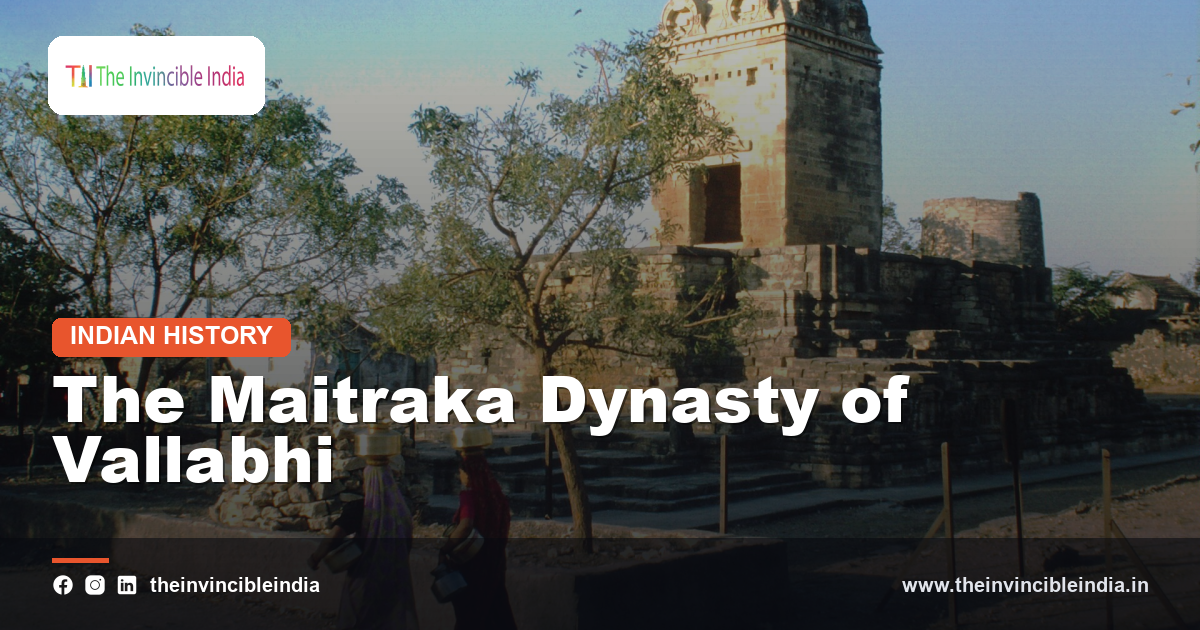
The Maitraka dynasty governed the Saurashtra peninsula and neighboring parts of western India during the centuries that followed the decline of the imperial Gupta Empire. From their capital at Vallabhi, near the Gujarat coast, the Maitrakas presided over a prosperous kingdom that connected maritime commerce with a vibrant intellectual life. Their copper-plate charters survive in remarkable numbers, giving historians an unusually detailed view of administration and landholding. Vallabhi itself gained fame as a center of Buddhist and general learning, mentioned by visiting Chinese pilgrims. This guide explores the origins, institutions, religion, and eventual decline of one of western India’s most significant early medieval dynasties.
Quick Facts
| Detail | Information |
|---|---|
| Dynasty | Maitraka, rulers of Vallabhi |
| Capital | Vallabhi, near modern Vala in Saurashtra |
| Region | Saurashtra and parts of western India |
| Period | Early medieval, from the late fifth century through the eighth |
| Founder | Bhatarka, a Gupta-era military governor |
| Known For | Copper-plate grants, maritime trade, and the learning center of Vallabhi |
Origins in the Gupta Twilight
The Maitrakas emerged during the closing phase of Gupta authority in western India. Their founder, Bhatarka, is generally described in the records as a military governor serving the Gupta emperors in the Saurashtra region. As imperial control weakened, he and his successors transformed that delegated authority into hereditary rule. This transition from governor to sovereign was a common pattern in the political fragmentation of the period. The exact chronology of the earliest rulers is debated, and scholars use inscriptions to piece together a plausible sequence. What is well established is that the family rose from the Gupta administrative framework and built an independent kingdom on its foundations. The Maitraka dynasty thus stands as a direct heir of Gupta governance in western India.
Vallabhi as Capital
Vallabhi, often written Valabhi, served as the capital of the Maitrakas and gave its name to the era of their rule. The city lay on the Saurashtra peninsula, within reach of the coast and of the agricultural heartlands of the region. Its location made it a suitable political center and a point of connection between maritime routes and inland trade. Though the ancient city has largely disappeared beneath later settlement, its reputation survives through inscriptions, literary references, and accounts by visitors. Vallabhi appears in the records as a thriving urban environment with monasteries, temples, and merchant quarters. As the heart of the kingdom, the city symbolized the prosperity, learning, and political confidence of the Maitraka age.
The Early Rulers and Consolidation
After Bhatarka, successive members of the family expanded and secured the territory. Early rulers initially used modest titles that acknowledged an earlier overlordship, gradually adopting grander ones as their independence grew. Their consolidation involved warfare with neighbors, administration of newly acquired districts, and the cultivation of relationships with powerful landowners and religious institutions. The records do not offer a full narrative, so historians reconstruct events from the preambles of land charters and from related sources. What emerges is a picture of steady growth rather than sudden conquest. The consolidation of the early Maitrakas laid the groundwork for the stable and wealthy kingdom that later rulers would govern, and it ensured the dynasty’s survival through a turbulent century.
Dhruvasena II and Relations with Harsha
Among the later Maitraka kings, Dhruvasena II, who bore the epithet Baladitya, is especially well known. He was a contemporary of the great northern ruler Harsha and is traditionally said to have been connected to him through marriage, which reflects the diplomatic importance of alliances in this period. The relationship between the two courts shows how regional dynasties negotiated their positions in a landscape dominated by a few powerful kings. The Chinese pilgrim Xuanzang, who traveled through India during these years, describes the kingdom of Valabhi in his account. The precise details of political relations are better left to specialist scholarship. The reign of Dhruvasena II represents a high point in the dynasty’s prestige and international visibility.
Administration and Copper-Plate Charters
The Maitrakas are famous for the large number of copper-plate charters that survive from their reign. These documents record grants of land and revenue to Brahmins, temples, and Buddhist monasteries, and they usually begin with a genealogy of the ruling house. They name officials, describe village boundaries, and specify the rights and obligations attached to each gift. For historians they offer a rare, continuous documentary record of a single dynasty. The system they reveal combined royal authority with local administrative divisions and a hierarchy of officers. Through these charters, the Maitrakas communicated legitimacy and secured the loyalty of religious and landholding elites. The plates are the most important source for understanding the political and social structure of early medieval Saurashtra.
Land, Revenue, and Rural Society
Agriculture formed the backbone of the Maitraka economy. The charters describe villages, fields, and boundaries in detail, indicating a society organized around cultivation and landholding. Revenue was collected from farmers in various forms, and grants to temples and religious communities created privileged tracts supporting worship and learning. The proliferation of such grants over time has led historians to discuss the growth of landed intermediaries in early medieval India, though the interpretation remains debated. Village life revolved around cultivation, local assemblies, and customary obligations. The relationship between the king, the grantee, and the cultivator formed the social framework of the countryside. The rural world described in Maitraka records provides a vivid picture of how a stable agrarian order supported the kingdom’s wider achievements.
Maritime Trade and the Western Coast
Saurashtra’s long coastline and its position on the Arabian Sea gave the Maitrakas access to a lively network of maritime commerce. Ports on the peninsula connected western India with distant regions across the sea, and merchants dealt in textiles, spices, and other goods. The wealth generated by trade supported urban life and royal patronage. Merchants and guilds appear in the records as donors and participants in civic life, showing the close links between commerce and religious institutions. The geographical advantage of the peninsula was a major reason for the kingdom’s prosperity. Maritime trade made Vallabhi a cosmopolitan place open to wider influences, and it contributed significantly to the cultural and economic vitality of the Maitraka realm.
Religion Under the Maitrakas
The Maitraka rulers are generally described in their inscriptions as devotees of Shiva, yet they supported a wide range of religious communities. Brahmanical temples, Buddhist monasteries, and other institutions all received grants and royal protection. This inclusive patronage was typical of the period and reflects a political culture that valued religious diversity as a source of social stability. Sun worship and Vaishnava devotion also flourished in the region, as did Jain traditions. The coexistence of many faiths contributed to a vibrant spiritual landscape. By supporting varied institutions, the Maitrakas strengthened their legitimacy among different communities. Religious patronage under the dynasty illustrates the plural character of western Indian society and its tradition of accommodation among diverse beliefs.
Vallabhi as a Center of Learning
Vallabhi won renown as a seat of higher learning. Chinese travelers of the seventh century describe its monasteries and scholars, and later tradition compared its reputation with that of the great monastic university at Nalanda in the east. Students came to study subjects ranging from religious philosophy to statecraft, and graduates are said to have been valued in administrative service. The details of its curriculum and organization are not fully documented, so claims should be treated with care. Still, the fame of the institution testifies to the intellectual vigor of the age. The educational reputation of Vallabhi remains one of the most celebrated aspects of Maitraka heritage and a source of pride in the history of Gujarat.
Buddhist Monasteries at Valabhi
Buddhism had a strong presence at Valabhi under Maitraka rule. Accounts of visiting pilgrims describe numerous monasteries and a considerable community of monks, and inscriptions record royal and private gifts to these institutions. Maitraka kings, even when personally devoted to Shiva, donated to Buddhist establishments, a pattern seen elsewhere in India. The monasteries functioned as centers of worship, scholarship, and charity, and they contributed to the city’s educational fame. Over time, the broader decline of Buddhism in India affected these institutions, though the process was gradual and complex. The Buddhist monasteries of Valabhi demonstrate the pluralism of Maitraka patronage and the lasting importance of monastic centers in the cultural life of early medieval western India.
Jain Traditions and the Council of Valabhi
Valabhi also holds an important place in Jain tradition. According to Jain sources, a council held there under the monk Devardhigani Kshamashramana sought to preserve the scriptures by committing them to writing. The traditional account is central to Jain historical memory, though scholars discuss its details and dating. The association highlights how important the region was for Jain communities, which continued to flourish in Gujarat in the following centuries. Gujarat’s enduring Jain heritage, visible in later temples and manuscript traditions, has roots in this early period. The role of Valabhi in Jain textual tradition adds another dimension to the city’s significance and underscores the diversity of the intellectual and religious life of the Maitraka age.
Literature and the Arts
The courts of the Maitrakas supported Sanskrit literature and learning. A well-known poem on the story of Rama, the Bhattikavya, is traditionally associated with Valabhi and is admired for its demonstration of grammatical forms through narrative verse. The attribution to the Maitraka court rests on tradition and on references within the text, and scholars treat details with caution. The period also saw artistic production in the form of temple sculpture and inscribed documents written in elegant script. The literary and artistic achievements of the age reflect the support of royal patrons and the presence of educated communities in the city. The cultural output of the Maitraka era shows that political stability and prosperity fostered creativity in language, art, and thought.
Military Organization and Frontiers
The Maitraka kingdom maintained armies to protect its territory and to deter neighbors. Inscriptions mention military commanders and titles linked to martial responsibility, reflecting the origin of the dynasty in military governorship. The kingdom’s borders faced the powers of Malwa, Gujarat, and the Deccan, and the political situation required vigilance. Fortified positions and a capable cavalry and infantry are generally assumed, though detailed descriptions are scarce. Diplomacy and marriage alliances complemented force. The ability of the Maitrakas to sustain their rule for several centuries suggests a capable military and administrative organization. Their frontier management ensured the survival of the kingdom through a period of continuing regional rivalry and set an example of effective governance in western India.
Decline of the Dynasty
The end of the Maitraka kingdom came in the eighth century, although the causes are debated. Traditional accounts connect its fall with attacks from across the sea or from the northwest, particularly raids from the Arab-held region of Sindh, but historians point to other contributing factors as well, including shifting trade patterns and regional political change. The great city of Vallabhi was damaged or abandoned, and political power moved to other centers in Gujarat. The details of the final years are uncertain, and scholars continue to examine the evidence. The collapse of Maitraka power brought a significant change to western India’s political landscape. Despite its fall, the dynasty’s influence persisted through the traditions of learning, administration, and culture it had nurtured.
The Maitrakas Today
The Maitraka dynasty continues to interest historians, archaeologists, and visitors curious about Gujarat’s early history. Its extensive copper-plate record offers a model for studying the administration of an early medieval kingdom, and its association with learning and trade has become part of regional pride. The site of ancient Vallabhi, near modern Vala, preserves traces of the past that continue to be studied. Debates about the dynasty’s chronology, the nature of its landholding, and the circumstances of its fall remain open and lively. The Maitrakas remind us that western India played a central role in the cultural and economic life of early medieval India, and their legacy endures in the written documents and traditions they left behind.
Sources & Further Reading
- Ministry of Culture, Government of India (indiaculture.gov.in).
- Archaeological Survey of India (asi.nic.in).
Frequently Asked Questions
Who were the Maitrakas?
The Maitrakas were an early medieval dynasty that ruled Saurashtra and nearby parts of western India from their capital at Vallabhi. They began as Gupta-era military governors and became independent rulers as imperial authority declined.
Why is Vallabhi famous?
Vallabhi is remembered as a prosperous capital and as a center of learning, described by Chinese pilgrims and compared in tradition with Nalanda. It was also a hub of trade and a site significant to Buddhist and Jain communities.
What are the Maitraka copper plates?
They are inscribed copper-plate charters recording grants of land and revenue to Brahmins, temples, and monasteries. Their large number makes them one of the best sources for the administration and society of early medieval Gujarat.
What religion did the Maitraka kings follow?
Their inscriptions generally describe them as devotees of Shiva, but they also supported Buddhist monasteries, Jain communities, and other religious institutions. Their patronage reflects the plural religious culture of the period.
How did the Maitraka dynasty end?
The kingdom declined in the eighth century, with traditional accounts pointing to attacks from the northwest or across the sea. Historians debate the causes and also consider changes in trade and regional politics.


