

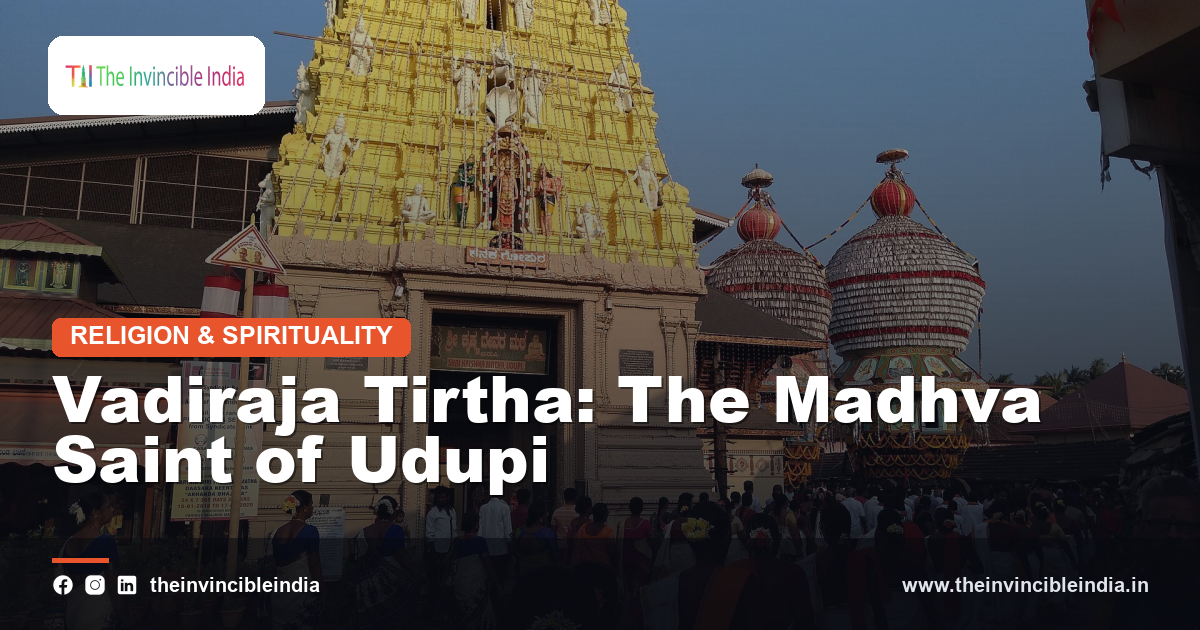
Vadiraja Tirtha, also called Vadiraja Swamy, Sri Vadirajaru or Vadiraja Guru Sarvabhauma, is a Madhva saint, scholar and poet of the Dvaita tradition of Karnataka, honoured as a head of the Sode Matha, one of the eight mathas, or monastic institutions, of Udupi. He is remembered for his devotion to Krishna, his love of Hayagriva, his Sanskrit works and his Kannada devotional songs, and he is revered by Madhva devotees across South India. His life is told largely through devotional tradition, and exact dates are not firmly documented. He belongs to the wider stream of devotion described in the guide to Vaishnavism.
Quick answer: Vadiraja Tirtha is a Madhva saint and scholar of the Dvaita tradition, traditionally the head of the Sode Matha, one of the eight Udupi mathas of coastal Karnataka. He is remembered for his devotion to Krishna and Hayagriva, his Sanskrit works and his Kannada songs such as Lakshmi Shobhane. He is revered as a pillar of the Madhva community and of Karnataka devotional culture.
Key Takeaways
- Vadiraja Tirtha is a saint and scholar of the Madhva or Dvaita tradition, associated with the Sode Matha, one of the eight Udupi mathas.
- He is traditionally credited with strengthening the Paryaya system by which the eight mathas take turns to worship Krishna at Udupi.
- He composed Sanskrit works such as Rukminisha Vijaya and Tirtha Prabandha and many Kannada devotional songs signed with the name Hayavadana.
- His Lakshmi Shobhane is a devotional song cycle still sung at Hindu weddings and auspicious occasions in Karnataka.
- His Brindavana, the sacred memorial shrine, is at Sode in the Uttara Kannada region of Karnataka.
- Many stories about his life are tradition and not documented history, and exact dates are not firmly established.
The sections below explain the life, works, teachings and continuing legacy in more detail.
Quick Facts
| Detail | Information |
|---|---|
| Also known as | Vadiraja Swamy, Sri Vadirajaru, Vadiraja Guru Sarvabhauma |
| Tradition | Madhva (Dvaita) Vaishnavism |
| Institution | Sode (Sonda) Matha, one of the eight Udupi mathas |
| Associated places | Udupi and Sode, Karnataka |
| Languages | Sanskrit and Kannada |
| Signature name in songs | Hayavadana |
| Best-known works | Lakshmi Shobhane, Rukminisha Vijaya, Tirtha Prabandha |
| Era | Medieval period (Vijayanagara age), exact dates not firmly documented |
Who Was Vadiraja Tirtha?
Vadiraja Tirtha was a Madhva saint, philosopher and poet who served as a head of the Sode Matha and became one of the most respected teachers of the Dvaita tradition. He is remembered as a scholar who defended the philosophy of Madhvacharya and as a devotee who sang of Krishna in the language of the common people. His name is spoken with deep reverence in Udupi and across Karnataka.
The accounts of his life come from devotional biography, and respectful readers treat them as sacred tradition rather than as exact history. What is consistent is the picture of a man of great learning who also valued simple, heartfelt worship. His story shows how scholarship and devotion can live together in one person.
What Is the Madhva Tradition?
The Madhva tradition is a Vaishnava school founded on the teachings of Madhvacharya, also known as Anandatirtha, and it follows the philosophy called Dvaita, or dualism. Dvaita holds that God, the individual soul and the world are real and distinct, and that Vishnu is the supreme being whom souls can approach through devotion and knowledge. The school is also called Tattvavada.
The tradition has its early centre in Udupi, the town in coastal Karnataka where Madhvacharya is said to have installed an image of Krishna. Vadiraja Tirtha belongs to the line of teachers who preserved and explained this philosophy in later centuries. Understanding the school helps explain why his devotion to Krishna and Vishnu is so central to his memory.
Where Is Udupi and Why Is It Important?
Udupi is a temple town on the coast of Karnataka and is famous for the Sri Krishna Matha, where Krishna is worshipped through a window with nine openings known as the Navagraha Kindi. Pilgrims come from all over India to see the image of the deity, which is adorned with great care each day. The town is also known beyond religion for its distinctive vegetarian food culture.
Udupi is the heart of the Madhva world and the place where Vadiraja Tirtha is most deeply remembered. The Krishna temple is not a normal temple run by a single priesthood but is managed by a rotation of eight mathas. The town is therefore a living example of how a religious tradition organises worship through community responsibility and shared service.
What Are the Ashta Mathas of Udupi?
The Ashta Mathas are the eight monastic institutions of Udupi that share the responsibility of worshipping Krishna at the Krishna Matha. Tradition traces them to the disciples of Madhvacharya, and they are commonly listed as Pejawar, Admar, Palimaru, Puttige, Sode, Kaniyooru, Shiroor and Krishnapura. Each is led by a swami who is the head of that matha.
Together the mathas manage the daily rituals, festivals and care of the deity in an orderly cycle. The arrangement spreads honour and duty across the community, so that no single institution holds the temple forever. Vadiraja Tirtha is closely linked with this system through his leadership of the Sode Matha and through the reforms that tradition credits to him.
What Is the Sode Matha?
The Sode Matha, also written Sonda Matha, is the monastic institution associated with Vadiraja Tirtha and is one of the eight mathas of Udupi. It takes its name from the village of Sode, in the Uttara Kannada region, and its swamis are regarded as successors in the line of Vadiraja. The matha preserves his memory and carries out worship in his tradition.
The Sode Matha has an important place within the Madhva community, and it is known for its devotion to Vadiraja, to Hayagriva and to Bhootaraja, a protective figure honoured at the Sode shrine according to tradition. Its role shows that the Madhva world extends beyond Udupi itself and includes centres in several parts of Karnataka.
What Is the Paryaya System and How Is Vadiraja Linked to It?
The Paryaya system is the rotation by which each of the eight Udupi mathas takes charge of the Krishna temple in turn, and tradition holds that Vadiraja Tirtha shaped it into the two-year cycle that is followed today. The handover ceremony, known as the Paryaya festival, is a major public event in Udupi, marked by processions and rites that draw large crowds.
The details of how the system developed over time are described by tradition, and scholars note that the exact history is not fully documented. Even so, Vadiraja is honoured as a key organiser who gave the worship its ordered and lasting form. The Paryaya remains a visible sign of the shared responsibility on which Udupi worship is built.
What Is the Hayagriva Connection?
Hayagriva is a form of Vishnu with a horse head who is worshipped as the source of knowledge, and Vadiraja Tirtha was a devoted follower of this deity. His Kannada songs carry the signature name Hayavadana, which means one with a horse face, and tradition connects him closely with the worship of Hayagriva at Sode and Udupi. The deity is invoked by students who seek learning.
A sweet dish made from boiled gram, sugar and coconut, often called Hayagriva, is associated in Karnataka with offerings made to this form of Vishnu. The connection shows how a saint can leave a mark on food culture as well as on philosophy. For Vadiraja, Hayagriva was the symbol of wisdom offered in humility.
Which Sanskrit Works Are Attributed to Vadiraja Tirtha?
The Sanskrit works attributed to Vadiraja Tirtha include Rukminisha Vijaya, a poetic work on the story of Krishna and Rukmini, Tirtha Prabandha, an account of sacred places, and Yuktimallika, a text defending Dvaita philosophy. These writings show a mind trained in logic, poetry and devotional geography. They place him among the leading authors of the Madhva school.
Scholars of the tradition value these works both for their ideas and for their literary skill. They show that the saint could speak in the learned register of Sanskrit as well as in the simple voice of the Kannada songs. Together the two bodies of writing give a full picture of a teacher who reached both scholars and ordinary devotees.
What Are Vadiraja Tirtha's Kannada Devotional Songs?
Vadiraja Tirtha composed many Kannada devotional songs that praise Krishna, Hayagriva and Vishnu in simple and musical language. They are signed with the name Hayavadana and are counted as part of the Haridasa literature of Karnataka. The songs make deep ideas of Dvaita available to listeners who do not read Sanskrit.
These compositions are sung in homes and temples and are valued for their warmth and clarity. They also contain humour and social observation in places, which shows the saint’s closeness to ordinary life. The songs are one reason that his name remains alive in daily worship, long after his scholarly debates have passed into history.
What Is Lakshmi Shobhane?
Lakshmi Shobhane is a devotional composition attributed to Vadiraja Tirtha that celebrates the divine wedding of Lakshmi and Vishnu, and it is sung at Hindu weddings and auspicious occasions in Karnataka. A shobhane is a wedding song of blessing. This one is especially loved in Madhva households, where it is sung at the time of marriage and festivals.
The song presents the wedding of the divine couple as a model of the union that families hope to build on earth. Its melody and its images of auspiciousness make it easy for communities to learn and pass on. Lakshmi Shobhane is probably the single best-known work of the saint among the general public.
What Is the Link With the Dasa Sahitya?
The Dasa Sahitya is the body of Kannada devotional literature composed by the Haridasas, or servants of Hari, and Vadiraja Tirtha is counted among its major figures. The movement used simple Kannada songs to spread devotion to Vishnu, and it includes famous names such as Purandara Dasa and Kanaka Dasa. It grew in the age of the Vijayanagara empire and later.
Vadiraja’s songs belong to this wider tradition, and he is often remembered as a bridge between the learned world of the mathas and the popular world of the songs. The Dasa Sahitya shows that Karnataka devotion was a shared enterprise of monks, wandering singers and households. Within it, the saint of Sode has an honoured place.
What Traditions Surround His Life and Travels?
Traditions about Vadiraja Tirtha describe a long life of travel, teaching and service, and they give him a place of special honour in Madhva memory. Accounts say that he came to monastic life at a young age, that he toured sacred places and that he guided the worship at Udupi for many years. Many devotees speak of a very long lifespan, which is a traditional claim and not a documented fact.
Other stories link him with the growth of a local variety of brinjal in Udupi and with miracles at Sode. These are told as tradition and cannot be checked by historical records. They are valued as expressions of how deeply the community loved the saint and how widely his influence was felt.
What Is His Brindavana at Sode?
The Brindavana of Vadiraja Tirtha at Sode is a sacred memorial shrine where devotees believe the saint remains present in spirit. In the Madhva tradition a Brindavana is the resting place of a saint, built in the form of a structure with a tulasi plant, and it is worshipped as a centre of blessing. The Sode Brindavana is a major site for the followers of Vadiraja.
Pilgrims visit to offer prayers, to take part in the aradhana ceremonies held in his memory and to seek blessings for learning and family life. The place is quiet and devotional, and it has become an important point on the pilgrim routes of Karnataka. It keeps alive the memory of a saint whose work is still felt at Udupi.
Why Is Vadiraja Tirtha Important in Indian Culture?
Vadiraja Tirtha is important in Indian culture because he combined deep scholarship with popular devotional art and helped sustain the worship of Krishna at Udupi. His songs contributed to Kannada literature and music, and his reforms are remembered as having strengthened a lasting model of shared temple management. He therefore belongs to both religious and literary history.
His legacy also shows how a regional language can carry the highest ideas of philosophy. The Dasa Sahitya and the Madhva school together form a distinctive part of the cultural heritage of Karnataka. The saint is a figure who connects temple worship, vernacular poetry and the daily practices of families.
What Lessons Does His Life Offer?
The life of Vadiraja Tirtha offers the lesson that learning and devotion strengthen each other, and that great philosophy should be shared in language that people can understand. He demonstrates that a monastic leader can be a scholar, a poet, an administrator and a humble servant of the deity at once. This balance is valued in the Madhva community.
His example also teaches that order and shared duty protect sacred institutions. The rotation of worship at Udupi spreads responsibility across many hands and keeps pride in check. Readers of every background can draw from this a quiet lesson about service, humility and the long care required to keep a living tradition healthy.
Vadiraja Tirtha Today
Vadiraja Tirtha today is remembered as one of the great saints of Karnataka, honoured at Udupi, at Sode and in Madhva homes across India. His songs are sung, his works are studied and the Sode Matha continues the tradition of worship that bears his name. Pilgrims who visit the Krishna temple at Udupi often also remember him in their prayers.
For students of Indian religion he is a clear example of how Dvaita philosophy, Kannada poetry and temple organisation came together in one life. The stories told about him are traditional, and respectful readers treat them as sacred narrative with real devotional meaning. His memory remains a living part of the spiritual culture of the Karnataka coast.
Sources & Further Reading
- Ministry of Culture, Government of India (indiaculture.gov.in).
- Sahitya Akademi, India’s National Academy of Letters (sahitya-akademi.gov.in).
Frequently Asked Questions
Who was Vadiraja Tirtha?
Vadiraja Tirtha was a Madhva saint, scholar and poet of the Dvaita tradition, traditionally the head of the Sode Matha, one of the eight Udupi mathas. He is remembered for his devotion to Krishna and Hayagriva and for his Sanskrit and Kannada works.
Which matha is associated with Vadiraja Tirtha?
The Sode Matha, also called Sonda Matha, is the monastic institution associated with Vadiraja Tirtha. It is one of the eight mathas of Udupi and is named after the village of Sode in the Uttara Kannada region.
What is Lakshmi Shobhane?
Lakshmi Shobhane is a devotional song attributed to Vadiraja Tirtha that celebrates the divine wedding of Lakshmi and Vishnu. It is sung at Hindu weddings and auspicious occasions, especially in Madhva families of Karnataka.
What is the Paryaya system of Udupi?
The Paryaya system is the rotation by which the eight Udupi mathas take turns to worship Krishna at the Krishna Matha, each for a period of two years. Tradition credits Vadiraja Tirtha with giving the system its lasting form.
What does Hayavadana mean in his songs?
Hayavadana means the horse-faced one and is a name of Hayagriva, a form of Vishnu worshipped as the source of knowledge. Vadiraja Tirtha used it as his signature name in many Kannada devotional songs.
Where is the Brindavana of Vadiraja Tirtha?
The Brindavana of Vadiraja Tirtha is at Sode in the Uttara Kannada region of Karnataka. Devotees visit it to offer prayers and to take part in the aradhana ceremonies held in his memory.


