

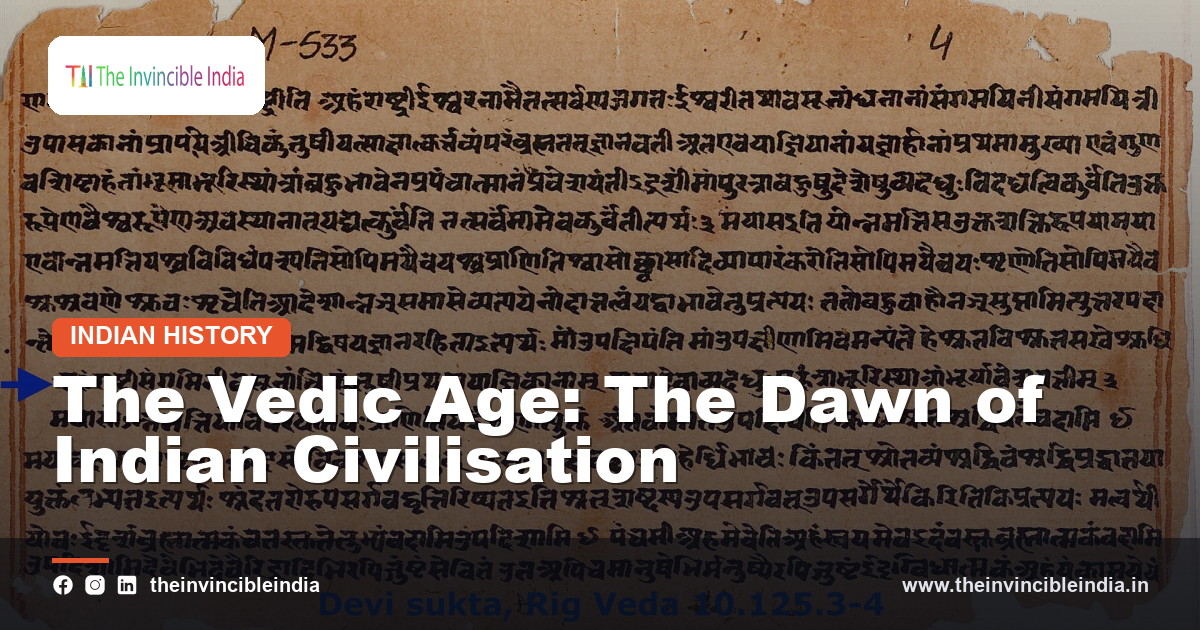
The Vedic Age was one of the most formative and important eras in the history of India, the age in which the Vedas, the most ancient and sacred texts of India, were composed, and in which the foundations of much of Indian religion, culture, thought and society were laid. Following the age of the Indus Valley, this era saw the flourishing of a new civilisation whose sacred hymns, rituals, philosophy and social order would shape India for thousands of years to come. The Vedic Age is thus of profound importance as the dawn of much that is characteristic of Indian civilisation. This guide explores the Vedic Age, its texts, its religion, its society and its enduring legacy, one of the great foundations of India’s ancient history.
Quick Facts
| Detail | Information |
|---|---|
| Era | A formative age of ancient India |
| Named after | The Vedas, the most ancient sacred texts |
| Significance | Shaped Indian religion, culture and society |
| Key texts | The Rigveda and the other Vedas |
| Legacy | The foundation of much of Indian civilisation |
| Followed | The age of the Indus Valley Civilisation |
The Dawn of a Civilisation
The Vedic Age was one of the most formative and important eras in the history of India, the age in which much of the foundation of Indian civilisation was laid. Named after the Vedas, the most ancient and sacred texts of India composed during this era, the Vedic Age saw the flourishing of a civilisation whose sacred hymns, rituals, philosophy and social order would shape the religion, culture and thought of India for thousands of years to come. It is thus of profound importance as a dawn of Indian civilisation. As the formative age in which the Vedas were composed and the foundations of Indian religion, culture and society were laid, the Vedic Age holds a place of profound importance in the history of India and is one of the great foundations of its ancient civilisation.
The Age of the Vedas
The Vedic Age takes its name from the Vedas, the most ancient and sacred scriptures of India, which were composed and transmitted during this era and are its greatest legacy. The Vedas, a vast body of sacred hymns, prayers, rituals and knowledge, are the oldest texts of Indian religion and among the oldest sacred texts in the world, and they were composed, memorised and transmitted with extraordinary care during the Vedic Age, forming the foundation of the tradition. The Vedas are the crowning legacy of the age. This character of the Vedic Age as the age of the Vedas, the most ancient and sacred scriptures of India composed and transmitted during this era, is the essence of its importance, and the Vedas are its greatest legacy and one of the most precious treasures of Indian civilisation.
The Rigveda
The oldest and most important of the Vedas is the Rigveda, a great collection of ancient sacred hymns that is among the oldest religious texts in the world. The Rigveda contains hymns of praise and prayer to the deities, composed by the ancient sages, revealing the religion, thought and life of the early Vedic people, and it is revered as the most ancient and sacred of the Vedas and a foundational text of Indian civilisation. The Rigveda is a treasure of the age and of humanity. This Rigveda, the oldest and most important of the Vedas and among the oldest religious texts in the world, is a great treasure of the Vedic Age, and its ancient hymns of praise and prayer, revealing the religion and thought of the early Vedic people, are a foundational and precious legacy of Indian civilisation.
The Four Vedas
The Vedic tradition comprises four Vedas, each with its own character and purpose, together forming the great body of the most ancient sacred knowledge of India. Besides the Rigveda of hymns, there are the Vedas concerned with the melodies of chant, with the formulas and procedures of ritual, and with further hymns and knowledge, and together the four Vedas encompass the sacred hymns, chants, rituals and wisdom of the Vedic tradition. These four Vedas are the great scriptures of the age. This body of the four Vedas, each with its own character and purpose and together forming the great collection of the most ancient sacred knowledge of India, is the crowning achievement of the Vedic Age, and the four Vedas together are among the most precious and foundational treasures of Indian religion and civilisation.
Religion and the Deities
The Vedic Age had a rich religion centred on the worship of the deities through sacred hymns and rituals, which formed the foundation of the later religion of India. The Vedic people worshipped a pantheon of deities, often associated with the forces and elements of nature, through the recitation of the sacred hymns and the performance of rituals and sacrifices, and this religion, with its hymns, deities and rituals, was the foundation from which the later Hindu tradition grew. This Vedic religion is a foundation of Indian faith. This rich religion of the Vedic Age, centred on the worship of the deities through sacred hymns and rituals, is one of the great foundations of Indian faith, and the deities, hymns and rituals of the Vedic religion are the ancient roots from which the later religious traditions of India developed.
The Sacred Rituals
Ritual and sacrifice held a central place in the religion of the Vedic Age, and the correct performance of the sacred rites was of great importance in Vedic life. The Vedic people performed elaborate rituals and sacrifices, accompanied by the recitation of the sacred hymns and formulas, to honour the deities, seek their blessings, and maintain the cosmic and social order, and the priests who performed these rites with exactness held an important place in society. These sacred rituals were central to Vedic religion. This central place of ritual and sacrifice in the Vedic Age, and the great importance of the correct performance of the sacred rites accompanied by the hymns and formulas, are a defining feature of the era, and the Vedic rituals are an important part of the religious foundation the age laid for Indian civilisation.
Vedic Society
The Vedic Age saw the development of a distinctive social order, organised around families, clans and communities, and increasingly around the emerging divisions of society. Vedic society was organised around the family, the clan and the tribe, with its chiefs and assemblies, its priests and warriors, and its farmers and herders, and over the course of the age the fourfold ordering of society into broad classes took shape, forming a social structure that would be influential in later India. This Vedic society is an important part of the era. This development of a distinctive social order during the Vedic Age, organised around families, clans and communities and around the emerging divisions of society, is an important part of the era, and the social structures that took shape in the Vedic Age were influential in the later social order of India.
The Sanskrit Language
The Vedic Age was the age of Sanskrit, the sacred and classical language of India, in its most ancient form, in which the Vedas were composed. The Vedas were composed in the ancient form of Sanskrit, a language of great richness, precision and beauty, which became the sacred and classical language of India and the vehicle of its religion, literature, philosophy and learning for thousands of years. This language of Sanskrit is a great legacy of the age. This character of the Vedic Age as the age of Sanskrit in its most ancient form, the language in which the Vedas were composed and which became the sacred and classical language of India, is a great legacy of the era, and the Sanskrit of the Vedas is the foundation of one of the world’s great classical languages.
The Oral Tradition
One of the most remarkable achievements of the Vedic Age was the oral tradition, the extraordinary system by which the Vedas were memorised and transmitted with perfect accuracy across the generations. Before the age of writing, the Vedas were preserved and passed down entirely by memory, through a rigorous and remarkable system of memorisation and recitation that preserved the sacred texts with astonishing exactness for thousands of years, a feat regarded as one of the wonders of human culture. This oral tradition is a marvel of the age. This oral tradition of the Vedic Age, the extraordinary system by which the Vedas were memorised and transmitted with perfect accuracy across the generations, is one of the most remarkable achievements of the era and one of the wonders of human culture, preserving the sacred texts intact through the ages.
Philosophy and Thought
The Vedic Age also gave rise to profound philosophy and thought, especially in its later texts, which explored deep questions about the universe, the self and the ultimate reality. The later Vedic texts, especially the Upanishads, turned from ritual to profound philosophical enquiry, exploring the nature of the self, the universe and the ultimate reality, and laying the foundations of Indian philosophy and spirituality. This philosophy and thought are among the greatest legacies of the age. This rise of profound philosophy and thought in the Vedic Age, especially in the later texts that explored deep questions about the universe, the self and the ultimate reality, is among the greatest legacies of the era, and the philosophy of the Vedic tradition is a foundation of the great tradition of Indian thought.
The Upanishads
Among the greatest fruits of the later Vedic Age are the Upanishads, profound philosophical texts that explore the deepest questions of existence and form the foundation of Indian philosophy. The Upanishads, composed toward the end of the Vedic Age, turn from the outward rituals to the inward search for truth, exploring the nature of the self and its relation to the ultimate reality, and they are revered as among the most profound spiritual and philosophical texts in the world. The Upanishads are a crowning glory of the age. These Upanishads, the profound philosophical texts of the later Vedic Age that explore the deepest questions of existence and the nature of the self and the ultimate reality, are a crowning glory of the era and among the most profound and revered spiritual texts in the world, a foundation of Indian philosophy.
Everyday Life
The Vedic Age also reveals a picture of the everyday life of its people, their occupations, their customs and their way of living, drawn from the sacred texts. The Vedic people lived by farming, herding and craft, organised in families and communities, with their customs, festivals and daily rituals, their music and their pursuits, and the texts of the age give glimpses of this life, of the concerns, values and activities of the people. This everyday life is an interesting aspect of the era. This picture of the everyday life of the Vedic people, their occupations, customs and way of living drawn from the sacred texts, is an interesting aspect of the era, and the glimpses of Vedic daily life help us to understand the society and culture that laid the foundations of Indian civilisation.
The Enduring Legacy
The Vedic Age left a profound and enduring legacy, shaping the religion, philosophy, language, literature and social order of India for thousands of years to come. The Vedas, the Vedic religion and rituals, the philosophy of the Upanishads, the Sanskrit language, and the social and cultural forms of the age all became foundational elements of Indian civilisation, so that the influence of the Vedic Age has endured throughout the history of India to the present day. This enduring legacy is the crown of the era’s importance. This profound and enduring legacy of the Vedic Age, shaping the religion, philosophy, language and social order of India for thousands of years, is the crown of its importance, and the influence of the Vedas and the Vedic Age has been one of the deepest and most lasting forces in the history and civilisation of India.
The Vedic Age in History
Today the Vedic Age is revered as one of the great foundations of Indian civilisation, the age of the Vedas that shaped the religion, culture, thought and society of India for ages to come. The Vedas remain sacred and revered, the Vedic religion and philosophy live on in the traditions of India, the Sanskrit language endures as a classical treasure, and the Upanishads are honoured across the world as profound spiritual texts. The influence of the Vedic Age endures throughout Indian civilisation. As the formative age in which the Vedas were composed and the foundations of Indian religion, culture and society were laid, the Vedic Age endures as one of the most important and revered eras in the history of India and a great foundation of its ancient and enduring civilisation.
Sources & Further Reading
- Ministry of Culture, Government of India, on the ancient heritage and texts of India (indiaculture.gov.in).
- Sahitya Akademi and scholarly works on the Vedas and ancient Indian literature.
Frequently Asked Questions
What was the Vedic Age?
The Vedic Age was a formative era of ancient India, named after the Vedas, the most ancient and sacred texts of India, which were composed during this era. It laid the foundations of much of Indian religion, culture, philosophy, language and society.
What are the Vedas?
The Vedas are the most ancient and sacred scriptures of India and among the oldest sacred texts in the world. They are a vast body of sacred hymns, prayers, rituals and knowledge, and comprise four Vedas, of which the oldest and most important is the Rigveda.
What is the Rigveda?
The Rigveda is the oldest and most important of the Vedas, a great collection of ancient sacred hymns of praise and prayer to the deities, composed by the ancient sages. It is among the oldest religious texts in the world and a foundational text of Indian civilisation.
What are the Upanishads?
The Upanishads are profound philosophical texts composed toward the end of the Vedic Age, which turn from outward ritual to the inward search for truth, exploring the nature of the self and the ultimate reality. They form a foundation of Indian philosophy and spirituality.
Why is the Vedic Age important?
The Vedic Age is important as a dawn of Indian civilisation, shaping its religion, philosophy, language, literature and social order for thousands of years. The Vedas, the Vedic religion, the Upanishads and the Sanskrit language are among its enduring and foundational legacies.


