

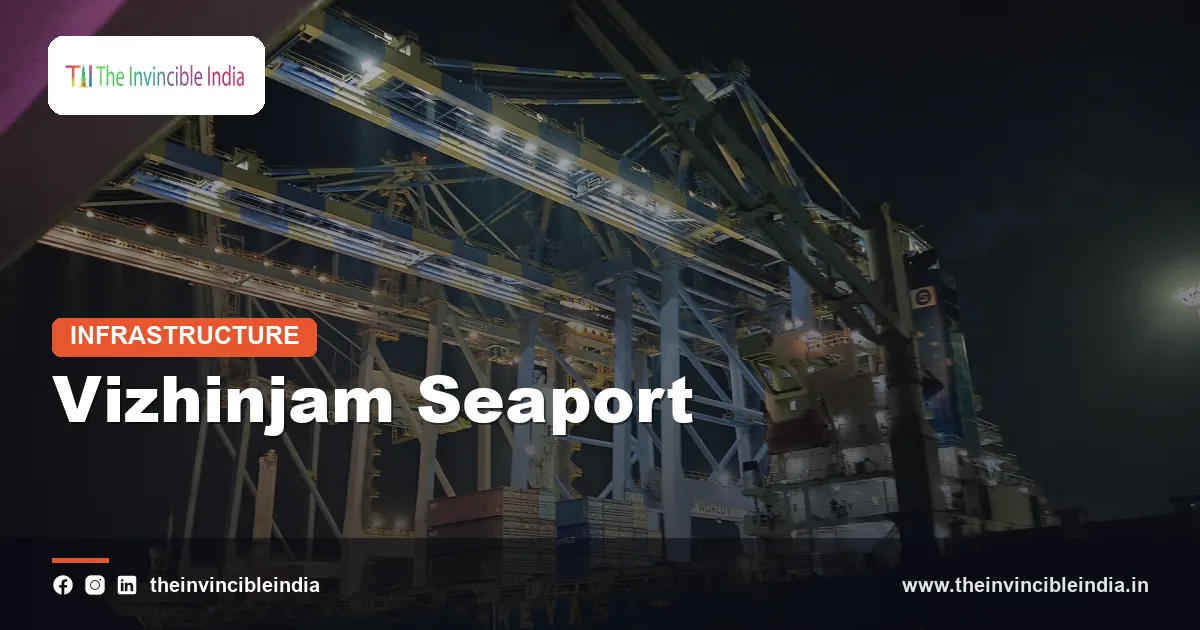
The Vizhinjam International Seaport is India’s first dedicated deepwater container transshipment port, located at Vizhinjam near Thiruvananthapuram in Kerala on the south-western tip of the Indian peninsula. Built under a public-private partnership between the Government of Kerala and Adani Ports and Special Economic Zone, the Vizhinjam International Seaport has a naturally deep harbour close to the main east-west shipping lane, and it is designed to handle the largest container ships in the world.
The Vizhinjam International Seaport matters because a large share of India’s transshipment cargo has traditionally been routed through foreign hubs such as Colombo, Singapore and Jebel Ali, which means that Indian trade pays for extra handling, time and foreign port revenue. This explainer covers where the port is, why its natural depth matters, how the landlord model works, what automation it uses, and how it is expected to reshape container logistics for India.
Quick Facts
| Attribute | Detail |
|---|---|
| Name | Vizhinjam International Seaport (Vizhinjam Port) |
| Location | Vizhinjam, Thiruvananthapuram district, Kerala |
| Type | Deepwater container transshipment port, with multipurpose potential |
| Distinction | India’s first dedicated deepwater container transshipment port |
| Model | Public-private partnership (landlord model), design-build-finance-operate-transfer |
| Developer and operator | Adani Vizhinjam Port Private Limited, a subsidiary of Adani Ports and Special Economic Zone |
| State partner | Government of Kerala, through Vizhinjam International Seaport Limited (VISL) |
| Concession agreement | Signed in 2015 |
| Operations | Trial operations began in 2024; formally commissioned in 2025 |
Key Takeaways
- The Vizhinjam International Seaport is India’s first dedicated deepwater container transshipment port, located near Thiruvananthapuram in Kerala.
- The Vizhinjam International Seaport has a natural depth that allows very large container ships to berth without extensive dredging, which lowers costs and increases reliability.
- The Vizhinjam International Seaport lies only a short distance from the busy international east-west shipping route that connects Europe and West Asia with East Asia.
- The Vizhinjam International Seaport was built as a public-private partnership in which the Government of Kerala owns the land and the private developer, Adani Ports, builds and runs the terminal under a long concession.
- The Vizhinjam International Seaport uses automated and remotely operated equipment, including a terminal operating system, to improve the speed of container handling.
- The Vizhinjam International Seaport is intended to bring back to India the transshipment business that has long gone to Colombo, Singapore and Jebel Ali in Dubai.
What Is the Vizhinjam International Seaport?
The Vizhinjam International Seaport is a deepwater seaport at Vizhinjam in Kerala, planned mainly for container transshipment, the process of moving containers from one ship to another at an intermediate port. In transshipment, large ocean-going mother vessels unload containers at a hub, and smaller feeder vessels then carry them to their final ports.
Vizhinjam is a natural harbour, long used by fishing communities and previously considered a site for a major port because of its sheltered waters and depth. The modern project turned this natural advantage into a planned port with a breakwater, a container terminal, quay cranes, yard equipment and supporting infrastructure.
The port is often called India’s first deepwater transshipment port because other Indian container ports mostly handle cargo whose origin or destination lies in India, and several have limited depth. A dedicated transshipment hub, by contrast, is built to serve the large mother vessels that call at a hub and redistribute cargo to many places.
Where Is the Vizhinjam Port and Why Does Its Location Matter?
The Vizhinjam port is located on the south-west coast of India, a few kilometres from Thiruvananthapuram, the capital of Kerala, and it sits close to one of the busiest shipping lanes in the world. This lane runs east-west across the Indian Ocean and links the Suez Canal and the Persian Gulf with the Strait of Malacca and the ports of East Asia.
The port is only a short distance from this route, so a ship travelling on it needs to make a very small detour to call at Vizhinjam. Distance matters in shipping because every extra hour adds cost in fuel, crew and time. A hub close to the main route offers an obvious advantage over one that needs a long diversion.
The location also gives Vizhinjam proximity to Indian cargo. Kerala and southern India produce and consume large volumes of goods, and the port can serve feeder routes along the Indian coast, to ports in Sri Lanka, the Maldives, the Gulf and East Africa.
Why Is the Natural Depth of Vizhinjam Important?
The natural depth of the Vizhinjam harbour is important because it allows the largest container ships, which need deep water to float safely when fully loaded, to berth without large and costly dredging. The harbour has a natural draft of around 18 to 20 metres close to the shore, which is among the deepest of any Indian port site.
Container ships have grown very large over the past two decades. The largest vessels, often called ultra large container vessels, carry well over 20,000 twenty-foot equivalent units (TEU) of cargo. A ship of this size needs a deep channel and berth, and many Indian ports cannot provide it without repeated dredging, which is expensive and has to be maintained continuously.
At Vizhinjam, the deep water starts close to the coast. This reduces the amount of dredging needed, shortens the approach and keeps maintenance costs lower. It also means that the port can host large mother vessels, which in turn attract shipping lines that want to keep their biggest ships on the main route.
What is a TEU?
A TEU, or twenty-foot equivalent unit, is the standard measure of container capacity, based on the volume of a 20-foot container. Port capacity and ship size are usually described in TEU, so a terminal that can handle a million TEU a year can process a million of these standard boxes.
What Is Transshipment and Why Does India Want It?
Transshipment is the transfer of cargo from one vessel to another at an intermediate hub, and India wants to handle more of it at home because it brings port revenue, jobs, logistics business and lower costs for Indian exporters and importers. Until now, a significant portion of the containers going to and from India have been transshipped at foreign hubs, mainly Colombo in Sri Lanka, Singapore and Jebel Ali in the United Arab Emirates.
When Indian cargo is transshipped abroad, several costs arise. The cargo takes longer to reach its destination, because it has to be carried first to a foreign hub and then back or onward. Indian shippers pay handling charges at a foreign port, and the revenue and employment stay outside India. The arrangement also leaves part of India’s trade dependent on foreign infrastructure.
- Revenue and jobs: A domestic hub brings port fees, shipping services and related work to India.
- Time and cost savings: Direct routing reduces transit time and lowers logistics costs for Indian businesses.
- Trade resilience: Domestic capacity reduces dependence on foreign ports during disruptions.
- Industrial growth: A hub supports shipping services, bunkering, repair, warehousing and manufacturing clusters nearby.
The government has a long-term maritime strategy that seeks to increase the capacity and efficiency of Indian ports, and Vizhinjam is one of the main steps towards that goal.
How Does the Vizhinjam Port Compare With Colombo, Singapore and Jebel Ali?
The Vizhinjam port is a new entrant that competes with established hubs at Colombo, Singapore and Jebel Ali by offering similar depth and a location close to the main shipping lane, but it must build volumes and shipping line relationships over time. The incumbent hubs have decades of experience, wide networks and large scale.
| Port | Country | Strength |
|---|---|---|
| Singapore | Singapore | One of the world’s largest transshipment hubs, with a wide network of services |
| Jebel Ali | United Arab Emirates (Dubai) | Major hub at the entrance to the Gulf, with a large associated free zone |
| Colombo | Sri Lanka | Large transshipment volume, handling a significant share of Indian cargo because of its closeness |
| Vizhinjam | India | New deepwater hub with natural depth, near the east-west route and close to Indian cargo |
Colombo’s success shows what is possible. The Sri Lankan port is close to India and sits near the same shipping lane, and it built its business largely on Indian cargo. Vizhinjam seeks to offer the same advantages inside India, with the additional benefit that the cargo does not have to cross a border.
To succeed, Vizhinjam must attract the major global shipping lines, offer competitive prices, maintain high productivity and link efficiently with the Indian hinterland by road and rail. Customs and regulatory processes also need to be fast so that transshipment cargo can move without delays.
What Is the Landlord PPP Model Used at Vizhinjam?
The Vizhinjam port was built under a public-private partnership based on the landlord model, in which the public sector owns the land and provides basic infrastructure while a private company builds, finances and operates the terminal under a long concession. The project follows a design-build-finance-operate-transfer structure.
The Government of Kerala, through its special-purpose company Vizhinjam International Seaport Limited (VISL), is the landlord. It provided land and built some shared facilities such as the approach infrastructure, and it holds the underlying public interest in the port. Adani Vizhinjam Port Private Limited, part of Adani Ports and Special Economic Zone, was selected through a competitive bidding process and signed a concession agreement in 2015.
The concession runs for a long period, with a provision for extension, and at the end the assets are transferred back to the state. The private developer invests in the breakwater, dredging and reclamation, the terminal, cranes and equipment, and it earns revenue from port charges. Because the project was commercially challenging, the central government and the state provided viability gap funding, a form of capital grant that supports infrastructure projects that are economically important but would otherwise not be commercially attractive on their own. The concession terms also provide for the operator to share part of its revenue with the state over time.
Roles at a glance
| Party | Role |
|---|---|
| Government of Kerala (VISL) | Landlord, land provider and public partner; manages the concession |
| Adani Vizhinjam Port Private Limited | Designs, builds, finances and operates the terminal |
| Government of India | Provides policy support and viability gap funding, along with connectivity and customs frameworks |
How Does Automation Work at the Vizhinjam Port?
Automation at the Vizhinjam port means that much of the container handling is done with remotely controlled or automated equipment guided by a terminal operating system, which raises speed and safety. The port was designed to use modern technology from the beginning, and is often described as an automated, or semi-automated, container terminal.
- Ship-to-shore cranes: Large cranes unload and load containers from vessels, and some are operated from remote control rooms.
- Automated yard cranes: Rail-mounted gantry cranes stack and retrieve containers in the yard with a high degree of automation.
- Automated vehicles and tractors: Equipment moves containers between the quay and the yard under system control.
- Terminal operating system: A software platform plans berths, schedules equipment and tracks every container.
- Digital gate systems: Technology speeds up the processing of trucks and documents at entry and exit points.
Automation does not remove jobs entirely. It changes the skills required, from manual handling to equipment control, maintenance and data management. The port also aims to employ and train local workers, and the project has involved training programmes for these new roles.
When Did the Vizhinjam Port Begin Operations?
The Vizhinjam port began trial operations in 2024 when the first large container ship called at the new terminal, and it was formally commissioned in 2025. The project had a long history before this, with planning going back many years and construction facing delays caused by land, environmental and local concerns.
| Stage | Development |
|---|---|
| Early planning | The site was identified as a natural deepwater harbour suitable for a major port |
| 2015 | Concession agreement signed between the Kerala government and the Adani group |
| Construction years | Breakwater, dredging, reclamation and terminal works carried out, with some delays |
| 2024 | First mother vessel arrives, and trial operations begin |
| 2025 | Formal commissioning of the port |
| Later phases | Planned expansion to raise capacity several times above the first phase |
The first phase has an annual capacity of roughly a million TEU, and later phases are planned to increase it substantially, subject to demand and approvals. Expansion would extend the breakwater and the quay, and would add more cranes and yard space.
What Connectivity and Infrastructure Does the Vizhinjam Port Need?
The Vizhinjam port needs strong road and rail links to reach the Indian hinterland, because transshipment hubs also handle gateway cargo that flows to and from the interior. Planned and ongoing works include a rail connection to the main railway network and improved road access, with a long tunnel rail link being part of the plans.
The wider port ecosystem includes container freight stations, warehouses, logistics parks, bunkering services and ship repair. The Kerala government has spoken of developing a growth area around the port, including an industrial and logistics cluster, to realise benefits beyond the terminal itself.
Vizhinjam also fits into the wider map of Indian ports. Kochi, further up the Kerala coast, has an international container transshipment terminal at Vallarpadam, but its depth is limited compared with Vizhinjam. Other projects, such as a proposed transshipment hub at Galathea Bay in the Great Nicobar Island, are aimed at a similar goal on the eastern side of the country.
What Challenges Does the Vizhinjam Port Face?
The Vizhinjam port faces challenges that include winning cargo from entrenched competitors, building hinterland connectivity, managing environmental and social impacts and keeping the project financially sustainable. A new transshipment hub depends on a small number of large shipping lines, so securing long-term commitments from them is critical.
- Attracting shipping lines: Global carriers decide where to place their hub services, and they need competitive prices and reliable productivity.
- Policy and customs: Transshipment needs simple, fast procedures, and rules should favour hub activity.
- Coastal and community concerns: Fishing communities and environmental groups have raised concerns about coastal erosion and livelihoods, which require continued attention and mitigation.
- Connectivity: Timely completion of rail and road links affects the port’s ability to serve inland cargo.
- Financial viability: Large investments must be recovered through volume growth over time.
These issues are normal for large ports, and the project’s future will depend on execution and on how fast it builds volume.
Bottom Line
The Vizhinjam International Seaport is a deepwater container transshipment port built on Kerala’s coast under a landlord PPP model, and it is meant to give India a hub of its own on the main east-west shipping route. If it attracts large shipping lines and develops strong inland links, Vizhinjam could keep more of India’s transshipment trade, revenue and jobs in the country.
Frequently Asked Questions
What is the Vizhinjam International Seaport?
The Vizhinjam International Seaport is India’s first dedicated deepwater container transshipment port, located at Vizhinjam near Thiruvananthapuram in Kerala. It is built to handle very large container ships and to transfer containers between mother vessels and feeder ships. It was developed under a public-private partnership with the Kerala government and Adani Ports.
Why is Vizhinjam port important for India?
The Vizhinjam port is important because it lets India handle transshipment cargo that has largely gone through foreign hubs such as Colombo, Singapore and Jebel Ali. This can lower costs and transit times for Indian trade and keep port revenue and jobs in the country. Its natural depth and closeness to the main shipping lane support this goal.
Who built the Vizhinjam port?
The Vizhinjam port was built by Adani Vizhinjam Port Private Limited, a subsidiary of Adani Ports and Special Economic Zone, in partnership with the Government of Kerala. The Kerala government acts as landlord through Vizhinjam International Seaport Limited. The concession agreement was signed in 2015.
How deep is the Vizhinjam port?
The Vizhinjam port has a natural depth of roughly 18 to 20 metres close to the shore. This allows ultra large container ships to berth with limited dredging. The depth is one of the main reasons the site was chosen.
What is the landlord model at Vizhinjam?
The landlord model at Vizhinjam means that the state government owns the land and provides common infrastructure, while a private developer builds and operates the terminal under a long concession. The project follows a design-build-finance-operate-transfer structure. At the end of the concession, the assets return to the public sector.
When did the Vizhinjam port start operations?
The Vizhinjam port started trial operations in 2024 when the first large container ship arrived, and it was formally commissioned in 2025. The first phase has a capacity of around a million TEU a year. Later phases are planned to raise this capacity.
{“@context”:”https://schema.org”,”@graph”:[{“@type”:”FAQPage”,”mainEntity”:[{“@type”:”Question”,”name”:”What is the Vizhinjam International Seaport?”,”acceptedAnswer”:{“@type”:”Answer”,”text”:”The Vizhinjam International Seaport is India’s first dedicated deepwater container transshipment port, located at Vizhinjam near Thiruvananthapuram in Kerala. It is built to handle very large container ships and to transfer containers between mother vessels and feeder ships. It was developed under a public-private partnership with the Kerala government and Adani Ports.”}},{“@type”:”Question”,”name”:”Why is Vizhinjam port important for India?”,”acceptedAnswer”:{“@type”:”Answer”,”text”:”The Vizhinjam port is important because it lets India handle transshipment cargo that has largely gone through foreign hubs such as Colombo, Singapore and Jebel Ali. This can lower costs and transit times for Indian trade and keep port revenue and jobs in the country. Its natural depth and closeness to the main shipping lane support this goal.”}},{“@type”:”Question”,”name”:”Who built the Vizhinjam port?”,”acceptedAnswer”:{“@type”:”Answer”,”text”:”The Vizhinjam port was built by Adani Vizhinjam Port Private Limited, a subsidiary of Adani Ports and Special Economic Zone, in partnership with the Government of Kerala. The Kerala government acts as landlord through Vizhinjam International Seaport Limited. The concession agreement was signed in 2015.”}},{“@type”:”Question”,”name”:”How deep is the Vizhinjam port?”,”acceptedAnswer”:{“@type”:”Answer”,”text”:”The Vizhinjam port has a natural depth of roughly 18 to 20 metres close to the shore. This allows ultra large container ships to berth with limited dredging. The depth is one of the main reasons the site was chosen.”}},{“@type”:”Question”,”name”:”What is the landlord model at Vizhinjam?”,”acceptedAnswer”:{“@type”:”Answer”,”text”:”The landlord model at Vizhinjam means that the state government owns the land and provides common infrastructure, while a private developer builds and operates the terminal under a long concession. The project follows a design-build-finance-operate-transfer structure. At the end of the concession, the assets return to the public sector.”}},{“@type”:”Question”,”name”:”When did the Vizhinjam port start operations?”,”acceptedAnswer”:{“@type”:”Answer”,”text”:”The Vizhinjam port started trial operations in 2024 when the first large container ship arrived, and it was formally commissioned in 2025. The first phase has a capacity of around a million TEU a year. Later phases are planned to raise this capacity.”}}]}]}


