

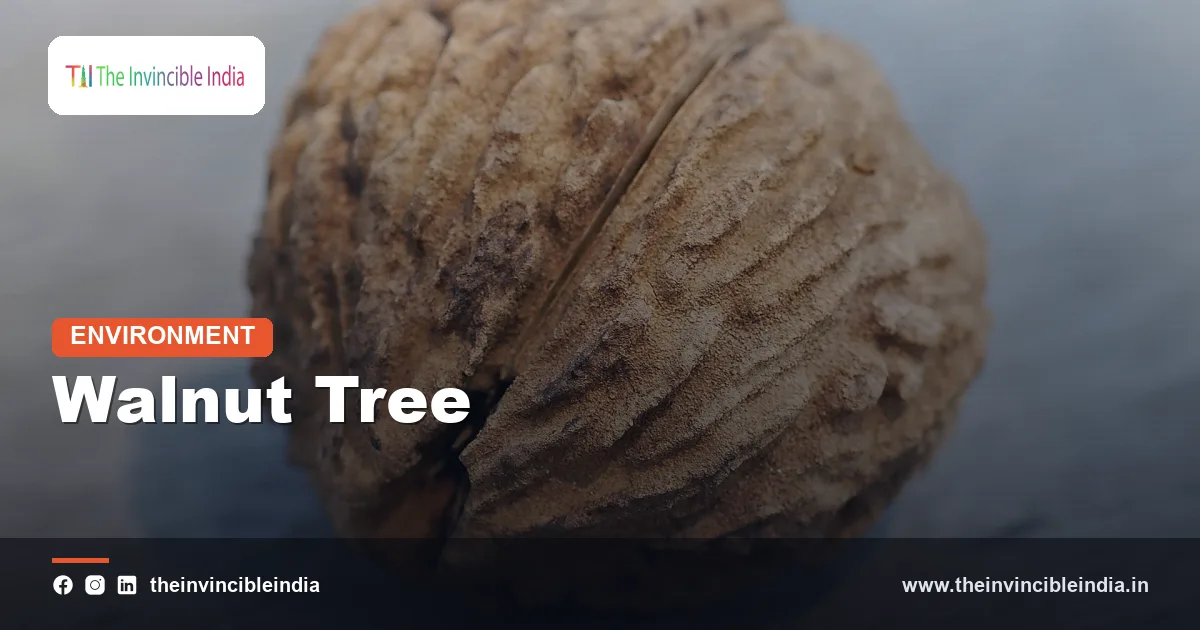
The walnut (Juglans regia), called akhrot in Hindi and also known as the Persian or English walnut, is a tall, long-lived, deciduous nut tree of cool temperate hills that is grown mainly in Jammu and Kashmir and the wider Indian Himalaya for its edible kernels and its fine, dark timber. The tree is native to a broad belt stretching from southeastern Europe through Central Asia to the Himalaya, and it has been part of Himalayan life for many centuries.
In India the walnut is the signature nut of the Kashmir valley, where it is both a food crop and a craft resource. This article explains what the walnut tree is, where it grows, how it flowers and bears nuts, what the kernel contains and why the wood is so valued.
| Quick Facts | Details |
|---|---|
| Common names | Walnut, Persian walnut, English walnut, akhrot (Hindi), doon (Kashmiri usage) |
| Scientific name | Juglans regia |
| Family | Juglandaceae (the walnut family, which also includes hickory and pecan) |
| Origin | Southeastern Europe, Central Asia and the Himalayan belt |
| Where grown in India | Jammu and Kashmir (the leading state by a wide margin), Himachal Pradesh, Uttarakhand and Arunachal Pradesh |
| Season | Flowering in spring; nuts mature and are harvested mostly in September and October |
| Part used | The kernel (seed) inside the hard shell; the wood, husk and bark are also used |
| Key nutrition | Unsaturated fat including alpha-linolenic acid (an omega-3), protein, fibre, magnesium |
| Main uses | Dry fruit, sweets, baking, oil, and carved furniture and woodcraft |
Key Takeaways
- The walnut is the nut of the deciduous tree Juglans regia, which can grow 25 metres or more tall and live for several centuries.
- Jammu and Kashmir is by a wide margin India’s leading walnut-growing region, and the Kashmir valley is the best-known source of Indian walnuts.
- Walnut trees are monoecious and wind-pollinated, carrying separate male catkins and female flowers on the same tree.
- A walnut is botanically the stone of a drupe, not a true nut, and the green husk around it splits open when the fruit is ripe.
- Walnut kernels are rich in unsaturated fats and are one of the few common plant foods that provide a notable amount of the omega-3 fatty acid alpha-linolenic acid.
- Walnut wood is dark, strong and finely grained, and Kashmir walnut wood carving is a recognised craft with Geographical Indication protection.
What is a walnut tree?
A walnut tree is a large, spreading, deciduous tree of the species Juglans regia that produces round, hard-shelled fruits whose edible seed is the walnut kernel. The tree has a stout trunk with pale grey, furrowed bark, a broad rounded crown and compound leaves made up of several smooth-edged leaflets.
The walnut belongs to the family Juglandaceae, which also includes the pecan, the hickory and the black walnut of North America. A full-grown tree reaches 20 to 30 metres in the wild and may live for 200 years or more. The leaves are strongly aromatic when crushed, and they unfold late in spring and fall in autumn after turning yellow.
The word walnut is believed to come from an old English term meaning foreign nut, in contrast with local hazelnuts. In India, the dried kernel is also called akhrot, a name in wide use across north India and used in the dry fruit trade.
Is a walnut a true nut?
No, a walnut is not a true nut in the strict botanical sense, because the part we eat is the seed inside the hard stone of a drupe. A drupe is a fleshy fruit with a stone, like a mango or a plum, and in the walnut the fleshy outer layer is the green husk that surrounds the hard shell.
During ripening, the husk turns from green to brownish-black and then splits, releasing the shell. Inside the shell are two wrinkled halves of kernel, joined by a thin partition. In everyday and trade usage, the walnut is nonetheless grouped with nuts and sold as dry fruit, and this is the practical meaning that matters in the kitchen and the market.
Where is the walnut grown in India?
The walnut is grown in India mainly in the temperate Himalayan region, with Jammu and Kashmir producing the large majority of the country’s crop. Other states with significant walnut-growing areas include Himachal Pradesh, Uttarakhand and Arunachal Pradesh, along with smaller plantings elsewhere in the hills.
- Jammu and Kashmir: the leading state, with major walnut-growing districts in the Kashmir valley and in the Chenab and Kishtwar region.
- Himachal Pradesh: walnut trees grow in the mid and high hill districts, often in and around villages.
- Uttarakhand: found in the Garhwal and Kumaon hills.
- Arunachal Pradesh: grown in some higher hill areas of the state.
Many walnut trees in the Himalaya are scattered seedling trees growing in orchards, village boundaries, fields and forests, not neat modern plantations. The tree is highly valued in rural economies because it provides food, cash income, timber and fuelwood. Annual production changes with weather and market conditions, and India also imports walnuts in addition to its own harvest, so exact figures should be checked against current official statistics.
What climate and soil does the walnut tree need?
The walnut tree needs a cool temperate climate with a distinct winter chill, a long frost-free growing period and a deep, fertile, well-drained loam soil. In India it grows well at roughly 1,200 to 2,200 metres above sea level, although the best range depends on the local conditions and the variety.
Cold and frost
The tree needs a period of winter cold to rest. However, late spring frost can kill the tender new shoots and flowers, so growers avoid frost pockets and low hollows where cold air collects. Early-leafing trees are especially at risk.
Soil and water
Deep soil is important because the walnut forms a long taproot when young. Heavy, waterlogged soils lead to root diseases, while very dry or shallow ground limits the size and quality of the nuts. Regular water during nut filling in summer improves kernel quality.
Neighbouring plants
The roots, leaves and husks of walnut trees release a compound called juglone, which can stunt or kill some nearby plants such as tomato and some other garden plants. Gardeners therefore consider the placement of other crops carefully near a walnut tree.
How does the walnut flower and bear nuts?
The walnut flowers in spring, and it bears separate male and female flowers on the same tree, which are pollinated by wind. The male flowers hang in long, drooping, green catkins, while the female flowers are small and sit at the tips of new shoots.
The tree is described as monoecious, meaning both sexes occur on a single tree. On many trees the male and female flowers mature at slightly different times, a habit called dichogamy, which reduces self-pollination. Planting trees of varieties that flower at overlapping times therefore improves nut set.
The timeline of bearing differs between tree types.
- Trees grown from seed commonly take eight to twelve years or longer to begin bearing, and their nuts vary in size and shell quality.
- Grafted trees of selected varieties often begin bearing in about four to six years and give more uniform nuts.
- Productive life continues for decades, and large old trees can carry heavy crops in good years.
What are the main walnut varieties in India?
The main walnut types in India are the local seedling walnuts of Kashmir, which dominate the trade, and a small number of selected grafted varieties released by research institutions. Seedling walnuts differ widely in shell thickness, kernel colour and size, which affects their price.
| Type | Description |
|---|---|
| Seedling walnuts | Trees raised from seed, the majority of Himalayan trees; mixed shell and kernel quality, sometimes thick-shelled |
| Selected thin-shell varieties | Grafted varieties, such as Sulaiman, Opex Caulchry, Lake English and Gobind, chosen for thinner shells and better kernels |
| Kagzi (paper-shell) walnut | A trade term for thin-shelled nuts whose shell can be cracked by hand |
| Imported walnuts | Mostly bought as shelled kernels or in-shell nuts of foreign varieties in the dry fruit trade |
Kernel colour is graded from extra light to dark amber, with lighter halves usually fetching higher prices. Whole halves are valued more than broken pieces, and the thin-shelled nuts are easier to crack, which is why farmers and agricultural departments in the region have promoted grafted plantings of thin-shell types.
When are walnuts harvested and how are they processed?
Walnuts are harvested in India mostly in September and October, when the green husks start to split and the nuts fall or can be shaken from the tree. The harvest is done by hand, by beating the branches with long poles or by collecting fallen nuts from the ground.
Husking and washing
After harvest, the soft outer husk is removed by hand or with a simple machine. Fresh husk juice stains the skin and the shell a deep brown because of the same compounds that make the husk useful as a dye, so workers commonly wear gloves. The nuts are washed to remove stains and sometimes bleached lightly to give a clean appearance.
Drying and storage
The cleaned walnuts are dried in the sun or in a warm, airy place until the kernels are brittle and the moisture content falls. Proper drying is important because damp walnuts become mouldy and the oils turn rancid. Dried nuts are graded by size and shell quality and stored in a cool, dry place. Walnuts keep longer in the shell than as loose kernels, and cold storage extends their freshness further.
What is inside a walnut: nutrition and health facts?
A walnut kernel is an energy-dense food rich in unsaturated fat, protein and fibre, and it contains notable amounts of the plant omega-3 fatty acid alpha-linolenic acid (ALA). Walnuts also supply magnesium, phosphorus, copper, manganese and several B vitamins, along with polyphenol antioxidants concentrated in the thin brown skin of the kernel.
- Fats: mostly polyunsaturated fat, including both omega-6 linoleic acid and omega-3 ALA.
- Protein: roughly 15 per cent of the kernel by weight, though values vary.
- Fibre: a good source of dietary fibre.
- Minerals: magnesium, phosphorus, copper and manganese.
- Polyphenols: compounds in the papery skin that act as antioxidants.
Because walnuts are high in calories, a small handful is a normal portion. Nutrient values differ with variety and storage, so food tables give approximate numbers. Tree nuts are among the common food allergens, and people with a known nut allergy must avoid walnuts completely and read labels on packaged foods. In India, walnuts are sometimes called brain food in popular belief, partly because the wrinkled kernel resembles a brain, but this resemblance is a folk idea and not a medical claim.
How is the walnut used in food and craft?
The walnut is used as a dry fruit, a baking and sweet ingredient, a source of oil, and as a premium timber for furniture and carving. In Kashmiri cooking, ground walnuts feature in chutneys and some sweets, and the kernel is a familiar part of festive foods and winter snacks.
- Food: eaten raw, added to halwa, cakes, brownies, laddoos and breads, or ground into chutneys and sauces.
- Oil: cold-pressed walnut oil is used in salad dressings and, historically, for cosmetics and lamps.
- Timber: walnut wood is hard, strong and fine-grained with a dark brown colour, and it is prized for furniture, gun stocks, panelling and carving.
- Craft: Kashmir walnut wood carving is a traditional craft with Geographical Indication status, known for its intricate floral and chinar-leaf patterns.
- Husk and bark: the green husk gives a brown dye, and the bark, known as dandasa, is traditionally used as a natural tooth-cleaning stick in parts of north India.
Because walnut timber is so valuable, a conflict can arise between harvesting nuts and felling the tree. Several Himalayan states have therefore placed restrictions on felling mature walnut trees, and farmers are encouraged to plant new grafted trees to renew orchards.
Bottom Line
The walnut is a tall, long-lived Himalayan tree that provides both a nutritious kernel and a valuable dark timber. Jammu and Kashmir leads India’s production, the crop depends on cold winters and frost-free springs, and the move from slow seedling trees to grafted thin-shell varieties is the main way growers are improving yield and quality.
Frequently Asked Questions
Which state is the largest producer of walnut in India?
Jammu and Kashmir is the largest walnut-producing state in India by a wide margin. The Kashmir valley and the Chenab region together supply the large majority of the country’s walnuts. Himachal Pradesh and Uttarakhand also grow the crop, though in smaller quantities.
What is akhrot called in English?
Akhrot is the Hindi name for the walnut. In English the tree is called the Persian or English walnut, and its scientific name is Juglans regia. The word usually refers to the dried kernel sold as dry fruit.
How long does a walnut tree take to bear nuts?
A walnut tree grown from seed usually takes about eight to twelve years to start bearing nuts, while a grafted tree may begin in about four to six years. Yields increase as the tree matures. Grafted varieties also give more uniform nuts.
Is walnut a nut or a fruit?
The walnut is botanically the seed of a drupe, a fleshy stone fruit, and not a true nut. The edible kernel lies inside a hard shell that is surrounded by a green husk. In the market and in the kitchen it is nevertheless treated as a nut or dry fruit.
Why are walnuts good for health?
Walnuts are good for health because they provide unsaturated fats, including the plant omega-3 ALA, along with protein, fibre, magnesium and antioxidants. A small handful a day fits into many balanced diets. Because they are high in calories, portions should be modest, and people with a nut allergy must avoid them.
Why does walnut husk stain the hands?
Walnut husk stains the hands because it contains natural brown pigments and compounds such as juglone that bind to skin. The stain is harmless but can last several days and is hard to wash off. Harvesters wear gloves, and the same pigments are why the husk is used as a natural dye.
{“@context”:”https://schema.org”,”@graph”:[{“@type”:”FAQPage”,”mainEntity”:[{“@type”:”Question”,”name”:”Which state is the largest producer of walnut in India?”,”acceptedAnswer”:{“@type”:”Answer”,”text”:”Jammu and Kashmir is the largest walnut-producing state in India by a wide margin. The Kashmir valley and the Chenab region together supply the large majority of the country’s walnuts. Himachal Pradesh and Uttarakhand also grow the crop, though in smaller quantities.”}},{“@type”:”Question”,”name”:”What is akhrot called in English?”,”acceptedAnswer”:{“@type”:”Answer”,”text”:”Akhrot is the Hindi name for the walnut. In English the tree is called the Persian or English walnut, and its scientific name is Juglans regia. The word usually refers to the dried kernel sold as dry fruit.”}},{“@type”:”Question”,”name”:”How long does a walnut tree take to bear nuts?”,”acceptedAnswer”:{“@type”:”Answer”,”text”:”A walnut tree grown from seed usually takes about eight to twelve years to start bearing nuts, while a grafted tree may begin in about four to six years. Yields increase as the tree matures. Grafted varieties also give more uniform nuts.”}},{“@type”:”Question”,”name”:”Is walnut a nut or a fruit?”,”acceptedAnswer”:{“@type”:”Answer”,”text”:”The walnut is botanically the seed of a drupe, a fleshy stone fruit, and not a true nut. The edible kernel lies inside a hard shell that is surrounded by a green husk. In the market and in the kitchen it is nevertheless treated as a nut or dry fruit.”}},{“@type”:”Question”,”name”:”Why are walnuts good for health?”,”acceptedAnswer”:{“@type”:”Answer”,”text”:”Walnuts are good for health because they provide unsaturated fats, including the plant omega-3 ALA, along with protein, fibre, magnesium and antioxidants. A small handful a day fits into many balanced diets. Because they are high in calories, portions should be modest, and people with a nut allergy must avoid them.”}},{“@type”:”Question”,”name”:”Why does walnut husk stain the hands?”,”acceptedAnswer”:{“@type”:”Answer”,”text”:”Walnut husk stains the hands because it contains natural brown pigments and compounds such as juglone that bind to skin. The stain is harmless but can last several days and is hard to wash off. Harvesters wear gloves, and the same pigments are why the husk is used as a natural dye.”}}]}]}


