

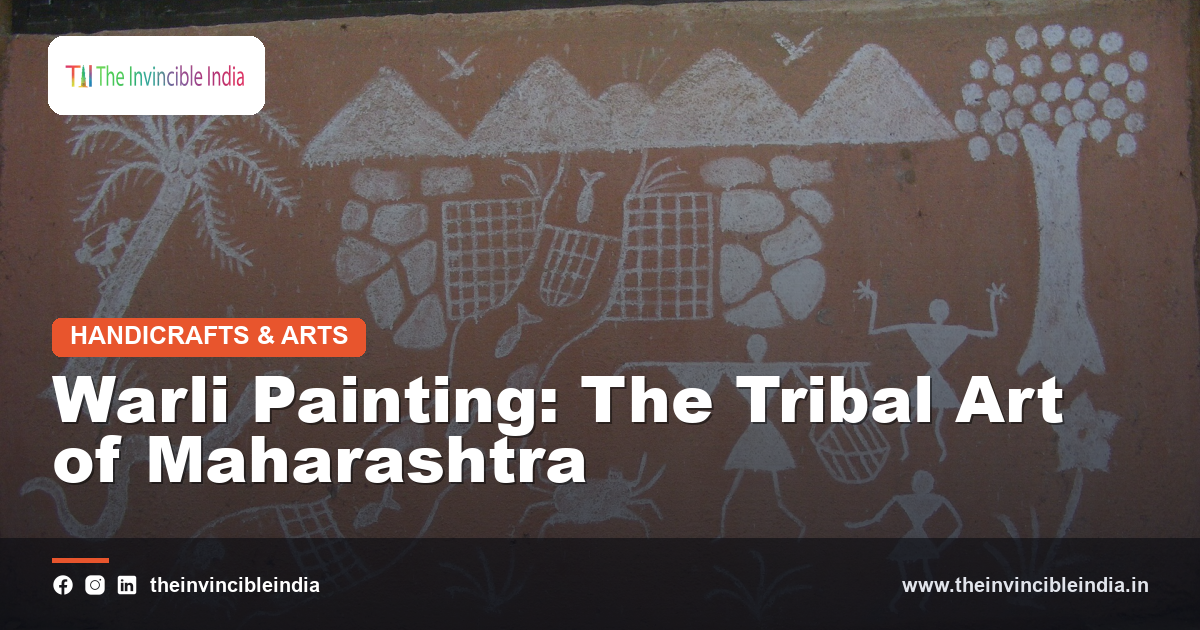
Warli painting is one of the most distinctive tribal art traditions of India, created by the Warli people of Maharashtra. Instantly recognisable by its simple white figures built from circles, triangles and lines set against an earthen brown background, it depicts the daily life, rituals, farming, dancing and deep bond with nature of the Warli community. Far more than decoration, the paintings are traditionally tied to ritual and to the great occasions of village life, especially weddings and harvests. From the mud walls of tribal homes, Warli art has travelled to galleries and products around the world while keeping its ancient character. This guide explores its origins, style, motifs, ritual meaning, famous artists and living tradition.
Quick Facts
| Detail | Information |
|---|---|
| Type | Tribal ritual and folk painting |
| Community | The Warli people of Maharashtra |
| Region | The north Konkan region of Maharashtra |
| Style | White geometric figures on an earthen background |
| Themes | Village life, nature, farming, dance and ritual |
| Recognition | Protected by a Geographical Indication (GI) tag |
The Art of the Warli People
Warli painting is the traditional art of the Warli, one of the tribal communities of Maharashtra, who live in the hilly and coastal region to the north of Mumbai. For the Warli, painting is not a professional craft but a part of the ritual and cultural life of the community, deeply connected to their beliefs, their relationship with nature and the great occasions of village life. The art reflects the world view of a people closely bound to the land, to farming and to the cycles of the seasons. As one of the best-known tribal art traditions of India, Warli painting offers a vivid window into the culture of its community.
Ancient Roots
The Warli tradition of painting is very old, rooted in the ancient culture of the community, and its simple, elemental style has been compared to the spirit of prehistoric rock art. For generations, the paintings were created on the mud walls of homes as part of ritual and celebration, an ephemeral art renewed for each occasion. Because the wall paintings did not survive, the antiquity of the tradition lies in its continuous practice rather than in surviving ancient works. This deep, living heritage, handed down within the community over centuries, gives Warli painting its timeless, elemental character and its powerful sense of connection to an ancient way of life.
The Distinctive Style
The Warli style is among the most distinctive and instantly recognisable in Indian art. Figures are built up from a few basic geometric shapes: the human body is formed of two triangles joined at their points, with a circle for the head, and circles, triangles and lines make up the whole visual world of the painting. The figures are rendered in white against a dark, earthen background, without shading or realistic detail, in a flat, rhythmic, almost diagrammatic manner. Despite this extreme simplicity, the paintings are full of life and movement, capturing scenes of activity and celebration with remarkable liveliness through the arrangement of their simple forms.
White on Earthen Brown
The characteristic look of Warli painting comes from its restricted palette: white figures on a background of earthen brown or reddish ochre. Traditionally, the background was the mud wall of the home, coated with cow dung and earth to give its warm brown tone, and the figures were painted in white using a paste made from rice. This simple contrast of white against brown, with no other colours, gives Warli painting its striking, austere beauty and its unity of appearance. The natural materials tie the art closely to the earth and the daily life of the community, and this white-on-brown palette remains a hallmark of the tradition even on modern surfaces.
Scenes of Village Life
Warli paintings are, above all, vivid records of village life and the life of the community. They depict people farming, sowing and harvesting, hunting and fishing, tending animals, carrying water, dancing and celebrating, and going about the many activities of daily life. Whole scenes teem with tiny figures engaged in these tasks, capturing the rhythm and busyness of the village. This focus on everyday life and communal activity gives Warli art its warmth and humanity, and makes each painting a lively document of the world of the Warli people, their work, their festivities and their deep involvement with the land and its seasons.
Nature and the Harvest
The bond between the Warli people and the natural world lies at the heart of their painting. The paintings are full of trees, animals, birds, the sun and the moon, and scenes of farming and harvest, reflecting a community whose life is closely tied to the land and its cycles. Nature is not merely a backdrop but a central subject, honoured and celebrated in the art. Many paintings are connected to the agricultural year and to the gratitude and hopes surrounding sowing and harvest. This deep reverence for nature, expressed in the imagery of the paintings, is fundamental to the Warli world view and to the meaning of their art.
The Tarpa Dance
One of the most beloved and characteristic images in Warli painting is the spiral or circle of dancers performing the tarpa dance. In this communal dance, people join hands and move in a great spiral or circle around a musician playing the tarpa, a traditional wind instrument, and the painted image of this swirling ring of figures captures the joy and unity of village celebration. The tarpa dance motif, with its rhythmic circle of tiny figures, has become emblematic of Warli art and expresses the communal spirit at its heart. It is a favourite subject and one of the most recognisable and delightful images in the tradition.
The Ritual Chauk
Warli painting is deeply tied to ritual, and its most sacred form is the ceremonial painting created for important occasions, especially weddings. Central to these is the chauk, a sacred square enclosing the image of a mother goddess associated with fertility and marriage, which forms the heart of the wedding painting. Created by particular women of the community according to tradition, these ritual paintings are essential to the ceremony, invoking blessings for fertility, prosperity and a good union. This ritual dimension shows that Warli painting is not merely decorative but sacred, an integral part of the ceremonies and spiritual life of the community.
Materials and Technique
Traditional Warli painting uses the simplest of natural materials. The background is the mud wall of the home, prepared with earth and cow dung, and the white figures are painted with a paste made from ground rice mixed with water and a binder, applied with a bamboo stick chewed at one end to form a rough brush. This humble technique, using only what is at hand, produces the art’s characteristic texture and its austere white-on-brown beauty. The simplicity of the materials is inseparable from the character of the art. On modern surfaces such as paper and cloth, artists reproduce the traditional look while adapting to new media.
A Living Tradition of Women and Men
Traditionally, the sacred ritual paintings of the Warli, such as the wedding chauk, were the preserve of particular women of the community, who held the knowledge of the sacred forms. Over time, and especially as Warli art gained wider recognition and became a source of income, men too took up the painting, and today both women and men create Warli art. This broadening has helped the tradition flourish and reach new markets while the sacred ritual forms retain their special significance. The continued practice of the art by the community, in both its ritual and its commercial forms, keeps the living tradition strong.
From Wall to World
For most of its history, Warli painting existed only on the walls of tribal homes, but in recent decades it has travelled far beyond the village. Encouraged by those who recognised its beauty and distinctiveness, artists began to create Warli paintings on paper, cloth and canvas, and the art found a wide market across India and around the world. Its striking style now appears on textiles, stationery, home decor and many other products, spreading Warli imagery globally and providing income for the community. This journey from ritual wall art to celebrated art form has raised the profile of the Warli people and their culture.
Famous Artists and Recognition
The rise of Warli painting to national and international fame owes much to gifted artists of the community who brought the tradition to wider attention, one of whom received high national honours and became renowned for taking the art to galleries far beyond the tribal villages. Such artists demonstrated the power and beauty of the tradition and inspired others to take it up, helping to establish Warli painting as one of the most admired tribal arts of India. Their recognition has been important in raising the status of the art and the community and in ensuring the tradition’s continuity and its transmission to new generations of painters.
Protecting the Tradition
As Warli painting gained popularity and commercial value, protecting the tradition and the interests of the community became important. Warli painting has been granted a Geographical Indication (GI) tag, which recognises it as a product distinctive to its region and community and helps safeguard its authenticity and the rights of the artists. Efforts to promote the art, support the artists and ensure that its commercial success benefits the community have accompanied its rise to fame. Protecting both the cultural integrity of the tradition and the livelihoods of the Warli people is an ongoing and important task as the art continues to spread.
Warli Painting Today
Today Warli painting flourishes both as a living ritual and folk tradition within the Warli community and as a celebrated art form known across India and around the world. The sacred wedding and ritual paintings continue in the villages, while artists create works on many surfaces for a wide audience, and the distinctive white-on-brown style appears on countless products. New generations carry the tradition forward, and the art remains a source of pride and livelihood for the community. In its elemental simplicity, its warmth and its deep connection to nature and communal life, Warli painting remains one of the great tribal art traditions of India.
Sources & Further Reading
- Ministry of Culture, Government of India, on the tribal and folk arts of India (indiaculture.gov.in).
- Geographical Indications Registry, Government of India, on the GI status of Warli painting (ipindia.gov.in).
- Development Commissioner (Handicrafts), Ministry of Textiles, on traditional Indian handicrafts.
Frequently Asked Questions
What is Warli painting?
Warli painting is the tribal art of the Warli people of Maharashtra, known for its simple white geometric figures, built from circles, triangles and lines, set against an earthen brown background. It depicts village life, nature, dance and ritual.
Which community creates Warli painting?
Warli painting is created by the Warli, a tribal community living in the north Konkan region of Maharashtra, to the north of Mumbai. For them it is a ritual and cultural art rather than a professional craft.
What is the tarpa dance in Warli painting?
The tarpa dance is a favourite Warli motif showing a spiral or circle of dancers holding hands and moving around a musician playing the tarpa, a wind instrument. It captures the joy and unity of communal celebration.
What materials are used in traditional Warli painting?
Traditional Warli painting uses a mud wall prepared with earth and cow dung as the background and a white paste of ground rice for the figures, applied with a chewed bamboo stick used as a brush.
Is Warli painting protected by a GI tag?
Yes. Warli painting has been granted a Geographical Indication (GI) tag, which recognises it as a product distinctive to its region and community and helps protect its authenticity and the interests of the artists.


