

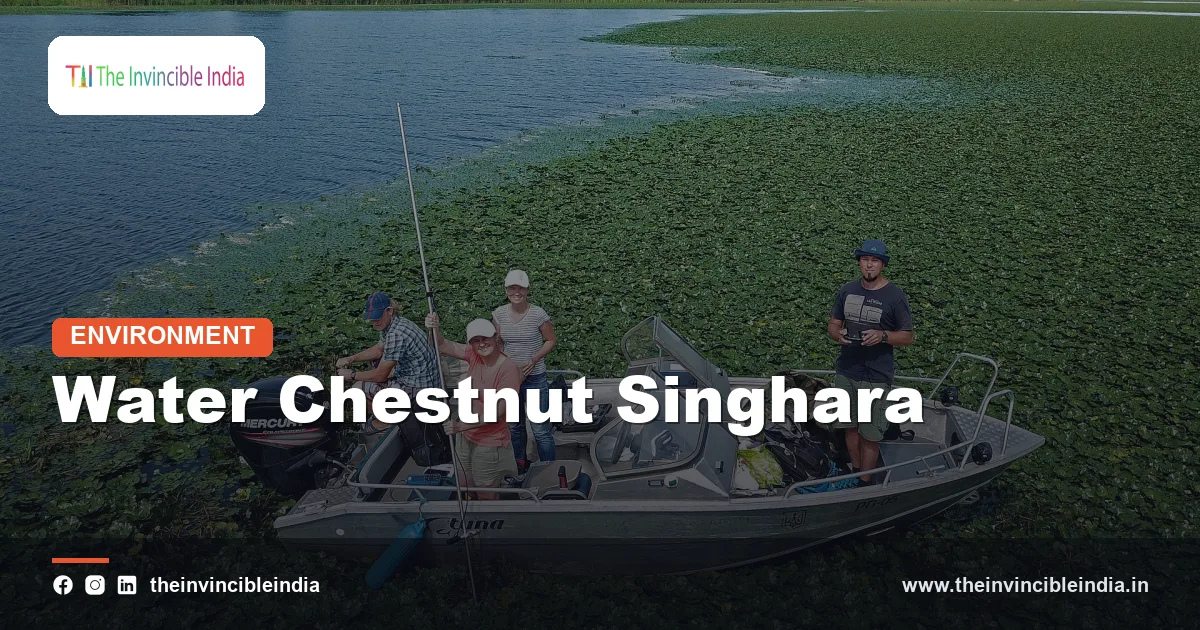
The water chestnut, called singhara in Hindi, is the horned, starchy fruit of a floating aquatic plant of the genus Trapa, grown in ponds, tanks and shallow lakes across northern and eastern India and eaten fresh, boiled or ground into flour. Singhara flour is a well-known fasting food during Navratri and other vrats, and the plant itself is among the most recognisable floating crops of Indian village ponds.
This explainer describes what the water chestnut is, how it differs from the Chinese water chestnut sold in tins, how the plant grows on water, where and when it is cultivated, what it contains and how it is eaten. It is written as a plain guide to a pond crop that many people know only by its flour.
| Quick Fact | Detail |
|---|---|
| Common names | Water chestnut, singhara (Hindi), singoda, paniphal (Marathi), water caltrop, bat nut, singhare |
| Scientific name | Trapa natans and Trapa bispinosa (names and groupings vary among botanists) |
| Family | Lythraceae (formerly placed in its own family, Trapaceae) |
| Where grown in India | Bihar, Uttar Pradesh, West Bengal, Madhya Pradesh, Odisha, Jharkhand, Punjab, Maharashtra, Assam and Jammu and Kashmir, in ponds, tanks and lakes |
| Season | Planted around the monsoon (June to July) and harvested mainly from about October to January |
| Part used | The starchy kernel inside the hard, horned fruit; also dried and milled into flour |
| Nutrition | Rich in starch and water, with potassium and fibre, and low in fat |
| Main uses | Eaten fresh or boiled, ground into singhara flour for fasting foods, and used in snacks and sweets |
Key Takeaways
- The water chestnut, or singhara, is the starchy, horned fruit of the floating aquatic plant Trapa, grown in still water across northern and eastern India.
- Singhara is a different plant from the Chinese water chestnut, which is a sedge corm used in stir-fries and canned in tins.
- Singhara flour is gluten-free and is traditionally eaten during Hindu fasts such as Navratri, in the form of rotis, pakoras and halwa.
- The singhara plant floats on water with a rosette of diamond-shaped leaves held up by inflated stalks, while its roots hang in the water below.
- Singhara is typically planted around the monsoon months and harvested mainly between about October and January.
- Raw singhara collected from polluted ponds can carry parasites, so cleaning and boiling the nuts is advised before eating.
What Is the Water Chestnut (Singhara)?
The water chestnut, or singhara, is the edible fruit of Trapa, an annual floating aquatic plant whose hard, dark, horn-shaped husk encloses a white, crisp, starchy kernel. In India it is harvested from ponds and lakes and sold fresh in winter markets, and it is also dried and ground into flour.
The fruit is easy to identify. It is shaped like a flattened triangle or a bull’s head, with two or four sharp horns, and it is purple-brown to green or black depending on the type and ripeness. The name singhara comes from the horn-like points, which resemble the horns (singh) of an animal, and the English names water caltrop and bat nut refer to the same spiky form.
The kernel inside is mildly sweet and nutty, with a firm, slightly crunchy bite when fresh. Boiled in its shell, it becomes soft and floury, similar to a boiled chestnut.
Is Singhara the Same as the Chinese Water Chestnut?
No, singhara is not the same as the Chinese water chestnut. Singhara is the horned fruit of a floating plant of the family Lythraceae, while the Chinese water chestnut, Eleocharis dulcis, is a round, dark corm that grows underground in the mud and belongs to the sedge family, Cyperaceae.
The two are often confused because both are called water chestnuts and both grow in shallow water. Cooks use them differently. Chinese water chestnut is a crunchy, mild, slightly sweet vegetable often added to stir-fries and dumplings, and it stays crisp when cooked. Singhara is starchier, with a floury texture when boiled, and is the form turned into flour. Anyone buying “water chestnut flour” in India is almost always buying singhara flour.
| Feature | Singhara (Trapa) | Chinese water chestnut (Eleocharis) |
|---|---|---|
| Plant type | Floating plant with rosette leaves | Erect, reed-like sedge |
| Edible part | Kernel inside a horned fruit | Round underground corm |
| Appearance | Horned, triangular, dark husk | Small, round, brown-black |
| Texture when cooked | Soft, starchy | Stays crisp |
| Main Indian use | Fresh nuts and fasting flour | Mostly in Chinese-style dishes |
How Does the Water Chestnut Plant Grow?
The water chestnut plant grows as a floating rosette: long stems rise from the pond bed, their tops spread out into a ring of diamond-shaped leaves on the water surface, and spongy, air-filled leaf stalks keep the ring afloat. Feathery roots hang from the stem into the water, and a firm anchor root holds the plant to the mud.
The floating leaves are glossy, toothed and arranged in a neat circle, which gives a pond with singhara a distinctive mosaic look. Below the surface, the stem produces fine, feathery, root-like structures that absorb nutrients. Small white four-petalled flowers appear in the leaf centre and are pollinated by insects or sometimes self-pollinate. After flowering, the stalk bends down so that the fruit develops under the water, and when ripe it either drops to the bottom or is picked while still attached.
Why the leaf stalks are swollen
Each leaf stalk in many Trapa types has an inflated, spongy section that works like a float. This feature helps the plant stay at the surface even as the water level rises and falls with rain and drawdown, and it is a useful clue for identifying the plant from a distance.
Annual life cycle
Trapa is an annual. A single fruit sprouts in spring from the pond bottom, sends up a long stem and spreads its rosette as the water warms. The plant fruits through the monsoon and post-monsoon, and the cycle ends when the leaves die back in winter.
Where Is Singhara Grown in India?
Singhara is grown in India in ponds, tanks, oxbow lakes and wetlands, mainly in Bihar, Uttar Pradesh, West Bengal, Madhya Pradesh, Odisha, Jharkhand, Punjab, Maharashtra, Assam and Jammu and Kashmir. It is largely a smallholder crop, and recorded production figures are limited and vary by source.
The crop suits regions with plenty of shallow, still, nutrient-rich water. In the Gangetic plain, many village ponds are leased for the season to growers, often from fishing and traditional pond-using communities. In Kashmir, a type of water chestnut known locally as gaer is harvested from lakes such as Wular and Dal, and it has been a seasonal food and source of income there for generations. In eastern India, wetlands and oxbow lakes support commercial singhara cultivation alongside fish.
Because it grows in water that might otherwise be fallow or used only seasonally, singhara is often valued by farmers with little land but access to a pond.
When Is Singhara Planted and Harvested?
Singhara is usually sown in nurseries in spring, transplanted into the pond around June and July with the onset of the monsoon, and harvested mainly between about October and January. The plant is a cool-season fruit in markets, available fresh for a few months each year.
A typical crop cycle looks like this:
- Seed selection: mature, healthy nuts are saved from the previous harvest and kept moist in water to prevent drying.
- Nursery stage: the nuts are sprouted in a small, shallow pond or tank, where young vines develop.
- Transplanting: vine cuttings are carried to the main pond and pushed into the water so that they float and root.
- Growth and manuring: the plants spread across the surface, and growers may add organic manure or fertiliser to boost fruiting.
- Picking: harvesters wade or use small boats and tubs, lifting the vines and picking ripe fruit by hand, usually several times over a few weeks.
Harvesters often work for hours standing in cold water in winter, a physically demanding task that also exposes them to leeches and insects. Fruit that is picked is washed, sorted and sold as fresh nuts in the market or dried for flour.
How Is Singhara Eaten?
Singhara is eaten fresh or boiled in its shell, roasted, or ground as flour to make rotis, puris, pakoras, halwa and porridge. The fresh kernel is peeled from the husk and eaten raw in small amounts, while most people prefer to boil it first.
Common ways to use the fruit and flour include:
- Boiled singhara: the whole fruit is boiled with a little salt, then cracked open, and the soft kernel is eaten like a chestnut. Street vendors sell it in winter.
- Singhare ka atta (flour): the dried kernel is ground into a fine, starchy flour, used in fasting dishes such as rotis, puris, pakoras and kadhi-like preparations.
- Singhara halwa: flour roasted in ghee and cooked with sugar and water into a sweet pudding.
- Vegetable curries: peeled kernels are sometimes added to curries, mixed with potato or other vegetables.
- Snacks: fresh kernels are sliced and tossed with spices as a salad or chaat.
The flour has a delicate, slightly sweet taste, and it binds poorly without added starchy ingredients, so cooks often mix it with boiled potato or sama rice flour for rotis.
Why Is Singhara Eaten During Fasts?
Singhara flour is eaten during Hindu fasts such as Navratri and ekadashi because it comes from an aquatic fruit rather than a cereal grain, so it is accepted by many communities as a permitted food during vrat. Grains like wheat and rice are avoided in many fasting traditions, while certain fruits, tubers and aquatic crops are allowed.
Practices differ by region, family and sect, so what is acceptable during a fast is a matter of local custom rather than a single rule. Singhara flour, kuttu (buckwheat) flour, rajgira (amaranth) and sama rice are among the most commonly used fasting ingredients. Of these, singhara flour is known for being filling, easy to cook and gluten-free. It is typically made with rock salt (sendha namak) instead of regular salt during fasts.
What Nutrients Does Singhara Provide?
Singhara provides starch for energy, along with potassium, fibre, some B vitamins and minerals, and very little fat. The fresh fruit is mostly water, while the dried flour is rich in carbohydrates.
In general terms, the nutritional profile shows:
- Carbohydrates: mainly starch, making singhara a good energy food.
- Potassium: a mineral present in useful amounts, supporting normal muscle and nerve function.
- Fibre: modest in the fresh kernel, and lower in refined flour.
- Protein: small amounts, so singhara is not a major protein source.
- Fat: very low, which suits a light fasting diet.
Exact values differ by type and by how the fruit is processed. Singhara has been used in traditional Indian medicine systems for various complaints, but such claims are not well-established clinically, and it is best treated as a nutritious food rather than a remedy.
Is Raw Singhara Safe to Eat?
Raw singhara is safe only when it comes from clean water and is thoroughly washed, because aquatic plants from polluted ponds can carry parasites and bacteria on their surfaces. Boiling the fruit in its shell before eating removes most of this risk.
Public health literature has long noted that people can pick up certain parasitic infections from eating raw aquatic plants grown in contaminated water. For this reason, health-conscious sellers and households wash the fruit, scrub the husk and boil it. Buyers of singhara flour should also choose flour from reliable brands or sellers, because adulterated or spoilt flour sold in festival seasons has occasionally caused food poisoning in India. Storing flour in a cool, dry, airtight container helps keep it fresh.
How Is Singhara Cultivated?
Singhara is cultivated as a pond crop in shallow still water about one to two metres deep, using vine cuttings or sprouted nuts as planting material. It needs warm weather, sunlight, nutrient-rich water and protection from strong flooding.
Pond preparation and care
Growers clear the pond of weeds and old vegetation, check the water depth and sometimes add organic manure. Vines are planted at regular intervals and left to spread. Because the plant floats, no soil preparation is needed in the usual sense, though the pond bottom provides anchorage and nutrients.
Problems in cultivation
- Leaf-eating insects and beetles: beetles and caterpillars can damage the floating leaves.
- Fungal and aphid attack: these can weaken the plant in humid weather.
- Water quality: pollution or abrupt changes in depth can reduce yields.
- Competition: fast-spreading weeds such as water hyacinth can crowd the pond.
Singhara and fish farming
Some growers combine singhara with fish, since the plant shades the water and the fish can feed on insects, though such integrated systems must be carefully managed to maintain oxygen in the water.
Does Water Chestnut Matter Ecologically?
Yes, water chestnut matters ecologically because it provides food and shelter in wetlands and supports rural livelihoods, but in some countries outside India Trapa has become an invasive weed that chokes waterways. In India, singhara is a traditional crop that is grown and harvested rather than a major invasive problem.
Floating plant mats shade the water, which can reduce light for submerged plants and lower oxygen at depth if the cover becomes too dense. In managed ponds, annual harvesting keeps the vegetation under control. In North America, introduced water chestnut has spread widely and is treated as a problem species, which shows why water plants can have very different roles in different places.
For Indian wetlands, the importance of singhara is mainly cultural and economic. It gives seasonal income to pond leaseholders and harvesters, supports local winter markets and preserves a food tradition linked to festivals and fasting.
Bottom Line
The water chestnut, or singhara, is a horned aquatic fruit grown in ponds and lakes across India, eaten fresh in winter and ground into the flour central to fasting foods. It is a different plant from the Chinese water chestnut, grows as a floating rosette and is best boiled before eating.
Frequently Asked Questions
What is singhara called in English?
Singhara is called water chestnut in English, and also water caltrop or bat nut. It is the horned fruit of the aquatic plant Trapa, and it is not the same as the Chinese water chestnut.
Is water chestnut a nut or a vegetable?
Singhara is botanically a fruit, because it develops from the flower of the Trapa plant, although it is eaten like a starchy vegetable or nut. Its kernel is white, crisp and mildly sweet when fresh.
Why is singhara flour eaten in fasts?
Singhara flour is eaten during fasts such as Navratri because it comes from an aquatic fruit rather than a grain. Many communities permit it during vrat, though customs vary by region and family.
When is singhara available in India?
Fresh singhara is available mainly from about October to January. The plant is usually planted around June and July and harvested in the post-monsoon and winter months.
Which states grow water chestnut?
Water chestnut is grown in Bihar, Uttar Pradesh, West Bengal, Madhya Pradesh, Odisha, Punjab, Maharashtra, Assam and Jammu and Kashmir, among others. It is usually grown in ponds, tanks and lakes, and recorded production figures vary by source.
Is it safe to eat raw singhara?
Raw singhara is safe only if it comes from clean water and is washed well. Boiling the fruit in its shell is the safer practice, because aquatic plants from polluted ponds can carry parasites or bacteria.
{“@context”:”https://schema.org”,”@graph”:[{“@type”:”FAQPage”,”mainEntity”:[{“@type”:”Question”,”name”:”What is singhara called in English?”,”acceptedAnswer”:{“@type”:”Answer”,”text”:”Singhara is called water chestnut in English, and also water caltrop or bat nut. It is the horned fruit of the aquatic plant Trapa, and it is not the same as the Chinese water chestnut.”}},{“@type”:”Question”,”name”:”Is water chestnut a nut or a vegetable?”,”acceptedAnswer”:{“@type”:”Answer”,”text”:”Singhara is botanically a fruit, because it develops from the flower of the Trapa plant, although it is eaten like a starchy vegetable or nut. Its kernel is white, crisp and mildly sweet when fresh.”}},{“@type”:”Question”,”name”:”Why is singhara flour eaten in fasts?”,”acceptedAnswer”:{“@type”:”Answer”,”text”:”Singhara flour is eaten during fasts such as Navratri because it comes from an aquatic fruit rather than a grain. Many communities permit it during vrat, though customs vary by region and family.”}},{“@type”:”Question”,”name”:”When is singhara available in India?”,”acceptedAnswer”:{“@type”:”Answer”,”text”:”Fresh singhara is available mainly from about October to January. The plant is usually planted around June and July and harvested in the post-monsoon and winter months.”}},{“@type”:”Question”,”name”:”Which states grow water chestnut?”,”acceptedAnswer”:{“@type”:”Answer”,”text”:”Water chestnut is grown in Bihar, Uttar Pradesh, West Bengal, Madhya Pradesh, Odisha, Punjab, Maharashtra, Assam and Jammu and Kashmir, among others. It is usually grown in ponds, tanks and lakes, and recorded production figures vary by source.”}},{“@type”:”Question”,”name”:”Is it safe to eat raw singhara?”,”acceptedAnswer”:{“@type”:”Answer”,”text”:”Raw singhara is safe only if it comes from clean water and is washed well. Boiling the fruit in its shell is the safer practice, because aquatic plants from polluted ponds can carry parasites or bacteria.”}}]}]}


