

The Western Satraps, also called the Western Kshatrapas, were a line of Shaka rulers who governed large parts of western and central India during the early centuries of the Common Era. Their territory took in Gujarat, Saurashtra, Malwa and neighbouring regions, and it gave them command of the rich trade between the Indian interior and the Arabian Sea. Although they descended from Central Asian peoples, they adopted Sanskrit, Indian names and local religious patronage with striking speed. Their silver coins, rock inscriptions and cave donations remain among the best sources for the period, and their long rivalry with the Satavahana dynasty shaped the politics of the Deccan and the west coast.
Quick Facts
| Detail | Information |
|---|---|
| Dynasty | Western Satraps (Western Kshatrapas) |
| Origin | Shaka (Scythian) people from Central Asia |
| Region | Gujarat, Saurashtra, Malwa, parts of Maharashtra and Rajasthan |
| Capitals | Ujjain and other regional centres |
| Best known for | Silver coinage and the Junagadh rock inscription |
| Main rivals | Satavahanas of the Deccan; later the Guptas |
Who Were the Western Satraps
The Western Satraps were a dynasty of Shaka origin who ruled a broad swathe of western India for several centuries. The word satrap comes from an old Iranian term for a provincial governor, and the title passed to the Shakas through the Parthian and Indo-Scythian worlds that bordered India’s northwest. Kshatrapa is the Sanskritised form of the same word, and both names appear in scholarship and in the records of the rulers themselves.
What distinguishes these rulers is how thoroughly they became part of Indian life. They took Indian names, patronised Buddhist and Brahmanical institutions, and issued inscriptions in Sanskrit. The Western Satraps therefore stand as a clear example of how migrating groups were absorbed into the cultural fabric of the subcontinent while still leaving their own distinctive mark on its coinage, administration and trade.
The Shakas and Their Arrival in India
The Shakas were nomadic peoples from the steppes of Central Asia who moved southwards across several generations. Pressure from other migrating groups pushed them into Bactria, Gandhara and the Indus region, and from there some bands drifted eastwards and southwards into the Indian heartland. Sources from India and abroad refer to them by names that scholars connect with the Scythians of the ancient world.
In India their political fortunes varied from place to place. In the northwest they formed several small kingdoms, while in the west they settled into the fertile lands of Malwa and Gujarat and found opportunities in the port-based economy of the coast. The western branch would prove to be the most durable, and the Western Satraps grew out of these settlements to become one of the longest-lasting dynasties of their age.
The Kshaharata and Kardamaka Lines
Historians usually speak of two major ruling houses among the Western Satraps. The earlier line is known as the Kshaharata family, of which Nahapana is the best-remembered ruler. His power extended across parts of Gujarat, Konkan and the northern Deccan, and inscriptions from cave sites in the Sahyadri hills record gifts made by members of his court and family.
The later and longer-lived line is called the Kardamaka family, associated with the rulers of Ujjain. Chashtana is generally regarded as its founder, and his descendants ruled for a very long span. Between them the two families give the Western Satraps their overall character, one dynasty giving way to another while the broad territorial base around the western coast and Malwa remained largely intact.
Nahapana and the Struggle with the Satavahanas
Nahapana ruled at a time when the Deccan was dominated by the Satavahanas, and the two powers came into direct conflict over the lands of the northern Deccan and the western ports. Nahapana’s coins and inscriptions show him controlling areas that the Satavahanas would later reclaim, which indicates that the rivalry was long and that territory changed hands more than once.
The Satavahana king Gautamiputra Satakarni is traditionally credited with a decisive campaign against Nahapana, and evidence of countermarked coins is often cited as a sign that the Satavahanas took over the silver currency of their rival. The contest was not merely a matter of prestige. Whoever held the western ports and the passes leading to them controlled a large share of India’s overseas commerce, which is why the struggle became a defining feature of the era.
Chashtana and the Ujjain Kshatrapas
After the setbacks suffered by the Kshaharata house, the fortunes of the Shakas in the west were rebuilt by Chashtana and his line. Ujjain, an ancient city with deep Buddhist and Brahmanical associations and a strategic place on the routes between north and south, became the principal seat of this dynasty. Its position between Malwa and the western coast made it ideal for a state whose wealth depended on commerce.
Chashtana and his successors ruled with the title of Kshatrapa, and for a time some members of the family held the higher title of Mahakshatrapa. The distinction is visible on coins and in inscriptions and probably reflects seniority within a family that often shared authority between a senior and junior ruler. The Ujjain Kshatrapas thus created a stable political tradition that outlasted many neighbouring dynasties.
Rudradaman and the Junagadh Inscription
Rudradaman is widely regarded as the most celebrated ruler of the Western Satraps, and he is known chiefly through a long rock inscription at Junagadh in Gujarat. The record praises his learning, his skill in music and grammar, his generosity and his military success, and it is among the earliest substantial inscriptions composed in refined Sanskrit prose, a fact that says a great deal about the cultural confidence of the dynasty.
The inscription describes the extent of his dominion, which reached across Saurashtra, Malwa, the Konkan and neighbouring territories. It also records that he restored an important reservoir near Girnar that had burst its embankments during heavy rains. By combining conquest, patronage and public works, Rudradaman came to embody the idea of a learned and responsible ruler, and his reputation still anchors the history of the dynasty.
The Sudarshana Lake and Public Works
The Sudarshana lake at Girnar is one of the most important examples of early water management in India, and the Western Satraps are connected with its history through the Junagadh inscription. The lake was created by damming a stream in the hills, and it had earlier been maintained by rulers of the Mauryan period. Its long story of building, breach and repair shows how successive dynasties treated irrigation as a royal duty.
According to the inscription, Rudradaman had the broken embankment rebuilt at his own expense, without burdening his subjects with extra taxes or forced labour. Whether or not the claim is entirely literal, it reveals the ideal of kingship that the dynasty wished to project. Care for water and agriculture was seen as a mark of legitimate rule, and the Satraps presented themselves as worthy heirs to that tradition.
Silver Coinage and the Coin Legends
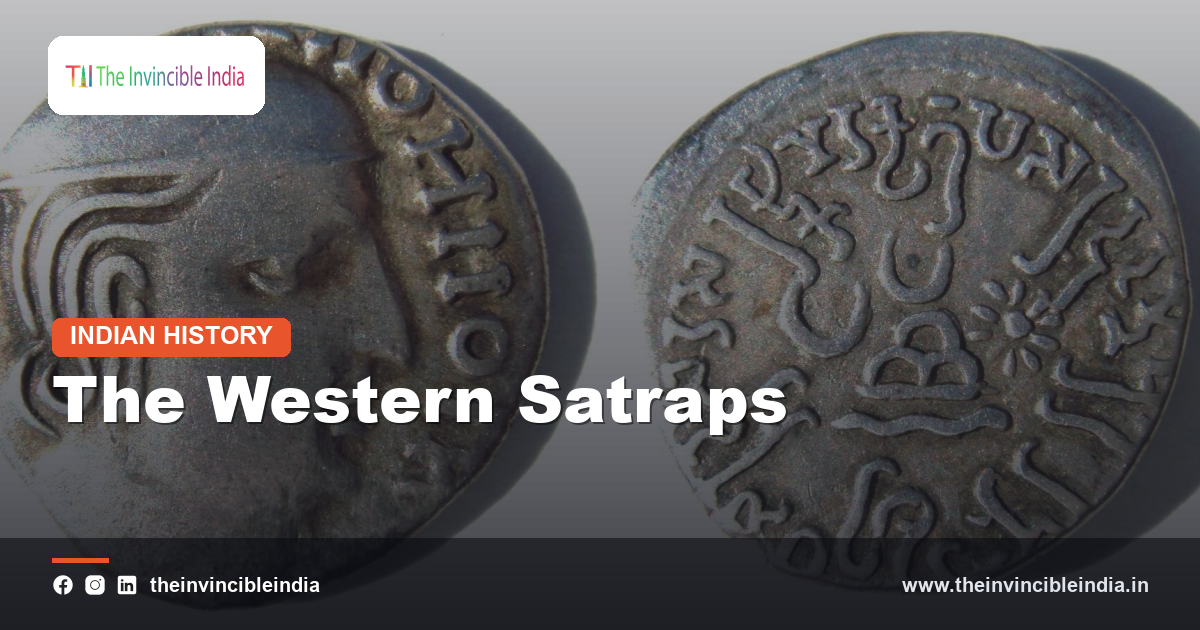
The silver coins of the Western Satraps are among the most informative artefacts of ancient India. Modelled on earlier issues of the Indo-Greek kings, they usually show the head of the ruler on one side and a symbol on the other, such as a hill with a crescent and a sun or star. The combination of Greek-derived design and Indian symbolism makes them a striking record of cultural exchange.
The legends on the coins include inscriptions in Brahmi script and, in some early issues, traces of Greek lettering. Later coins carry the names of the ruler and his father along with dates reckoned in an era that scholars have linked with the Shaka era. Because rulers and their fathers are named in sequence, the coins allow historians to reconstruct family trees and reign order with unusual confidence, giving numismatics a central role in the story of this dynasty.
Ports, Trade and the Arabian Sea
The prosperity of the Western Satraps rested largely on the trade of the Arabian Sea. Ports along the coast of Gujarat and the Konkan connected the Indian interior with the Red Sea, the Persian Gulf and the wider Mediterranean world. Barygaza, the modern Bharuch, was among the most important of these harbours and is described in ancient Greek-language sailing accounts as a busy centre of exchange.
Goods moved between inland cities and the coast along well-established overland routes, and Ujjain stood at a key junction of those routes. Cotton textiles, spices, gems and other commodities travelled outward, while coin, wine and luxury goods flowed in. By controlling both the ports and the roads that fed them, the Western Satraps collected substantial revenue and became one of the most commercially powerful dynasties of their age.
Religion and Patronage of Caves and Monasteries
The Western Satraps and their officials supported a variety of religious traditions, and this pluralism is visible in the cave sites of western India. Inscriptions at places such as Nashik and Junnar record donations of caves, cisterns and endowments to Buddhist monks, often made by members of the ruling family, their ministers or wealthy merchants attached to their courts.
These records show that the rulers adopted the patterns of giving already established in the region. They also patronised Brahmanical learning, as their use of Sanskrit and their Vedic-style names suggest. Rather than favouring one faith exclusively, the dynasty supported the institutions that sustained the communities within its territory, and this inclusive approach helped it win acceptance among the settled populations it governed.
Language, Script and Cultural Assimilation
Language offers one of the clearest windows into the assimilation of the Western Satraps. Early rulers bore names with Iranian or Central Asian elements, but later members of the family adopted names that are recognisably Sanskritic, and their inscriptions were composed in Sanskrit rather than in Prakrit alone. The shift shows that the dynasty was investing in the prestige language of Indian court culture.
The same process is visible in marriage, religion and administration. The rulers intermarried with local families, supported local institutions and adopted familiar titles and forms of government. This gradual absorption is a recurring pattern in Indian history, in which foreign groups entered as outsiders yet ended as participants in a shared civilisation. The Western Satraps represent one of its most fully documented examples.
Administration and the Satrapal System
The administrative system of the Western Satraps drew on both Iranian and Indian models. The idea of a satrapy, a province under a governor who ruled in the name of a higher sovereign, had a long history in the ancient Near East and in the Indo-Scythian and Kushan worlds. In practice the Western Satraps functioned as fully independent rulers within their own territory.
One notable feature was joint rule, in which a senior ruler and a junior colleague shared authority, and the title of the junior partner is often visible on coins. Provincial governors, ministers and local chiefs managed day-to-day affairs, while the ruler at Ujjain maintained the army and the treasury. This flexible structure allowed the dynasty to govern a large and varied territory over a long period without relying on a single centralised bureaucracy.
Relations with the Kushanas and Other Powers
The Western Satraps did not exist in isolation. To the north the Kushanas built a large empire, and the two dynasties shared a common Central Asian heritage while competing for the wealth of the trade routes. The western rulers appear to have maintained their independence while acknowledging the presence of their powerful neighbour, and some scholars have discussed possible links between the two courts.
To the south lay the Satavahanas, with whom relations swung between rivalry and marriage alliances. Farther east, other regional dynasties emerged as the political map of the subcontinent shifted. The story of the Western Satraps is therefore also a story of diplomacy, in which a mid-sized kingdom survived among larger powers through skilful use of commerce, alliances and strategically placed cities.
Decline and the Gupta Conquest
The power of the Western Satraps weakened gradually over time. Internal rivalries within the ruling family, pressure from neighbouring kingdoms and changes in trade patterns all played a part in reducing the strength of the dynasty. The later rulers still issued coins and maintained their courts, but the extent of their territory diminished, and the political centre of gravity in northern India was shifting.
The end came when the Gupta ruler Chandragupta II extended his authority into western India and brought the region of the Western Satraps under Gupta control. The conquest gave the Gupta empire direct access to the western ports and their wealth, and it marked the close of a dynasty that had lasted for centuries. The absorption of the region into the larger imperial order of the Gupta empire closed one chapter and opened another.
How Historians Study the Satraps
The history of the Western Satraps has to be reconstructed from a limited range of sources, since no long native chronicle of the dynasty survives. Coins are the most abundant evidence, and the habit of naming rulers and their fathers on the coins makes it possible to arrange them in order. Inscriptions, especially the Junagadh record, provide narrative detail and insights into royal ideals.
Foreign accounts, particularly Greek-language descriptions of the sea trade, add commercial context, while literary references in Indian texts provide occasional glimpses of the Shakas as neighbours and rivals. Each type of evidence has limitations, and scholars continue to debate questions of exact reign order and chronology. The careful combination of these sources is what allows the dynasty to be understood as a coherent historical phenomenon.
The Western Satraps Today
The Western Satraps continue to matter because they illuminate several important themes in Indian history at once. They show how foreign migrants became part of Indian society, how coinage and inscriptions can reconstruct the past, and how maritime trade shaped the politics of the western coast. Museums in Gujarat, Maharashtra and elsewhere hold their coins, and the Junagadh inscription remains a landmark of early Sanskrit writing.
For students and travellers alike, the sites associated with the dynasty, from the Girnar hills to the caves of the Sahyadris, offer tangible links to a cosmopolitan past. The story of the Western Satraps reminds readers that ancient India was never a closed world. It was a connected civilisation that welcomed new peoples, absorbed their contributions and grew richer through the exchange.
Sources & Further Reading
- Archaeological Survey of India (asi.nic.in).
- Ministry of Culture, Government of India (indiaculture.gov.in).
Frequently Asked Questions
Who were the Western Satraps?
The Western Satraps were a dynasty of Shaka origin who ruled Gujarat, Saurashtra, Malwa and neighbouring regions for several centuries. They are also called the Western Kshatrapas and are known mainly through their coins and inscriptions.
Why is Rudradaman important?
Rudradaman is the best-known Western Satrap ruler because of the long Sanskrit inscription at Junagadh that records his achievements. It praises his learning and conquests and describes his repair of the Sudarshana lake near Girnar.
Why are Western Satrap coins so valuable to historians?
Their silver coins carry the names of the ruler and his father and later bear dates in a Shaka-linked era. This allows historians to reconstruct reign order and family lines with more confidence than for many other ancient dynasties.
How did the Western Satraps make their wealth?
Their wealth came mainly from trade, since they controlled ports on the Arabian Sea coast and the inland routes that led to them. Ujjain and the port of Barygaza were central to this commerce.
How did the Western Satraps come to an end?
The dynasty weakened over time and was eventually absorbed by the Gupta empire under Chandragupta II. The conquest gave the Guptas direct access to the western ports.


