

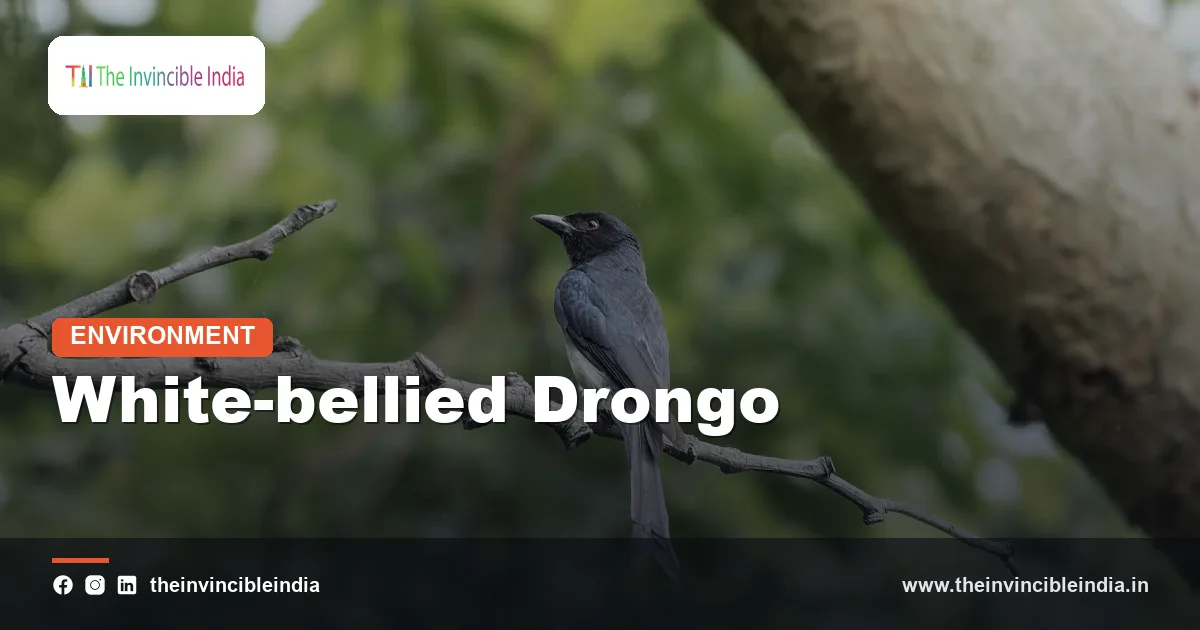
The white-bellied drongo (Dicrurus caerulescens) is a slim, glossy blue-black songbird with a clean white belly and a long forked tail, found in the open forests, plantations and gardens of India. It is an insect hunter that watches from an exposed perch, dashes out to snatch a flying insect and returns to the same spot, and it is also a skilled mimic of other birds. This guide explains how the white-bellied drongo looks, where it lives, what it eats and how it breeds.
The white-bellied drongo is easy to learn because few other birds combine a dark upper body, a white lower belly and a deeply forked tail. It is a bold, noisy and watchful bird, and it plays a quiet but useful role as a controller of insects in woodland and farmland edges.
| Common name | White-bellied drongo |
|---|---|
| Scientific name | Dicrurus caerulescens |
| Family | Dicruridae (drongos), order Passeriformes |
| Size | About 24 cm long, with a long, deeply forked tail |
| Range in India | Resident across peninsular India, the Western Ghats, central and eastern India and the Himalayan foothills; also Nepal and Sri Lanka |
| Habitat | Open deciduous and moist forest, forest edges, scrub, plantations, orchards and well-wooded gardens |
| Diet | Flying insects caught in the air, plus other insects, and occasionally flower nectar |
| Breeding | Shallow cup nest of fine twigs and fibres bound with cobweb, built in a tree fork; usually three to four spotted eggs |
| Conservation status | Least Concern on the IUCN Red List |
Key Takeaways
- The white-bellied drongo is a slim, dark, glossy drongo with a white belly and vent and a long forked tail, found across much of India and Sri Lanka.
- The white-bellied drongo hunts by perching in the open, flying out to catch insects in mid-air and returning to its post, a method known as hawking.
- The white-bellied drongo is a mimic that copies the calls of other birds, which can help it deceive rivals or draw attention during territorial displays.
- The white-bellied drongo builds a neat cup nest bound with spider silk and defends it aggressively against crows, kites and other intruders.
- The white-bellied drongo differs from the all-black black drongo by its white lower belly and its preference for wooded rather than open farmland habitats.
- The IUCN lists the white-bellied drongo as Least Concern because it is widespread and adaptable.
What does the white-bellied drongo look like?
The white-bellied drongo looks like a sleek, slaty blue-black bird with a white belly and vent, a red-brown eye and a long, forked tail. At about 24 centimetres, it is slightly smaller and slimmer than the common black drongo.
The upper body, head, throat and chest are dark, with a faint metallic gloss that shows a blue-green sheen in good light. The white begins on the lower breast or belly and continues to the undertail, and in flight the contrast is striking. The bill is black and fairly stout, with stiff bristles at the base that protect the face from the struggles of insects. The legs are short and dark.
Males and females look alike. Young birds are duller, with a browner tone, less gloss and a less deeply forked tail. They often have pale scalloping on the belly and take some months to acquire the sharp adult pattern.
How does the white-bellied drongo move?
The white-bellied drongo moves with swift, agile flight, twisting sharply to follow insects, and it perches upright on a bare twig or wire. The long, swallow-like tail acts as a rudder, helping the bird make tight turns. The tail is often flicked or fanned when the bird lands.
Where is the white-bellied drongo found in India?
The white-bellied drongo is found throughout much of India, including peninsular India, the Western and Eastern Ghats, central India and the Himalayan foothills, and it also lives in Nepal and Sri Lanka. It is a bird of the Indian subcontinent and does not occur widely beyond it.
It prefers light, open woodland to deep, closed forest. It is common in dry and moist deciduous forests, teak and sal woodland, and in plantations and orchards with enough open space for flying. It also visits gardens and wooded suburbs, especially where large trees border open ground.
The bird is mostly resident, although some birds move locally with the seasons, descending from hill areas in cold weather or wandering in search of insect-rich areas.
What does the white-bellied drongo eat?
The white-bellied drongo eats mostly flying insects, which it catches in mid-air, along with other insects it picks from foliage or the ground. It also drinks nectar from flowers on occasion, and may take a small lizard or similar item.
The typical hunting method is a sally from a perch. The drongo sits upright on an exposed branch, watches for movement, launches in a rapid arc to seize a moth, beetle, dragonfly, grasshopper or wasp, and then flies back to the same or a nearby post. This style is called hawking or flycatching.
- Prey: beetles, bugs, moths, termites on the wing, grasshoppers and flying ants.
- Hunting spots: clearings, forest tracks, plantation edges and the open canopy.
- Extra foods: nectar from flowering trees such as silk cotton and coral tree, which also brings insects.
By removing large numbers of insects, drongos are considered helpful to farmers and foresters. Many plantation and orchard managers value them for their natural pest control.
Can the white-bellied drongo mimic other birds?
Yes, the white-bellied drongo can mimic other birds, and like other drongos it is known for imitating the calls of other species in its habitat. It has a varied repertoire of whistles, harsh notes and cheerful phrases, and it mixes borrowed calls with its own.
Mimicry in drongos has several possible uses. Imitating the alarm calls of other birds may startle rivals, or draw other species into a mixed flock where the drongo can steal insects that they flush. Some drongos worldwide are known for using false alarm calls to make other animals drop food. Whether the white-bellied drongo does this regularly is less clear, but the habit of mimicry is well recorded in the drongo family.
The voice of the white-bellied drongo is most often heard at dawn and dusk, when the bird calls from the treetops. Its song can be varied and melodious for a bird of its type, making it one of the more pleasant voices of the woodland chorus.
How does the white-bellied drongo nest?
The white-bellied drongo nests in a small, shallow cup of fine twigs, grass and fibres bound with cobweb, which is placed in a horizontal fork of a tree branch, often fairly high. The nest is neat and light, and it is attached firmly so that it can sway with the branch.
The breeding season falls mainly in the warmer months before and during the early monsoon, though timing varies with region. The female usually lays three to four eggs, which are whitish or pinkish and marked with small spots. Both parents share nest-building, incubation and feeding of the chicks. The young are fed insects until they fledge and for a period afterwards.
Why are drongos known as fierce nest defenders?
Drongos are known as fierce nest defenders because they attack much larger birds that approach the nest, including crows, kites and eagles. They dive at the intruder, calling loudly, and sometimes strike the larger bird on the back. This courage has made drongos famous among village communities as protectors of the bird community, since other nesting birds often settle near a drongo nest for safety.
How is the white-bellied drongo different from other drongos?
The white-bellied drongo differs from other Indian drongos mainly in its white belly, its smaller, slimmer build and its liking for open forest. Comparing a few features makes the species easy to separate from similar black drongos.
| Drongo | Approximate size | Key identification point | Typical habitat |
|---|---|---|---|
| White-bellied drongo | About 24 cm | Dark upper body, white belly and vent, forked tail | Open forest, plantations, gardens |
| Black drongo | About 28 cm | All black with a glossy sheen, deeply forked tail | Open farmland, roadsides, villages |
| Bronzed drongo | About 23 cm | Small, all glossy dark with bronze-green sheen, shallow fork | Forest canopy and mixed flocks |
| Ashy drongo | About 29 cm | Ashy grey body, red eye, forked tail | Forest and edges, widespread in winter |
| Greater racket-tailed drongo | About 35 cm or more with tail | Crest of feathers and long racket-tipped outer tail feathers | Moist forest, Western Ghats, northeast |
In practice, a bird with a pale belly and a deeply forked tail in an Indian woodland is likely to be the white-bellied drongo. Observers should note that in poor light the white can be hard to see, so a view from below is often best.
Why do drongos have forked tails?
Drongos have forked tails because the shape improves control during rapid aerial turns, helping them chase and capture fast-moving insects. The two long outer tail feathers spread and flex like a rudder, letting the bird change direction in an instant.
The fork also helps in display and recognition. A bird flicking its tail on a perch signals alertness to its mate and to rivals. The name drongo comes from a word used in Madagascar for the local species, and the family name Dicruridae refers to the forked tail, from Greek words meaning two-tailed or forked.
How does the white-bellied drongo behave through the day and the year?
The white-bellied drongo is a bird of daylight that is most active at dawn and in the late afternoon, when insects are flying in greatest numbers. It usually lives alone or in pairs, and it holds a small territory around its favourite perches throughout much of the year.
In the cooler months, the white-bellied drongo may join the loose feeding parties that move through the forest, where it takes insects flushed by other birds. During the breeding season it becomes far more territorial, and a pair will drive away other drongos, crows and birds of prey that come too close. After the young leave the nest, family groups may stay together for a few weeks before the juveniles disperse.
Roosting takes place in the tree canopy, often in dense foliage, and the birds frequently call at first light before leaving to hunt. Wet weather can reduce insect activity, so drongos tend to hunt closer to cover and from lower perches during heavy rain.
Why are drongos called guardians of other birds?
Drongos are called guardians of other birds because their loud alarm calls and fearless attacks on predators warn neighbouring species of danger. Smaller birds often nest or forage near a drongo to benefit from this protection.
When a hawk, crow or snake appears, the drongo gives a sharp, harsh alarm and may mob the intruder. Other birds respond to these calls by taking cover or joining the mobbing. Researchers studying drongos elsewhere, notably the fork-tailed drongo in Africa, have shown that other animals rely on drongo alarms, and the same social pattern is described for Asian drongos. This does not mean drongos act out of kindness, as they gain from driving off predators near their own nests. The result, however, is a safer neighbourhood for many smaller birds.
- Mobbing: the drongo attacks larger birds from above and behind.
- Alarm calls: a loud, grating call carries across the woodland.
- Neighbourly nesting: small birds such as bulbuls and sunbirds sometimes nest near drongo nests.
Is the white-bellied drongo threatened?
The white-bellied drongo is not threatened; the IUCN rates it as Least Concern because it has a large range, a stable population and tolerance of modified habitats. It remains a regular sight in many Indian woodlands and gardens.
It can still be affected by deforestation, loss of large trees and heavy pesticide use that reduces insect prey. Like most native Indian birds, it is protected under the Wildlife (Protection) Act, 1972, which prohibits hunting and capture of wild birds.
How can you watch the white-bellied drongo?
The best way to watch the white-bellied drongo is to scan exposed branches and wires along forest edges and clearings in the early morning or evening. The bird usually sits in plain view, so patience is more important than equipment.
- Look at open perches: dry twigs at the top of a tree are favourite lookouts.
- Watch for sallies: a quick dash and return to the same spot is a sure sign of a drongo.
- Listen for varied calls: a mix of whistles and harsh notes from a treetop may be a drongo mimicking others.
- Check flowering trees: blossoming silk cotton and coral trees attract insects, and drongos follow.
- Keep distance at nests: an active nest is guarded, and close approach can cause the parents to abandon it.
Bottom Line
The white-bellied drongo is a slim, dark, white-bellied insect hunter of Indian woodlands and gardens, recognised by its forked tail, aerial sallies and varied voice. It is secure and adaptable, and it benefits people by keeping insect numbers in check.
Frequently Asked Questions
What is a white-bellied drongo?
A white-bellied drongo is a slim, glossy dark songbird with a white belly and a long forked tail. It lives in the open forests and gardens of India, Nepal and Sri Lanka. It catches insects in mid-air from an exposed perch.
Where does the white-bellied drongo live in India?
The white-bellied drongo lives across peninsular India, the Western and Eastern Ghats, central India and the Himalayan foothills. It prefers open deciduous or moist forest, plantations and well-wooded gardens. It is mainly a resident bird with only local movements.
What does the white-bellied drongo eat?
The white-bellied drongo eats mostly flying insects such as beetles, moths, termites and grasshoppers, which it catches in mid-air. It also picks insects from foliage and sometimes sips flower nectar. It hunts by perching in the open and darting out to seize prey.
Can the white-bellied drongo mimic other birds?
Yes, the white-bellied drongo can mimic the calls of other birds, a habit common across the drongo family. It blends borrowed notes with its own whistles and harsh calls. Mimicry may help it startle rivals or join mixed flocks.
How is the white-bellied drongo different from the black drongo?
The white-bellied drongo has a white lower belly, while the black drongo is entirely black. The white-bellied drongo is also smaller and slimmer and prefers wooded areas, whereas the black drongo is common on open farmland and roadsides. Both have forked tails and hunt insects from perches.
Is the white-bellied drongo protected in India?
Yes, the white-bellied drongo is protected like most native wild birds in India under the Wildlife (Protection) Act, 1972, which prohibits hunting and capture. The IUCN also lists it as Least Concern because its population is widespread and stable.
{“@context”:”https://schema.org”,”@graph”:[{“@type”:”FAQPage”,”mainEntity”:[{“@type”:”Question”,”name”:”What is a white-bellied drongo?”,”acceptedAnswer”:{“@type”:”Answer”,”text”:”A white-bellied drongo is a slim, glossy dark songbird with a white belly and a long forked tail. It lives in the open forests and gardens of India, Nepal and Sri Lanka. It catches insects in mid-air from an exposed perch.”}},{“@type”:”Question”,”name”:”Where does the white-bellied drongo live in India?”,”acceptedAnswer”:{“@type”:”Answer”,”text”:”The white-bellied drongo lives across peninsular India, the Western and Eastern Ghats, central India and the Himalayan foothills. It prefers open deciduous or moist forest, plantations and well-wooded gardens. It is mainly a resident bird with only local movements.”}},{“@type”:”Question”,”name”:”What does the white-bellied drongo eat?”,”acceptedAnswer”:{“@type”:”Answer”,”text”:”The white-bellied drongo eats mostly flying insects such as beetles, moths, termites and grasshoppers, which it catches in mid-air. It also picks insects from foliage and sometimes sips flower nectar. It hunts by perching in the open and darting out to seize prey.”}},{“@type”:”Question”,”name”:”Can the white-bellied drongo mimic other birds?”,”acceptedAnswer”:{“@type”:”Answer”,”text”:”Yes, the white-bellied drongo can mimic the calls of other birds, a habit common across the drongo family. It blends borrowed notes with its own whistles and harsh calls. Mimicry may help it startle rivals or join mixed flocks.”}},{“@type”:”Question”,”name”:”How is the white-bellied drongo different from the black drongo?”,”acceptedAnswer”:{“@type”:”Answer”,”text”:”The white-bellied drongo has a white lower belly, while the black drongo is entirely black. The white-bellied drongo is also smaller and slimmer and prefers wooded areas, whereas the black drongo is common on open farmland and roadsides. Both have forked tails and hunt insects from perches.”}},{“@type”:”Question”,”name”:”Is the white-bellied drongo protected in India?”,”acceptedAnswer”:{“@type”:”Answer”,”text”:”Yes, the white-bellied drongo is protected like most native wild birds in India under the Wildlife (Protection) Act, 1972, which prohibits hunting and capture. The IUCN also lists it as Least Concern because its population is widespread and stable.”}}]}]}


