

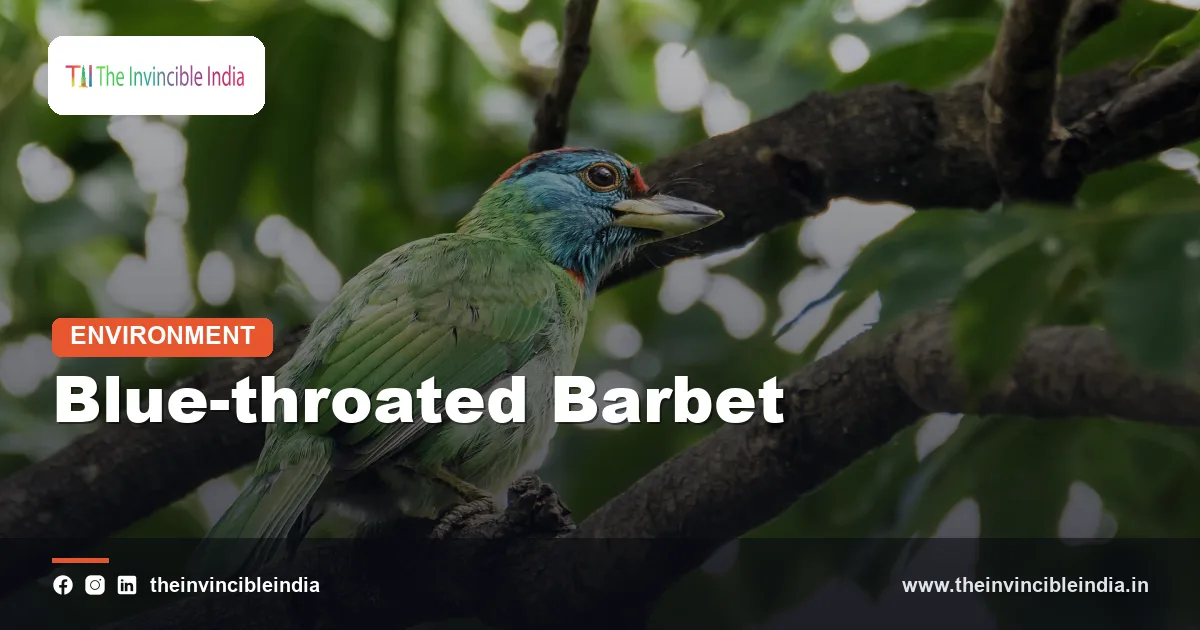
The blue-throated barbet (Psilopogon asiaticus) is a medium-sized, grass-green Asian barbet with a bright blue face and throat, found in the Himalayan foothills and the forests of northeast India. It is best known for its loud, monotonous, ringing call, which carries through hill woods and gardens long before the bird itself is spotted high in a fruiting tree. This guide explains how the blue-throated barbet looks, where it lives, what it eats, how it nests and why it matters to Indian forests.
Although the blue-throated barbet is brilliantly coloured, it is surprisingly hard to see, because its green body blends perfectly with leaves. Most people first meet the species through sound, and learning that call is the quickest way to find the bird.
| Common name | Blue-throated barbet |
|---|---|
| Scientific name | Psilopogon asiaticus (formerly Megalaima asiatica) |
| Family | Megalaimidae (Asian barbets), order Piciformes |
| Size | About 23 cm long; a stout, short-tailed bird |
| Range in India | Himalayan foothills from Himachal Pradesh and Uttarakhand eastwards through the Himalayan belt and the northeast hills |
| Habitat | Broadleaved forest, forest edges, fruiting groves, orchards and large gardens, from the foothills to mid-hill elevations |
| Diet | Mainly fruit, especially figs and berries, plus insects and occasional nectar |
| Breeding | Nests in a hole the pair excavates in a dead or soft tree trunk; eggs are white |
| Conservation status | Least Concern on the IUCN Red List |
Key Takeaways
- The blue-throated barbet is a green barbet with a blue head and throat that lives in the Himalayan foothills and the hills of northeast India.
- The blue-throated barbet feeds mostly on fruit, particularly wild figs, and acts as an important seed disperser for forest trees.
- The blue-throated barbet digs its own nest cavity in dead wood, and the same hole may later be used by other birds and small animals.
- The loud, repetitive call of the blue-throated barbet is usually the first sign of its presence, because its green plumage hides it among leaves.
- The male and female blue-throated barbet look alike, so the sexes cannot be told apart by colour in the field.
- The IUCN lists the blue-throated barbet as a species of Least Concern, though loss of old fruiting trees and dead standing timber can reduce local numbers.
What does the blue-throated barbet look like?
The blue-throated barbet looks like a plump, bright green bird with a pale blue face, chin and throat, a heavy pale bill and a very short tail. It is roughly the size of a myna, about 23 centimetres from bill tip to tail tip, though its chunky build makes it seem more compact than a myna.
The body is a rich leaf green above and a slightly paler, yellower green below. The blue of the head is the standout feature, and it is bordered by small patches of red and black on the crown and neck. The bill is thick, strong and slightly curved, with a pale colour that stands out against the head. At the base of the bill sit stiff bristles that give barbets their name, as they look like a beard.
Young blue-throated barbets are duller than adults. Their blue is paler and the red and black head markings are less clear, so a young bird can look like an almost plain green barbet at first glance.
Why is the blue-throated barbet so hard to see?
The blue-throated barbet is hard to see because green plumage, a habit of sitting still for long periods and a preference for the upper canopy keep it concealed. The bird often perches motionless on a bare branch inside a leafy tree while calling. A glimpse of blue is often the only giveaway.
Other body features
- Feet: two toes point forward and two backward, an arrangement called zygodactyl that helps barbets grip and climb trunks, as woodpeckers do.
- Bill: strong, with a slightly serrated cutting edge suited to tearing fruit and excavating wood.
- Tail: short and square, so the bird appears to be all head and body in profile.
- Flight: direct, rather heavy and often undulating, usually over short distances from tree to tree.
Where is the blue-throated barbet found in India?
The blue-throated barbet is found along the Himalayan foothills from Himachal Pradesh and Uttarakhand eastwards through Uttar Pradesh terai, Bihar, Sikkim, West Bengal and the whole northeast, including Assam, Arunachal Pradesh, Meghalaya, Nagaland, Manipur, Mizoram and Tripura. Beyond India, the species extends through Nepal, Bhutan and Bangladesh into Myanmar and parts of Southeast Asia and southern China.
It is a resident bird, meaning it stays in the same region through the year rather than making long migrations. Some birds do shift to slightly lower elevations in colder months, following fruiting trees, but the movement is local.
Which habitats does the blue-throated barbet prefer?
The blue-throated barbet prefers broadleaved forest and its edges, along with mature groves, plantations, orchards and well-wooded gardens. It is especially common in the lower hills, where tall fig and other fruiting trees stand near patches of dead timber. It is rarely found in dry, open scrub or the treeless plains.
The bird tolerates a degree of human presence. In hill towns across the Himalayan foothills it often visits large trees in compounds, temple groves and tea gardens, provided old trees remain.
What does the blue-throated barbet eat?
The blue-throated barbet eats mainly fruit, with wild figs, banyan and peepal figs, and a variety of small berries forming the bulk of its diet. It supplements this with insects, and it will sometimes take flower nectar or petals.
Fig trees are central to its life. Because many fig species fruit at different times, a single area can offer ripe figs across much of the year, and the barbet stays close to them. The bird swallows fruit whole or in large pieces, digests the pulp and passes the seeds, often far from the parent tree.
- Fruit: wild figs, banyan and peepal fruits, mulberries and other soft berries.
- Insects: beetles, caterpillars, termites and other small invertebrates, which are important when feeding chicks.
- Other items: occasional flower nectar and buds.
Adults feed their young a more insect-rich diet than their own, since growing chicks need protein. This is typical of fruit-eating birds, which turn to insects during the breeding season.
Why is the blue-throated barbet call so loud?
The blue-throated barbet call is so loud because the bird uses it to mark territory and keep in touch with its mate across dense, leafy forest where sight lines are short. The call is a ringing, repeated note delivered at a steady, almost metronomic pace, and it can go on for minutes without a pause.
A calling bird usually sits on a high, fairly open branch, tilts its head slightly and throws the sound out with a visible throat movement. In many hill areas it is the dominant sound of a spring morning. The calling is strongest in the breeding season but can be heard for much of the year.
Several Indian barbets have similarly repetitive calls, and listeners often confuse them. The blue-throated barbet call is usually slower, deeper and more resonant than the sharp metallic note of the coppersmith barbet, a smaller bird of the plains. Learning to tell the two apart by ear is a useful beginner skill.
How does the blue-throated barbet breed and nest?
The blue-throated barbet breeds by excavating a nest hole in a dead or rotten tree trunk or branch, laying a few white eggs inside and raising the chicks with both parents sharing the work. Breeding is generally in the warmer months, from spring into early summer, though exact timing varies with altitude and local weather.
Both sexes take part in digging the cavity, using the strong bill to chip away softened wood. The entrance is a neat round opening, and the chamber below is bare, with eggs laid on a small bed of wood chips. A clutch is small, commonly two to four eggs, and the eggs are white, as is usual for hole-nesting birds.
Incubation takes roughly two weeks, and the parents take turns on the eggs. After hatching, the chicks are fed fruit and insects at intervals and stay in the hole for several weeks before they leave the nest. Even after fledging, young birds may be fed by the parents for a short while.
Why do dead trees matter for the blue-throated barbet?
Dead standing trees matter for the blue-throated barbet because the bird can only nest where wood is soft enough to excavate. Foresters and gardeners who remove every dead branch remove the nest sites of barbets, woodpeckers and other cavity nesters. Leaving safe dead limbs in place is one of the simplest ways to help them.
How can the blue-throated barbet be told apart from other Indian barbets?
The blue-throated barbet can be told apart from other Indian barbets mainly by its blue face and throat, its larger size and its slow, deep call. India has several barbets that share the green plumage, so comparing head colour is the quickest method.
| Barbet | Approximate size | Key identification point | Typical range in India |
|---|---|---|---|
| Blue-throated barbet | About 23 cm | Blue face and throat, heavy pale bill | Himalayan foothills and northeast |
| Brown-headed barbet | About 27 cm | Brownish streaked head and neck, orange bill and legs | Widely across the plains and peninsula |
| Coppersmith barbet | About 17 cm | Crimson forehead and chest patch, yellow face patches | Across most of India, including towns |
| Lineated barbet | About 28 cm | Streaked head and breast, pale yellow bill | Foothills and eastern regions |
| White-cheeked barbet | About 23 cm | Pale cheek patch, dark streaked head | Western Ghats and south India |
In the northeast, the range of the blue-throated barbet overlaps with other forest barbets, and several species may call from the same hillside. Looking for the blue face and listening for the call pattern together gives the most reliable identification.
What role does the blue-throated barbet play in the forest?
The blue-throated barbet plays two main roles in the forest: it spreads the seeds of fruiting trees, and it creates nest cavities that other animals later use. These are both ecological services that support the wider forest community.
As a fruit eater, the barbet carries seeds away in its gut and drops them at new places, helping figs and other trees to colonise gaps and slopes. Figs are called a keystone resource in tropical forests because so many birds, bats and mammals depend on them, and fig-eating birds such as the blue-throated barbet are part of that web.
When the barbet abandons a nest hole, other species may move in. Small owls, starlings, mynas, tits and even squirrels, bats and insects may use old barbet holes in later seasons. In this way a single pair of barbets can create housing for a whole group of wildlife.
Is the blue-throated barbet threatened?
The blue-throated barbet is not considered threatened; the IUCN rates it as Least Concern because it is widespread, fairly common and tolerant of altered habitats. In India it continues to be a regular bird in many foothill and northeastern forests and hill gardens.
Local pressures still exist. Clearing of old fruiting trees, felling of dead timber, conversion of forest to monoculture plantation and heavy use of pesticides can reduce food and nest sites. Most native wild birds in India are also legally protected under the Wildlife (Protection) Act, 1972, which prohibits capture and trade.
How can you watch blue-throated barbets?
The best way to watch a blue-throated barbet is to listen for its call at dawn, find a fruiting fig tree nearby and wait quietly with binoculars. The bird is most active in the early morning and late afternoon, when it feeds and calls.
- Follow the sound: trace the call to a tall tree and scan bare or semi-bare upper branches.
- Visit fruiting trees: a ripe fig tree attracts barbets, bulbuls, mynas and many other birds.
- Use the light: morning sun on the bird brings out the blue; midday glare flattens the colours.
- Stay still: barbets are wary of sudden movement but tolerate a quiet observer.
- Check dead limbs: nest holes in snags often reveal where a pair is breeding, which should be watched from a respectful distance.
Good areas for the species include forest edges, tea estates and wooded parks in the Himalayan foothills and the northeast. Photographers should avoid disturbing active nests, since the parents may abandon a hole if flushed repeatedly.
Bottom Line
The blue-throated barbet is a green, blue-faced fruit eater of the Himalayan foothills and northeast India, easier to hear than to see. It disperses seeds, creates nest holes for other creatures and remains a secure species where old trees and dead wood are left standing.
Frequently Asked Questions
What is a blue-throated barbet?
A blue-throated barbet is a green Asian barbet with a blue face and throat, found in the Himalayan foothills and northeast India. It is about 23 cm long and eats mainly fruit. It is known for its loud, repeated call.
Where does the blue-throated barbet live in India?
The blue-throated barbet lives in the Himalayan foothills from Himachal Pradesh and Uttarakhand eastwards, and across the hill states of the northeast. It prefers broadleaved forest, orchards and wooded gardens. It is a resident bird that does not migrate long distances.
What does the blue-throated barbet eat?
The blue-throated barbet eats mostly fruit, especially wild figs, banyan and peepal fruits and berries. It also takes insects, which are important for feeding chicks. Occasionally it feeds on flower nectar.
How does the blue-throated barbet nest?
The blue-throated barbet nests in a hole that the pair chisels into a dead or soft tree trunk or branch. The female lays a small clutch of white eggs, typically two to four. Both parents incubate the eggs and feed the chicks.
How can I tell a blue-throated barbet from a coppersmith barbet?
A blue-throated barbet is larger and has a blue face and throat, while a coppersmith barbet is small with a crimson forehead and chest patch. Their calls also differ, with the blue-throated barbet giving a slower, deeper note than the sharp metallic tuk of the coppersmith. The coppersmith also lives in towns across much of India.
Is the blue-throated barbet endangered?
No, the blue-throated barbet is not endangered; the IUCN lists it as Least Concern. It remains common across much of its range. Loss of old fruiting trees and dead standing timber can still affect local populations.
{“@context”:”https://schema.org”,”@graph”:[{“@type”:”FAQPage”,”mainEntity”:[{“@type”:”Question”,”name”:”What is a blue-throated barbet?”,”acceptedAnswer”:{“@type”:”Answer”,”text”:”A blue-throated barbet is a green Asian barbet with a blue face and throat, found in the Himalayan foothills and northeast India. It is about 23 cm long and eats mainly fruit. It is known for its loud, repeated call.”}},{“@type”:”Question”,”name”:”Where does the blue-throated barbet live in India?”,”acceptedAnswer”:{“@type”:”Answer”,”text”:”The blue-throated barbet lives in the Himalayan foothills from Himachal Pradesh and Uttarakhand eastwards, and across the hill states of the northeast. It prefers broadleaved forest, orchards and wooded gardens. It is a resident bird that does not migrate long distances.”}},{“@type”:”Question”,”name”:”What does the blue-throated barbet eat?”,”acceptedAnswer”:{“@type”:”Answer”,”text”:”The blue-throated barbet eats mostly fruit, especially wild figs, banyan and peepal fruits and berries. It also takes insects, which are important for feeding chicks. Occasionally it feeds on flower nectar.”}},{“@type”:”Question”,”name”:”How does the blue-throated barbet nest?”,”acceptedAnswer”:{“@type”:”Answer”,”text”:”The blue-throated barbet nests in a hole that the pair chisels into a dead or soft tree trunk or branch. The female lays a small clutch of white eggs, typically two to four. Both parents incubate the eggs and feed the chicks.”}},{“@type”:”Question”,”name”:”How can I tell a blue-throated barbet from a coppersmith barbet?”,”acceptedAnswer”:{“@type”:”Answer”,”text”:”A blue-throated barbet is larger and has a blue face and throat, while a coppersmith barbet is small with a crimson forehead and chest patch. Their calls also differ, with the blue-throated barbet giving a slower, deeper note than the sharp metallic tuk of the coppersmith. The coppersmith also lives in towns across much of India.”}},{“@type”:”Question”,”name”:”Is the blue-throated barbet endangered?”,”acceptedAnswer”:{“@type”:”Answer”,”text”:”No, the blue-throated barbet is not endangered; the IUCN lists it as Least Concern. It remains common across much of its range. Loss of old fruiting trees and dead standing timber can still affect local populations.”}}]}]}


