

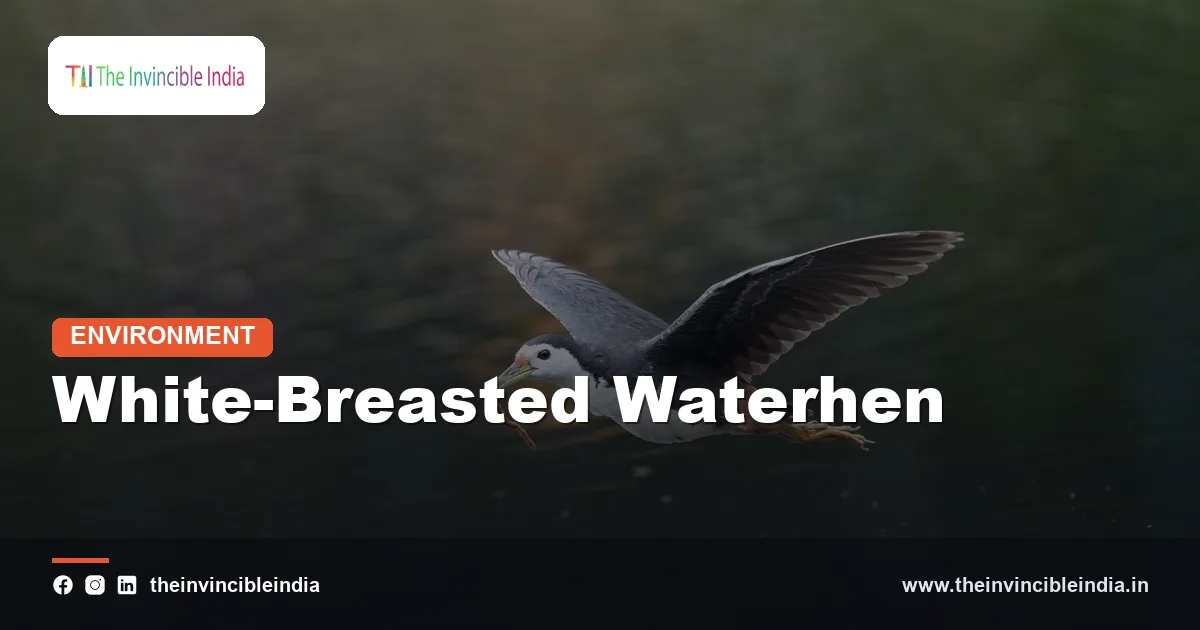
The white-breasted waterhen (Amaurornis phoenicurus) is a common South and Southeast Asian wetland bird of the rail family, recognisable by its slaty-grey back, white face and breast, rufous-chestnut rear and a habit of constantly flicking its short, upturned tail. The white-breasted waterhen lives in reedy marshes, ponds, paddy fields and even garden ditches across India, where it is often seen walking boldly in the open at dawn and dusk but slips into cover at any alarm.
The white-breasted waterhen is also one of the loudest birds of the Indian monsoon, producing a long, repetitive series of croaks and grunts that surprises many people hearing it for the first time. This explainer covers the bird’s identification, voice, diet, habitat, nesting, behaviour and its place in India’s wetlands.
Quick Facts About the White-Breasted Waterhen
| Attribute | Detail |
|---|---|
| Common name | White-breasted waterhen |
| Scientific name | Amaurornis phoenicurus |
| Family | Rallidae (rails, crakes, gallinules and coots) |
| Size | About 32 cm long, roughly the size of a small domestic hen |
| Key features | Slaty-grey upperparts, white face and breast, rufous undertail and belly, yellow-green bill with a red base, yellow legs |
| Behaviour | Walks with a jerky gait, flicks its tail up and down, and runs rather than flies when disturbed |
| Voice | Loud, repetitive “kruak-kruak-kroak” croaks, especially in the monsoon and at night |
| Habitat | Marshes, reedbeds, ponds, paddy fields, canal banks and well-vegetated garden drains |
| Conservation | Assessed as Least Concern by the IUCN |
Key Takeaways
- The white-breasted waterhen (Amaurornis phoenicurus) is a member of the rail family, Rallidae, and is one of the most widespread rails of the Indian subcontinent.
- The white-breasted waterhen has a white face and breast, slaty-grey upperparts and a rufous patch beneath the tail, which together make it easy to identify.
- The white-breasted waterhen constantly flicks its short tail up and down while walking, a behaviour often visible from a distance.
- The white-breasted waterhen produces loud, repeated croaking calls that peak in the monsoon breeding season, often continuing into the night.
- The white-breasted waterhen eats insects, snails, worms, seeds and plant matter, foraging at the edges of water and in dense marsh vegetation.
- The white-breasted waterhen builds a cup-shaped nest of reeds and grass, often in a bush or dense vegetation near water, and its black chicks leave the nest soon after hatching.
What Is the White-Breasted Waterhen?
The white-breasted waterhen is a medium-sized wetland bird in the rail family, Rallidae, with the scientific name Amaurornis phoenicurus. Rails are mostly secretive, ground-dwelling water birds with strong legs, long toes and a laterally flattened body that helps them slip through dense reeds.
The name “waterhen” refers to its hen-like shape and its association with water, though the bird is not related to domestic fowl. In India it is commonly called “dauk” or “dahuk” in several northern languages, a name echoing its call. Related Indian rails include the purple swamphen, the common moorhen, the Eurasian coot and several crakes.
The white-breasted waterhen is among the easiest rails to see because it frequently ventures into the open. This boldness separates it from many of its cousins, which spend almost all of their lives hidden in vegetation.
How Do You Identify a White-Breasted Waterhen?
A white-breasted waterhen is identified by its slate-grey crown, back and wings, its clean white face, throat, breast and upper belly, and its chestnut-rufous lower belly and undertail. The bill is yellow-green with a red patch at the base, and the legs and long toes are yellow-green.
The short tail is usually held cocked and flicked, which exposes the rufous undertail and makes the bird noticeable. Males and females look similar, and juveniles are duller, browner and lack the clean white face. Seen from a distance, the bird gives a distinct two-tone impression of dark above and white below.
How is it different from similar birds?
The white-breasted waterhen can be distinguished from the common moorhen by its white face and breast, as the moorhen is dark slate with a red frontal shield and white flanks. It also lacks the blue body and heavy red bill of the purple swamphen. The ruddy-breasted crake is smaller and reddish, while the white-breasted waterhen has a large body and long legs.
What Does the White-Breasted Waterhen Sound Like?
The white-breasted waterhen has a loud, harsh, repetitive call, usually written “kruak-kruak-kruak-kroak”, that can continue for minutes at a time. The calls are produced mainly in the breeding season, especially during the monsoon, and they carry a long distance across ponds and marshes.
The calling is frequently done at dawn, dusk and at night, and it may involve two birds answering one another. Some listeners describe it as a series of croaks, grunts and bubbling notes. The volume is out of proportion to the bird’s size, which is why many urban residents notice the call without ever seeing the caller.
Outside the breeding season, the bird is quieter, giving only occasional sharp notes when alarmed. The tail-flick and the call together make the white-breasted waterhen one of the most easily recognised rails for anyone who spends time near water in India.
Where Does the White-Breasted Waterhen Live?
The white-breasted waterhen lives in freshwater marshes, reedbeds, ponds, paddy fields, irrigation canals, mangrove edges and densely vegetated ditches across India and most of South and Southeast Asia. It needs cover for shelter and nesting, and nearby open mud or shallow water for foraging.
The bird has adapted well to human-modified landscapes. It is often found in city parks with ponds, along railway-side drains, in village tanks and even in overgrown gardens with a water source. It is mostly resident in India, with local movements related to rainfall and water availability.
| Habitat type | How the white-breasted waterhen uses it |
|---|---|
| Reedbeds and marshes | Shelter, nesting and foraging among dense vegetation |
| Paddy fields | Foraging for insects, snails and grain, especially in the monsoon |
| Ponds and village tanks | Feeding along muddy edges and in floating vegetation |
| Garden ditches and drains | Cover and food in urban and suburban settings |
| Mangrove edges | Foraging on mud and in tidal channels in coastal areas |
What Does the White-Breasted Waterhen Eat?
The white-breasted waterhen is omnivorous and eats insects, snails, worms, small crustaceans, tadpoles, seeds, grain and soft plant matter. It forages by walking slowly at the edge of water or on floating vegetation, picking food from the mud, leaves and surface.
Insects such as beetles, grasshoppers and aquatic larvae make up a large part of the diet, along with molluscs and earthworms. The bird also eats rice and other seeds, and it can sometimes be seen in paddy fields where it takes both pests and grain. Its long toes spread its weight, allowing it to walk on floating plants such as water hyacinth and lotus leaves without sinking.
- Animal food: insects, snails, worms, small crustaceans, tadpoles
- Plant food: seeds, grain, shoots and soft vegetation
- Feeding style: walking and probing at the water’s edge, often at dawn and dusk
- Feeding aids: long toes that allow movement over floating plants
How Does the White-Breasted Waterhen Breed?
The white-breasted waterhen breeds mainly during the monsoon, building a cup-shaped nest of reeds, grass and leaves in dense vegetation, a bush or a low tree near water. The nest is typically a few feet above water or ground and is sometimes hidden among reeds or even in garden hedges.
The female lays several eggs, commonly around six, which are cream or pinkish with reddish-brown blotches. Both parents are involved in incubation and caring for the chicks. The chicks are covered in black down and are able to walk and swim soon after hatching, leaving the nest to follow their parents. They are fed on insects and small animals at first and later forage independently.
Because breeding coincides with the rains, loud calling, courtship chases and territorial disputes are all frequent during this period. The timing varies across India, depending on when the monsoon arrives in each region.
Why Does the White-Breasted Waterhen Flick Its Tail?
The white-breasted waterhen flicks its tail up and down as it walks, a habit that is common among rails and is thought to serve as communication and alertness signalling. The flick exposes the rufous undertail, which contrasts with the white underparts, and may signal alarm to other birds, though the exact function is not fully settled.
Researchers have proposed several explanations for tail-flicking in rails and other wetland birds, including startling hidden prey, signalling to a mate, coordinating movement within a family group and warning predators that they have been seen. The white-breasted waterhen performs the behaviour almost constantly, and so the flicking is an excellent clue for identification at a distance.
Is the White-Breasted Waterhen Shy or Bold?
The white-breasted waterhen is both shy and bold, depending on the situation. It often feeds in the open near reedy cover during quiet hours but dashes quickly into vegetation when disturbed. It prefers to run than to fly, and when it does fly, it does so awkwardly, with dangling legs, for a short distance.
This skulking behaviour means that a bird heard in a thicket may be impossible to see. In cities where people leave it undisturbed, individuals become remarkably tame and may forage on lawns near ponds. Patience, a quiet approach and early morning visits improve the chances of good views.
Is the White-Breasted Waterhen Threatened?
No, the white-breasted waterhen is assessed as Least Concern by the International Union for Conservation of Nature (IUCN), because it has a very wide range and adapts to modified habitats. It is one of the more numerous rails in India, although exact population figures are not known.
Local threats include draining and filling of wetlands, pollution of ponds, clearing of reedbeds and disturbance at nests. Like other native wild birds, it is protected by the Wildlife (Protection) Act, 1972. Conserving small village ponds, urban lakes and paddy-field margins helps maintain this species, along with many other wetland animals that share the same habitat.
How Can You See a White-Breasted Waterhen?
The best way to see a white-breasted waterhen is to visit a pond, marsh or paddy field early in the morning or just before dusk and watch the edge of the vegetation for a dark-and-white bird flicking its tail. Quietness is more useful than equipment, as the bird retreats at sudden movements.
- Look near reed edges, floating vegetation and muddy banks.
- Listen for repetitive croaking during the monsoon, especially at dusk.
- Use binoculars from a distance to avoid flushing birds.
- Avoid approaching nests, which are often close to paths and water.
- Record sightings on citizen-science platforms to contribute to wetland monitoring.
Bottom Line
The white-breasted waterhen is a common, adaptable Indian rail, known for its white face and breast, flicking tail and monsoon croaking. It lives wherever there is reed cover near water, from large marshes to small garden ditches, and its steady presence is a simple sign that a local wetland is still working.
Frequently Asked Questions
What is a white-breasted waterhen?
The white-breasted waterhen is a medium-sized wetland bird, Amaurornis phoenicurus, belonging to the rail family. It has slaty-grey upperparts, a white face and breast, and a rufous undertail. It is common across India and much of South and Southeast Asia.
Why does the white-breasted waterhen make so much noise?
The white-breasted waterhen calls loudly mainly to defend territory and attract mates during the breeding season. The repetitive croaks are most frequent in the monsoon and often continue at night. Outside the breeding season, the bird is much quieter.
Where can I find white-breasted waterhens in India?
White-breasted waterhens can be found in marshes, ponds, paddy fields, canals and garden ditches across most of India. They prefer places with dense vegetation beside shallow water. City parks and village tanks with reeds are good places to look at dawn or dusk.
What does the white-breasted waterhen eat?
The white-breasted waterhen eats insects, snails, worms, small crustaceans, tadpoles, seeds and plant matter. It forages by walking along water edges and over floating plants. It is omnivorous, so its diet changes with the season and local food supply.
Why does the white-breasted waterhen flick its tail?
The white-breasted waterhen flicks its tail as part of its normal walking behaviour, and the movement probably serves as a signal. It may warn other birds, communicate with mates or startle prey, though the exact reason is debated. The flick also exposes the bird’s rufous undertail.
Is the white-breasted waterhen a protected bird?
Yes, the white-breasted waterhen is protected in India as a native wild bird under the Wildlife (Protection) Act, 1972. The IUCN rates it as Least Concern globally because it is widespread. Even so, wetland loss and pollution can reduce local populations.
{“@context”:”https://schema.org”,”@graph”:[{“@type”:”FAQPage”,”mainEntity”:[{“@type”:”Question”,”name”:”What is a white-breasted waterhen?”,”acceptedAnswer”:{“@type”:”Answer”,”text”:”The white-breasted waterhen is a medium-sized wetland bird, Amaurornis phoenicurus, belonging to the rail family. It has slaty-grey upperparts, a white face and breast, and a rufous undertail. It is common across India and much of South and Southeast Asia.”}},{“@type”:”Question”,”name”:”Why does the white-breasted waterhen make so much noise?”,”acceptedAnswer”:{“@type”:”Answer”,”text”:”The white-breasted waterhen calls loudly mainly to defend territory and attract mates during the breeding season. The repetitive croaks are most frequent in the monsoon and often continue at night. Outside the breeding season, the bird is much quieter.”}},{“@type”:”Question”,”name”:”Where can I find white-breasted waterhens in India?”,”acceptedAnswer”:{“@type”:”Answer”,”text”:”White-breasted waterhens can be found in marshes, ponds, paddy fields, canals and garden ditches across most of India. They prefer places with dense vegetation beside shallow water. City parks and village tanks with reeds are good places to look at dawn or dusk.”}},{“@type”:”Question”,”name”:”What does the white-breasted waterhen eat?”,”acceptedAnswer”:{“@type”:”Answer”,”text”:”The white-breasted waterhen eats insects, snails, worms, small crustaceans, tadpoles, seeds and plant matter. It forages by walking along water edges and over floating plants. It is omnivorous, so its diet changes with the season and local food supply.”}},{“@type”:”Question”,”name”:”Why does the white-breasted waterhen flick its tail?”,”acceptedAnswer”:{“@type”:”Answer”,”text”:”The white-breasted waterhen flicks its tail as part of its normal walking behaviour, and the movement probably serves as a signal. It may warn other birds, communicate with mates or startle prey, though the exact reason is debated. The flick also exposes the bird’s rufous undertail.”}},{“@type”:”Question”,”name”:”Is the white-breasted waterhen a protected bird?”,”acceptedAnswer”:{“@type”:”Answer”,”text”:”Yes, the white-breasted waterhen is protected in India as a native wild bird under the Wildlife (Protection) Act, 1972. The IUCN rates it as Least Concern globally because it is widespread. Even so, wetland loss and pollution can reduce local populations.”}}]}]}


