

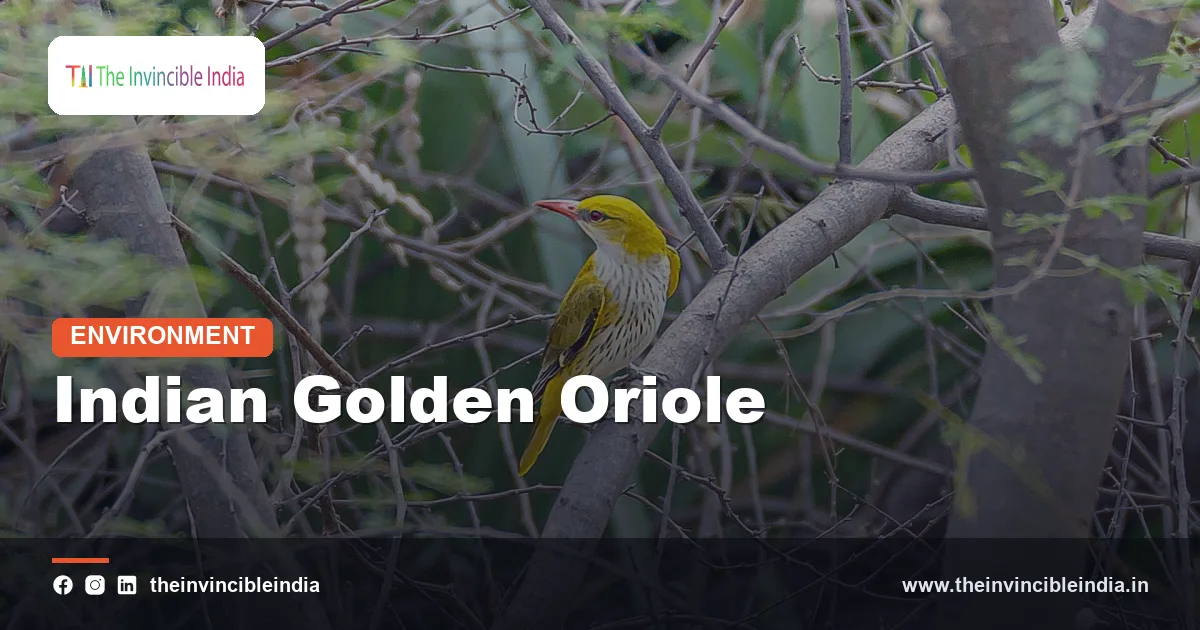
The Indian golden oriole (Oriolus kundoo) is a brilliant yellow-and-black songbird of the Indian subcontinent, easily recognised by its golden plumage, black wings, black eye-stripe that continues behind the eye, and a rich, fluty whistle. The Indian golden oriole lives mostly in the leafy canopy of woodlands, orchards and tree-lined avenues, where it eats fruit and insects and weaves a neat cup-shaped nest that hangs from a forked branch.
The Indian golden oriole was long treated as a race of the Eurasian golden oriole but is now widely recognised as a separate species. This explainer covers how to identify the bird, its calls, diet, nesting habits, movements, the split from its European relative, and how to see it in India.
Quick Facts About the Indian Golden Oriole
| Attribute | Detail |
|---|---|
| Common name | Indian golden oriole |
| Scientific name | Oriolus kundoo |
| Family | Oriolidae (the Old World orioles) |
| Size | About 25 cm long, a little larger than a bulbul |
| Male plumage | Bright golden-yellow body with black wings and tail, a black stripe through and behind the eye, and a pinkish-red bill |
| Female plumage | Duller, with greenish-yellow upperparts and faintly streaked underparts |
| Call | A loud, liquid, fluty whistle, often written “pee-lo” or “kwayo”, plus harsh cat-like notes |
| Habitat | Open woodland, mango and other orchards, gardens, groves and tree-lined roads |
| Conservation | Assessed as Least Concern by the IUCN |
Key Takeaways
- The Indian golden oriole (Oriolus kundoo) is a yellow-and-black songbird of the family Oriolidae found across the Indian subcontinent.
- The male Indian golden oriole has a black eye-stripe that extends behind the eye, a feature used to separate it from the Eurasian golden oriole.
- The Indian golden oriole feeds on fruit such as figs and berries and also on insects, caterpillars and sometimes nectar.
- The Indian golden oriole weaves a hanging cup nest, slung between the arms of a horizontal fork high in a tree.
- The Indian golden oriole was long treated as a subspecies of the Eurasian golden oriole (Oriolus oriolus) but is now commonly treated as a distinct species.
- The Indian golden oriole is often heard long before it is seen, because its bright plumage blends into sunlit leaves.
What Is the Indian Golden Oriole?
The Indian golden oriole is a medium-sized, arboreal songbird in the family Oriolidae, with the scientific name Oriolus kundoo. The name “kundoo” was given by the British naturalist William Henry Sykes in the 1830s, apparently from a local name, and the bird is known in Hindi as “peelak” or “pilak”, which reflects its yellow colour.
The Old World orioles are a small family of about thirty species spread across Africa, Asia, Europe and Australasia. They are unrelated to the New World orioles of the Americas, which belong to a different family, the icterids, and only share a name because of similar colours. The Indian golden oriole is one of several orioles in India, alongside the black-naped, black-hooded and maroon orioles.
Though the bird is vividly coloured, it is surprisingly hard to spot. Golden-yellow plumage dissolves into dappled light among leaves, so even experienced birdwatchers often hear an oriole well before they find it.
How Do You Identify an Indian Golden Oriole?
An adult male Indian golden oriole is identified by its golden-yellow head and body, black wings with a yellow patch, a black tail with yellow edges, a pinkish-red bill and a bold black stripe that runs through the eye and extends behind it. The black stripe linking the eye to the nape is the most reliable field mark in the male.
The female is greener above and paler, whitish-yellow below, with soft streaking on the breast and a less distinct eye-stripe. Young birds are similar to the female but more streaked, and they gain the bright yellow of adulthood over time. In all plumages, the bill is reddish or pinkish, which helps separate orioles from similar yellow birds.
What does the eye-stripe tell you?
The extent of the black stripe is the main way to tell the Indian golden oriole from the Eurasian golden oriole. In the Indian golden oriole the black stripe extends behind the eye and may join around the nape, while in the Eurasian golden oriole it generally stops at the eye. The pattern of black on the wing also differs somewhat, though lighting and angle can complicate things.
What Does the Indian Golden Oriole Sound Like?
The Indian golden oriole has a loud, rich, flute-like whistle, often written “pee-lo” or “kwayo”, which carries a long way through the tree canopy. The song is a short, liquid phrase repeated at intervals, and it is one of the most pleasing sounds in Indian woodland in spring and early summer.
The bird also gives harsh, nasal, cat-like calls, particularly when it is alarmed or in disputes with other orioles. These grating notes can surprise newcomers, who expect only melody from such a bright bird. Males sing most during the breeding season, and calling is strongest in the early morning.
Because the song is so distinctive, many birders use sound to locate an oriole, then scan the upper branches for movement. The bird often moves from tree to tree in an undulating, swooping flight, giving flashes of yellow.
What Does the Indian Golden Oriole Eat?
The Indian golden oriole eats a mix of fruit and insects, including figs, berries, mulberries and other soft fruits, along with caterpillars, beetles, grasshoppers and other invertebrates. It also takes nectar from flowers on occasion, particularly from flowering trees such as silk-cotton and coral trees.
Fruit becomes more important in the non-breeding season, while insects and caterpillars are especially important when feeding chicks. By eating fruit and moving between trees, the Indian golden oriole helps to disperse seeds across orchards and woodlands. It also eats many caterpillars that may damage leaves, so it is often regarded as a useful bird around gardens.
- Fruit: figs, mulberries, berries and other soft fruit
- Insects: caterpillars, beetles, grasshoppers and other invertebrates
- Nectar: taken from some flowering trees
- Foraging style: mostly in the upper and middle canopy, gleaning from leaves and branches
Where Does the Indian Golden Oriole Live?
The Indian golden oriole lives in open deciduous woodland, mango groves, orchards, gardens and tree-lined roads across much of India, Pakistan, Nepal and neighbouring countries. It prefers areas with tall, leafy trees and avoids dense, dark forest and treeless country.
Its range extends from the foothills of the Himalaya through the plains to the peninsula, and in the north-west it reaches Central Asia. Many birds are resident or move locally, while others are migratory, breeding in the north and moving south or to lower elevations in winter. The movement pattern differs between regions, and in some areas the species is seen mainly in particular seasons.
Urban parks and large campuses with mature trees can host golden orioles, particularly where fruiting trees are present. Hearing the whistle in a city park in April or May is often the first sign that an oriole is nearby.
How Does the Indian Golden Oriole Build Its Nest?
The Indian golden oriole builds a neat, deep cup-shaped nest that hangs from a horizontal fork of a branch, usually high in a tree. The nest is woven from grass, bark strips, plant fibres and thin rootlets, and it is often bound with spider silk and decorated with lichen, feathers or bits of paper.
The female does most of the building, and the cup is slung between the two arms of the fork like a small hammock. A typical clutch is two to three eggs, which are white with dark spots. Both parents feed the chicks, mostly on caterpillars and other insects. Breeding generally takes place in the hot season before and around the early monsoon, though timing varies across the range.
| Nesting feature | Typical pattern |
|---|---|
| Nest shape | Deep cup slung between the arms of a horizontal fork |
| Materials | Grass, bark strips, plant fibre, rootlets, spider silk |
| Nest height | Often several metres above the ground, in a leafy tree |
| Clutch | Commonly two to three eggs |
| Breeding season | Mostly spring and early summer, varying by region |
Is the Indian Golden Oriole Different From the Eurasian Golden Oriole?
Yes, the Indian golden oriole is now widely treated as a separate species from the Eurasian golden oriole (Oriolus oriolus), although it was once considered a subspecies. The two are very similar in overall appearance, but the Indian bird has a longer black stripe behind the eye, and the two differ in genetics, voice and breeding range.
The Eurasian golden oriole breeds across Europe and western Asia and winters mostly in Africa. The Indian golden oriole breeds in South Asia and parts of Central Asia and is not a long-distance migrant to Africa. Taxonomists have increasingly separated the two, though some older books and websites still list them together, which can cause confusion in checklists.
Why does the split matter?
The split matters because it changes species counts and conservation assessments. Treating the Indian golden oriole as its own species acknowledges that South Asian populations have evolved separately. Birders keeping life lists also need to know which name is used by their checklist, since the same bird may be recorded under either name.
Which Other Orioles Are Found in India?
India has several orioles, and the Indian golden oriole is one of the most widespread. The black-hooded oriole (Oriolus xanthornus) has a black head and bib with golden-yellow underparts, and it is common across the peninsula and the plains. The black-naped oriole has a black band on the nape, and the maroon oriole is a deep reddish bird of hill forests.
- Indian golden oriole: all-yellow head, black eye-stripe, black wings with yellow patch
- Black-hooded oriole: black head and throat, yellow body
- Black-naped oriole: yellow head with a black band across the nape
- Maroon oriole: deep maroon body with a black head, found in forests and hills
Telling these apart is easiest by looking at the head pattern, then at the bill colour and wing markings. In poor light all orioles can look like dark silhouettes, so voice is a helpful guide too.
Is the Indian Golden Oriole Threatened?
No, the Indian golden oriole is assessed as Least Concern by the International Union for Conservation of Nature (IUCN), because it has a wide range and is relatively common in suitable habitat. Local populations can still be affected by tree felling, loss of old orchards, pesticide use and the cage-bird trade.
Orioles are protected as native wild birds under the Wildlife (Protection) Act, 1972, which prohibits capturing or killing them. Planting native fruiting trees such as figs, mulberry and neem, and retaining mature trees in cities, helps support them. As with most common birds, exact population numbers are not known and trends can differ by region.
How Can You See an Indian Golden Oriole?
The best way to see an Indian golden oriole is to listen for its fluty whistle in a leafy tree or orchard early in the morning, then scan the upper canopy for a flash of yellow. Spring and early summer are the best seasons, because males are singing and the leaves have not yet become too dense.
- Visit mango groves, large parks and wooded campuses at dawn.
- Look for fruiting trees, especially figs, which attract orioles.
- Scan for undulating flight between treetops.
- Keep a respectful distance from nests, which are easy to disturb.
- Record sightings on a citizen-science platform to help track seasonal movements.
Bottom Line
The Indian golden oriole (Oriolus kundoo) is a bright, flute-voiced canopy bird that eats fruit and insects and weaves a hanging cup nest in tall trees. Its long black eye-stripe and separate evolutionary history set it apart from the Eurasian golden oriole, and mature, fruit-bearing trees remain the key to keeping it common around Indian towns and woodlands.
Frequently Asked Questions
What is the Indian golden oriole?
The Indian golden oriole is a yellow-and-black songbird, Oriolus kundoo, found across the Indian subcontinent. The male has a golden body, black wings and a black eye-stripe that extends behind the eye. It is known in Hindi as peelak and lives mostly in leafy tree canopies.
How is the Indian golden oriole different from the Eurasian golden oriole?
The Indian golden oriole differs from the Eurasian golden oriole mainly in its longer black eye-stripe, which extends behind the eye. The two are now widely treated as separate species, with different breeding ranges and migration patterns. The Eurasian oriole breeds in Europe and western Asia and winters in Africa.
What does the Indian golden oriole eat?
The Indian golden oriole eats both fruit and insects. Typical foods include figs, berries, mulberries, caterpillars, beetles and grasshoppers, and it sometimes takes nectar. Insects are especially important when the birds are feeding their chicks.
What does the Indian golden oriole’s call sound like?
The Indian golden oriole’s call is a loud, liquid, flute-like whistle, often written as “pee-lo” or “kwayo”. It also makes harsh, cat-like notes when alarmed. Males sing most in the breeding season, especially in the early morning.
How does the Indian golden oriole build its nest?
The Indian golden oriole builds a deep cup nest that hangs from a horizontal fork of a branch. It is woven from grass, bark strips and plant fibre and bound with spider silk. The female usually lays two to three eggs, and both parents feed the chicks.
Is the Indian golden oriole common in India?
Yes, the Indian golden oriole is fairly widespread in India and is assessed as Least Concern by the IUCN. It is found in woodlands, orchards, gardens and tree-lined roads. Its numbers depend on the availability of mature trees, so local populations can vary.
{“@context”:”https://schema.org”,”@graph”:[{“@type”:”FAQPage”,”mainEntity”:[{“@type”:”Question”,”name”:”What is the Indian golden oriole?”,”acceptedAnswer”:{“@type”:”Answer”,”text”:”The Indian golden oriole is a yellow-and-black songbird, Oriolus kundoo, found across the Indian subcontinent. The male has a golden body, black wings and a black eye-stripe that extends behind the eye. It is known in Hindi as peelak and lives mostly in leafy tree canopies.”}},{“@type”:”Question”,”name”:”How is the Indian golden oriole different from the Eurasian golden oriole?”,”acceptedAnswer”:{“@type”:”Answer”,”text”:”The Indian golden oriole differs from the Eurasian golden oriole mainly in its longer black eye-stripe, which extends behind the eye. The two are now widely treated as separate species, with different breeding ranges and migration patterns. The Eurasian oriole breeds in Europe and western Asia and winters in Africa.”}},{“@type”:”Question”,”name”:”What does the Indian golden oriole eat?”,”acceptedAnswer”:{“@type”:”Answer”,”text”:”The Indian golden oriole eats both fruit and insects. Typical foods include figs, berries, mulberries, caterpillars, beetles and grasshoppers, and it sometimes takes nectar. Insects are especially important when the birds are feeding their chicks.”}},{“@type”:”Question”,”name”:”What does the Indian golden oriole’s call sound like?”,”acceptedAnswer”:{“@type”:”Answer”,”text”:”The Indian golden oriole’s call is a loud, liquid, flute-like whistle, often written as “pee-lo” or “kwayo”. It also makes harsh, cat-like notes when alarmed. Males sing most in the breeding season, especially in the early morning.”}},{“@type”:”Question”,”name”:”How does the Indian golden oriole build its nest?”,”acceptedAnswer”:{“@type”:”Answer”,”text”:”The Indian golden oriole builds a deep cup nest that hangs from a horizontal fork of a branch. It is woven from grass, bark strips and plant fibre and bound with spider silk. The female usually lays two to three eggs, and both parents feed the chicks.”}},{“@type”:”Question”,”name”:”Is the Indian golden oriole common in India?”,”acceptedAnswer”:{“@type”:”Answer”,”text”:”Yes, the Indian golden oriole is fairly widespread in India and is assessed as Least Concern by the IUCN. It is found in woodlands, orchards, gardens and tree-lined roads. Its numbers depend on the availability of mature trees, so local populations can vary.”}}]}]}


