

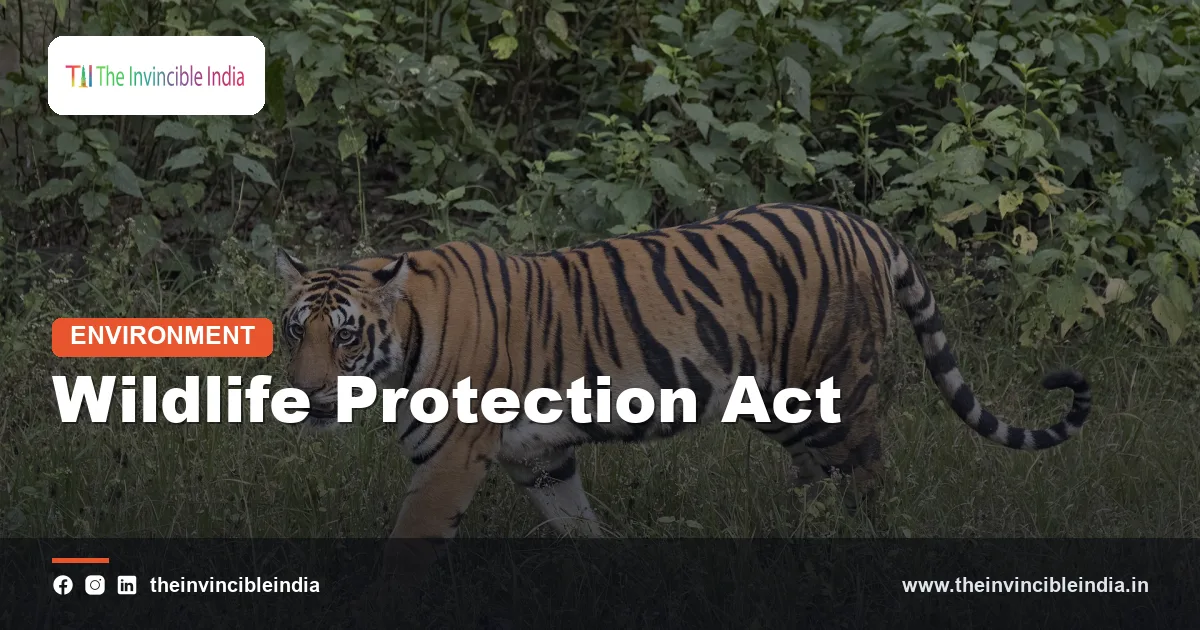
The Wildlife Protection Act, formally known as the Wildlife (Protection) Act, 1972, is the cornerstone of wildlife conservation law in India. It gives the country a single, uniform legal framework to protect wild animals, birds and plants, to control hunting and trade, and to create and manage protected areas such as national parks and sanctuaries. Almost every conservation programme in India, from tiger reserves to elephant corridors, draws its legal authority from this statute.
The Act did not appear out of nowhere. It was the result of decades of concern about vanishing species, patchy state-level rules and growing international attention to the environment. Over the years it has been amended several times, most notably in 2002, 2006 and 2022, to keep pace with new threats and new ideas. This explainer walks through why the law was needed, how it works, who enforces it and where it still faces difficulties.
| Quick Facts: The Wildlife (Protection) Act, 1972 | |
|---|---|
| Full name | The Wildlife (Protection) Act, 1972 |
| Year enacted | 1972 (Parliament, at the request of states) |
| Constitutional route | Article 252, which lets Parliament legislate for states that pass resolutions asking it to |
| Core purpose | Protection of wild animals, birds and plants; regulation of hunting and trade; creation of protected areas |
| Main tool | Schedules that classify species by the level of protection they receive |
| Protected area categories | National Parks, Wildlife Sanctuaries, Conservation Reserves, Community Reserves |
| Key institutions | National Board for Wildlife, State Boards for Wildlife, Chief Wildlife Warden, Wildlife Crime Control Bureau |
| Major amendments | 2002, 2006 and 2022, among others |
Why the Wildlife Protection Act Was Needed
By the middle of the twentieth century, India’s wildlife was under serious pressure. Large-scale hunting, a thriving trade in skins, horns and feathers, the clearing of forests for farming and development, and a rapidly growing human population had pushed several species towards the brink. The tiger, the Asiatic lion, the one-horned rhinoceros and many birds were all visibly declining.
India did have earlier laws. The colonial-era Wild Birds and Animals Protection Acts, and the Indian Forest Act, 1927, contained some protective provisions. But these laws were limited in scope, often focused on regulating hunting seasons rather than conserving species, and varied widely from one state to another. Wildlife was largely a state subject, so a species protected in one state could be freely hunted just across the border.
The push for a uniform national law
- Inconsistent state laws: Different states had different lists of protected animals, penalties and enforcement machinery.
- Migratory and ranging species: Animals do not respect administrative boundaries, so protection had to be coordinated across states.
- Growing commercial trade: Demand for skins, ivory and live animals created an organised market that local rules could not control.
- Institutional gaps: There was no dedicated, statutory machinery for managing protected areas or prosecuting wildlife offences.
Stockholm 1972 and the Constitutional Route
The year 1972 was a landmark for global environmental thinking. The United Nations Conference on the Human Environment was held in Stockholm in June that year, and India took an active part in it. The conference put environmental protection firmly on the international agenda, and countries were encouraged to build domestic laws to safeguard nature. India’s wildlife law of the same year fits naturally into this wave of national commitments.
Why Parliament passed it under Article 252
At the time, wildlife and forests were primarily matters on which the states had the power to legislate. Parliament could not simply pass a national law on the subject on its own authority. Article 252 of the Constitution provides a way around this: if the legislatures of two or more states pass resolutions asking Parliament to make a law on a state subject, Parliament may do so, and the law applies to those states. Other states can later adopt it by passing their own resolutions.
Several states made this request, and the Act was passed on that basis and then adopted by the rest. Later, the Forty-second Amendment of 1976 moved “forests” and the “protection of wild animals and birds” into the Concurrent List, giving the Centre and the states shared authority. The Constitution also reflects the same spirit: Article 48A directs the State to protect and improve the environment and safeguard forests and wildlife, while Article 51A(g) makes it a fundamental duty of every citizen to protect and improve the natural environment, including wildlife.
The Schedule System: Classifying Species by Protection
The heart of the Wildlife Protection Act is its system of schedules. Instead of giving every species the same treatment, the Act sorts them into lists, and the list a species falls under determines how strongly it is protected and how severe the penalties are for harming it. This allows the law to focus its toughest provisions on the most endangered species while still regulating the rest.
How the schedules work in principle
- The first schedule, Schedule I, carries the highest level of protection and the strictest penalties. Species such as the tiger, Asian elephant, Asiatic lion and Great Indian Bustard have traditionally been placed here.
- Lower-ranked schedules give a lesser, but still real, degree of protection to other animals, with lighter punishments for offences.
- Separate schedules deal with protected plants, whose collection, uprooting or trade is regulated.
- The government can add or remove species by notification after assessing their conservation status.
The 2022 restructuring
The Wildlife (Protection) Amendment Act, 2022 reorganised this system. The original Act had six schedules, including one for animals that could be declared vermin. The amendment reduced the number of schedules and simplified their structure, so that the animals receiving the highest protection and those receiving lesser protection are placed in clearly defined lists, with a separate schedule for protected plants. A new schedule was added for specimens listed under the Convention on International Trade in Endangered Species of Wild Fauna and Flora (CITES), tying India’s domestic law more closely to its international trade obligations.
| Schedule concept | What it covers | Level of protection |
|---|---|---|
| Highest-protection list (Schedule I) | Critically threatened and iconic species such as the tiger and elephant | Strictest; heaviest penalties |
| Lesser-protection list | Other wild animals that still need legal safeguards | Protected, with lighter penalties |
| Plants schedule | Specified wild plants whose collection or trade is restricted | Regulated; licences needed |
| CITES schedule (added in 2022) | Specimens listed under the CITES appendices | Trade regulated through permits and registration |
The Ban on Hunting and Its Exceptions
One of the Act’s most important effects was to make hunting of protected wild animals an offence. Before 1972, hunting had been a common pastime and a status symbol, and shikar had long been part of royal and colonial culture. The Act changed this by laying down that no person shall hunt any wild animal specified in its schedules, with only narrow exceptions.
The definition of hunting in the Act is broad. It covers not only killing but also capturing, trapping, poisoning, injuring or driving a wild animal, and even attempting to do any of these things. It also includes injuring or destroying the eggs or nests of birds and reptiles.
The limited exceptions
- Self-defence: A person may kill or injure a wild animal in good faith to defend their own life or that of another person.
- Dangerous animals: The Chief Wildlife Warden can permit the capture, translocation or, as a last resort, killing of an animal that has become dangerous to human life or is disabled or diseased beyond recovery.
- Scientific research and management: Permits may be granted for education, scientific research, scientific management, including translocation, or collection of specimens for recognised institutions.
These exceptions are tightly controlled through written permissions and procedures, so that they cannot become a loophole for routine hunting. Even a legitimately killed animal generally remains the property of the government.
Protected Areas under the Wildlife Protection Act
Protecting individual species is only half the story. Animals need habitat, and the Act therefore provides a framework for setting aside land and water as protected areas. Four categories are recognised, each with a different degree of restriction and a different relationship with local people.
| Category | Key features | Who owns or manages the land |
|---|---|---|
| National Park | Highest level of protection among protected areas; grazing and private rights generally not allowed; human activity tightly restricted | Government land, managed by the forest or wildlife department |
| Wildlife Sanctuary | Protects wildlife and habitat; some regulated human activities and certain rights may continue | Mostly government land, with some rights settled |
| Conservation Reserve | Buffer or connecting areas near parks and sanctuaries, managed with local participation | Government-owned land |
| Community Reserve | Area where communities or individuals voluntarily conserve wildlife on their own land | Private or community land |
National Parks and Wildlife Sanctuaries
National parks and wildlife sanctuaries were part of the original design. A national park is meant to protect wildlife and its habitat as fully as possible, with very limited human use. A sanctuary is somewhat more flexible: certain activities such as limited collection of forest produce or existing rights may be allowed under regulation, though harming wildlife is still prohibited. A sanctuary can later be upgraded to a national park if conditions allow.
Conservation and Community Reserves
These two categories were added by the 2002 amendment. Conservation Reserves are declared by state governments on government land, often to connect larger protected areas or to shield their edges. Community Reserves recognise that much of India’s wildlife survives on land owned by villages and families, and they allow such owners to take part formally in conservation without surrendering their land rights. This shift acknowledged that conservation cannot rely on state-owned forests alone.
Regulating Trade in Wildlife and Wildlife Products
Hunting is only one way wildlife is lost. Much of the pressure comes from the market: tiger skins and bones, elephant ivory, rhino horn, pangolin scales, shahtoosh wool, exotic birds and reptiles, and medicinal plants. The Act makes trade in animals and animal articles from protected species heavily restricted or prohibited, and it requires dealers in certain wild-animal products to be licensed and to declare their stocks.
The role of CITES
India is a party to CITES, the international agreement that regulates cross-border trade in endangered species through a system of permits. Under CITES, species are placed in appendices according to how threatened they are and how trade should be controlled. The 2022 amendment gave this international framework a firm place inside the domestic law by creating a separate schedule for CITES-listed specimens and by designating authorities to issue permits and certificates for import, export and re-export. It also requires registration of certain captive animals and provides for the voluntary surrender of such specimens.
Other trade controls
- Declarations of ownership for certain animal articles and trophies.
- Licensing of dealers and manufacturers who handle wildlife products.
- Restrictions on the sale of live protected species and on the transfer of captive animals such as elephants, subject to conditions.
- Rules covering zoos, which fall under the Central Zoo Authority added by an earlier amendment.
Institutions Created and Empowered by the Act
A law is only as strong as the bodies that carry it out. The Wildlife Protection Act, along with its amendments, set up a layered institutional structure.
National Board for Wildlife
The National Board for Wildlife (NBWL) is the apex advisory body on wildlife matters, chaired by the Prime Minister. It reviews policy, advises the government on protecting wildlife and, notably, must be consulted before projects affecting protected areas can proceed. Its work is carried out largely through a Standing Committee. The Board grew out of the older Indian Board for Wildlife, which dates back to 1952.
State Boards for Wildlife
Each state or Union territory has a State Board for Wildlife, usually headed by the Chief Minister. These boards advise on the selection and management of protected areas and on policies for wildlife conservation within the state.
Chief Wildlife Warden and field officers
The Chief Wildlife Warden is the key statutory official in each state, with wide powers over permits, protected area management and the grant of exceptions to the hunting ban. Under this officer work wildlife wardens, honorary wardens and forest staff who patrol and protect habitats on the ground.
Wildlife Crime Control Bureau
Wildlife crime often crosses state and national boundaries, so a specialised agency was needed. The Wildlife Crime Control Bureau (WCCB) was established under the 2006 amendment. It gathers intelligence, coordinates enforcement among states and agencies, and helps customs and police tackle organised trafficking.
Project Tiger, Project Elephant and Other Programmes
The Act provides the legal backbone for several landmark conservation initiatives. Project Tiger, launched in 1973, only a year after the Act came into force, created a network of tiger reserves, with core areas kept free of human disturbance. The 2006 amendment gave this effort a statutory footing by establishing the National Tiger Conservation Authority and the framework for tiger reserves, with a core and buffer structure.
Project Elephant, started in 1992, focuses on protecting elephants, their habitats and migration corridors, and on reducing conflict with people. Both programmes depend on powers under the Act to notify protected areas, control hunting and regulate trade in ivory and other products. Species recovery programmes for the rhinoceros, the Asiatic lion, the gharial and various birds also draw on its provisions, as does the regulation of zoos and captive breeding.
- Tiger reserves: Notified on the recommendation of the National Tiger Conservation Authority, with a protected core and a buffer.
- Elephant reserves: Large landscapes that help maintain connected habitats.
- Species recovery and captive breeding: Supported through zoo regulation and scientific management provisions.
Penalties and Enforcement
The Act defines a range of offences and ties the severity of punishment to the importance of the species and the nature of the crime. Offences involving species in the highest-protection schedule and offences inside national parks and sanctuaries carry stiffer punishments, including mandatory minimum imprisonment terms and fines. Repeat offenders face heavier penalties, and the 2022 amendment raised fines across the board to strengthen deterrence.
Enforcement tools
- Search, arrest and seizure: Authorised officers can search premises, seize illegally held animals, trophies and vehicles, and arrest suspects.
- Forfeiture: Equipment, vehicles and weapons used in the offence may be confiscated.
- Compounding: For certain lesser offences, the Chief Wildlife Warden may accept a payment in lieu of prosecution, though this does not apply to the most serious violations.
- Burden of proof: For some offences the law places the burden on the accused to explain possession of protected specimens.
Cases are tried before courts, and the judiciary, including the Supreme Court, has played an active role in interpreting the Act and in monitoring protected areas.
Forest-Dwelling Communities and Human-Wildlife Conflict
Conservation in India has to reckon with the fact that millions of people live in and around forests and depend on them for livelihoods. The Act, particularly in its early form, was often criticised for restricting traditional rights and for displacing communities from protected areas. The Forest Rights Act, 2006, passed to recognise the rights of forest-dwelling communities, sought to balance this. It recognises individual and community forest rights and also contains provisions for critical wildlife habitats, where conservation needs may require stricter safeguards, with consultation and consent of the communities involved.
Managing conflict
Human-wildlife conflict, including crop raiding by elephants, livestock loss to leopards and tigers, and attacks on people, is a growing reality as habitats shrink. The Act allows capture, translocation or, in the last resort, killing of animals that endanger human life, under official permission. Compensation schemes run by states, community-based early warning systems and corridor protection complement these legal powers. The 2022 amendment also contains provisions to deal with invasive alien species, which can damage native habitats.
Criticism and Challenges
Despite its achievements, the Wildlife Protection Act faces real challenges. Many wildlife experts and communities point to the following issues.
- Enforcement gaps: Forest departments are often understaffed and underequipped, and prosecution rates and conviction rates in wildlife cases remain a concern.
- Poaching and illegal trade: Organised networks continue to target tigers, rhinos, pangolins, turtles and birds, often with links across borders.
- Habitat loss and fragmentation: Roads, mines, dams and other infrastructure squeeze wildlife into smaller areas, and the Act cannot by itself stop these pressures.
- Community concerns: Critics argue that top-down protected area management has sometimes ignored local people, and that some amendments may centralise decision-making.
- Conflict and compensation: Delays in compensation can weaken local goodwill towards conservation.
Supporters note that the Act has helped bring species such as the tiger and the one-horned rhinoceros back from very low numbers, and that India’s network of protected areas now covers a significant share of its land. Most commentators agree that the law works best when combined with community participation, scientific monitoring and strong enforcement.
Conclusion
The Wildlife Protection Act has shaped India’s relationship with its natural heritage for more than five decades. By classifying species, banning hunting, creating protected areas, regulating trade and building dedicated institutions, it turned scattered rules into a coherent national system. Its amendments, from the reserves added in 2002 to the CITES alignment in 2022, show that the law is meant to evolve. The challenge ahead is to keep that evolution rooted in science, local participation and effective enforcement, so that India’s remarkable biodiversity continues to thrive alongside its people. Last updated: 1 October 2026.
Frequently Asked Questions
What is the Wildlife Protection Act of India?
The Wildlife (Protection) Act, 1972 is India’s main law for protecting wild animals, birds and plants. It bans hunting of protected species, regulates trade in wildlife products and provides for the creation of national parks, sanctuaries and other protected areas.
Why was it passed under Article 252?
Wildlife was then primarily a state subject, so Parliament could not legislate on it directly. Under Article 252, Parliament can pass a law on a state subject if state legislatures pass resolutions requesting it, which is how the Act was enacted and then adopted across the country.
What are the schedules under the Act?
Schedules are lists that classify species according to the level of protection they receive. Schedule I gives the highest protection and the strictest penalties, while other schedules cover lesser-protected animals, plants and, after the 2022 amendment, CITES-listed specimens.
Is hunting allowed under any circumstances?
Hunting of protected wild animals is generally prohibited. Narrow exceptions exist for self-defence, for animals that have become dangerous to human life or are diseased beyond recovery, and for scientific research or management, all subject to official permission.
What is the difference between a national park and a wildlife sanctuary?
A national park offers stricter protection, with grazing and most human activities generally not permitted. A wildlife sanctuary is more flexible and may allow certain regulated activities or existing rights, though harming wildlife remains prohibited.
Which bodies enforce the Act?
Enforcement involves the National Board for Wildlife, State Boards for Wildlife, the Chief Wildlife Warden and forest staff in each state, and the Wildlife Crime Control Bureau, which tackles organised wildlife crime across states and borders.
{“@context”:”https://schema.org”,”@graph”:[{“@type”:”FAQPage”,”mainEntity”:[{“@type”:”Question”,”name”:”What is the Wildlife Protection Act of India?”,”acceptedAnswer”:{“@type”:”Answer”,”text”:”The Wildlife (Protection) Act, 1972 is India’s main law for protecting wild animals, birds and plants. It bans hunting of protected species, regulates trade in wildlife products and provides for the creation of national parks, sanctuaries and other protected areas.”}},{“@type”:”Question”,”name”:”Why was it passed under Article 252?”,”acceptedAnswer”:{“@type”:”Answer”,”text”:”Wildlife was then primarily a state subject, so Parliament could not legislate on it directly. Under Article 252, Parliament can pass a law on a state subject if state legislatures pass resolutions requesting it, which is how the Act was enacted and then adopted across the country.”}},{“@type”:”Question”,”name”:”What are the schedules under the Act?”,”acceptedAnswer”:{“@type”:”Answer”,”text”:”Schedules are lists that classify species according to the level of protection they receive. Schedule I gives the highest protection and the strictest penalties, while other schedules cover lesser-protected animals, plants and, after the 2022 amendment, CITES-listed specimens.”}},{“@type”:”Question”,”name”:”Is hunting allowed under any circumstances?”,”acceptedAnswer”:{“@type”:”Answer”,”text”:”Hunting of protected wild animals is generally prohibited. Narrow exceptions exist for self-defence, for animals that have become dangerous to human life or are diseased beyond recovery, and for scientific research or management, all subject to official permission.”}},{“@type”:”Question”,”name”:”What is the difference between a national park and a wildlife sanctuary?”,”acceptedAnswer”:{“@type”:”Answer”,”text”:”A national park offers stricter protection, with grazing and most human activities generally not permitted. A wildlife sanctuary is more flexible and may allow certain regulated activities or existing rights, though harming wildlife remains prohibited.”}},{“@type”:”Question”,”name”:”Which bodies enforce the Act?”,”acceptedAnswer”:{“@type”:”Answer”,”text”:”Enforcement involves the National Board for Wildlife, State Boards for Wildlife, the Chief Wildlife Warden and forest staff in each state, and the Wildlife Crime Control Bureau, which tackles organised wildlife crime across states and borders.”}}]}]}


