

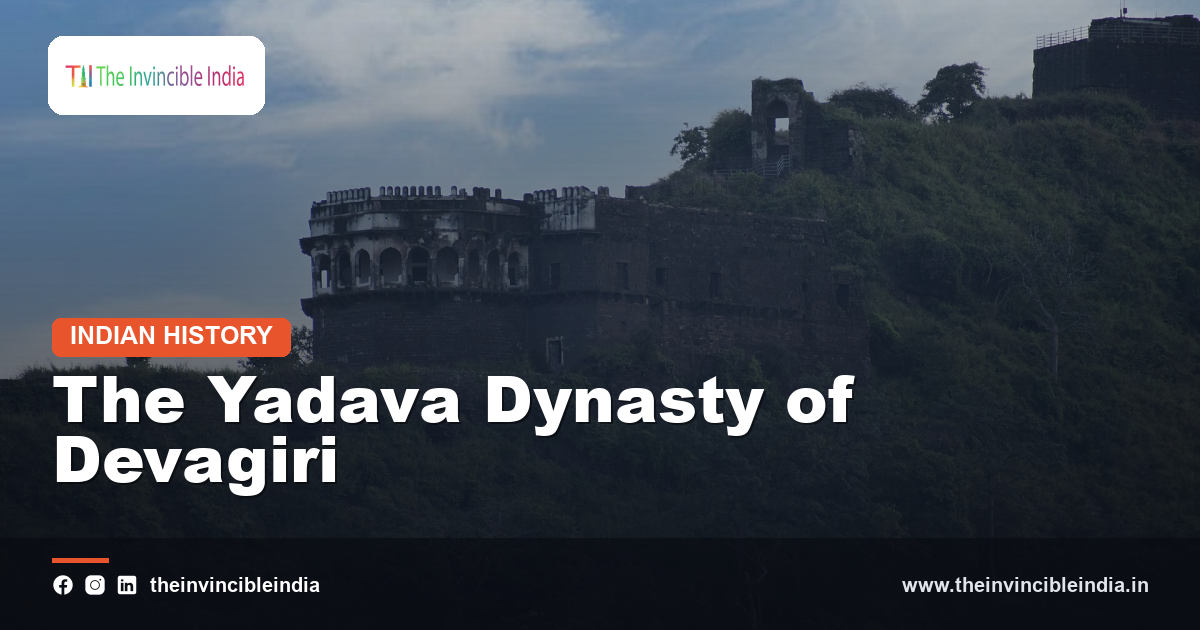
In the centuries before the Delhi Sultanate reached the Deccan, a powerful line of kings known as the Yadavas, or Seunas, ruled much of the western plateau from their stronghold at Devagiri. Rising from the status of feudatories to become masters of a wide kingdom, they competed with the Hoysalas, the Paramaras, the Kakatiyas, and the Chalukyas, much as other great houses of the Deccan did. Their story begins in the age of the Chalukyas, whose overlordship they eventually threw off. The Yadavas are remembered for their formidable fortress, their support for Sanskrit and Marathi learning, and their distinctive temple style, and for being the first major southern kingdom to face the northern armies.
Quick Facts
| Detail | Information |
|---|---|
| Dynasty | Yadava, also called Seuna |
| Capital | Devagiri, later known as Daulatabad |
| Region | Western Deccan, present-day Maharashtra |
| Overlords Before Independence | The Chalukyas of Kalyani |
| Cultural Legacy | Early Marathi literature and Hemadpanti temples |
| Decline | Subdued by Delhi Sultanate expeditions |
Origins of the Seuna Yadavas
The Yadavas of Devagiri claimed descent from the legendary Yadava clan of Krishna, an ancient lineage celebrated in epic and puranic tradition. Their early inscriptions also use the name Seuna, linked to the Seunadesha, a territory in the northwestern Deccan that they governed in the beginning. Historians generally regard them as a local dynasty that emerged from the political fabric of the Deccan, serving as chiefs and officers under larger powers before establishing themselves independently. The claim of a Yadava pedigree gave their rule religious and legendary prestige, connecting the Deccan kings to a heroic past. This combination of a modest regional origin and a grand ancestral claim was typical of many medieval Indian dynasties, and the Seunas used it skillfully to support their ambitions.
Feudatories of the Chalukyas and Rashtrakutas
For many generations the early Yadavas served as subordinate rulers within the political orders of the Deccan. They are associated with the age of the Rashtrakutas and then with the Chalukyas of Kalyani, to whom they owed allegiance while governing their own districts. Service as feudatories brought experience in administration and warfare, as well as marriage ties with more powerful houses. Over time, ambitious Yadava chiefs expanded their holdings, gathered armies, and built alliances that prepared the ground for independence. The weakening of the Chalukya power in the later twelfth century offered the opportunity they had been awaiting. Their emergence was thus gradual rather than sudden, the result of patient growth within a system of overlords that finally began to break apart.
Rise to Independence
As the Chalukya kingdom of Kalyani fragmented, a Yadava ruler named Bhillama is traditionally credited with asserting full sovereignty and carrying the family into the ranks of the great Deccan powers. He is associated with the conquest of neighboring territories and with the establishment of Devagiri as the principal seat of the dynasty. This transition marked a decisive change, since the Yadavas now competed as equals with other former feudatories who were carving out their own states. The new kingdom drew strength from the broad plateau, from rich agricultural lands, and from its position along trade routes linking western ports with the interior. The rise to independence turned the Yadavas from servants of empire into builders of one, giving the house a new confidence and ambition.
Devagiri: A Hill Fortress and Capital
Devagiri, meaning the hill of the gods, takes its name from a dramatic conical rock rising from the plateau near present-day Aurangabad. The Yadavas turned this natural fortress into the heart of their kingdom, with the surrounding town serving as an administrative and commercial center. The hill is steep, with sheer scarped sides, and over the years it received layers of walls, gateways, moats, and passages designed to confuse attackers. The fortress later passed to other dynasties and was renamed Daulatabad, and later rulers added their own structures to it. Even today it is regarded as one of the most impressive military sites of medieval India. Its choice as a capital reflects the Yadava understanding that geography could be shaped into a lasting source of strength.
Territorial Expansion and Rivalries
Yadava kings pursued an active policy of expansion, pressing in several directions against neighboring kingdoms. To the south lay the Hoysalas, whose rise paralleled their own, while to the east the Kakatiyas controlled the Telugu country, and to the north the Paramaras and the rulers of Gujarat held strong positions. Campaigns, treaties, and shifting alliances marked the relations among these powers, and borderlands often changed hands. At times the Yadavas extended their authority across large parts of the western and central Deccan, reaching a high point of influence in the thirteenth century. These rivalries drained resources but also stimulated innovation in warfare and administration. The Yadavas thus took part fully in the competitive world of medieval Deccan politics, where no state could remain secure without constant effort.
Government and Society
The Yadava state was governed through a hierarchy of ministers, provincial governors, and local officers who collected revenue, kept order, and supported religious and public institutions. A learned class of Brahmin scholars and ministers staffed the royal court and drafted records and grants, while military commanders held lands in return for service. Village communities retained considerable autonomy, with local leaders handling disputes and managing resources. Merchants and craft guilds played an important role in the economy, and royal grants regularly supported temples and educational establishments. Inscriptions in Sanskrit and Marathi record the details of such arrangements. This blend of central authority and local self-management gave the kingdom stability, allowing the dynasty to hold a wide and diverse territory together for several generations.
The Reign of Singhana
Among the Yadava rulers, Singhana is widely regarded as one of the most successful, presiding over a period of military vigor and cultural brilliance. Under his leadership the kingdom expanded its reach and held its own against rival powers, and the court became a gathering place for scholars and artists. He is remembered as a generous patron whose support helped to produce important works in several fields. His reign is often seen as the high-water mark of Yadava strength, when the dynasty seemed to rival the greatest houses of the peninsula. Later rulers inherited a large and prosperous kingdom, though they also faced rising dangers. The achievements of Singhana’s era show how effective kingship could combine conquest with sustained support for learning.
Hemadri and the Hemadpanti Style
The minister Hemadri, also known as Hemadpant, served the later Yadava kings and became famous both as an administrator and as a scholar. He is credited with a large encyclopedic work on religious observance and with reforms in the keeping of records. His name has also been attached to a style of temple architecture found across Maharashtra, called Hemadpanti, characterized by carefully cut black basalt blocks fitted together without mortar. These temples are often built on star-shaped plans with intricately carved pillars and doorways. Although scholars debate how directly Hemadri shaped the style, the label remains in popular use for these buildings. The name thus stands for a distinctive regional tradition of construction that endures in many villages and towns of the western Deccan.
Temples and Architecture
Yadava patronage produced a rich body of temple building, drawing on the shared architectural language of the Deccan while developing local features. Basalt, a hard volcanic stone common in the region, was cut with precision, and carved decoration appeared on pillars, ceilings, and doorways. Shrines dedicated to Shiva, Vishnu, and other deities, as well as Jain establishments, benefited from royal and ministerial support. Stepwells, tanks, and inscriptions accompany many of these sites, showing that temples served as centers of community life. Some of the finest examples are found in the countryside of present-day Maharashtra, where they stand as quiet witnesses of the kingdom. The architectural record of the Yadavas reveals a confident dynasty that expressed its piety and prosperity in lasting stone.
Marathi Language and the Bhakti Movement
The Yadava period was formative for the Marathi language, which rose from regional speech to a vehicle of serious literature. Marathi appears increasingly in inscriptions, and religious teachers began to address ordinary people in their own tongue rather than only in Sanskrit. The great saint-poet Dnyaneshwar composed his famous Marathi commentary on the Bhagavad Gita during the later Yadava age, and the Mahanubhava sect also produced early prose in the language. These developments belonged to the wider bhakti movement, which stressed devotion and accessibility. The cultural world of the Yadava court, with its mix of Sanskrit learning and popular religious expression, helped lay the foundations of Maharashtra’s literary and spiritual tradition. Marathi owes a considerable debt to this age of creative growth.
Learning, Music and Science at Court
The Yadava court encouraged Sanskrit scholarship in many disciplines, from law and ritual to astronomy and music. The musical treatise Sangita Ratnakara, composed by Sarngadeva, who was associated with the Yadava court, became one of the foundational texts of Indian musical theory and is valued by both Hindustani and Carnatic traditions. Astronomers and mathematicians also found support, and scholars gathered around royal and ministerial patrons. This intellectual activity shows that the Yadavas understood power in cultural terms as well as military ones. Texts produced under their patronage traveled widely, and their influence extended beyond the lifetime of the dynasty. The learning of the Yadava age forms an important chapter in the history of Indian ideas, even though the dynasty is better known for its fortress.
Trade, Agriculture and the Economy
The Yadava economy rested on agriculture in the fertile river valleys of the Deccan plateau, supported by village tanks and wells. Trade routes crossed the kingdom, linking the western coast and its ports with the interior markets and with the south and the north. Merchants, artisans, and guilds made goods for local use and long-distance exchange, and temples played an economic role as large landholders and employers. Revenue from land, trade, and tolls funded the army and the court, and royal grants supported religious and educational institutions. The dynasty’s choice of Devagiri as capital reflected the commercial importance of its location at a crossroads of the peninsula. A prosperous economy allowed the Yadavas to fund both a large fort and a lasting cultural legacy.
Ramachandra and the Northern Invasions
The rise of the Delhi Sultanate in the north eventually brought a new threat to the Deccan, and the Yadavas were the first major southern kingdom to meet it. During the reign of Ramachandra, an army sent from Delhi under the sultan’s commander reached Devagiri, and the fortress and kingdom came under heavy pressure. The Yadava king accepted terms that recognized the sultan’s superiority and involved tribute, while retaining a measure of rule. The episode shocked the southern world, demonstrating that even a well-defended capital could be reached by distant armies. It also set the stage for further expeditions that would transform the political map of the peninsula. The encounter marked a turning point from which the Deccan would never fully return to its earlier independence.
Decline and the End of Yadava Rule
After the first northern expedition, Yadava authority never fully recovered. Later rulers faced additional campaigns, shifts in loyalty among nobles, and attempts to throw off the sultan’s overlordship, each of which brought stronger retaliation. In time the dynasty lost its independence, and Devagiri was incorporated into the expanding Sultanate. The fall of the Yadavas opened the Deccan to a new political order and encouraged the rise of fresh regional powers, including the Bahmani Sultanate and the Vijayanagara Empire, whose history is told in the guide to the Vijayanagara Empire. The loss of Yadava rule thus closed one era of Deccan history and began another, in which Hindu and Muslim states competed and interacted across the plateau.
Devagiri Under Later Rulers
After Yadava rule ended, Devagiri continued to play a major role in Indian history. One Delhi sultan briefly attempted to make the fortress city his capital, renaming it Daulatabad and ordering a large movement of people, an experiment that proved short-lived. Later dynasties of the Deccan, including the Bahmanis and the Mughals, valued the fort for its strength. Additions to the site include a tall victory tower and mosque from the Sultanate period. The fortress remained a prize for centuries because of its natural advantages and strategic location. Although the Yadavas lost control, their choice of site proved remarkably durable, and the great hill remains the most visible reminder of the kingdom.
The Yadava Legacy
The Yadava legacy lies in the lasting contributions they made to the culture of Maharashtra and the wider Deccan. They helped Marathi rise as a literary language, supported scholars and musicians whose works remain influential, and fostered a temple tradition that still shapes the landscape. Their capital became one of the great fortresses of the subcontinent, studied for its defensive design and its dramatic setting. Politically, their encounter with the Delhi Sultanate marked a major turning point in the history of southern India. Compared with larger empires, they are less widely known, but a study of their age reveals the vitality of regional kingdoms. Related developments are described in the guide to the Hoysala dynasty, their southern contemporaries.
The Yadava Dynasty Today
Today the memory of the Yadavas survives chiefly in the fort of Devagiri, in the stone temples scattered across Maharashtra, and in the literature of the Marathi language. The fortress at Daulatabad is a protected monument visited by travelers and students of history, who come to see its moats, gateways, and dark passages. Hemadpanti temples are still used for worship in many villages, and their carved basalt continues to attract scholars of architecture. Marathi saints and poets of the age are honored in festivals, pilgrimages, and everyday devotion. Museums and research institutions preserve inscriptions that illuminate the period. The Yadava dynasty remains an important part of the heritage of western India, linking the medieval past to living cultural traditions.
Sources & Further Reading
- Ministry of Culture, Government of India (indiaculture.gov.in).
- Archaeological Survey of India (asi.nic.in).
Frequently Asked Questions
Who were the Yadavas of Devagiri?
The Yadavas, also called the Seunas, were a medieval dynasty that ruled much of the western Deccan from their capital at Devagiri. They began as feudatories of the Chalukyas and rose to full independence.
Where was Devagiri and what is it called today?
Devagiri was a hill fortress near present-day Aurangabad in Maharashtra. It was later renamed Daulatabad and survives as one of the most impressive medieval forts of India.
What is Hemadpanti architecture?
Hemadpanti is a style of temple building in Maharashtra, associated with the Yadava minister Hemadri. It is marked by finely cut black basalt blocks, often laid without mortar, and by star-shaped plans and carved pillars.
How did the Yadavas contribute to Marathi literature?
Their period saw Marathi rise as a language of inscription and religious writing, and the saint-poet Dnyaneshwar composed his famous work in the later Yadava age. The court also supported Sanskrit scholarship, including the musical treatise Sangita Ratnakara.
How did Yadava rule end?
The dynasty faced expeditions from the Delhi Sultanate, beginning with the reign of Ramachandra, and gradually lost its independence. Devagiri was eventually absorbed into the Sultanate’s territories.


