

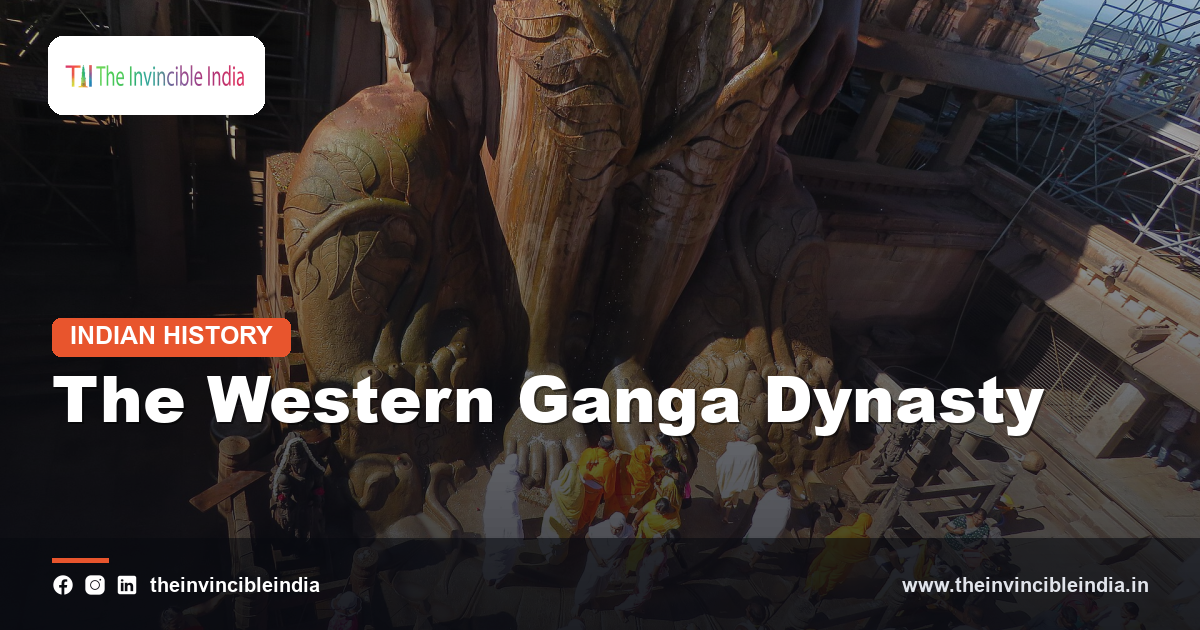
Long before the great empires of the medieval Deccan took their familiar shape, a ruling house known as the Western Gangas governed much of southern Karnataka from the fertile country called Gangavadi. Contemporary with and often caught between powerful neighbors such as the Pallavas, the Chalukyas, and the Rashtrakutas, they endured for several centuries and left behind a distinctive legacy of Jain monuments, early Kannada writing, and temple building. Their story is closely related to that of the Kadamba dynasty, another early Kannada-speaking power, and it culminates in the towering Gommateshwara statue at Shravanabelagola, one of the best-known monuments of the Indian peninsula.
Quick Facts
| Detail | Information |
|---|---|
| Dynasty | Western Ganga dynasty |
| Region | Gangavadi, southern Karnataka |
| Early Capital | Kolar, later Talakad |
| Religious Patronage | Jainism, alongside Hindu temples |
| Famed Monument | Gommateshwara statue at Shravanabelagola |
| Later History | Absorbed by the expanding Chola power |
Origins and the Name Ganga
The Western Gangas are named to distinguish them from the Eastern Gangas of Kalinga, a separate dynasty that ruled along the eastern coast. Their own traditions linked the family to an ancient royal lineage, and later inscriptions preserve legendary accounts of how the founders came south and established a kingdom with the help of a Jain teacher. Historians treat these stories with caution, yet they reveal how closely the dynasty identified itself with Jain religious ideals from the very beginning. What is clear from the inscriptional record is that by the early centuries of the common era a Ganga polity had taken root in the Mysore plateau and surrounding hill country. The family would hold that ground, in various forms of independence and subordination, for a very long time.
Gangavadi: The Heartland of the Dynasty
The territory associated with the dynasty came to be known as Gangavadi, a broad region covering much of the southern Karnataka plateau and reaching into neighboring districts. It was a landscape of rolling uplands, granite outcrops, river valleys, and carefully managed tank systems, well suited to settled farming and to the construction of fortified settlements. The valley of the Kaveri gave the kingdom a dependable agricultural base, while the surrounding hills offered natural defenses against rivals. Gangavadi was not merely a political label but a cultural region, and its name continued to appear in inscriptions long after the dynasty itself had faded. The identity of this heartland helped bind together local chiefs, village assemblies, and religious institutions under Ganga leadership.
Kolar and the Move to Talakad
Early Ganga rulers are associated with Kolar in the eastern part of their territory, a base that placed them near routes connecting the Karnataka plateau with the Tamil country. In later centuries the royal seat shifted to Talakad on the banks of the Kaveri, a location that offered stronger access to the rich river plain and a more central position within Gangavadi. Talakad grew into an important political and religious center, with temples and monastic establishments clustered along the river. The relocation reflected changing priorities, as the dynasty looked more toward the interior and the Kaveri basin than toward the frontier. Talakad remained the emblem of Ganga authority for generations and is still remembered as a major historic site of Karnataka.
Relations with the Pallavas and Early Chalukyas
For much of their early history the Western Gangas lived in the shadow of larger neighbors. To the south and east lay the Pallavas of Kanchipuram, while to the north the early Chalukyas of Badami built a rising power that eventually dominated the Deccan. The Gangas navigated this environment through a mixture of resistance, alliance, and acceptance of overlordship, sometimes serving as feudatories and sometimes asserting greater independence when their rivals were distracted. Marriage links and military cooperation formed part of this diplomacy. The ability of a modest kingdom to survive between such formidable powers says a good deal about the strength of its local roots. The Gangas proved skilled at preserving their identity while adapting to the shifting balance of power around them.
The Era of Rashtrakuta Dominance
When the Rashtrakutas rose to supremacy in the Deccan, Ganga rulers found themselves increasingly drawn into the politics of that great empire. Conflict and reconciliation alternated, and in time the Gangas became important allies and subordinates, contributing troops and administrators to Rashtrakuta campaigns. This partnership brought them security and prestige even as it narrowed their freedom of action. Ganga princes also formed marriage connections with the imperial house, tying the two dynasties together. The relationship allowed the Gangas to survive a turbulent age and to continue patronizing temples, monasteries, and learning within their own domain. It also shaped the cultural world of southern Karnataka, where Ganga and Rashtrakuta traditions of art and religion blended and influenced one another.
Administration and Local Government
Ganga government rested on a partnership between the royal court and a dense network of local institutions. The king ruled with the advice of ministers and military commanders, while the territory was divided into provinces and smaller units administered by officials and hereditary chiefs. At the village level, assemblies and local elders managed land, tanks, and temple affairs, and inscriptions frequently record grants of land or revenue to temples and religious communities. These grants were an important instrument of governance, binding powerful institutions to the crown. Officials combined civil and military duties, and noble families often held hereditary positions. The result was a flexible system able to absorb changes at the top, which helped the kingdom endure through generations of external pressure and internal succession disputes.
Patronage of Jainism
The Western Gangas are remembered above all as patrons of Jainism, a faith that flourished in Karnataka under their protection. Rulers, queens, ministers, and generals endowed Jain temples, monasteries, and rock-cut shrines, and many inscriptions describe donations made by Jain laywomen and laymen of the court. Jain teachers found support for their scholarship, and the faith became closely woven into the cultural life of the kingdom. This patronage did not mean exclusion of other traditions, since the dynasty also supported Hindu temples and Shaiva and Vaishnava institutions. Yet the strong Jain character of the Ganga court distinguished it from many contemporaries. Karnataka remains one of the most important centers of Jain heritage in India, and the foundations of that status were laid substantially during the Ganga centuries.
Shravanabelagola as a Sacred Center
Shravanabelagola, set among two granite hills in the Hassan region, became one of the great pilgrimage centers of the Jain world during the Ganga period. Tradition associates the site with ancient Jain ascetics who came to the south, and the hills are dotted with inscriptions, shrines, and memorials to monks who practiced austerity there. Ganga rulers and their officials supported the site generously, and it became a place where royal devotion and monastic discipline met. A cluster of basadis, or Jain temples, grew in the town below, and a sacred tank in the center gave the settlement its distinctive character. The site remains active as a place of worship and pilgrimage, and its long history makes it a living record of the cultural world the Gangas helped create.
Chavundaraya and the Gommateshwara Statue
The most famous monument of the Ganga age is the colossal statue of Gommateshwara, also called Bahubali, carved from a single block of granite on the larger hill at Shravanabelagola. It is traditionally associated with Chavundaraya, a minister and commander serving the Ganga court who was also a patron of learning. The figure stands naked and serene, with creepers winding around the legs, symbolizing deep meditation and renunciation of worldly attachment. Its scale, its calm expression, and the skill of its carving make it one of the great works of Indian sculpture. Pilgrims climb a long flight of steps to reach the statue, and a grand head-anointing ceremony held at long intervals draws devotees from across the country. The monument has become a symbol of Karnataka itself.
Kannada Language and Literature
The Ganga centuries were formative for the Kannada language, which increasingly appears in inscriptions and, eventually, in literary works. While Sanskrit remained the language of formal learning, Kannada gained respect as a medium for royal records and creative writing, helped by the encouragement of Ganga rulers and courtiers. Several Ganga kings are remembered as scholars or patrons of scholars, and Jain writers were prominent among those who developed early Kannada prose and poetry. Chavundaraya himself is credited with a Kannada work on Jain heroes and was connected with the circle of learned monks of his age. These developments laid foundations on which the great medieval poets of Karnataka would later build. The dynasty therefore deserves recognition for its role in nurturing one of India’s classical literary languages.
Temples and Architectural Style
Ganga architecture shows the blending of influences typical of a kingdom located between several larger cultural zones. Early structures were modest, built of local stone with clean lines, while later temples display the greater elaboration seen across the Deccan under the Rashtrakutas. Jain basadis, Shaiva shrines, and Vaishnava temples all appear within Ganga territory, often built of granite or of softer stone suited to detailed carving. Pillared halls, carved doorways, and sculpted figures show a confident regional style. The remains at Talakad, Shravanabelagola, and other sites reveal how craftsmen drew on a shared architectural vocabulary while giving it local character. These buildings later influenced the Hoysala builders, who inherited much of the same territory and would carry temple sculpture in Karnataka to still greater heights.
Economy, Irrigation and Trade
The prosperity of Gangavadi rested mainly on agriculture, supported by tanks, channels, and the waters of the Kaveri. Rulers and local chiefs commissioned the construction and maintenance of irrigation works, recognizing that stable harvests underpinned the strength of the kingdom. Inscriptions record gifts of land and the care of village tanks, showing that water management was regarded as a pious as well as a practical duty. Beyond farming, craft production, local markets, and the movement of goods along regional routes contributed to the economy. Temples and monasteries acted as economic institutions, holding land and supporting artisans and servants. The long survival of the dynasty owed much to this careful management of land and water, which kept the countryside productive through periods of conflict and political change.
Notable Rulers and Remembered Figures
The Ganga line produced many rulers, a number of whom are remembered in inscriptions and later tradition. Durvinita is often cited as a scholarly king associated with the patronage of Sanskrit learning, while later rulers such as Shivamara and Marasimha appear prominently in the records of the Rashtrakuta period. Rachamalla is associated with the age of Chavundaraya, whose service to successive kings made him one of the most celebrated ministers in the region. Royal women also appear as donors and builders of temples, showing the active role of the court in religious life. Exact details of reigns remain debated among historians, so the dynasty is best understood through its general achievements. Together these figures illustrate a court that valued scholarship, devotion, and military service in nearly equal measure.
Religious Life Beyond Jainism
Although Jainism is closely identified with the dynasty, the religious world of Gangavadi was far more varied. Shaiva and Vaishnava temples received royal and local patronage, and Brahmin scholars and ritual specialists found support at court. Village shrines and regional deities continued to hold the loyalty of ordinary people, while monastic communities of different traditions held land and taught students. This diversity created a climate in which several faiths could flourish side by side, even if rivalries sometimes surfaced in later centuries. Inscriptions record grants to many kinds of institutions, reflecting the practical need of kings to maintain good relations with every major religious community. The pluralism of the Ganga age forms an important part of the larger story of religious coexistence in southern India.
Decline and the Chola Conquest
The power of the Western Gangas weakened as the Rashtrakuta empire declined and as the Cholas of Tamil country grew stronger and more ambitious. Chola rulers pressed northward into the Karnataka plateau, and Gangavadi eventually came under Chola control, bringing the independent Ganga line to an end. The region was then administered as part of the Chola realm, and its temples and local institutions continued under new overlords. The collapse of Ganga authority was part of a wider realignment of power in the peninsula rather than the result of a single dramatic defeat. For a closer look at the conquerors, readers may consult the guide to the Chola dynasty. Later, the Hoysalas would emerge in the same territory and eventually drive out Chola authority.
Inscriptions as Historical Evidence
Much of what is known about the Western Gangas comes from inscriptions on stone and copper plate, which record grants, donations, genealogies, and the deaths of Jain ascetics and warriors. These records are written in Sanskrit and in Kannada, and they provide valuable evidence for administration, religion, and social life. Memorial stones commemorating heroes who fell in battle are especially numerous in the region and give a vivid picture of the values of the age. Because inscriptions often served royal or religious purposes, they present events from a particular point of view, and historians read them carefully against one another. Archaeological remains at temple sites add further detail. Taken together, these sources allow a reasonably full outline of Ganga history, even where individual dates and sequences of rulers remain subjects of scholarly discussion.
Legacy of the Western Gangas
The Western Gangas left a legacy that extends far beyond the political boundaries of their kingdom. They helped establish Karnataka as a major home of Jain culture, encouraged the rise of Kannada as a literary language, and sponsored monuments that continue to attract visitors from around the world. Their patient management of land and water and their skill at surviving between rival empires offer a case study in regional statecraft. The institutions they supported, from monasteries to village assemblies, shaped later dynasties such as the Hoysalas, whose story appears in the guide to the Hoysala dynasty. Their contribution is often overshadowed by larger empires, but it formed an essential foundation for the later cultural glory of southern India.
The Western Ganga Dynasty Today
Today the memory of the Western Gangas lives on mainly through the monuments and sacred places they supported. Shravanabelagola draws pilgrims and travelers who come to see the Gommateshwara statue, and the site is a living center of Jain worship. Talakad and other Ganga-era locations are studied by historians, epigraphists, and archaeologists who continue to refine the understanding of the period. Inscriptions are preserved and read in museums and research institutions, and the Kannada literary tradition acknowledges its early debt to Ganga patronage. For students of Indian history, the dynasty offers a reminder that important cultural achievements often arise in regional kingdoms rather than in the largest empires. The Western Gangas remain a lasting emblem of the artistic and spiritual heritage of Karnataka.
Sources & Further Reading
- Ministry of Culture, Government of India (indiaculture.gov.in).
- Archaeological Survey of India (asi.nic.in).
Frequently Asked Questions
Who were the Western Gangas?
The Western Gangas were a ruling dynasty that governed much of southern Karnataka from the region known as Gangavadi for several centuries. They are named to distinguish them from the Eastern Gangas of Kalinga, and they are remembered for patronizing Jainism and Kannada.
Where was the Western Ganga capital?
Early Ganga rulers are associated with Kolar, while the later royal seat was at Talakad on the banks of the Kaveri. Talakad remained the symbol of Ganga authority for many generations.
What is the Gommateshwara statue?
It is a colossal monolithic granite statue of Bahubali, also called Gommateshwara, at Shravanabelagola. It is traditionally associated with the minister Chavundaraya, who served the Ganga court, and it is among the best-known monuments of India.
How did the Western Ganga dynasty end?
Ganga power declined as the Rashtrakuta empire weakened and the Cholas expanded northward. Gangavadi came under Chola control, and the independent Ganga line came to an end.
Why are the Western Gangas important to Kannada history?
Their period saw Kannada gain standing in inscriptions and early literature, with Jain writers prominent among its pioneers. This helped lay the foundations for the later flowering of Kannada poetry.


