

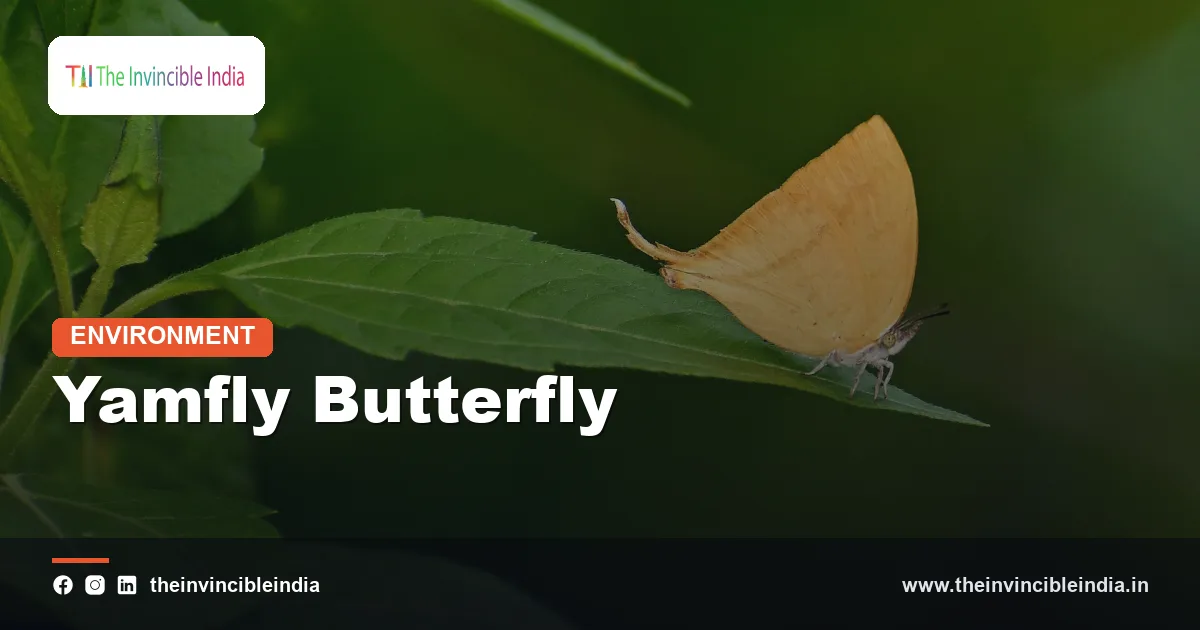
The yamfly (Loxura atymnus) is a small, bright orange lycaenid butterfly of South and Southeast Asia, with slender tails on the hindwings and caterpillars that feed on climbing plants such as wild yams (Dioscorea) and smilax (Smilax). Its tawny-orange upperside, bordered with black on the forewing, makes the yamfly one of the more eye-catching small butterflies of Indian forest edges, even though it is easily overlooked because of its size and its habit of settling among leaves.
The common name comes directly from the caterpillar’s diet, since the plants it favours include wild yams. This article explains how to identify the yamfly, where it lives in India, what its caterpillars and adults eat, how quickly its life cycle runs and why the butterfly is often seen in the company of ants.
Quick Facts: Yamfly
| Common name | Yamfly |
|---|---|
| Scientific name | Loxura atymnus (Cramer, 1782); the nominate subspecies is credited to Stoll, 1780 |
| Family and subfamily | Lycaenidae (blues, hairstreaks and allies), subfamily Theclinae |
| Wingspan | Small; roughly 3.5 to 4.5 cm in most field descriptions |
| Caterpillar host plants | Smilax zeylanica (preferred for egg-laying) and Dioscorea pentaphylla, both climbing plants |
| Range in India | South India (subspecies atymnus), north-east India (subspecies continentalis) and the Andaman and Nicobar Islands (prabha and nicobarica) |
| Habitat | Forest, forest edges and wooded scrub where the host climbers grow |
| Life cycle | About 23 to 26 days from egg to adult in laboratory rearing, allowing several broods a year |
| Notable features | Bright orange upperside, black forewing margin, slender hindwing tails, ant-associated adult feeding |
Key Takeaways
- The yamfly, Loxura atymnus, is a small lycaenid butterfly with a bright orange-tawny upperside and a black margin on the forewing.
- Yamfly caterpillars feed on climbing plants, notably Smilax zeylanica and Dioscorea pentaphylla, and the common name refers to the yam genus.
- The yamfly occurs in South India, north-east India and the Andaman and Nicobar Islands, where different subspecies are recognised.
- In laboratory rearing, a yamfly completes its life cycle in about 23 to 26 days, so the species can produce several generations a year.
- The adult yamfly has been photographed feeding on nectar from extrafloral nectaries that are visited by ants.
- The underside of the yamfly is dark yellow-ochre with pale blackish markings, which looks very different from the orange upperside.
What is the yamfly butterfly?
The yamfly is a lycaenid butterfly in the genus Loxura, described in the eighteenth century from specimens collected in Asia. The species belongs to the subfamily Theclinae, the group of hairstreaks, whose members often have fine tails on the hindwings and caterpillars that are tended by ants.
Lycaenidae is the second-largest family of butterflies, and the yamfly is a typical example of its small, delicate members. The English name highlights the host plants and reflects the way many butterflies were named by early naturalists: after a plant that their caterpillars were known to eat.
The genus Loxura is small and confined to tropical Asia. Within India the yamfly is the representative that most observers will meet, and field guides usually describe it as a distinctive, easily recognised hairstreak because of its colour.
How can you identify a yamfly?
A yamfly can be identified by its bright orange-tawny upperside, the black border on the forewing, the slender tails on the hindwing and the dark yellow-ochre underside with pale blackish markings. The combination of orange above and a muted, marked underside is unusual among small Indian butterflies.
- Males: orange-tawny upperwings with a black forewing margin that widens towards the outer edge, and a narrow pale band on the hindwing.
- Females: paler above than males, with somewhat broader marginal bands.
- Antennae: black with an orange tip to the club, a small detail visible in close photographs.
- Body: brown above and grey below.
- Tails: slender tails on the hindwing, which are a feature of the genus and help the butterfly to be recognised even when the colour is hidden.
Because the yamfly commonly rests with its wings folded, the underside is the surface seen most often. The pale, blackish pattern on a dark yellow-ochre ground is cryptic against dry leaves and twigs, and it is easy to mistake the butterfly for a withered leaf unless it moves.
Where does the yamfly live in India?
The yamfly lives in South India, in north-east India and on the Andaman and Nicobar Islands, with regional subspecies recognised in each area. The geographic split reflects the fact that the butterfly’s range is a patchwork of forest regions, with gaps where the host climbers do not grow.
| Subspecies | Region |
|---|---|
| Loxura atymnus atymnus | South India |
| Loxura atymnus continentalis | North-east India and Indochina |
| Loxura atymnus prabha | Andaman Islands |
| Loxura atymnus nicobarica | Nicobar Islands |
| Loxura atymnus arcuata | Sri Lanka |
The species is a forest and forest-edge butterfly. It is found where its host climbers grow in moist, wooded surroundings, from low-lying forest to hill slopes, and it may enter gardens and plantations adjoining forest if the right vines are present.
What do yamfly caterpillars eat?
Yamfly caterpillars eat the young shoots and leaves of climbing plants, with Smilax zeylanica and Dioscorea pentaphylla being the two most clearly documented hosts. The female prefers to lay eggs on Smilax zeylanica, a thorny, woody climber of forest edges.
Dioscorea is the genus of true yams, a group of twining vines that produce underground tubers. Wild species of Dioscorea grow in many Indian forests, and some cultivated species are important food crops. The elephant foot yam, however, belongs to a different plant genus, so the yamfly’s name should not be taken to mean that it is a pest of commonly grown tuber crops.
Smilax and Dioscorea are both climbers of damp, shady places that put out fresh shoots during and after the rains. The female yamfly times her egg-laying to these flushes of new growth, since the tender tips are easiest for newly hatched caterpillars to eat.
How does the yamfly develop from egg to adult?
The yamfly develops from egg to adult in about three to four weeks under warm laboratory conditions, passing through the egg, four caterpillar instars and the pupa. Such a short cycle lets the butterfly raise several generations in a year when conditions are favourable.
| Stage | Details |
|---|---|
| Egg | Dome-shaped and whitish, less than 1 mm across, laid singly at the base of young shoots |
| Caterpillar | Four instars; the first three last about two to three days each, and the fourth stops feeding after around four days |
| Pupa | Formed roughly two weeks after hatching |
| Adult | Emerges after about a week as a pupa; the whole cycle takes 23 to 26 days in the laboratory |
These figures come from rearing under controlled conditions and the timing in the wild may be slower in cool or dry weather. They do, however, show how rapidly the yamfly can multiply when host shoots are abundant.
Why is the yamfly associated with ants?
The yamfly is associated with ants because adults have been photographed feeding on nectar from extrafloral nectaries that attract ants, and because many hairstreak caterpillars rely on ant attendance. Extrafloral nectaries are nectar-producing glands located on stems, buds or leaves, away from the flower itself.
Plants that carry extrafloral nectaries use them to attract ants, which in turn defend the plant from herbivores. A butterfly that feeds at such glands lives alongside the ants, and the yamfly has been recorded doing so on orchid buds visited by yellow crazy ants.
This behaviour illustrates the complex web of interactions found in ordinary Indian vegetation. A single bud can host a plant, a nectar gland, a colony of ants and a butterfly, all benefiting from the same sugary secretion in different ways.
Where and when can you see a yamfly?
A yamfly can be seen in moist forest edges, wooded trails and shaded clearings where Smilax or wild yam vines grow, and because of its short life cycle it may be found during most of the year in suitable places. Numbers usually rise during and after the rains, when the host climbers put out fresh shoots.
The best time of day is the morning, when the butterfly rests on exposed leaves in patches of sunlight and its orange upperside may flash as it shifts position. In the heat of the day it often retreats to shadier foliage.
- Check the margins of forest paths where climbers hang from shrubs.
- Scan leaf surfaces at about eye level, where small butterflies commonly rest.
- Look near flowering plants and buds that attract ants.
- Photograph both the upperside and the underside if the butterfly opens its wings.
How does the yamfly behave?
The yamfly behaves as a small, active hairstreak that flies in short bursts, settles frequently on leaves and keeps close to its host climbers and nectar sources. The flight is fast for such a small insect, and the butterfly may vanish suddenly into foliage.
Resting and basking
Resting yamflies usually close their wings, which reveals the muted underside and helps them to merge with dry leaves. In the morning they may open the wings partly to absorb warmth.
Feeding
Adults feed on nectar, including nectar from extrafloral glands, using a short proboscis. Because the plant glands are often visited by ants, the butterflies must share the feeding site with insects that are usually aggressive towards other visitors.
Mating and egg-laying
Females search for young shoots of host climbers and deposit single eggs at the base of the new growth. The small dome-shaped egg is hard to see, and finding one requires patient inspection of tender shoots.
Which butterflies look similar to the yamfly?
Several orange or tawny butterflies resemble the yamfly at a glance, but most differ in size, wing shape or tails. The tawny coster (Acraea terpsicore) is a commonly mentioned lookalike, because it is also orange and widespread, but it is a nymphalid with broader wings, a slow flight and no tails.
- Tawny coster: orange with dark spots, slow and fluttering, found in open scrub and gardens.
- Orange-coloured skippers: stout-bodied butterflies that rest with wings angled and do not have slender tails.
- Other hairstreaks: species with tails but usually with blue or brown rather than orange upperwings.
A reliable shortcut is to check size and tails. The yamfly is small, has thin hindwing tails and keeps near forest vines, whereas the most common orange lookalikes are larger, tailless and found in open country.
Is the yamfly under threat?
The yamfly is not known to be globally threatened, and its range across tropical Asia suggests that it is secure as a species. Local populations, however, depend on the survival of forest edges with healthy stands of Smilax and wild yam climbers.
The main risks are clearing of scrub and forest margins, burning of undergrowth, herbicide use along paths and the removal of climbers during garden or plantation maintenance. Because the host plants are often regarded as weeds or thorny nuisances, they are usually cut without thought for the insects that use them.
Leaving patches of native climbers along forest edges is a simple conservation step. Such patches support not only the yamfly but also a range of other insects, birds and small animals.
Why is the yamfly interesting to naturalists?
The yamfly is interesting to naturalists because it combines a bright, memorable appearance with a clear link to specific host plants and ants, which makes it a good teaching example of how butterflies depend on their surroundings. It shows that even a tiny butterfly can reveal the structure of a plant community.
The species also demonstrates the difference between the upperside and underside of a butterfly. Bright orange above and cryptic ochre below, the yamfly uses two different colour schemes for display and for concealment, depending on whether the wings are open or closed.
Bottom Line
The yamfly is a small, orange, tailed hairstreak of Indian forest edges whose life depends on climbing plants such as wild yams and smilax, and on a short life cycle that fits the rhythm of the rains. Protecting native climbers and forest margins is the surest way to keep this butterfly flying.
Frequently Asked Questions
What is a yamfly?
A yamfly is a small lycaenid butterfly called Loxura atymnus. It has a bright orange-tawny upperside, a black forewing border and slender hindwing tails. The name refers to the wild yam plants on which its caterpillars feed.
Where is the yamfly found in India?
The yamfly is found in South India, north-east India and the Andaman and Nicobar Islands. Different subspecies occur in each region. It lives in forests and forest edges where its host climbers grow.
What do yamfly caterpillars eat?
Yamfly caterpillars eat the young shoots and leaves of climbers, especially Smilax zeylanica and Dioscorea pentaphylla. The female prefers Smilax zeylanica for egg-laying. Eggs are laid singly at the base of fresh shoots.
How long does the yamfly life cycle take?
In laboratory rearing, the yamfly completes its life cycle in about 23 to 26 days from egg to adult. The caterpillar passes through four instars before forming a pupa. This quick cycle allows several generations in a year.
Why do yamflies appear near ants?
Yamflies have been photographed feeding at extrafloral nectaries, which are nectar glands that attract ants. The butterflies share these sugary sources with the ants. Hairstreak caterpillars are also commonly tended by ants in general.
How can I tell a yamfly from a tawny coster?
The yamfly is smaller, has slender tails on the hindwing and keeps near forest climbers, while the tawny coster is larger, tailless and has dark spots on an orange background. The tawny coster flies slowly in open scrub and gardens. The yamfly flies in quick bursts and settles among leaves.
{“@context”:”https://schema.org”,”@graph”:[{“@type”:”FAQPage”,”mainEntity”:[{“@type”:”Question”,”name”:”What is a yamfly?”,”acceptedAnswer”:{“@type”:”Answer”,”text”:”A yamfly is a small lycaenid butterfly called Loxura atymnus. It has a bright orange-tawny upperside, a black forewing border and slender hindwing tails. The name refers to the wild yam plants on which its caterpillars feed.”}},{“@type”:”Question”,”name”:”Where is the yamfly found in India?”,”acceptedAnswer”:{“@type”:”Answer”,”text”:”The yamfly is found in South India, north-east India and the Andaman and Nicobar Islands. Different subspecies occur in each region. It lives in forests and forest edges where its host climbers grow.”}},{“@type”:”Question”,”name”:”What do yamfly caterpillars eat?”,”acceptedAnswer”:{“@type”:”Answer”,”text”:”Yamfly caterpillars eat the young shoots and leaves of climbers, especially Smilax zeylanica and Dioscorea pentaphylla. The female prefers Smilax zeylanica for egg-laying. Eggs are laid singly at the base of fresh shoots.”}},{“@type”:”Question”,”name”:”How long does the yamfly life cycle take?”,”acceptedAnswer”:{“@type”:”Answer”,”text”:”In laboratory rearing, the yamfly completes its life cycle in about 23 to 26 days from egg to adult. The caterpillar passes through four instars before forming a pupa. This quick cycle allows several generations in a year.”}},{“@type”:”Question”,”name”:”Why do yamflies appear near ants?”,”acceptedAnswer”:{“@type”:”Answer”,”text”:”Yamflies have been photographed feeding at extrafloral nectaries, which are nectar glands that attract ants. The butterflies share these sugary sources with the ants. Hairstreak caterpillars are also commonly tended by ants in general.”}},{“@type”:”Question”,”name”:”How can I tell a yamfly from a tawny coster?”,”acceptedAnswer”:{“@type”:”Answer”,”text”:”The yamfly is smaller, has slender tails on the hindwing and keeps near forest climbers, while the tawny coster is larger, tailless and has dark spots on an orange background. The tawny coster flies slowly in open scrub and gardens. The yamfly flies in quick bursts and settles among leaves.”}}]}]}


