

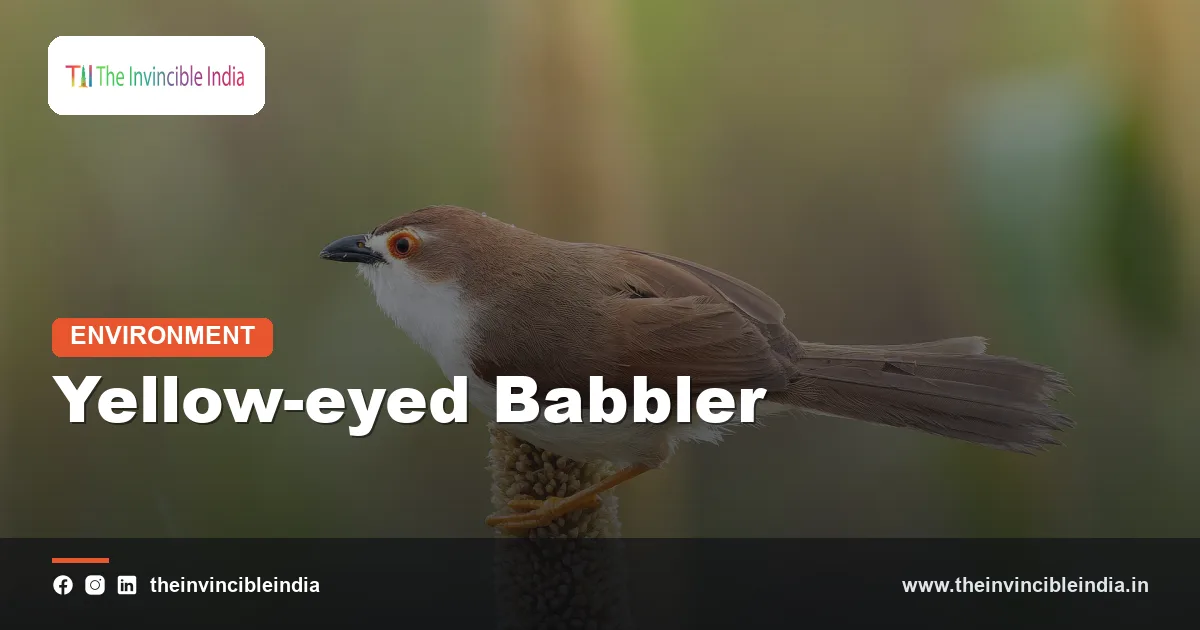
The yellow-eyed babbler (Chrysomma sinense) is a small, long-tailed, warm-brown bird of tall grass and scrub that is resident across the Indian subcontinent and is recognised by its bright orange-yellow eye and eye-ring, white underparts and sweet, ringing whistled song. Despite its name it is not a typical babbler in the strict sense, because modern classification places the species among the parrotbill family, although birdwatchers in India still treat it as one of the familiar “babblers” of open country.
The yellow-eyed babbler is a bird that most people overlook, because it spends much of its day clambering low inside dense grass and thorny bushes rather than perching in the open. This explainer covers what the yellow-eyed babbler looks like, where it lives in India, what it eats, how it sings and breeds, and how it is faring as grasslands and scrub shrink across the country.
| Attribute | Detail |
|---|---|
| Common name | Yellow-eyed babbler |
| Scientific name | Chrysomma sinense |
| Family | Paradoxornithidae (parrotbills and allies; earlier placed with the Old World babblers) |
| Size | About 18 cm long, with a long, rounded and graduated tail |
| Range and habitat in India | Widespread resident of tall grassland, scrub, thorn thickets, reedy edges and field margins across much of the country |
| Diet | Mainly insects and other small invertebrates, with some nectar, berries and seeds |
| Breeding | Neat cup nest of grass and fibre in a low bush or clump of grass; usually three to five eggs, often around the rains |
| Conservation status | Least Concern on the IUCN Red List, but dependent on grassland and scrub that are under pressure |
Key Takeaways
- The yellow-eyed babbler is a roughly 18 cm, warm rufous-brown bird with white underparts, a bright orange-yellow eye and eye-ring, and a long graduated tail.
- The yellow-eyed babbler is a resident of the Indian subcontinent and mainland Southeast Asia, and in India it lives in tall grass, scrub and thorn thickets rather than in forest.
- The yellow-eyed babbler feeds mostly on insects and spiders picked from stems and leaves, and it also takes nectar and small fruits.
- The yellow-eyed babbler is a vocal bird whose clear, sweet, whistled phrases are usually the first sign that it is present in a patch of grass.
- The yellow-eyed babbler builds a cup-shaped nest of grass in a low bush or grass clump and lays a small clutch of speckled eggs.
- The yellow-eyed babbler is classed as Least Concern, yet it is a useful indicator of healthy tall-grass and scrub habitat, which is among the most neglected habitats in India.
What does the yellow-eyed babbler look like?
The yellow-eyed babbler is a slim, small bird about 18 cm long, with rufous-brown upperparts, clean white underparts, a white throat and a notably long, rounded tail that makes up a large share of its length. Seen well, the bird is distinctive. The crown and back are a warm earthy brown, the wings may show a hint of chestnut, and the whole bird looks neat and slightly sleek compared with the scruffier birds that share its habitat.
The feature that gives the species its name is the eye. The iris is bright yellowish and is surrounded by a naked eye-ring of orange-yellow skin, which gives the bird a wide-eyed, alert expression even at a distance of several metres. Combined with a short, stout, slightly curved dark bill, this gives the head a distinctive look that separates the species from other brown birds of scrub.
Sexes and young birds
- Males and females look very similar, so the sexes are hard to tell apart in the field.
- Young birds are somewhat duller, with a paler eye and eye-ring that take time to develop their full colour.
- Plumage wear can make birds look more faded in the dry season, just before the rains.
Shape and posture
The yellow-eyed babbler often holds its tail cocked or fanned, flicks it while moving and shows a lively, restless character. It frequently clings sideways to vertical grass stems, a habit that places it among birds adapted to reeds and tall grass rather than to the open ground.
Where is the yellow-eyed babbler found in India?
The yellow-eyed babbler is found across most of peninsular and northern India, in areas that have tall grass, scrub, thorn thickets and rough field edges. Beyond India, the species occurs across the wider Indian subcontinent and into mainland Southeast Asia, which is a large range for what is a rather small and unassuming bird.
Within India the yellow-eyed babbler is a bird of dry and semi-arid zones as well as damper plains. It is resident, meaning it does not undertake long seasonal migrations, although individuals and small groups may move locally in response to changes in cover and food. The bird is generally uncommon in the heavily forested Western Ghats and in very high mountain areas, because the open, grassy habitat it prefers is limited there.
Typical habitats
- Tall grassland and savanna-like scrub with scattered bushes.
- Thorn scrub and open woodland with a dense grassy understorey.
- Reedy margins of wetlands, canals and irrigation channels.
- Field boundaries, hedgerows and uncultivated waste patches near villages.
- Dry riverbeds with thickets of tamarisk and similar low shrubs.
What does the yellow-eyed babbler eat?
The yellow-eyed babbler eats mainly insects, which it gleans from grass stems, leaves and twigs, along with spiders and other small invertebrates. Its diet is supplemented by small amounts of plant food, particularly nectar from flowering shrubs and small berries or seeds when they are available.
The bird forages low in dense vegetation, climbing and hopping between stems, peering into leaf clusters and probing the bases of grass tufts. Because it searches so thoroughly through a patch of vegetation, a group of yellow-eyed babblers can remove a surprising number of insects from a small area of scrub. Some observers have noted birds visiting nectar-rich flowers, where their foreheads and bills can pick up pollen, which suggests a minor role in pollination.
| Food type | Examples | Where it is taken |
|---|---|---|
| Insects | Caterpillars, beetles, bugs, grasshoppers, ants | Grass stems, leaves and bark crevices |
| Other invertebrates | Spiders and small snails | Low vegetation and ground litter |
| Nectar | Flowers of bushes and shrubs | Flowering scrub in the dry season |
| Fruit and seed | Small berries and grass seeds | Fruiting scrub and grass heads |
How does the yellow-eyed babbler sing and call?
The yellow-eyed babbler sings a clear, sweet and ringing series of whistled notes, often repeated from the top of a bush or a grass stem, which makes it one of the more melodious birds of Indian scrub. The song is generally a short, rising and falling phrase, and a bird will repeat it again and again, especially in the breeding season and early in the morning.
Besides the whistled song, the yellow-eyed babbler gives sharper, scolding calls when it is alarmed, and softer contact notes that keep a group together while it moves through thick vegetation. Because the birds hide so well, sound is often the best way to locate the species. A birdwatcher who learns the whistled phrase can usually find a group by walking slowly along the edge of a grassy patch and listening carefully.
Why sound matters for finding the bird
Dense grass hides almost every part of the bird except its song. A bird that sings from an exposed stem is often briefly visible, and this is the best moment to see the bright eye and long tail clearly. After a minute or so the bird usually drops back into cover.
How does the yellow-eyed babbler behave?
The yellow-eyed babbler is a social, active and fairly bold bird that moves in pairs or small parties and keeps close to dense cover. Groups of four to eight birds are common outside the breeding season, and members keep in touch through frequent calls as they forage through the same stretch of scrub.
The flight of the yellow-eyed babbler is short and low, usually a quick, fluttering dash from one bush to the next with the long tail trailing behind. The bird does not fly far unless forced to, and it prefers to scramble along stems and between branches. This gives it a mouse-like, creeping quality when it is moving inside thick vegetation.
- Pairs or small groups forage together within a loose territory.
- Birds regularly clamber up grass stems and cling to them sideways.
- Individuals pause to sing from an exposed perch before diving into cover again.
- The species roosts in dense vegetation, often in a small group.
How does the yellow-eyed babbler breed?
The yellow-eyed babbler breeds by building a neat, deep cup-shaped nest of grass and fine fibres, placed low in a bush, thorny shrub or dense grass clump, and the female usually lays three to five eggs. The nest is often bound with spider silk and lined with finer grass, and it is carefully hidden among stems so that it is difficult to spot.
The eggs are typically pinkish or whitish with reddish speckles or blotches. Breeding in India tends to be linked to the rainy season in many regions, when insects are plentiful and the grass is tall enough to offer cover, although the exact timing varies with local climate. Both parents are involved in raising the young, which leave the nest before they can fly well and stay hidden in nearby vegetation while the adults feed them.
Stages of the breeding cycle
- Pairs establish a territory and sing from conspicuous perches.
- The nest is built in a low bush or clump of grass, usually within a metre or two of the ground.
- Eggs are incubated for about two weeks, with both parents helping.
- Chicks are fed on insects and fledge after another two weeks or so.
How is the yellow-eyed babbler different from similar birds?
The yellow-eyed babbler is best separated from similar brown scrub birds by its orange-yellow eye and eye-ring, white throat and underparts, and long graduated tail. Several other birds of grass and scrub share its general colour, which makes careful observation of the eye, tail and habit important.
| Bird | Key difference from the yellow-eyed babbler |
|---|---|
| Jungle babbler | Larger and greyer, travels in noisy flocks, has a pale eye but no bright eye-ring |
| Large grey babbler | Much larger, with a long tail and grey-brown plumage, lacking the white underparts |
| Common babbler | Dark-streaked brown back and a pale eye without a bright yellow ring, and lacking the neat white underparts |
| Prinias and warblers | Smaller, thinner billed, with different calls and no bright eye-ring |
Because of its shape and clinging habits, the yellow-eyed babbler can also be mistaken for a prinia at first glance. A good look at the eye and the pale underparts generally settles the identification.
Why does the yellow-eyed babbler matter for the environment?
The yellow-eyed babbler matters because it is both a natural insect controller and an indicator of the health of tall-grass and scrub habitats, which often receive less attention than forests. By eating large numbers of insects, including caterpillars and beetles, the birds help keep populations of plant-eating insects in check across fields, hedges and rough ground.
Grasslands and scrub are sometimes wrongly labelled “wasteland” in land records, which makes them easy to convert to plantations, farms, mines or housing. When these patches disappear, birds like the yellow-eyed babbler lose their nesting cover and their insect food at once. Keeping hedgerows, field margins and patches of tall grass is therefore one of the simplest ways to support the species.
What is the conservation status of the yellow-eyed babbler?
The yellow-eyed babbler is classed as Least Concern on the IUCN Red List, because it has a very wide range across South and Southeast Asia and is still locally common in suitable habitat. This rating describes the species as a whole and does not mean that every local population is secure.
In India the main pressures on the yellow-eyed babbler are the conversion of grassland and scrub into cultivation and built-up areas, the clearing of hedgerows, overgrazing, and the burning of grass at the wrong time of year. Pesticide use on farmland can also reduce the insects on which the bird depends. Protecting patches of tall grass and avoiding widespread removal of thorny scrub are useful conservation measures that benefit many other species as well.
How can you watch the yellow-eyed babbler?
The best way to watch the yellow-eyed babbler is to visit a patch of tall grass or thorn scrub early in the morning, stand still near its edge and listen for the sweet whistled song. Early hours are best because the birds are most active and vocal before the day becomes hot.
- Walk slowly along field edges, scrubby tracks and the margins of wetlands.
- Listen first, then scan the tops of bushes and grass stems for an upright, long-tailed bird.
- Use binoculars to see the bright eye and eye-ring, which are the key identification marks.
- Avoid walking into the grass itself, since this can damage nests and disturb breeding birds.
- Be patient, because the birds often vanish into cover and reappear a few metres away.
Bottom Line
The yellow-eyed babbler is a small, melodious, bright-eyed bird of tall grass and scrub that is widespread but easy to miss. Its presence says a good deal about the quality of the rough, unglamorous habitats around Indian fields and villages, and these habitats deserve more protection than they usually receive.
Frequently Asked Questions
What is a yellow-eyed babbler?
The yellow-eyed babbler is a small, long-tailed bird of tall grass and scrub with rufous-brown upperparts, white underparts and a bright orange-yellow eye and eye-ring. It is a resident across the Indian subcontinent. Scientists place it in the parrotbill family, although it is still commonly called a babbler.
What does the yellow-eyed babbler eat?
The yellow-eyed babbler eats mainly insects and spiders picked from grass stems and leaves. It also takes nectar from flowers and small berries or seeds. This varied diet lets the bird stay in the same patch of scrub through most of the year.
Where does the yellow-eyed babbler live in India?
The yellow-eyed babbler lives in tall grassland, scrub, thorn thickets and the reedy edges of wetlands across much of India. It prefers open, grassy habitats over dense forest. It is also found in field margins and hedgerows near villages.
How can you identify a yellow-eyed babbler?
The yellow-eyed babbler is identified by its bright orange-yellow eye and eye-ring, its white throat and underparts, and its long graduated tail. It often clings sideways to grass stems and sings a sweet, whistled phrase. Its slim shape and neat appearance distinguish it from larger, scruffier babblers.
Does the yellow-eyed babbler sing?
The yellow-eyed babbler does sing, and its clear, sweet, whistled phrases are one of the most pleasant sounds of Indian scrub. Birds repeat the song from exposed perches, especially in the early morning. The song is often the first sign that a group of yellow-eyed babblers is nearby.
Is the yellow-eyed babbler endangered?
The yellow-eyed babbler is not endangered, and the IUCN classes it as Least Concern because it has a very wide range. Local declines can still occur where grassland and scrub are converted to farms, mines or buildings. Protecting tall grass and hedgerows helps the species survive.
{“@context”:”https://schema.org”,”@graph”:[{“@type”:”FAQPage”,”mainEntity”:[{“@type”:”Question”,”name”:”What is a yellow-eyed babbler?”,”acceptedAnswer”:{“@type”:”Answer”,”text”:”The yellow-eyed babbler is a small, long-tailed bird of tall grass and scrub with rufous-brown upperparts, white underparts and a bright orange-yellow eye and eye-ring. It is a resident across the Indian subcontinent. Scientists place it in the parrotbill family, although it is still commonly called a babbler.”}},{“@type”:”Question”,”name”:”What does the yellow-eyed babbler eat?”,”acceptedAnswer”:{“@type”:”Answer”,”text”:”The yellow-eyed babbler eats mainly insects and spiders picked from grass stems and leaves. It also takes nectar from flowers and small berries or seeds. This varied diet lets the bird stay in the same patch of scrub through most of the year.”}},{“@type”:”Question”,”name”:”Where does the yellow-eyed babbler live in India?”,”acceptedAnswer”:{“@type”:”Answer”,”text”:”The yellow-eyed babbler lives in tall grassland, scrub, thorn thickets and the reedy edges of wetlands across much of India. It prefers open, grassy habitats over dense forest. It is also found in field margins and hedgerows near villages.”}},{“@type”:”Question”,”name”:”How can you identify a yellow-eyed babbler?”,”acceptedAnswer”:{“@type”:”Answer”,”text”:”The yellow-eyed babbler is identified by its bright orange-yellow eye and eye-ring, its white throat and underparts, and its long graduated tail. It often clings sideways to grass stems and sings a sweet, whistled phrase. Its slim shape and neat appearance distinguish it from larger, scruffier babblers.”}},{“@type”:”Question”,”name”:”Does the yellow-eyed babbler sing?”,”acceptedAnswer”:{“@type”:”Answer”,”text”:”The yellow-eyed babbler does sing, and its clear, sweet, whistled phrases are one of the most pleasant sounds of Indian scrub. Birds repeat the song from exposed perches, especially in the early morning. The song is often the first sign that a group of yellow-eyed babblers is nearby.”}},{“@type”:”Question”,”name”:”Is the yellow-eyed babbler endangered?”,”acceptedAnswer”:{“@type”:”Answer”,”text”:”The yellow-eyed babbler is not endangered, and the IUCN classes it as Least Concern because it has a very wide range. Local declines can still occur where grassland and scrub are converted to farms, mines or buildings. Protecting tall grass and hedgerows helps the species survive.”}}]}]}


