

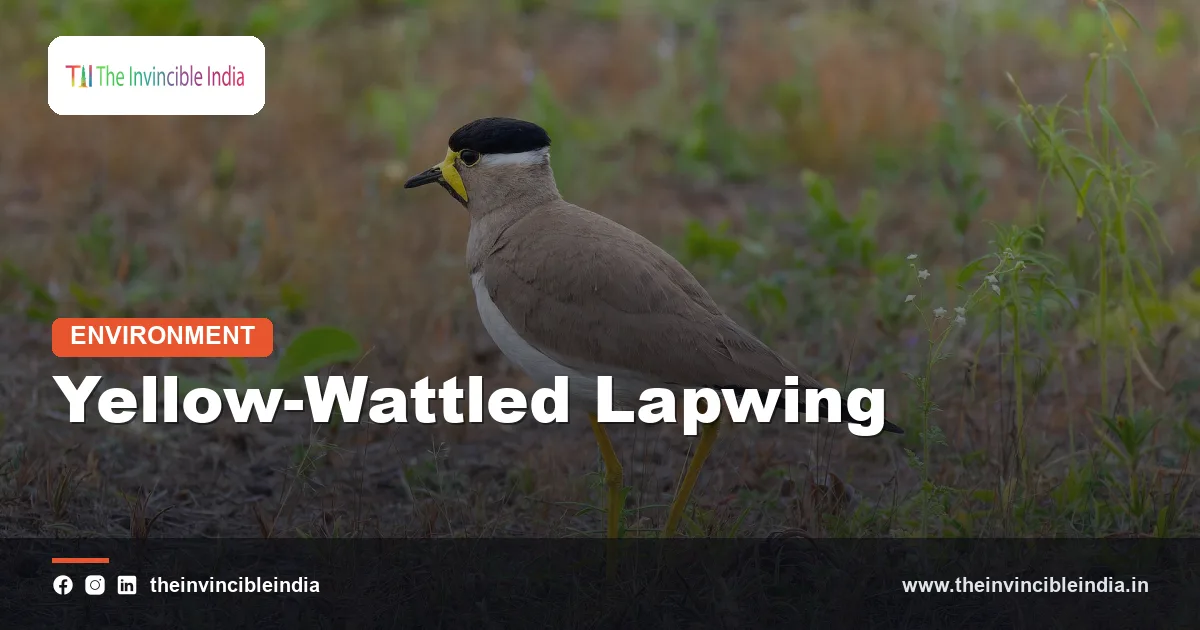
The yellow-wattled lapwing (Vanellus malabaricus) is a sandy-brown plover of India’s dry open country, identified by the bright yellow fleshy wattles in front of its eyes, its yellow legs and a black cap bordered by a white band. It nests in a bare scrape on the ground, calls sharply when disturbed, and is a bird of dry grassland, fallow fields and scrub rather than of wetlands.
The yellow-wattled lapwing is found mainly in peninsular India and Sri Lanka, where it is a locally common resident. It is often overlooked because its plumage blends so well with dry earth, and it is frequently confused with its louder relative, the red-wattled lapwing, which is a very different bird in several ways.
| Quick Fact | Detail |
|---|---|
| Common names | Yellow-wattled lapwing, yellow-wattled plover |
| Scientific name | Vanellus malabaricus |
| Family | Charadriidae (plovers and lapwings) |
| Size | About 26 to 28 cm long |
| Key field marks | Yellow facial wattles, yellow legs, black cap with white border, sandy-brown back |
| Habitat | Dry grassland, fallow farmland, scrub, dry riverbeds and open stony ground |
| Diet | Insects such as beetles, ants and termites, plus other small invertebrates |
| Nest | Shallow scrape on bare ground, often among pebbles; usually about three or four eggs |
| Conservation status | Least Concern on the IUCN Red List |
Key Takeaways
- The yellow-wattled lapwing is a ground-dwelling plover of dry open country in the Indian subcontinent, easily recognised by yellow facial wattles and yellow legs.
- The yellow-wattled lapwing lacks the black neck and red wattles of the red-wattled lapwing and instead has a pale sandy-brown body with a black cap and a white band behind the eye.
- The yellow-wattled lapwing nests in a simple scrape on bare ground, relying on camouflaged eggs and distraction displays rather than a built nest to protect its clutch.
- The yellow-wattled lapwing feeds mainly on insects, especially beetles, ants and termites, which it picks from the ground in short run-and-stop bursts.
- The yellow-wattled lapwing is typically a bird of dry plains and is less tied to water than most lapwings, though it may visit wet edges after rain.
- The yellow-wattled lapwing is classed as Least Concern, but loss of grassland and trampling of ground nests by livestock and vehicles can affect local numbers.
What does a yellow-wattled lapwing look like?
A yellow-wattled lapwing looks like a medium-sized, long-legged wader with sandy-brown upperparts, a black crown, a white band behind and above the eye, and a white belly. The most striking features are the bright yellow wattles, which are fleshy folds of skin that hang in front of the eye, and the yellow bill base and legs.
The bill is yellow with a dark tip. The breast is brownish, shading into the white belly, and the tail is white with a broad black band near the tip, which flashes clearly when the bird takes off. In flight, the broad white wing bars contrast with black flight feathers.
Unlike the red-wattled lapwing, the yellow-wattled lapwing does not have a black throat and neck with a white stripe running down the side of the neck. The whole impression is paler, sandier and plainer, a pattern that suits a bird living on dry, light-coloured soil.
Where does the yellow-wattled lapwing live in India?
The yellow-wattled lapwing lives mainly in the drier parts of peninsular India, including the Deccan plateau, Karnataka, Tamil Nadu, Andhra Pradesh, Maharashtra, Gujarat and parts of central and northern India, and it also occurs in Sri Lanka. Its range extends in places toward the western plains, and it is seen only locally in the northern foothills.
It prefers dry, open habitats where the ground is bare or covered with short grass. Common places to find it include:
- Dry grassland and scrub plains.
- Fallow and ploughed fields after harvest.
- Stony or gravelly ground and dry riverbeds.
- Edges of dry reservoirs and tanks, usually away from deep water.
- Open ground near cultivation, airfields and the outskirts of towns.
The species is non-migratory, although flocks may wander locally outside the breeding season, in response to rain, crop cycles and the availability of insects.
How is the yellow-wattled lapwing different from the red-wattled lapwing?
The yellow-wattled lapwing differs from the red-wattled lapwing mainly in wattle colour, head pattern and habitat: its wattles are yellow rather than red, and it has a pale brown body without the black neck and white cheek stripe of its red-wattled cousin. It also prefers drier, more open land and is generally less noisy and less common.
| Feature | Yellow-wattled lapwing | Red-wattled lapwing |
|---|---|---|
| Scientific name | Vanellus malabaricus | Vanellus indicus |
| Wattles | Yellow | Red |
| Head and neck | Black cap, white band behind eye; pale throat | Black head, throat and breast with white stripe on neck side |
| Bill | Yellow with dark tip | Red with black tip |
| Legs | Yellow | Yellowish |
| Habitat | Dry plains, scrub, fallow fields | Near water, fields, parks and wet ground |
| Voice | Sharp, high, less insistent calls | Loud “did-he-do-it” alarm call |
| Abundance | Local and patchy | Widespread and common |
A quick tip for beginners: if the lapwing has a bold black-and-white face and neck and a vivid red facial patch, it is the red-wattled species. If the bird looks sandy, with yellow around the eye, it is the yellow-wattled.
What does the yellow-wattled lapwing eat?
The yellow-wattled lapwing eats mostly insects and other small invertebrates, including beetles, ants, termites, grasshoppers and their larvae, which it takes from the soil surface. The bird is a visual hunter that walks or runs a few steps, stops, scans the ground, and then snaps up prey with a quick peck.
This run-stop-peck pattern is common in plovers and lapwings. In farmland, yellow-wattled lapwings follow ploughs and visit freshly turned soil, where insects and grubs are exposed. Some seeds and plant material may also be taken, but animal prey makes up most of the diet.
By eating many ground-dwelling insects, including some crop pests, the bird provides a small benefit to farmers, although its contribution is rarely measured.
How does the yellow-wattled lapwing breed?
The yellow-wattled lapwing breeds by laying eggs directly in a shallow scrape on bare ground, usually among pebbles, dry clods or sparse grass, and it builds little or no nest lining. Breeding is mostly in the dry season, often from about March to June in much of India, before the monsoon rains arrive, although timing varies with region.
The clutch is typically three or four eggs, buff to olive in colour with dark blotches, which make them almost invisible against stony soil. Both parents take part in incubation and in defending the nest. The chicks are precocial, meaning they are covered in down and can walk and feed soon after hatching, and they leave the nest scrape within hours.
- Nest site: bare, open ground, frequently among stones.
- Clutch size: usually three to four eggs.
- Egg colour: buff or olive with dark blotches, well camouflaged.
- Chicks: downy and mobile soon after hatching.
- Parental care: both parents guard the eggs and young.
What is the distraction display of the yellow-wattled lapwing?
The distraction display of the yellow-wattled lapwing is a behaviour in which a parent pretends to be injured, dragging a wing or fluttering along the ground, to lead a predator away from its eggs or chicks. Many ground-nesting plovers use this broken-wing act, and the lapwing performs it when a person, dog or other intruder comes close to the nest.
The bird also uses more direct defence. It calls sharply, circles overhead, and may swoop at intruders. Once the threat has moved away from the nest, the parent usually returns to the scrape and settles on the eggs again.
Because the eggs are laid on open ground, they are vulnerable to livestock, vehicles and people walking through fields. If you notice a lapwing displaying vigorously, it is best to move away quietly and avoid searching for the nest.
What does the yellow-wattled lapwing sound like?
The yellow-wattled lapwing sounds like a bird giving sharp, high-pitched, repeated notes, often rendered as a sequence of thin “chee” or “tit” calls, usually given in alarm or while in flight. It is generally quieter and less insistent than the red-wattled lapwing, whose loud, ringing calls are among the most familiar sounds of Indian fields.
Calls are most noticeable in the breeding season, when pairs defend territory, and at dusk, when birds may be active. Because the species is rather unobtrusive, many people first notice it only when a bird calls and flies up from the ground.
Is the yellow-wattled lapwing threatened?
The yellow-wattled lapwing is not globally threatened and is listed as Least Concern by the IUCN, but it depends on dry grassland and open ground that are shrinking in many areas. Conversion of scrub and grassland to intensive farming, plantations, roads and built-up land can remove nesting habitat.
The ground-nesting habit makes the species vulnerable at a local level, because eggs and chicks are easily trampled or destroyed by grazing animals, tractors and off-road vehicles. Wild birds, including lapwings, are protected under India’s Wildlife (Protection) Act, 1972, which prohibits hunting and capture in most circumstances.
Conservation of open natural grasslands, which are often wrongly labelled as wasteland, helps this species along with many others, such as bustards, larks, coursers and wolves.
How can you spot a yellow-wattled lapwing?
You can spot a yellow-wattled lapwing by scanning dry, open ground for a sandy-coloured bird standing upright with yellow patches near the eyes, then confirming the black cap and yellow legs with binoculars. Early morning and late afternoon are the best times, when birds are most active and the light shows the yellow wattles clearly.
- Search fallow fields, dry scrub and edges of dry tanks rather than lakes.
- Look for birds standing still on bare ground, as they tend to freeze when watched.
- Scan for the white tail with a black band when the bird flies.
- Keep a respectful distance, especially in the nesting season.
- Note the date and place, which can be recorded in citizen-science bird platforms.
Why do lapwings have wattles?
Lapwings have wattles as bare, fleshy skin ornaments on the face whose exact function is not fully settled, but they are generally thought to play a role in recognition and display between birds of the same species. The yellow wattles of the yellow-wattled lapwing are bright against its dull plumage and are clearly visible at a distance.
Wattles are found in several groups of birds, from chickens and turkeys to some plovers. In lapwings they are usually larger and more vivid in breeding adults. Because the colour comes from living tissue with a blood supply, it can look brighter in the breeding season and fade when the bird is stressed or unwell.
Whatever their evolutionary role, wattles are a convenient tool for birdwatchers, since the colour of the wattle is the quickest way to separate the lapwing species of the Indian subcontinent.
Bottom Line
The yellow-wattled lapwing is a sandy-brown, yellow-faced plover that quietly occupies India’s dry plains and scrub. Its camouflage, ground nest and broken-wing display show how a bird can survive in open country, and its future depends on keeping that open habitat intact.
Frequently Asked Questions
What is a yellow-wattled lapwing?
A yellow-wattled lapwing is a medium-sized plover, Vanellus malabaricus, with yellow facial wattles, yellow legs and a sandy-brown back. It lives in dry open country in peninsular India and Sri Lanka. It feeds on insects and nests on bare ground.
How do you tell a yellow-wattled lapwing from a red-wattled lapwing?
You tell the two apart mainly by the colour of the wattles and the pattern of the head and neck. The yellow-wattled lapwing has yellow wattles and a pale throat, while the red-wattled lapwing has red wattles, a black throat and a white stripe down the side of the neck. The yellow-wattled bird also favours drier habitat.
Where can you see yellow-wattled lapwings in India?
You can see yellow-wattled lapwings in dry grassland, scrub, fallow fields and stony ground across peninsular India and parts of central India. They are patchy rather than evenly spread, so local knowledge helps. Early morning visits to dry open plains usually give the best chance.
What does a yellow-wattled lapwing eat?
A yellow-wattled lapwing eats mainly insects such as beetles, ants and termites, along with other small invertebrates. It hunts by running a few steps, pausing and pecking at the ground. Freshly ploughed fields are productive feeding sites.
When does the yellow-wattled lapwing breed?
The yellow-wattled lapwing usually breeds in the dry season, commonly from around March to June in much of India, before the monsoon. The exact timing varies with region and local conditions. It lays about three or four camouflaged eggs in a scrape on bare ground.
Is the yellow-wattled lapwing endangered?
No, the yellow-wattled lapwing is not endangered and is listed as Least Concern by the IUCN. However, grassland loss, farming changes and disturbance of ground nests can reduce local populations. Protecting open dry habitats helps keep the species secure.
{“@context”:”https://schema.org”,”@graph”:[{“@type”:”FAQPage”,”mainEntity”:[{“@type”:”Question”,”name”:”What is a yellow-wattled lapwing?”,”acceptedAnswer”:{“@type”:”Answer”,”text”:”A yellow-wattled lapwing is a medium-sized plover, Vanellus malabaricus, with yellow facial wattles, yellow legs and a sandy-brown back. It lives in dry open country in peninsular India and Sri Lanka. It feeds on insects and nests on bare ground.”}},{“@type”:”Question”,”name”:”How do you tell a yellow-wattled lapwing from a red-wattled lapwing?”,”acceptedAnswer”:{“@type”:”Answer”,”text”:”You tell the two apart mainly by the colour of the wattles and the pattern of the head and neck. The yellow-wattled lapwing has yellow wattles and a pale throat, while the red-wattled lapwing has red wattles, a black throat and a white stripe down the side of the neck. The yellow-wattled bird also favours drier habitat.”}},{“@type”:”Question”,”name”:”Where can you see yellow-wattled lapwings in India?”,”acceptedAnswer”:{“@type”:”Answer”,”text”:”You can see yellow-wattled lapwings in dry grassland, scrub, fallow fields and stony ground across peninsular India and parts of central India. They are patchy rather than evenly spread, so local knowledge helps. Early morning visits to dry open plains usually give the best chance.”}},{“@type”:”Question”,”name”:”What does a yellow-wattled lapwing eat?”,”acceptedAnswer”:{“@type”:”Answer”,”text”:”A yellow-wattled lapwing eats mainly insects such as beetles, ants and termites, along with other small invertebrates. It hunts by running a few steps, pausing and pecking at the ground. Freshly ploughed fields are productive feeding sites.”}},{“@type”:”Question”,”name”:”When does the yellow-wattled lapwing breed?”,”acceptedAnswer”:{“@type”:”Answer”,”text”:”The yellow-wattled lapwing usually breeds in the dry season, commonly from around March to June in much of India, before the monsoon. The exact timing varies with region and local conditions. It lays about three or four camouflaged eggs in a scrape on bare ground.”}},{“@type”:”Question”,”name”:”Is the yellow-wattled lapwing endangered?”,”acceptedAnswer”:{“@type”:”Answer”,”text”:”No, the yellow-wattled lapwing is not endangered and is listed as Least Concern by the IUCN. However, grassland loss, farming changes and disturbance of ground nests can reduce local populations. Protecting open dry habitats helps keep the species secure.”}}]}]}


