

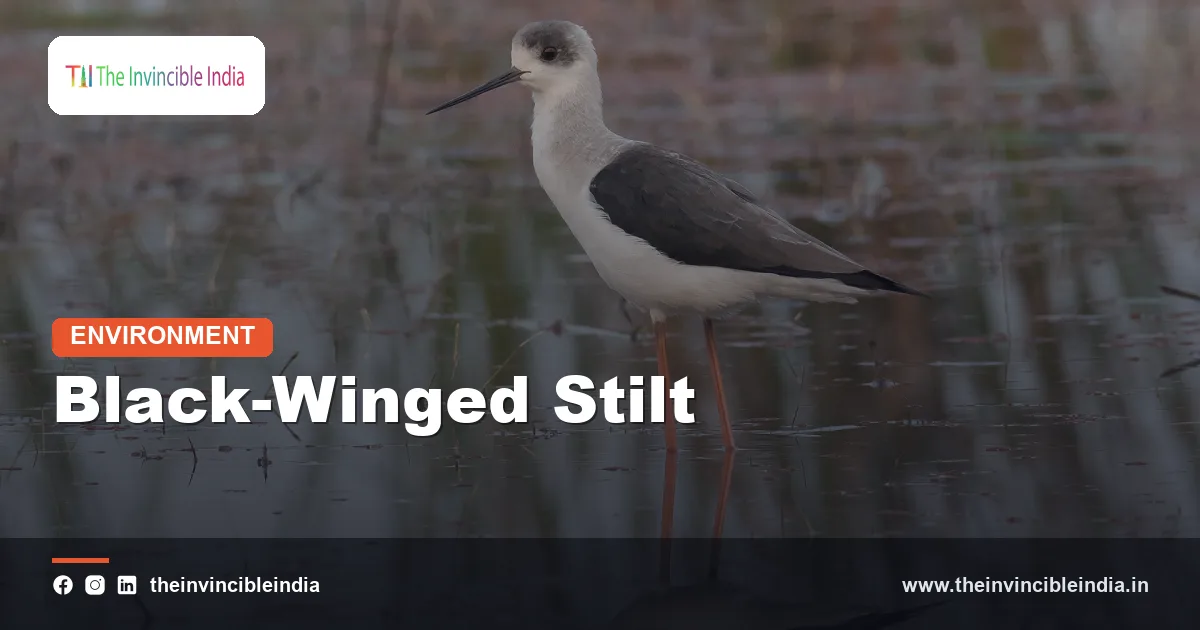
The black-winged stilt (Himantopus himantopus) is an elegant black-and-white wading bird with extremely long pink-red legs and a needle-thin black bill, found in shallow wetlands, salt pans, marshes and flooded fields across India. It wades deep into the water on its stilt-like legs to pick insects, small crustaceans and other prey from the surface and mud.
The black-winged stilt is both a resident and a winter visitor in India, so its numbers swell in the cooler months when birds arrive from the north. It is among the easiest waders to recognise, and it is a common sight at lakes, reservoirs, sewage ponds and coastal lagoons.
| Quick Fact | Detail |
|---|---|
| Common names | Black-winged stilt, common stilt |
| Scientific name | Himantopus himantopus |
| Family | Recurvirostridae (avocets and stilts) |
| Size | About 33 to 36 cm long; very long legs |
| Key field marks | White body, black wings and back, long pink-red legs, thin straight black bill |
| Habitat | Shallow freshwater and brackish wetlands, salt pans, mudflats, flooded fields |
| Diet | Aquatic insects, crustaceans, molluscs, tadpoles and tiny fish |
| Nest | Ground nest at the water’s edge or on a small mound; usually about four eggs |
| Conservation status | Least Concern on the IUCN Red List |
Key Takeaways
- The black-winged stilt is a wading bird with some of the longest legs, relative to body size, of any bird, a feature that lets it feed in water too deep for most waders.
- The black-winged stilt has a white body, black wings, a thin straight black bill and pink-red legs, and the amount of black on the head varies with sex, age and season.
- The black-winged stilt is found across India both as a breeding resident and as a winter visitor, and it favours shallow wetlands, salt pans and flooded fields.
- The black-winged stilt feeds mainly on aquatic insects, crustaceans, molluscs and tadpoles, picking prey delicately from the water surface and mud.
- The black-winged stilt nests on the ground near water, and both parents mob intruders with loud, repeated calls to protect the eggs and chicks.
- The black-winged stilt is listed as Least Concern, but it relies on shallow wetlands, which are lost to drainage, pollution and development in many places.
What does a black-winged stilt look like?
A black-winged stilt looks like a slender, long-necked wader with a clean white head, neck and underparts, glossy black wings and back, a long thin black bill and strikingly long pink to red legs. In flight, the legs trail far behind the tail, and the black wings contrast sharply with the white body.
The head pattern is variable. Breeding males often show a black patch or cap on the crown and back of the neck, while females and many non-breeding birds have a whiter head with a greyish smudge. Juveniles are browner, with pale-edged back feathers and duller legs.
The legs deserve special mention. They are among the longest, in proportion to body size, of any bird, apart from flamingos, and they appear almost too thin to support the body. This unusual anatomy is an adaptation to wading through water that other shorebirds would find too deep.
Where is the black-winged stilt found in India?
The black-winged stilt is found in suitable wetlands across almost all of India, from the Himalayan foothills to the southern coast and from Gujarat to the north-east. It is a familiar bird at large lakes and reservoirs, at coastal lagoons and salt pans, and at smaller village ponds and flooded paddy fields.
Some well-known places where stilts are regularly seen include the Rann of Kutch and Gujarat’s coastal wetlands, Sambhar Lake in Rajasthan, Chilika Lake in Odisha, Point Calimere in Tamil Nadu, Keoladeo National Park in Rajasthan and the backwaters and lagoons of the west and east coasts. The species also appears at man-made habitats such as sewage-treatment ponds and reservoirs.
- Freshwater wetlands: lakes, marshes, reservoirs and tank edges.
- Coastal habitats: salt pans, lagoons, estuaries and tidal flats.
- Farmland: flooded fields and irrigated paddy.
- Artificial water: sewage ponds and shallow storage tanks.
What does the black-winged stilt eat?
The black-winged stilt eats mainly small aquatic animals, including water insects and their larvae, crustaceans, molluscs, worms, tadpoles and occasionally tiny fish. It picks these from the water surface, from the mud, or from just below the surface in shallow water.
The bill is thin and straight, built for precise pecking rather than probing deeply. A stilt usually walks slowly and steadily through shallow water, sometimes pausing to look and then stabbing quickly at prey. The long legs allow it to feed where the water is up to its belly, away from the crowds of shorter-legged waders.
Stilts occasionally feed in groups and may also catch flying insects hovering over the water. In saline habitats such as salt pans, they take advantage of brine shrimp and similar small crustaceans.
Is the black-winged stilt a resident or a migrant in India?
The black-winged stilt is both a resident and a migrant in India, because local breeding birds stay in the country all year while additional birds arrive from the north in winter. This dual status is common in waders, and it makes the stilt visible across the year in many wetlands.
Wintering stilts arrive from breeding grounds in Central Asia and nearby regions, usually from autumn, and many leave again in spring. In India, local breeding often takes place during the dry season, around March to July in many regions, in places where water levels are stable and shallow.
Because the numbers fluctuate seasonally, bird-count surveys such as the Asian Waterbird Census usually record stilts in higher numbers in winter, when migrants mix with residents in the same wetlands.
How does the black-winged stilt breed?
The black-winged stilt breeds by making a simple nest on the ground near water, either a scrape lined with bits of vegetation or a small mound of mud and plant material, and laying usually about four eggs. The eggs are buff or olive with dark blotches and are camouflaged against the muddy ground.
Stilts often nest in loose colonies, with several pairs spread across the same patch of shallow water or mudflat. Both parents incubate the eggs, which hatch after roughly three and a half weeks. The chicks are covered in down and can leave the nest soon after hatching, though the parents continue to guard and lead them.
- Nest site: mudflats, islets, edges of shallow lakes and salt pans.
- Nest type: ground scrape or small mound that can be raised if water rises.
- Clutch size: usually about four eggs.
- Parental care: both parents incubate and defend the young.
- Chicks: precocial and able to feed themselves shortly after hatching.
How does the black-winged stilt defend its nest?
The black-winged stilt defends its nest by noisy group mobbing, in which adults fly at intruders, call loudly and sometimes feign injury to draw predators away. The call is a sharp, repeated, yapping note, often written as “kyip”, and a colony can sound like a pack of small dogs when disturbed.
Both parents take part in defence. They may dive-bomb crows, gulls, dogs or people who approach the nest area, and neighbouring pairs often join in. The combined effort helps protect the vulnerable ground nests from predators.
Observers should keep well away from nesting stilts. Repeated disturbance can make parents leave the nest, which exposes the eggs to heat, cold or predators.
How can you tell a black-winged stilt from similar waders?
You can tell a black-winged stilt from similar waders by its extreme leg length, pink-red colour and the black-and-white plumage, which no other common Indian wader combines. Shorter-legged waders such as sandpipers and plovers are plainer and do not wade as deeply.
| Bird | Legs | Bill | Plumage |
|---|---|---|---|
| Black-winged stilt | Very long, pink-red | Thin, straight, black | White body, black wings and back |
| Pied avocet | Long, bluish-grey | Thin and upcurved | White with black bands on head and wings |
| Little ringed plover | Short, pale | Short, dark | Brown above, white below with a black neck band |
| Common redshank | Medium, orange-red | Medium, red base | Greyish-brown, streaked |
The upcurved bill of the avocet is the main feature distinguishing it from the stilt, which has a straight bill. Both belong to the same family, Recurvirostridae.
Is the black-winged stilt threatened?
The black-winged stilt is not threatened and is classed as Least Concern by the IUCN, since it has a very large range and a large, widespread population. Even so, local declines can occur when wetlands are drained, polluted or converted for other uses.
Shallow wetlands, salt pans and seasonal marshes are often undervalued and are among the most threatened habitat types in India. Drainage for development, disturbance, dumping of waste, and changes to salt-pan management can reduce nesting and feeding space. In India, wild birds are protected under the Wildlife (Protection) Act, 1972, and many stilt habitats lie within sanctuaries, Ramsar Sites and bird areas.
How can you watch black-winged stilts responsibly?
You can watch black-winged stilts responsibly by observing from a distance, using binoculars or a telescope, and avoiding any approach to nesting areas. A quiet position at a path or hide gives the best views, with early morning and late afternoon providing good light.
- Use binoculars instead of walking close to the water’s edge.
- Avoid flushing flocks, which wastes energy and exposes birds to predators.
- Keep dogs on leads near wetlands, especially in the nesting season.
- Do not litter, since plastic and waste harm wetland life.
- Report sightings to citizen-science platforms to support monitoring.
What role do stilts play in wetland ecosystems?
Stilts play the role of mid-level predators in wetland food webs, because they eat large numbers of aquatic insects, crustaceans and other small animals while themselves being prey for larger birds and mammals. Their presence often signals that a shallow wetland still supports plenty of invertebrate life.
Bird-watchers and wetland managers frequently use waders as simple indicators of wetland health. A site where stilts feed and breed successfully is likely to have clean enough water, adequate food and some safety from disturbance. A sudden absence from a previously used site can be an early warning of drainage, pollution or heavy human pressure.
Stilts also share wetlands with many other species, from flamingos and avocets to ducks, herons and sandpipers. In salt pans and shallow lagoons, they often feed alongside these birds without much conflict, since their long legs let them reach depths that smaller waders cannot.
- Predator of aquatic insects and small crustaceans.
- Prey for larger raptors, foxes and snakes at nest sites.
- Indicator of healthy shallow-water habitat.
- Shares feeding space with many other wetland species.
Bottom Line
The black-winged stilt is a graceful, long-legged wader that brings colour and movement to India’s shallow wetlands. It is common and secure for now, yet its survival depends on healthy shallow-water habitats, which deserve the same attention as larger and more famous wetlands.
Frequently Asked Questions
What is a black-winged stilt?
A black-winged stilt is a long-legged wading bird, Himantopus himantopus, with a white body, black wings and back, and pink-red legs. It lives in shallow wetlands across India and much of the world. It feeds mainly on insects and other small aquatic animals.
Why does the black-winged stilt have such long legs?
The black-winged stilt has long legs so that it can wade into deeper water than most other waders and feed there with little competition. The legs also keep its body dry while its thin bill picks prey from the surface. Relative to body size, they are among the longest of any bird.
Is the black-winged stilt found all over India?
Yes, the black-winged stilt is found in suitable wetlands across almost all of India. It occurs at lakes, reservoirs, salt pans, coastal lagoons and flooded fields, and its numbers increase in winter when migrants arrive. It is mostly absent from dry, waterless areas.
What does a black-winged stilt eat?
A black-winged stilt eats aquatic insects, crustaceans, molluscs, worms, tadpoles and sometimes small fish. It picks prey from the water surface and mud with its thin straight bill. In salt pans it also feeds on tiny crustaceans such as brine shrimp.
How many eggs does a black-winged stilt lay?
A black-winged stilt usually lays about four eggs in a ground nest close to water. The eggs are buff or olive with dark blotches, which camouflages them against mud. Both parents incubate them and guard the chicks after hatching.
What is the difference between a stilt and an avocet?
The main difference is the bill: a stilt has a thin, straight bill, while an avocet has a bill that curves upward. The black-winged stilt also has pink-red legs and black wings, whereas the pied avocet has bluish-grey legs and bold black bands on a white body. Both are in the same family, Recurvirostridae.
{“@context”:”https://schema.org”,”@graph”:[{“@type”:”FAQPage”,”mainEntity”:[{“@type”:”Question”,”name”:”What is a black-winged stilt?”,”acceptedAnswer”:{“@type”:”Answer”,”text”:”A black-winged stilt is a long-legged wading bird, Himantopus himantopus, with a white body, black wings and back, and pink-red legs. It lives in shallow wetlands across India and much of the world. It feeds mainly on insects and other small aquatic animals.”}},{“@type”:”Question”,”name”:”Why does the black-winged stilt have such long legs?”,”acceptedAnswer”:{“@type”:”Answer”,”text”:”The black-winged stilt has long legs so that it can wade into deeper water than most other waders and feed there with little competition. The legs also keep its body dry while its thin bill picks prey from the surface. Relative to body size, they are among the longest of any bird.”}},{“@type”:”Question”,”name”:”Is the black-winged stilt found all over India?”,”acceptedAnswer”:{“@type”:”Answer”,”text”:”Yes, the black-winged stilt is found in suitable wetlands across almost all of India. It occurs at lakes, reservoirs, salt pans, coastal lagoons and flooded fields, and its numbers increase in winter when migrants arrive. It is mostly absent from dry, waterless areas.”}},{“@type”:”Question”,”name”:”What does a black-winged stilt eat?”,”acceptedAnswer”:{“@type”:”Answer”,”text”:”A black-winged stilt eats aquatic insects, crustaceans, molluscs, worms, tadpoles and sometimes small fish. It picks prey from the water surface and mud with its thin straight bill. In salt pans it also feeds on tiny crustaceans such as brine shrimp.”}},{“@type”:”Question”,”name”:”How many eggs does a black-winged stilt lay?”,”acceptedAnswer”:{“@type”:”Answer”,”text”:”A black-winged stilt usually lays about four eggs in a ground nest close to water. The eggs are buff or olive with dark blotches, which camouflages them against mud. Both parents incubate them and guard the chicks after hatching.”}},{“@type”:”Question”,”name”:”What is the difference between a stilt and an avocet?”,”acceptedAnswer”:{“@type”:”Answer”,”text”:”The main difference is the bill: a stilt has a thin, straight bill, while an avocet has a bill that curves upward. The black-winged stilt also has pink-red legs and black wings, whereas the pied avocet has bluish-grey legs and bold black bands on a white body. Both are in the same family, Recurvirostridae.”}}]}]}


