

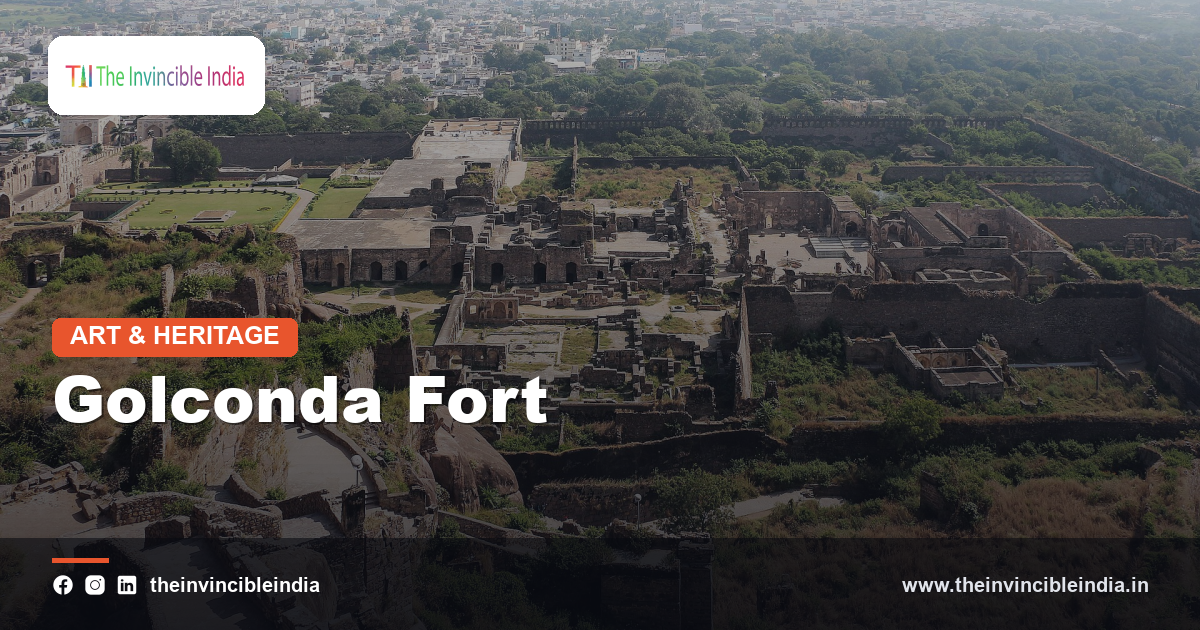
Golconda Fort rises on a granite hill on the outskirts of Hyderabad, its massive walls and bastions bearing witness to centuries of Deccan political history. Built up over successive dynasties and reaching its most celebrated form under the Qutb Shahi rulers, the fort combines formidable military architecture with a legacy tied to one of the most storied chapters of the global diamond trade. Its ingenious defensive design places it among the notable strongholds discussed alongside other great forts of India. Today Golconda stands as a striking ruin, its silhouette and clever engineering still capable of impressing visitors centuries after its active military use ended.
Quick Facts
| Detail | Information |
|---|---|
| Location | Near Hyderabad, Telangana |
| Built by | Kakatiya origins, expanded by Qutb Shahi dynasty |
| Material | Granite |
| Notable feature | Acoustic engineering at entrance gate |
| Historic association | Diamond trade and cutting center |
| Status | Protected historical monument |
A Hilltop Stronghold
Golconda Fort occupies a commanding position atop a granite hill, its elevated location chosen for the natural defensive advantage it offered over the surrounding plains. The fort’s walls follow the contours of the hill, incorporating the natural rock formations into its overall defensive scheme.
This hilltop siting allowed defenders to observe approaching threats from a considerable distance while making any assault on the fort a physically demanding undertaking. Such strategic use of natural terrain is a recurring feature of major Indian forts, and Golconda represents one of the most effective examples of this defensive philosophy in the Deccan region.
Early Origins
The site’s fortification history is generally traced back to the Kakatiya dynasty, which is credited with an early mud fort at the location before it was substantially rebuilt and expanded by later rulers. This early phase established the strategic significance of the site long before its later transformation into the imposing structure seen today.
Subsequent regional powers recognized the value of the location and continued to develop its defenses, laying the groundwork for the far more elaborate fortifications that would follow under later dynasties, particularly during the period of Qutb Shahi rule in the region.
The Qutb Shahi Era
Golconda reached its greatest prominence under the Qutb Shahi dynasty, which ruled the surrounding Deccan region for an extended period and made the fort their capital before eventually founding the city of Hyderabad nearby. Under their rule, the fort was massively expanded and reinforced with new walls, gates, and internal structures.
The Qutb Shahis transformed Golconda from a regional stronghold into a major political and economic center, reflecting their growing power in the Deccan. This period represents the fort’s architectural and historical high point, shaping much of what survives at the site today.
The Outer and Inner Fortifications
Golconda’s defenses consist of multiple concentric walls, with an outer fortification enclosing the lower town and an inner citadel rising on the hill itself. This layered defensive structure meant that attackers who breached the outer wall still faced additional formidable obstacles before reaching the fort’s core.
Massive gateways punctuate the outer walls, each designed to control and funnel movement while providing defenders with tactical advantages against any assault. The scale of these fortifications reflects the strategic importance the site held for its rulers, who invested heavily in ensuring its defensive integrity.
The Fateh Darwaza
Among Golconda’s most notable gateways is the Fateh Darwaza, or Victory Gate, named to commemorate a successful military campaign associated with the fort’s history. The gate is constructed with heavy wooden doors reinforced with iron spikes, a design intended to deter the use of war elephants as battering instruments.
Beyond its defensive function, the Fateh Darwaza is also renowned for its role in the fort’s celebrated acoustic system, serving as the starting point for a sound signal that could be heard across a considerable distance within the fort, a feature that continues to draw the attention of visitors today.
The Acoustic Engineering
One of Golconda’s most famous features is its ingenious acoustic design, in which a hand clap made at a specific point beneath the entrance gate’s dome can be heard clearly at the highest point of the fort, several hundred meters away. This effect was reportedly used as a warning and communication system to alert the citadel of approaching visitors or threats.
The design relies on the careful shaping of the gate’s dome and the fort’s layout to carry sound efficiently across the distance, an early example of applied acoustic engineering integrated into military architecture. This feature remains one of the most popular attractions for visitors exploring the fort today.
The Bala Hisar
At the summit of the fort stands the Bala Hisar, the citadel that once housed the ruler’s private quarters and served as the fort’s uppermost defensive stronghold. From this vantage point, occupants could observe the surrounding landscape and the city that developed at the base of the hill.
The climb to the Bala Hisar takes visitors through a series of gates and fortified passages, illustrating the layered defensive design of the fort as a whole. Reaching the summit rewards visitors with sweeping views over the fort’s outer walls and the wider Hyderabad landscape beyond.
Water Supply Systems
Sustaining a fort of Golconda’s size required a sophisticated system for supplying water to its hilltop structures, and the site incorporated mechanisms to draw and distribute water to various levels of the fortification. Such systems were essential for enabling the fort to withstand prolonged sieges without depending on external supply.
The presence of these engineering solutions highlights the practical considerations that shaped the fort’s design beyond pure military defense, reflecting the broader challenge faced by builders of hilltop forts in ensuring the sustained habitability of elevated strongholds during extended periods of use.
Golconda and the Diamond Trade
Golconda’s name became closely associated with diamonds during the period of its prominence, as the fort served as a major trading and cutting center for diamonds mined in the surrounding region. Stones passing through Golconda’s markets gained a reputation for quality that spread the fort’s name across international trade networks.
Although the diamonds themselves were mined at various sites in the wider region rather than at the fort itself, Golconda’s role as a commercial and administrative hub made it the point through which these gems reached wider markets, cementing its lasting association with some of history’s most famous diamonds.
Royal Tombs Nearby
Close to Golconda Fort stand the tombs of the Qutb Shahi rulers, a cluster of domed mausoleums that reflect the same architectural traditions found within the fort itself. These tombs, built over the dynasty’s reign, form an important complementary heritage site associated with the fort’s royal history.
The tombs’ architecture, characterized by large domes and refined stonework, illustrates the aesthetic sensibilities of the Qutb Shahi rulers who once governed from Golconda. Together with the fort, these monuments form a broader historical landscape documenting the dynasty’s cultural and architectural legacy.
Decline of the Fort
Golconda’s prominence began to wane following a prolonged siege by the Mughal empire, which eventually brought an end to Qutb Shahi rule in the region. The fort’s capture marked a turning point after which its role as a capital diminished, particularly as political and administrative activity increasingly shifted toward Hyderabad.
Over subsequent centuries, Golconda gradually lost its former significance as a center of power, though its massive fortifications remained standing as a testament to its earlier importance, eventually transitioning from an active stronghold into the historical monument it is known as today.
Architectural Style
Golconda’s architecture reflects the broader Deccan Sultanate tradition, characterized by robust granite construction, functional military design, and decorative elements influenced by Persian and regional Indian styles. This blend of practicality and ornamentation is visible in the fort’s gateways, pavilions, and remaining palace structures.
The fort’s design prioritizes defensive strength while still incorporating architectural refinements typical of its era, illustrating how military necessity and aesthetic ambition were balanced in the construction of major Deccan strongholds during the period of Qutb Shahi rule.
Conservation Efforts
As a protected historical monument, Golconda Fort is subject to ongoing conservation work aimed at stabilizing its extensive ruins and preserving surviving structures from further deterioration. Given the fort’s scale, conservation efforts focus on prioritizing the most historically and structurally significant sections.
Public awareness of the fort’s heritage value, supported by its status as a major tourist destination, has helped sustain interest in its preservation. These ongoing efforts aim to balance public access with the long-term protection of a site that has stood, in various forms, for many centuries.
Sound and Light Shows
In recent decades, Golconda Fort has become known for evening sound and light presentations that narrate the fort’s history against the backdrop of its illuminated ramparts. These programs offer visitors a dramatic, narrative-driven introduction to the site’s long and eventful past.
Such presentations have helped popularize the fort among a broader audience, complementing daytime visits focused on its architecture and acoustic features. This blend of historical monument and modern visitor experience reflects Golconda’s ongoing role as one of the region’s most significant cultural attractions.
Visiting Golconda Fort
Visitors to Golconda typically begin at the Fateh Darwaza, testing its famous acoustic effect before making the climb through successive gates and courtyards toward the Bala Hisar at the summit. Along the way, ruined palace structures, mosques, and water systems offer glimpses into the fort’s former grandeur.
The physical climb to the top, while demanding, rewards visitors with panoramic views over Hyderabad and a fuller appreciation of the fort’s scale and strategic positioning, making Golconda one of the more immersive fort visits available in the Deccan region.
Golconda in Regional Memory
Golconda occupies a prominent place in the collective memory of the Deccan, its name having become closely intertwined with legends of wealth, craftsmanship, and dynastic ambition that circulated well beyond the immediate region. Stories connecting the fort to famous historical gemstones have contributed to its enduring international reputation.
This popular association has helped sustain interest in the fort across generations, blending documented history with enduring local lore. Such layered memory, combining verified history with popular legend, is common among India’s most storied monuments, and Golconda remains a particularly vivid example of this dynamic.
Markets Beneath the Ramparts
The lower town enclosed within Golconda’s outer walls once housed bustling markets, workshops, and residential quarters that supported the fort’s role as a commercial and administrative center. These spaces provided the practical infrastructure needed to sustain both the ruling court and the broader population living under its protection.
Traces of this urban fabric remain visible in the layout of the outer fortification, offering a sense of how a working Deccan capital was organized around trade, craft production, and governance. This dimension of Golconda complements its better-known military and architectural achievements, rounding out its historical significance.
Golconda Fort Today
Today Golconda Fort stands as one of the most evocative ruins of the Deccan Sultanate era, its granite walls and acoustic gateway continuing to draw visitors interested in its military ingenuity and storied past. Its historical association with diamonds and its role as a Qutb Shahi capital remain central to its identity.
As both a protected monument and a popular heritage destination, Golconda Fort continues to serve as an important reminder of the political and economic history of the Deccan, its ruins offering a tangible connection to the dynasties that once ruled from within its walls.
Sources & Further Reading
- Archaeological Survey of India (asi.nic.in).
- Ministry of Culture, Government of India (indiaculture.gov.in).
Frequently Asked Questions
Where is Golconda Fort located?
Golconda Fort is located on the outskirts of Hyderabad in the state of Telangana.
Which dynasty is most associated with Golconda Fort?
The fort is most closely associated with the Qutb Shahi dynasty, which made it their capital and greatly expanded its fortifications.
What is the famous acoustic feature at Golconda?
A hand clap made beneath the dome at the fort’s main entrance can reportedly be heard clearly at the citadel at the hilltop, several hundred meters away.
Why is Golconda associated with diamonds?
Golconda served as a major historical trading and cutting center for diamonds mined in the surrounding region, giving it a lasting association with the gem trade.
What brought an end to Golconda's role as a capital?
A prolonged Mughal siege ended Qutb Shahi rule at Golconda, after which political activity gradually shifted toward the city of Hyderabad.


