

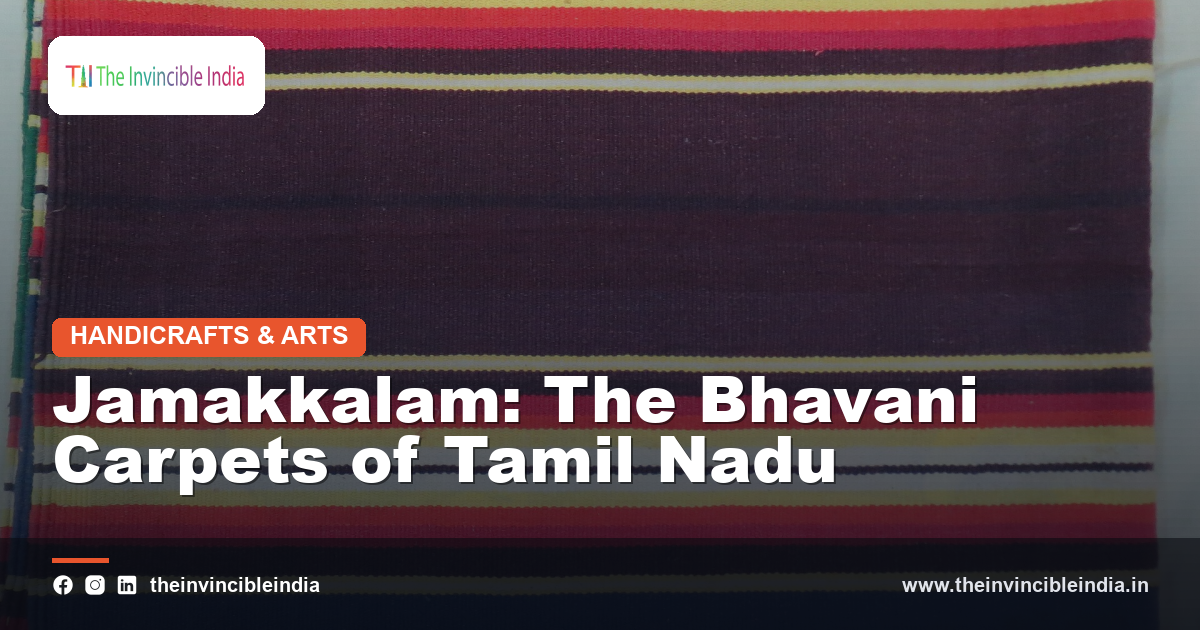
Few household textiles are as cheerful and enduring as Jamakkalam, the handwoven cotton carpet of Bhavani in Tamil Nadu. Made on traditional handlooms by generations of weaving families, these floor spreads and bedcovers are known for their bold stripes and checks, their reversible weave, and their honest practicality. Like the silks of Kanchipuram, they belong to the rich textile heritage of the Tamil country, though their character is humbler and more everyday. This guide explores the town where Jamakkalam is made, the materials and methods behind it, the uses it serves, and the efforts that keep the craft alive today.
Quick Facts
| Detail | Information |
|---|---|
| Craft | Handwoven cotton carpet |
| Place | Bhavani, Erode district, Tamil Nadu |
| Main material | Dyed cotton yarn |
| Technique | Handloom (often pit loom) weaving |
| Signature | Bold stripes and checks |
| Common uses | Floor spread, bedspread, runner |
Bhavani and the Origins of Jamakkalam
Jamakkalam is the traditional handwoven cotton carpet of Bhavani, a town in the Erode district of Tamil Nadu that lies where the Bhavani river meets the Kaveri. The word is generally used in Tamil for a floor spread or carpet, and in Bhavani it has come to describe a specific craft with its own methods and look. For generations, weaving families in the town have produced these colourful floor coverings and bedspreads from cotton yarn.
The craft grew in a region already rich in handloom skill, and it remains a defining part of the town’s identity. Bhavani is known not only for its riverside temples but also for the rhythmic sound of looms working in homes and workshops. Jamakkalam is therefore both a product and a heritage of the place that bears its name.
A Town of Rivers and Looms
Bhavani sits at a meeting point of rivers that has been regarded as sacred for centuries, and the confluence has drawn pilgrims to its temples. The same abundant water supported the practical needs of textile work, including washing and dyeing, which helped weaving flourish in the surrounding area. Tamil Nadu has a deep handloom history, and Bhavani became one of its recognised centres.
Weaving communities settled in and around the town, and the knowledge of making cotton carpets was passed from one generation to the next. The sounds and sights of weaving became part of daily life in many neighbourhoods. The river, the temples, and the looms together define Bhavani, and Jamakkalam stands as the most visible expression of its textile culture.
Cotton Yarn as the Foundation
Jamakkalam is made primarily from cotton, a fibre well suited to the warm climate of southern India and to the hard use that floor coverings receive. Cotton yarn is strong, absorbent, and takes dye well, which allows the weavers to create the bright, saturated colours for which these carpets are known. The yarn is sourced in different counts, depending on the thickness and softness of the cloth required.
Because the carpet is meant to be walked on, slept on, or used as a spread, the yarn must be tough but also comfortable to the touch. Good cotton gives Jamakkalam its durability and its pleasing, slightly textured surface. The choice of material explains why these carpets have remained practical household items as well as admired craft products.
Dyeing and the Colour Palette
Colour is the most striking feature of Jamakkalam. Bold stripes, checks, and bands in shades of red, green, blue, yellow, orange, and black are arranged together to produce carpets that feel lively and warm. The yarn is dyed before weaving, so that the colours run all the way through the cloth rather than sitting on the surface.
Dyeing demands skill, since the weaver must achieve consistent shades across batches and fix the colour so that it withstands washing and sunlight. The palette has traditionally favoured strong contrasts, though softer combinations are also woven for modern interiors. The colours of Jamakkalam give the carpet its cheerful identity and make it instantly recognisable among South Indian floor coverings.
Warping and Preparing the Loom
Weaving a Jamakkalam begins long before the shuttle moves. The dyed yarn is arranged into a warp, with threads of different colours laid out in a planned order that will produce the stripes or checks of the final design. This warping stage is crucial, because any mistake in colour sequence or tension will show in the finished carpet.
The warp is then stretched and fixed on the loom, where it must be set at an even, firm tension. Experienced weavers prepare the loom with great care, aware that patient preparation saves time later. The groundwork laid in warping and setting up the loom determines the neatness, balance, and strength of every Jamakkalam that comes off it.
The Handloom and the Weaving Process
Jamakkalam is woven on traditional handlooms, often pit looms in which the weaver sits with the feet working the pedals below floor level. By pressing the pedals, the weaver raises and lowers sets of warp threads, passes the weft through with a shuttle, and beats it firmly into place. The rhythm is steady, physical, and repeated thousands of times for a single carpet.
The weft is typically woven to produce a dense, flat cloth, and the interplay of coloured warp and weft creates stripes and checks of great clarity. Because the process is manual, no two carpets are exactly identical, and subtle variations reflect the hand of the weaver. Handloom weaving is what gives Jamakkalam its tactile quality and its status as a genuine craft rather than a mass-produced floor covering.
Stripes, Checks, and Design Character
The design language of Jamakkalam is built on stripes and checks rather than on elaborate figurative pictures. Broad bands of colour alternate with narrow lines, and crossing warp and weft colours generate squares and blocks of changing shade. The result is an abstract yet harmonious surface that suits many kinds of rooms.
Borders are often added to frame the carpet and provide a visual finish, and the width and colour of these edges contribute to the overall impression. Simplicity of structure allows the colours themselves to carry the design. The clarity of stripe and check in Jamakkalam is a mark of the weaver’s discipline and a major reason for the craft’s long popularity.
Reversible and Practical Qualities
One notable quality of Jamakkalam is that it is generally woven flat, without a cut pile, so both faces of the cloth show the pattern. This reversibility gives the carpet extra life, since it can be turned over when one side wears or becomes soiled. The flat weave also makes it light enough to be rolled, carried, and stored with ease.
Practicality has always been part of the carpet’s appeal. It serves as a floor spread, a sleeping mat, a prayer or sitting carpet, and a bedspread, and its cotton construction allows frequent washing. These characteristics help explain why Jamakkalam has remained in daily use for so long. Its usefulness and its beauty reinforce one another, which is the best definition of a lasting household craft.
Uses in Homes and Institutions
In traditional households Jamakkalam is used wherever a clean, colourful cotton spread is needed. It covers floors in sitting rooms, serves as bedding during warm nights, and is laid out for guests at family gatherings. Temples, community halls, and institutions have also long used such carpets for seating at events and ceremonies.
Over time interior designers and home owners beyond Tamil Nadu have adopted Jamakkalam as floor runners, wall hangings, table covers, and decorative throws. Its adaptability suits both rustic and contemporary settings. The wide range of uses shows that a craft rooted in everyday needs can adapt gracefully to changing homes and tastes.
Weaving Families and Community Life
The Jamakkalam tradition survives because of the families and communities that have carried it. Within these households, children often grow up watching the looms, learning the rhythms of warping and weaving long before they take a shuttle in hand. Tasks are shared, from winding yarn to dyeing, weaving, and finishing.
Cooperative societies have supported many weavers by supplying yarn, providing market links, and helping them reach a fair price. Women contribute significantly through preparatory and finishing work. The social fabric of the weaving neighbourhoods is as important to the craft as the looms themselves, since it is through family and community that skills are preserved and transmitted.
Recognition and Geographical Identity
Bhavani Jamakkalam is recognised as a distinct regional craft product of Tamil Nadu, and efforts have been made to protect its identity through geographical indication registration. Such recognition is intended to ensure that carpets sold under the name genuinely come from the traditional weaving area and follow established methods.
For buyers this offers a measure of assurance, and for weavers it supports fair market value and brand recognition. Recognition also encourages local pride and gives the craft greater visibility in national and international markets. Protection of the Bhavani name helps safeguard the heritage of Jamakkalam and the livelihoods of the people who maintain it.
Choosing and Identifying a Good Carpet
A good Jamakkalam should feel firm and even, with straight stripes, clean colour boundaries, and a consistent weave across the whole piece. The edges should be neat, the fringe or selvedge securely finished, and the colours well fixed. Holding the carpet to the light can reveal uneven spots or loose threads that suggest poor workmanship.
Buyers are often advised to purchase from reliable cooperatives, government emporiums, or established weavers, and to ask about the yarn and the dyes used. Genuine handloom pieces carry subtle irregularities that machine production does not. A careful look at structure and finish is the most reliable guide to a carpet that will serve well and last long.
Washing and Everyday Care
Cotton carpets are forgiving, but they last longest when treated with some care. Jamakkalam can usually be washed in cool water with a mild detergent, ideally on the first few occasions separately, since new dyes may release some colour. Gentle rinsing and drying in shade rather than harsh sun help retain brightness.
Shaking out dust regularly, rotating the carpet through different parts of the room, and flipping it over from time to time distribute wear evenly. Stains are best treated promptly with mild cleaning rather than strong chemicals. Simple, regular maintenance preserves the vivid look of the carpet, and the reversible construction makes it easy to keep one face fresh for a long time.
Challenges Facing Jamakkalam Weavers
Handloom weavers in Bhavani confront competition from power-loom and machine-made carpets that imitate the stripes and checks at much lower cost. Rising yarn prices, labour-intensive production, and the attraction of other occupations for younger people have added to the strain, and many families have struggled to maintain a stable income from weaving.
Cooperative support, handloom promotion schemes, exhibitions, and digital marketing offer some relief by connecting weavers directly with buyers. Training in new colours and products has also helped. The future of Jamakkalam depends on sustained appreciation for handloom work, because a market that values the craft is what allows the weavers to continue.
Innovation and New Markets
In recent years Jamakkalam weavers and designers have experimented with new colour palettes, narrower and wider formats, and new product types such as yoga mats, bags, table runners, cushions, and curtains. These products take advantage of the sturdy cotton cloth while meeting modern needs in urban households.
Such innovation widens the market without changing the core technique, and it brings fresh income to weaving households. Online platforms and craft fairs introduce the carpets to buyers who may never have visited Tamil Nadu. Thoughtful innovation helps the tradition stay relevant, allowing a centuries-old craft to find a place in contemporary living spaces.
Jamakkalam Today
Jamakkalam today stands as one of the best-known handloom floor coverings of South India, appreciated for its bright colours, honest cotton construction, and reversible practicality. It continues to be woven in Bhavani by families who combine inherited skill with modern awareness of the market.
As interest in handmade and sustainable textiles grows, the carpet has an opportunity to reach even more admirers. It carries with it the character of its town, its rivers, and its weavers. Each Jamakkalam on a floor or bed is a reminder that a humble household textile, when made with care, can become a lasting emblem of regional heritage.
Sources & Further Reading
- Ministry of Culture, Government of India (indiaculture.gov.in).
- Development Commissioner (Handicrafts), Ministry of Textiles, Government of India.
Frequently Asked Questions
What is Jamakkalam?
Jamakkalam is a handwoven cotton carpet made in Bhavani, Tamil Nadu. It is known for its colourful stripes and checks and is used as a floor spread, bedspread, or runner.
Why is Jamakkalam associated with Bhavani?
Bhavani, in Erode district, has long been a centre of handloom weaving, and its weaving families have produced these cotton carpets for generations. The craft is closely tied to the identity of the town.
Is Jamakkalam reversible?
Yes, it is generally woven flat without a cut pile, so both sides show the pattern. This allows the carpet to be turned over when one side wears or becomes soiled.
How is a Jamakkalam carpet cared for?
It can usually be washed in cool water with a mild detergent and dried in the shade. Early washes should be done separately in case new dyes release some colour.
What are Jamakkalam carpets used for?
They are used as floor coverings, sleeping spreads, bedcovers, and ceremonial seating. Modern designers also make runners, table covers, mats, and wall hangings from the same cloth.


