

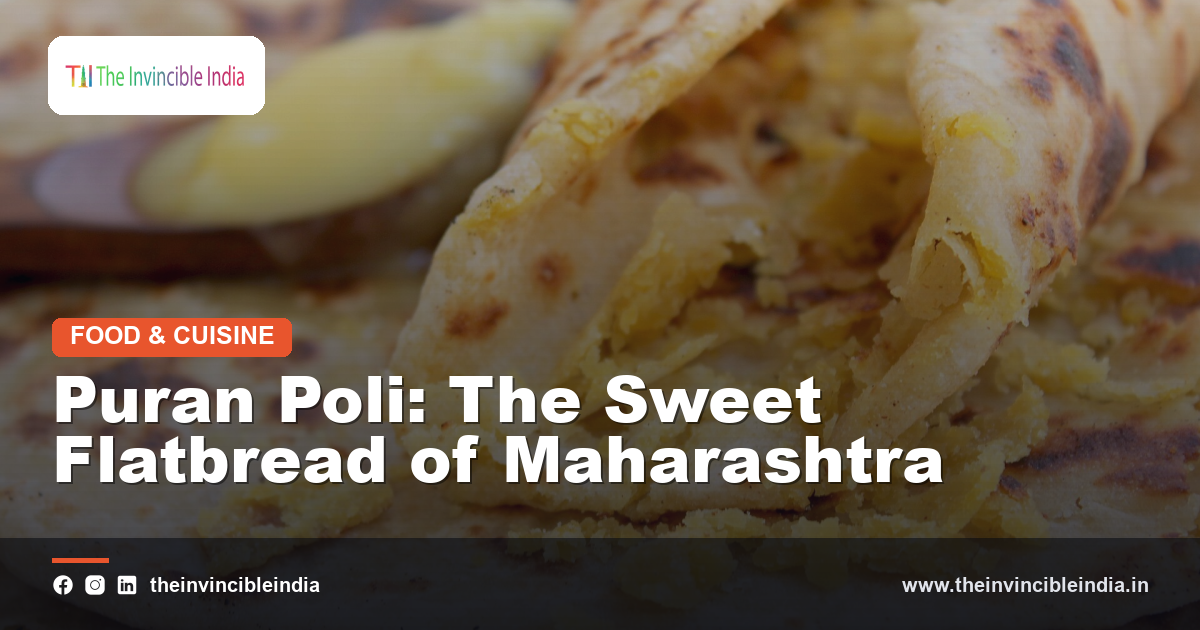
Puran poli is the celebrated sweet flatbread of Maharashtra, a thin, soft and golden bread wrapped around a fragrant filling of cooked lentils, jaggery and gentle spices. It is the dish most closely associated with festive days in Marathi homes, prepared with care, served with generous spoonfuls of ghee and shared among family and neighbours. Both a dessert and a main-course indulgence, it reflects the region’s love of balanced sweetness and wholesome ingredients, and it holds a distinguished place in the broader Maharashtrian cuisine. This guide explores puran poli, its ingredients, its method, its festivals and its lasting importance in Indian food culture.
Quick Facts
| Detail | Information |
|---|---|
| Type | Sweet stuffed flatbread |
| Region | Maharashtra, western India |
| Main ingredients | Chana dal, jaggery, flour, ghee |
| Flavour | Sweet, mildly spiced with cardamom and nutmeg |
| Served with | Ghee, milk and katachi amti |
| Cultural link | Festivals such as Holi, Gudi Padwa and Diwali |
What Is Puran Poli
Puran poli is a traditional Maharashtrian flatbread in which a soft dough is filled with a sweet mixture of cooked split chickpeas and jaggery, then rolled thin and cooked on a griddle. The word puran refers to the sweet filling, while poli simply means flatbread. The result is a tender, golden disc with a delicate outer layer and a rich, fragrant interior. It is usually eaten warm with a generous topping of ghee, and many people enjoy it with milk as well. Neither purely a bread nor purely a sweet, it occupies a happy middle ground that makes it suitable for celebration. As a dish combining comfort, sweetness and craft, puran poli remains one of Maharashtra’s most beloved culinary treasures.
A Festival Food of Maharashtra
In Maharashtra, puran poli is closely associated with festivals and auspicious days, when its preparation becomes a household event. It is prepared in large quantities, offered to deities where appropriate and then served to family, guests and neighbours. The effort involved in making it is part of its significance, since a dish that takes time and care signals respect for the occasion. Many families have their own treasured methods, taught by mothers and grandmothers who consider the preparation a form of inheritance. The aroma of cardamom and warm jaggery drifting from the kitchen is for many people a defining memory of festive days. Puran poli therefore stands as a delicious symbol of celebration, generosity and family tradition in Marathi homes.
The Sweet Lentil Filling
The heart of puran poli is the puran, a smooth, sweet filling made from chana dal, the split and husked Bengal gram. The dal is boiled until very soft, drained of its excess water and then cooked with jaggery until the mixture thickens into a fragrant paste. It is flavoured with cardamom and often a hint of nutmeg, sometimes with a touch of saffron or dry ginger. The filling must be smooth and free of lumps, which is why it is traditionally mashed or passed through a special sieve. Its consistency needs to be firm enough to hold its shape but soft enough to spread inside the dough. A well-made puran is the essence of the dish and the true measure of a cook’s skill.
The Role of Jaggery
Jaggery, the unrefined cane sugar widely used across India, gives puran poli its characteristic flavour. Unlike refined white sugar, jaggery carries a deep, caramel-like sweetness with a faint earthy note that blends beautifully with the nutty chana dal. Many cooks believe that it also makes the filling softer and more aromatic. The amount used is a matter of taste, with some households preferring a mild sweetness and others a richer one. Grated jaggery melts easily into the hot dal and helps bind the mixture. This traditional sweetener ties the dish to the agricultural heritage of western India, where sugarcane has long been cultivated, and it explains why puran poli tastes so distinct from sweets made with refined sugar.
Preparing the Dough
The outer layer of puran poli is made from a soft, pliable dough. Traditionally it is prepared from refined wheat flour, known as maida, though many modern households use whole wheat flour or a blend of the two. The flour is kneaded with water, a little salt, turmeric for colour and a generous amount of oil or ghee until it becomes elastic and smooth. The dough is then rested for some time so that it relaxes and becomes easier to roll. Kneading well and resting patiently are the secrets to a thin, tear-free poli. A soft and supple dough allows the filling to be enclosed without leaking, and this careful preparation lays the foundation for the delicate texture that makes puran poli so appealing.
Stuffing and Rolling
Assembling puran poli requires patience and a gentle touch. A small ball of dough is flattened into a disc, a portion of the sweet filling is placed in the centre, and the edges are drawn up and pinched closed to form a sealed parcel. The parcel is then dusted lightly with flour and rolled out very gently, using the lightest pressure so that the filling spreads evenly without breaking through. Experienced cooks can roll a thin, perfectly round poli with ease, while beginners often find it a challenge. The aim is a thin disc in which the filling reaches every edge. This delicate stage is where skill shows most clearly, and mastering it is a point of pride among those who prepare the dish.
Cooking on the Tawa
The rolled poli is cooked on a hot flat griddle known as a tawa, where it is turned and cooked on both sides until golden-brown spots appear. Ghee is brushed over the surface during cooking, which makes the bread soft, fragrant and slightly crisp at the edges. The heat must be carefully controlled, since too hot a griddle will burn the poli before the dough is cooked and too cool a griddle will make it dry. Each poli is cooked individually and often stacked in a cloth to stay warm. The gentle toasting also brings out the aroma of the jaggery and spices. This final stage transforms a delicate parcel into the golden, tender bread that is so eagerly awaited at the table.
The Traditional Pooran Yantra
In traditional kitchens, a special utensil called the pooran yantra is used to produce a smooth filling. This simple tool, a kind of hand-operated sieve or press, forces the cooked dal and jaggery mixture through small holes, creating a fine, lump-free paste. Although many modern cooks now rely on a blender or a potato masher, the traditional implement is still treasured in many families and is often passed down as a household heirloom. Its use reflects the care that traditionally went into making puran poli and the importance of a perfectly smooth texture. The survival of such tools shows how deeply the dish is rooted in domestic craft, and how the equipment itself becomes part of the cultural memory surrounding it.
Katachi Amti and Other Accompaniments
Puran poli is most commonly served with plenty of ghee, which melts into the warm bread, and with milk for those who enjoy the pairing. A distinctive Maharashtrian accompaniment is katachi amti, a spicy and tangy lentil broth made from the water in which the chana dal was boiled. Rather than discarding this nutritious liquid, cooks season it with spices, tamarind and jaggery to produce a thin soup that cuts through the sweetness of the poli. The contrast between sweet bread and piquant broth is much loved. This thrifty and clever use of every part of the ingredient reflects the practical wisdom of Maharashtrian cooking, and it makes the meal more balanced and memorable.
Puran Poli at Holi and Gudi Padwa
Puran poli is traditionally linked with several major festivals in Maharashtra. During Holi, which is celebrated in the spring, it is prepared as a special offering, and in many communities it is a central part of the festive meal. It also appears at Gudi Padwa, the Marathi new year, when families welcome the beginning of the year with auspicious foods. Other occasions include Diwali and various family ceremonies and religious observances. Its sweetness symbolises prosperity and good fortune, which suits the hopeful spirit of these celebrations. By appearing at so many important moments in the calendar, puran poli has become inseparable from the rhythm of Maharashtrian festive life and from the way families mark time together.
Regional Cousins Across India
Stuffed sweet flatbreads similar to puran poli appear in several regions of India, each with local character. In Karnataka the equivalent is known as holige or obbattu, and in Andhra Pradesh and Telangana as bobbatlu or bakshalu. Tamil Nadu has its own version called poli, while in Gujarat a related sweet is called vedmi. Although the fillings, flavourings and cooking methods differ, all share the idea of a thin bread enclosing a sweet, lentil-based paste. These parallel traditions show how food ideas travel and adapt across neighbouring states. The family resemblance among them highlights the shared culinary heritage of southern and western India while allowing puran poli to retain its unmistakable Marathi identity.
Variations and Modern Adaptations
While the classic recipe remains the most popular, cooks have developed numerous variations of puran poli over time. Some use whole wheat flour for a healthier version, while others add a little semolina to the dough for texture. The filling may be enriched with dry fruits, coconut or a touch of saffron, and some households adjust the jaggery or cardamom to suit their taste. Modern kitchens often use pressure cookers to boil the dal and food processors to blend the filling, saving considerable time. Even so, the essential structure of the dish remains unchanged. These adaptations demonstrate that the recipe is living and flexible, able to welcome new methods while staying faithful to the flavours that define it.
Nutritional Character
Puran poli is a rich and energy-giving food, best enjoyed as a festive treat. The chana dal provides plant protein and fibre, the jaggery offers energy along with small amounts of minerals, and the ghee adds richness and flavour. Wheat flour supplies carbohydrate, making the dish filling and satisfying. Because it is traditionally prepared on special occasions and eaten in moderation, it fits comfortably into a balanced diet. Using whole wheat flour and a moderate amount of jaggery and ghee can make it somewhat lighter for everyday enjoyment. This combination of pulse, grain and natural sweetener gives the dish a wholesome quality that sets it apart from many modern confections, and it helps explain its enduring place in Indian homes.
Tips for Making Perfect Puran Poli
Cooks who wish to prepare puran poli at home can follow some time-tested guidelines. The dal should be cooked until completely soft, and the filling should be thick and smooth, neither too wet nor too dry. The dough must be kneaded well and rested, so that it stretches easily without tearing. When rolling, a light hand and a dusting of flour prevent the filling from breaking through. The griddle should be moderately hot, and ghee should be applied generously for the best flavour. Using the leftover dal water to make katachi amti avoids waste and adds a delicious accompaniment. With practice and patience, anyone can learn to produce soft, golden polis that capture the authentic taste of Maharashtra’s festive kitchens.
Sharing and Serving the Dish
Puran poli is rarely made for one person alone. It is prepared in generous batches and shared with relatives, neighbours and friends, particularly on festival days. Served warm on a plate with ghee and sometimes accompanied by a bowl of milk or amti, it forms the centrepiece of the festive meal. Leftover polis keep well for a short time and are often enjoyed the next day, cold or reheated. The act of sharing the dish strengthens social bonds and expresses hospitality, which are values central to Indian culture. In this way puran poli functions not only as a food but also as a gesture of warmth and welcome, extending the joy of celebration beyond the immediate family.
Puran Poli Today
Today, puran poli continues to be cherished across Maharashtra and wherever Marathi communities have settled. It is prepared in homes, sold by sweet shops and caterers during festival seasons and featured in restaurants that celebrate regional Indian cuisine. Younger generations are discovering the recipe through family kitchens and food media, ensuring that the tradition is not lost. While convenience foods have altered many habits, the affection for this golden, fragrant bread remains strong. As a dish that unites craft, taste and ceremony, puran poli stands as one of Maharashtra’s finest culinary achievements and a lasting emblem of festive celebration in the rich food heritage of India.
Sources & Further Reading
- Ministry of Culture, Government of India (indiaculture.gov.in).
- Maharashtra Tourism, Government of Maharashtra (maharashtratourism.gov.in).
Frequently Asked Questions
What is puran poli?
Puran poli is a Maharashtrian sweet flatbread stuffed with a filling of cooked chana dal and jaggery flavoured with cardamom and nutmeg. It is cooked on a griddle and served warm with ghee.
What is the filling of puran poli made from?
The filling, called puran, is made by boiling chana dal until soft and cooking it with jaggery into a smooth paste. It is flavoured with cardamom and often a little nutmeg or saffron.
When is puran poli traditionally eaten?
It is associated with festivals such as Holi and Gudi Padwa, as well as Diwali and family celebrations. It is considered an auspicious and celebratory dish.
What is katachi amti?
Katachi amti is a spicy and tangy lentil broth made from the water used to boil the chana dal. It is the classic accompaniment that balances the sweetness of puran poli.
Are there similar sweet flatbreads in other states?
Yes, similar dishes include holige or obbattu in Karnataka, bobbatlu in Andhra Pradesh and Telangana, and poli in Tamil Nadu. Each uses a sweet lentil-based filling inside a thin bread.


