

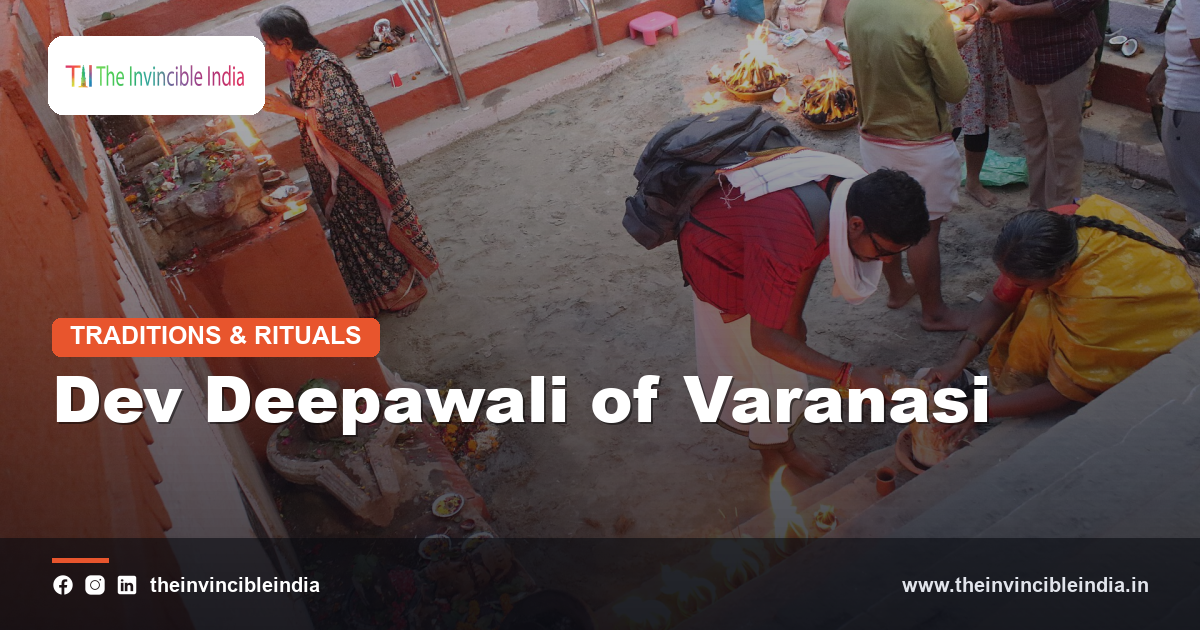
Dev Deepawali, the festival of lamps of the gods, is celebrated on the full moon of the Hindu month of Kartik, when the riverfront of Varanasi is transformed by hundreds of thousands of small oil lamps placed along its ghats. It is observed roughly a fortnight after the household celebrations described in the history and significance of Diwali, and the two festivals are linked by their shared language of light. According to tradition, the gods themselves descend to the holy city on this night to bathe in the Ganga, and the lamps are a welcome offered to them. Pilgrims take a ritual dip at dawn, evening aarti is performed on the river steps, and boats carry visitors across the water to view the glowing shoreline. Dev Deepawali has become one of the most admired spectacles of Indian devotional life.
Quick Facts
| Detail | Information |
|---|---|
| Festival Type | Hindu festival of lamps |
| Primary Location | The ghats of Varanasi, Uttar Pradesh |
| Timing | Full moon of the month of Kartik |
| Associated Deities | Lord Shiva, the Ganga, and all the gods |
| Central Rituals | Ganga snan, lamp lighting, and aarti |
| Also Known As | Diwali of the Gods |
What Dev Deepawali Means
The name Dev Deepawali combines dev, meaning god, with deepawali, meaning a row of lamps, and it is usually translated as the Diwali of the Gods. The festival is held on the full moon of Kartik, the same lunar day known more widely as Kartik Purnima, and it centres on the belief that the divine beings of the Hindu pantheon come down to earth to bathe in the Ganga at Varanasi. Where ordinary Diwali illuminates homes for the benefit of the household and its prosperity, Dev Deepawali illuminates the river itself as a collective offering to the gods. The distinction gives the festival its particular character, which is public, communal and devotional rather than domestic. The meaning of the name therefore explains the whole observance, in which light is offered upward and outward to the divine.
Varanasi as the Setting
Varanasi, also called Kashi and Benares, is regarded as one of the oldest continuously inhabited cities in the world and as a supremely sacred centre of Hindu life. The city rises in a long crescent above the western bank of the Ganga, and its stone ghats, which are broad flights of steps leading down into the water, form a continuous waterfront for several kilometres. These steps are used daily for bathing, prayer, funeral rites and teaching, and on Dev Deepawali they become a vast stage of light. The city is traditionally associated with Lord Shiva, who is regarded as its presiding deity, and this association makes it a natural home for a festival honouring the gods. The setting is therefore inseparable from the festival, because the ghats, the river and the sacred geography of Kashi together give the lamps their meaning.
The Sacred Date of Kartik Purnima
Dev Deepawali falls on Kartik Purnima, the full moon of the month of Kartik, which in the Hindu calendar is regarded as an especially auspicious period for charity, bathing and devotion. The month itself is associated with lamp lighting, and many families keep a lamp burning through its days as an act of discipline. The full moon at its close is treated as the culmination of this devotional season, and holy bathing on this day is believed to carry great merit. Because the Hindu calendar is lunar, the festival shifts from year to year against the Gregorian calendar, usually falling in the later part of the autumn. Almanacs and temple authorities announce the exact timing each year. The sacred date thus anchors Dev Deepawali within a month already devoted to light, purification and remembrance of the divine.
The Legend of Tripurari Purnima
Kartik Purnima is also called Tripurari Purnima in many traditions, after a well known story about Lord Shiva. According to Hindu tradition, three powerful demon brothers had built three flying cities, known together as Tripura, and used them to threaten the world and the gods. Shiva is said to have destroyed all three cities with a single arrow when they aligned, earning the title Tripurari, the enemy of Tripura. The gods are described as rejoicing at this deliverance and lighting lamps in celebration, and this victory is one of the explanations given for the festival of lights in Varanasi. Shiva is the guardian deity of the city, so the story fits the setting well. The legend frames Dev Deepawali as a celebration of the triumph of divine order over arrogance and destruction, expressed through the gift of light.
Dawn Bathing in the Ganga
The day of Dev Deepawali begins long before the lamps are lit, with pilgrims entering the Ganga at dawn for a ritual bath known as Ganga snan. Hindu tradition holds that bathing in the river on Kartik Purnima washes away accumulated impurity and brings spiritual merit, and the practice draws devotees from Varanasi and from distant regions. Many bathe in the cold, early light, offer water to the rising sun, and make small offerings of flowers and lamps to the river. Priests seated on wooden platforms along the ghats conduct prayers for families and receive offerings of grain or other donations. The sight of crowds at the water’s edge in the grey morning mist is among the most memorable features of the day. The dawn bath is the personal side of the festival, preparing devotees for the collective illumination that follows.
Lighting the Ghats
As dusk falls, volunteers, temple committees, local families and residents place small clay lamps called diyas on the steps of the ghats, row after row, until the entire waterfront is outlined in light. The lamps are filled with oil or ghee and set out in careful patterns along the stone, on temple walls, on the platforms of the boatmen, and sometimes on the surface of the water itself. Lighting them is understood as an act of devotion, and many people take part simply by placing a single lamp and offering a short prayer. The scale of the display is possible only because of widespread participation, which makes the festival a communal achievement. The glow of the ghats reflected on the dark river is the defining image of Dev Deepawali, and it expresses the tradition of welcoming the gods with light.
Ganga Aarti at Dashashwamedh Ghat
The best known ceremony of the evening is the Ganga aarti, a choreographed ritual of worship performed at Dashashwamedh Ghat and at other ghats in the city. Priests stand in a row on raised platforms, dressed in traditional clothing, and offer to the river a series of tall multi-tiered lamps, incense, flowers, conch blasts and the sound of bells, all in a rhythm directed by the lead priest. Devotional chanting and music accompany the movements, and crowds gather on the steps and in boats to watch and take part. On Dev Deepawali the aarti is particularly elaborate and draws very large audiences. The ceremony treats the Ganga as a living goddess who receives worship, and this belief is central to the festival. The evening aarti is therefore the devotional high point, in which light, sound and prayer come together.
The Spectacle from the River
One of the most popular ways to experience Dev Deepawali is from a boat on the Ganga, where the full length of the lit ghats can be seen at once. Boatmen carry pilgrims and visitors along the shoreline in the evening, and the slow movement of the boats allows the changing shapes of the temples, palaces and steps to be seen in the lamplight. Floating lamps, set on leaf cups with a flower and a flame, drift out from the shore and add small points of light to the dark water. From the river the festival appears as a continuous ribbon of light curving along the city’s edge. Many people regard the view from the water as the most complete one, because it shows the unity of the ghats. The river perspective makes clear why the festival is described as a visual and spiritual offering at once.
Decoration, Rangoli and Fireworks
Alongside the lamps, the ghats and neighbouring lanes are decorated with garlands of marigold, strings of lights, and rangoli designs made in coloured powder and flower petals. Temples are adorned, and the steps leading to the water are cleaned and prepared in advance by local committees and volunteers. Fireworks and laser displays have become part of the modern celebration in some years, and cultural performances of music and dance are often presented in the evening. The decoration echoes the visual vocabulary of Diwali, in which beauty and auspiciousness are expressed through colour and light. Local residents also decorate their balconies and rooftops, so the whole riverfront participates. The overall effect is festive without losing its devotional core, and it shows how a sacred observance can embrace artistic expression while remaining centred on worship of the river and the gods.
Shiva, the Ganga and the Gods
Dev Deepawali brings together several strands of Hindu devotion in a single evening. Lord Shiva is honoured as the guardian of Kashi, and many devotees visit the Kashi Vishwanath Temple and other shrines on the day. The Ganga is worshipped as a goddess whose waters purify, and her association with Shiva, who in tradition received her descent upon his locks, makes the pairing especially fitting. Other deities are also remembered, since the festival’s central idea is that all the gods gather in the city on this night. Devotees may offer prayers to Vishnu, Ganesha and local deities as well. This breadth reflects the inclusive character of Hindu practice, in which many divine forms are venerated together. The gathering of gods on the ghats is the idea that gives the whole festival its unity and its name.
Remembrance and Civic Tribute
In recent years Dev Deepawali in Varanasi has also included public acts of remembrance, in which lamps are lit to honour the armed forces and those who have given their lives in service of the country. Such tributes are organised by local committees and civic bodies and are presented alongside the traditional religious observances. They add a patriotic and commemorative dimension to a festival whose roots are devotional, and many residents regard this as a natural extension of the idea of offering light to those worthy of honour. Cultural programmes, public lectures and music performances may also be held. The festival has therefore grown in scope while keeping its sacred heart. Dev Deepawali demonstrates how a long-standing ritual can be adapted to express contemporary civic values without displacing the devotion at its centre.
A Festival Shared Across Faiths
Kartik Purnima is a day of religious significance beyond Hindu tradition, and Varanasi’s celebration takes place within a culturally diverse region. Sikhs mark the same full moon as the birth anniversary of Guru Nanak, the founder of their faith, with prayers, hymns and community meals in gurdwaras. Jain tradition regards the day as an important occasion for pilgrimage and fasting, particularly at sacred hills visited by the community. Sarnath, near Varanasi, is a place of deep importance in Buddhist history, and the city’s wider heritage reflects centuries of coexistence. These parallel observances are distinct in belief and practice, and each is conducted in its own way. Their overlap shows how a single lunar date can hold meaning for several traditions. Dev Deepawali, within this context, is one expression among many of the reverence that the day inspires.
Boatmen, Priests and Artisans
The festival depends on the labour and skill of many groups of people who live and work along the river. Boatmen prepare their craft and carry pilgrims through the evening, priests conduct rituals and receive offerings on the ghats, and potters supply the vast quantities of clay lamps needed for the display. Flower sellers, sweet makers, musicians and local shopkeepers all take part in the economy of the festival, and many families rely on the season for a significant share of their annual income. Volunteers, including students and members of neighbourhood groups, help with preparation and cleaning. This collective effort is part of the festival’s identity, since the lighting of the ghats would not be possible without it. Dev Deepawali is, in this sense, a shared achievement of the whole community of Kashi, which gives the spectacle its warmth and its authenticity.
Planning a Respectful Visit
Visitors who wish to witness Dev Deepawali should plan well in advance, as the city is very busy and accommodation is in high demand during the festival period. It is wise to arrive early to secure a place on the steps or to arrange boat transport through licensed operators. Modest clothing is appropriate, shoes are removed before entering temples, and photography should be done with sensitivity, particularly near ritual activity and funeral ghats. Lamps and offerings should be disposed of in the places provided, so that the river and its steps remain clean. Crowds can be dense, so keeping belongings secure and following the instructions of local officials is advisable. Visiting with an attitude of respect enriches the experience, since the festival is first of all an act of worship. A considerate visitor adds to the dignity of the occasion rather than detracting from it.
Caring for the River and Heritage
The scale of Dev Deepawali has encouraged discussion about protecting the river and the historic ghats from the effects of large crowds. Many organisers and residents emphasise the use of clay lamps rather than plastic, careful collection of waste, and clean-up efforts after the festival. The ghats themselves are historic structures, many of them built over several centuries, and conserving them is a continuing task for civic bodies and heritage groups. The Ganga’s cleanliness is a matter of both environmental and spiritual concern in Hindu tradition, since the river is worshipped as a goddess. Campaigns for river care often draw upon this devotional language, linking reverence with responsibility. Dev Deepawali can therefore serve as an occasion to renew commitment to the river as well as to celebrate it, joining the sacred and the practical in a single act of care.
Dev Deepawali Today
Dev Deepawali today is among the most celebrated festivals of Varanasi and a major draw for pilgrims and travellers from India and abroad. It has grown in scale and organisation over recent decades, supported by temple committees, civic bodies and countless local volunteers, while its essential practices of bathing, lamp lighting and aarti remain unchanged. The festival continues to link the sacred geography of Kashi with the wider Hindu calendar, and it stands beside the household celebrations of Diwali as a communal counterpart. For those who attend, it offers an image of light on water that is easily remembered. For residents, it is an act of devotion renewed each year. Dev Deepawali endures as a living expression of reverence for the Ganga, for Shiva and for the gods who are believed to visit the holy city.
Sources & Further Reading
- Ministry of Culture, Government of India (indiaculture.gov.in).
- Ministry of Tourism, Government of India (incredibleindia.gov.in).
Frequently Asked Questions
What is Dev Deepawali?
Dev Deepawali is the festival of lamps of the gods, held on the full moon of Kartik, when the ghats of Varanasi are lit with countless lamps. According to tradition, the gods descend to bathe in the Ganga on this night.
When is Dev Deepawali celebrated?
It is celebrated on Kartik Purnima, the full moon day of the Hindu month of Kartik. Because the Hindu calendar is lunar, the Gregorian date changes each year and is announced by temples and almanacs.
How is Dev Deepawali different from Diwali?
Diwali is celebrated on a new moon night in homes across India, while Dev Deepawali is held on a full moon and centres on the riverfront of Varanasi. Diwali lights households, whereas Dev Deepawali offers light to the Ganga and the gods.
What happens during the Ganga aarti on Dev Deepawali?
Priests perform a coordinated ritual with tall lamps, incense, flowers, bells and conch shells, worshipping the river as a goddess. The ceremony is especially elaborate on this day and draws large crowds to the ghats and the boats.
Is Dev Deepawali only for Hindus?
The ritual is Hindu in origin, but the day is also meaningful to other traditions, since Sikhs observe the birth anniversary of Guru Nanak on the same full moon. Visitors of all backgrounds attend respectfully to witness the festival.


