

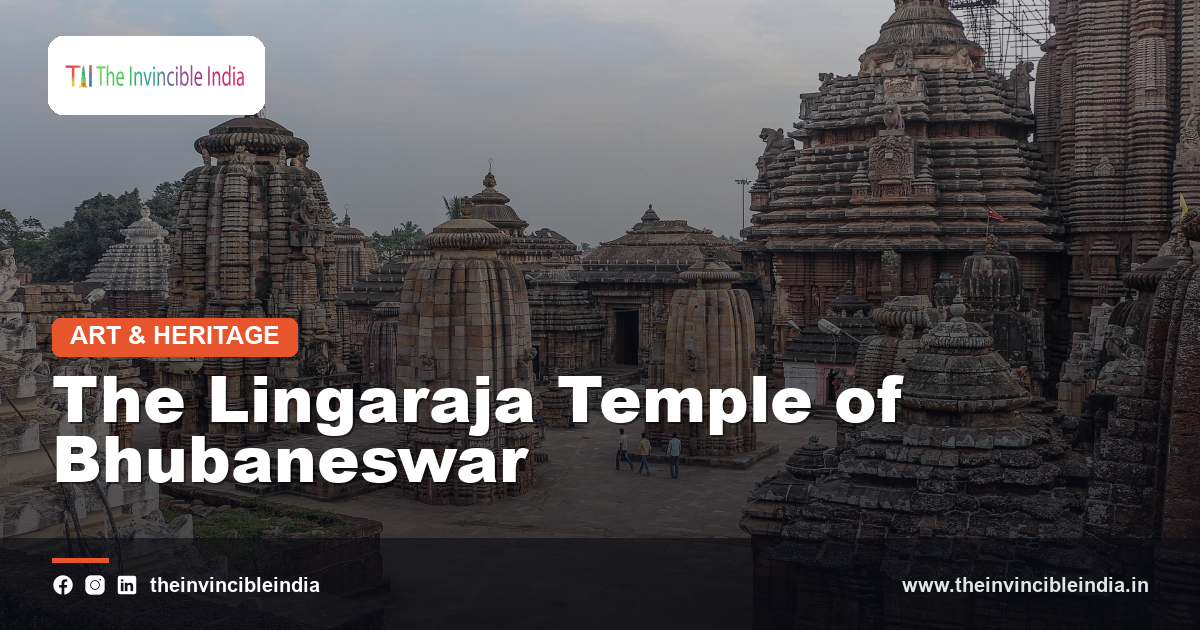
The Lingaraja temple stands at the heart of old Bhubaneswar in Odisha, a monumental sandstone shrine whose curving tower dominates the skyline of the city often called the Temple City of India. Dedicated to Shiva in the composite form of Harihara, it is widely regarded as the finest and most fully developed expression of the Kalinga style, the regional tradition that shaped the sacred architecture of eastern India. Like the great monuments surveyed in the guide to Indian temple architecture, it is not a museum piece but a living place of worship, where daily ritual and seasonal festivals continue to animate a medieval masterpiece.
Quick Facts
| Detail | Information |
|---|---|
| Location | Bhubaneswar, Odisha |
| Deity | Shiva as Harihara (Lingaraja) |
| Style | Kalinga (Nagara) temple architecture |
| Material | Sandstone and laterite |
| Period | Medieval, c. 11th century onward |
| Status | Active place of worship |
The Temple City of Bhubaneswar
Bhubaneswar, the capital of Odisha, has long been celebrated as a city of temples, and the Lingaraja temple is the crowning glory of that tradition. The old quarter of the city, centred on the sacred lake known as Bindusagar, contains a dense concentration of shrines built across many centuries, ranging from small wayside sanctuaries to monumental complexes. Within this landscape the Lingaraja rises above everything else, its great tower visible from far beyond the temple walls. The city has been associated with Shiva worship for a very long time, and the district around the lake was traditionally known as Ekamra Kshetra, the sacred field of the mango tree. Understanding the temple therefore begins with understanding the city, because the shrine, the tank, and the surrounding lanes together form a single religious and architectural landscape that has endured for a millennium.
Ekamra Kshetra and Sacred Geography
The older name of Bhubaneswar’s sacred zone, Ekamra Kshetra, refers to a tradition in which the deity of the city was worshipped beneath a mango tree. This memory is preserved in the religious literature of Odisha, which describes the area as one of the most hallowed places for devotees of Shiva. The sacred geography is organised around the Bindusagar, a large water tank that pilgrims regard as the gathering of waters from many holy rivers and pools. Ritual bathing, ceremonial processions, and festival rites are all linked to this body of water, which sits close to the main temple. The relationship between temple and tank follows a widespread pattern in Indian sacred planning, where water is considered essential for purification and worship. By placing the Lingaraja within this carefully defined sacred field, the builders gave the monument a setting that reinforced its religious meaning.
Origins and the Dynasties Behind the Temple
The Lingaraja temple belongs to the medieval period of Odisha’s history, and its construction is generally associated with the era when the Somavamshi rulers held power in the region, with later contributions linked to the Eastern Ganga dynasty. As with many great temples, the monument was not the work of a single moment but the product of building and embellishment across successive generations. The royal patronage of eastern India in this age was directed at creating grand stone temples that expressed both devotion and political authority. Earlier temples in Bhubaneswar, built in the preceding centuries, served as laboratories in which the architectural vocabulary of the region was refined. The Lingaraja represents the mature culmination of that process, bringing together proportion, scale, and sculptural richness in one composition. It stands as a record of how dynastic patronage and religious devotion combined to produce the architectural identity of Odisha.
The Kalinga Style of Temple Building
The Lingaraja is the defining monument of the Kalinga style, a regional branch of the northern Nagara tradition of temple architecture. In this style, the sanctuary is crowned by a curvilinear tower known as a rekha deul, while the entrance hall takes the form of a pyramidal roof called a pida deul. The two elements are arranged along a single axis, creating a sequence of spaces that leads the worshipper from the outer world toward the sacred centre. Unlike the temples of some other regions, those of Odisha are characterised by a deliberate contrast between the vertical sweep of the main tower and the stepped, horizontal profile of the halls in front of it. This interplay gives the Kalinga temple its distinctive silhouette. The Lingaraja demonstrates the style at its most complete, showing how a limited set of architectural forms could be developed to produce a monument of great visual authority.
The Great Tower of the Sanctum
The tower that rises above the sanctum, called the vimana or deul, is the most striking feature of the Lingaraja temple. Its profile curves gently inward and upward before ending in a crowning member, giving the impression of a mountain peak ascending toward the sky. The surface of the tower is divided by strong vertical projections that run from base to summit, creating rhythmic bands of light and shadow as the sun moves across the stone. Smaller miniature towers are set into the facets, repeating the main form at reduced scale and reinforcing the sense of upward movement. The scale of the structure was intended to express the cosmic significance of the deity within, since the tower symbolically represents a sacred mountain. Seen from the temple courtyard or from the surrounding lanes, it remains an overwhelming presence that anchors the entire complex and the city around it.
The Jagamohana and Entrance Halls
In front of the main sanctuary the Lingaraja temple contains a series of linked halls, each serving a distinct purpose in worship and ritual. The nearest to the sanctum is the jagamohana, or assembly hall, topped by a pyramidal roof composed of receding tiers. Beyond it lie the natamandapa, a hall traditionally associated with ritual dance and music, and the bhogamandapa, where offerings of food are presented to the deity. These halls were added as the temple developed, and together they extend the central axis of the monument, creating a processional path for devotees. The progression from lower, broader roofs to the soaring main tower produces a deliberate crescendo of height. Each hall also provided space for the performing arts and communal gatherings that have always accompanied temple worship in Odisha, so that the architecture served the social life of the community as much as the ritual needs of the priests.
Sculptural Decoration on the Walls
The outer surfaces of the Lingaraja are covered with carved ornament that rewards close attention. Panels of sculpture show deities, celestial beings, and graceful female figures, while bands of floral scrollwork, geometric patterns, and animal motifs fill the spaces between them. The carving is executed in a refined manner that balances elaborate detail with a sense of architectural order, so that decoration never overwhelms the underlying structure. Many niches on the walls house images of guardian deities and forms of Shiva, reflecting the religious identity of the shrine. The stone surface was treated almost as a canvas, with sculptors working directly on the blocks that make up the walls. The result is a building that seems both massive and delicate, a combination that characterises the best temples of Odisha. For the visitor, the sculptural programme offers a visual introduction to the iconography and artistic skill of the medieval craftsmen of Kalinga.
Harihara and the Meaning of the Deity
The presiding deity of the temple is worshipped as Lingaraja, meaning the king of the lingam, and is understood as Harihara, a form that unites Shiva and Vishnu in a single sacred presence. This blending of traditions reflects the religious history of Odisha, where Shaiva and Vaishnava devotion developed alongside one another and influenced each other, particularly through the cult of Jagannath at nearby Puri. The central object of worship is a large self-manifested lingam, which is regularly bathed and adorned as part of the daily liturgy. The idea of Harihara carries a message of harmony, suggesting that different paths of devotion ultimately lead to the same divine reality. This theological openness is part of what makes the Lingaraja temple distinctive among the Shiva shrines of India. The sanctum thus holds not only an ancient symbol of the divine but also a statement about the unity underlying the diversity of Hindu belief.
Daily Worship and Temple Ritual
Worship at the Lingaraja follows an elaborate daily schedule that has been maintained for centuries by hereditary families of temple servants. The day begins before dawn with rites to awaken the deity and continues through ceremonies of bathing, dressing, and offering that are repeated at fixed hours. Food offerings play a central role, and the preparation of sacred meals is an important part of temple life, reflecting the strong tradition of ritual cooking associated with the temples of Odisha. Devotees bring flowers, water, and other simple items, and many believe that offering water on the lingam brings blessings. The temple has traditionally been closed to non-Hindus inside the main sanctuary, but viewing platforms outside the walls allow other visitors to see the great tower and appreciate the complex from a respectful distance. The continuity of these practices ensures that the temple remains a functioning centre of faith, not merely an architectural monument.
Mahashivaratri and the Festival Calendar
The festival calendar of the Lingaraja temple brings the monument to life with colour, music, and large gatherings of pilgrims. The most important occasion is Mahashivaratri, the great night of Shiva, when devotees observe fasting and vigil and the temple is thronged with worshippers throughout the night. Another well-known observance is Ashokashtami, associated with a grand chariot procession in which the deity is carried in a decorated car to a nearby shrine. Seasonal rites, including the long summer festival of Chandan Yatra, link the temple to the lake and to the cycle of the agricultural year. During these events, the usual daily routine expands into a series of processions, ceremonies, and cultural performances. The festivals show how a temple functions as a social institution, bringing together priests, artisans, musicians, and ordinary families. Through them, the Lingaraja renews its place as the spiritual heart of Bhubaneswar year after year.
The Temple Complex and Its Subsidiary Shrines
The Lingaraja stands within a large walled enclosure that contains many smaller shrines in addition to the principal temple. These subsidiary sanctuaries are dedicated to various deities and are scattered around the courtyard, creating a miniature world of worship within the compound. A high boundary wall surrounds the whole complex, separating the sacred precinct from the bustle of the streets outside. Entrance is through a gateway that opens onto a spacious court, from which the main tower can be seen in full. The presence of so many shrines within one enclosure reflects the layered history of the site, as additional temples were added by devotees and patrons over time. The arrangement also illustrates the Indian temple as a complex rather than a single building, a precinct in which ritual, community life, and architecture all meet. Exploring the courtyard offers a sense of the full religious world that the Lingaraja has sustained.
Bindusagar and the Ritual Landscape
Close to the temple lies the Bindusagar, the great sacred tank that forms an essential part of the ritual landscape. According to tradition, the waters of the tank draw together the essence of many holy rivers, making a dip in it spiritually purifying. Stone steps lead down to the water on its banks, and a small shrine stands on an island in the centre. During major festivals the tank becomes a stage for ceremonies, and the deity is carried out in procession to take part in water-borne rites. The lake also serves as a point of orientation within the old city, linking the many temples that cluster around its edge. The relationship between water and sanctuary is a recurring theme in Indian religious architecture, and nowhere is it more clearly displayed in Odisha than here. The Bindusagar completes the Lingaraja, turning the temple into part of a larger sacred whole.
Relationship with Other Bhubaneswar Temples
The Lingaraja is the largest of the temples of Bhubaneswar, but it is by no means the only important one. Within the old city stand many shrines that trace the evolution of Odishan architecture, from compact early structures to the monumental complexes of the later period. Temples such as the Mukteshvara and Rajarani are often admired for their refined proportions and delicate carving, and they help to place the Lingaraja in context. Studying them together shows how architects gradually enlarged the scale of the tower, deepened the sculptural programme, and developed the sequence of halls. The Lingaraja can be understood as the culmination of this long experiment. Its size and complexity reflect not only artistic ambition but also the growing importance of Bhubaneswar as a religious centre. Visitors who wish to understand Odisha’s heritage therefore treat the Lingaraja as the principal chapter in a much longer architectural story.
Building Materials and Craftsmanship
The temple is constructed mainly of local sandstone, with laterite used in some areas, and the stonework shows exceptional precision. Blocks were cut and fitted with great care, often without the use of mortar, relying on their weight and accurate shaping to maintain stability. Sculptors and masons worked together under the direction of master builders who followed the principles laid down in traditional treatises on temple design. These craft traditions were passed from one generation to the next within families and guilds, and some of them survive in Odisha to this day. The softness of fresh sandstone allowed intricate carving, but the stone also hardens and darkens with exposure, giving the monument its present weathered tone. The endurance of the structure over so many centuries is a testament to the technical skill of its builders and reminds visitors that the beauty of the temple rests on rigorous engineering as well as artistic imagination.
Conservation and Protection
Preserving a monument as old and as heavily used as the Lingaraja is a continuing task. The temple is protected as a monument of national importance, and conservation work is carried out to stabilise the stone, repair damaged sections, and manage the effects of weather, pollution, and heavy footfall. Because the temple remains an active place of worship, conservators must balance the needs of ritual with the requirements of preservation, a challenge common to living heritage sites. Cooperation between temple authorities, heritage agencies, and local communities plays an important part in this effort. Documentation, careful cleaning, and structural monitoring all help to extend the life of the monument. The goal is to keep the temple both physically sound and religiously alive, so that future generations can encounter it as earlier ones did. In this sense, conservation is itself a form of cultural continuity, protecting a building whose significance lies in how it is used as well as how it looks.
The Lingaraja Temple Today
Today the Lingaraja temple remains the most important monument of Bhubaneswar and one of the great sacred sites of eastern India. Pilgrims arrive throughout the year to offer worship, while scholars, photographers, and travellers come to study its architecture and absorb its atmosphere. Its tower still defines the skyline of the old city, and its rituals still follow the rhythms established long ago. For those interested in the heritage of Odisha, it offers an unmatched introduction to the Kalinga style and to the living religious traditions that sustain it. The temple also stands as a symbol of the region’s cultural identity, linking the present community to a long history of devotion and artistic achievement. As a place where architecture, ritual, and landscape remain closely united, the Lingaraja continues to demonstrate why the temples of Odisha hold such an important place in the cultural history of India.
Sources & Further Reading
- Archaeological Survey of India (asi.nic.in).
- Ministry of Culture, Government of India (indiaculture.gov.in).
Frequently Asked Questions
Who is worshipped at the Lingaraja temple?
The presiding deity is worshipped as Lingaraja, a form of Shiva understood as Harihara, which also carries aspects of Vishnu. The central object of worship is a large lingam in the sanctum.
Which architectural style does the Lingaraja temple represent?
It is the finest example of the Kalinga style, a regional form of the Nagara tradition. The style is recognised by a curvilinear tower over the sanctum and stepped, pyramidal roofs over the entrance halls.
Can non-Hindus enter the Lingaraja temple?
Entry to the main sanctuary has traditionally been reserved for Hindus. Other visitors can view the tower and the complex from a viewing platform outside the walls.
What are the main festivals at the Lingaraja temple?
Mahashivaratri is the most important festival, marked by fasting and an all-night vigil. Other well-known observances include Ashokashtami, with its chariot procession, and the Chandan Yatra.
What is the Bindusagar?
The Bindusagar is the large sacred tank beside the temple, regarded as a gathering of holy waters. It forms part of the ritual landscape and is used in festival ceremonies.


