

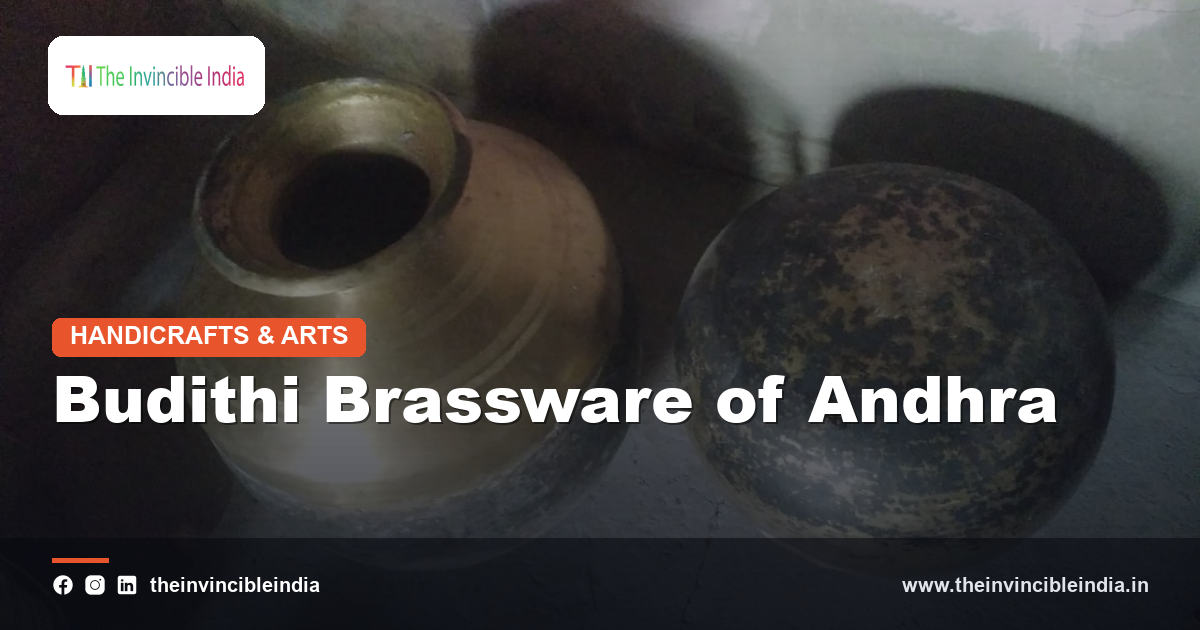
Budithi brassware is the metalworking tradition of a village in the Srikakulam region of Andhra Pradesh, where artisan families have long shaped brass and bell metal into vessels, lamps and ritual objects by hand. Valued for their weight, their resonant tone and their warm golden finish, these pieces occupy the same cultural space as other regional metal arts such as Bidriware, in which functional objects are treated as vehicles of skill and ornament. Budithi work is rooted in everyday household use as well as temple and ceremonial life, and the craft continues to be practised by communities who inherited their techniques across generations. This guide explores its materials, methods, forms, cultural meaning and present-day prospects.
Quick Facts
| Detail | Information |
|---|---|
| Craft | Hand-cast and hammered brass and bell metal |
| Region | Srikakulam area, Andhra Pradesh |
| Typical objects | Vessels, plates, bowls, lamps, ritual items |
| Key techniques | Casting, hammering, turning and polishing |
| Cultural role | Household, temple and ceremonial use |
| Recognition | Associated with Geographical Indication protection |
What Is Budithi Brassware
Budithi brassware is the collective name for brass and bell metal objects made by hand in and around the village of Budithi in the Srikakulam region of Andhra Pradesh. The craft produces everyday and ceremonial items, including serving vessels, bowls, plates, lamps and small ritual objects, all shaped from alloys prized for their durability and their pleasing sound when struck. Unlike factory-made metalware, Budithi pieces carry the marks of manual work, from the slight irregularities of hammering to the careful finish achieved through repeated polishing. The craft is valued both for its practical reliability and for the quiet beauty of its forms. In this way, Budithi brassware represents a living household tradition in which utility and artistry have long coexisted within a single object.
The Village and Its Setting
Budithi is a village in the coastal Andhra region, part of a landscape of farming settlements, tanks and small market towns in the north-eastern part of the state. Within this setting, metalworking developed as a specialised occupation practised by dedicated artisan families, supplying vessels and utensils to surrounding communities. The village gradually became identified with its metalware, so that the name Budithi came to signify a particular quality of brass and bell metal craftsmanship. Such craft villages are a characteristic feature of Indian handicraft geography, in which a single settlement carries a skill across many generations. The setting of Budithi therefore explains much about the craft, which grew from local demand, local skill and a shared identity centred on the workshop.
Origins and Historical Background
The early history of Budithi metalwork is best understood in general terms, as part of the long Indian tradition of making vessels and ritual objects from copper, brass and bell metal. Metal utensils have been central to Indian households for centuries, valued for their durability and, in many traditions, for their perceived purity and suitability for cooking, serving and worship. Craft villages arose wherever demand, raw material access and inherited skill came together, and Budithi emerged as one such centre in the Andhra region. The craft was passed within families, with younger members learning each stage of the process through years of practice alongside elders. This pattern of hereditary transmission shaped the craft’s continuity and gives Budithi brassware its deep roots in community memory.
Brass and Bell Metal Explained
Brass is generally an alloy of copper and zinc, while bell metal is a copper-based alloy traditionally combined with tin, known for its hardness and its clear, ringing sound. Both have long histories in Indian metalwork, and Budithi artisans are associated with working these materials into finished objects. Bell metal is particularly valued for items where resonance matters, as well as for durable vessels that hold their form through heavy use. The choice of alloy affects the weight, colour and sound of the finished piece, and experienced craftspeople develop a close sense of how each behaves under heat and hammer. Understanding these materials helps explain why Budithi pieces feel substantial in the hand and why they have remained practical household objects for so long.
The Making Process in Outline
The making of a Budithi vessel is a sequence of stages that moves from raw metal to finished object through heat, force and patient finishing. Metal is melted and prepared, then shaped through casting or through hammering sheets and discs into the required form. Rough pieces are refined by turning, scraping and repeated smoothing, after which they are polished to bring out the characteristic lustre. Each stage requires different skills, and in many workshops the work is divided among members of a family or a small team. The overall process combines strength with precision, since a vessel must be both robust and well balanced. This outline shows how Budithi brassware is the product of coordinated manual labour rather than a single dramatic technique.
Casting Techniques
Casting is one of the foundational techniques in Indian metalwork, in which molten metal is poured into a prepared mould so that it hardens into a desired shape. In traditional workshops the moulds are prepared by hand using locally suited materials, and the quality of the mould strongly influences the quality of the cast piece. After the metal cools, the rough casting is removed and prepared for further finishing. Casting allows artisans to produce forms with thicker walls and heavier bases, which suit lamps, bowls and ritual objects. It also forms the starting point for items later refined through turning and polishing. Within the Budithi tradition, casting therefore stands as an essential early stage that gives the finished vessel its basic body and weight.
Hammering and Shaping
Hammering is the second great pillar of the craft, in which heated metal is beaten into shape through repeated, controlled blows. This method thins and hardens the metal, shaping discs and sheets into curved vessels while giving them strength and a characteristic surface texture. The work demands rhythm, stamina and an experienced eye, since uneven blows can distort a form or weaken the wall of a vessel. Skilled craftspeople shape pieces gradually, reheating the metal as needed and checking symmetry by sight and touch. Hammered surfaces are often left partly visible or only lightly refined, so that the maker’s hand remains legible in the finished object. Hammering thus contributes both structure and character to Budithi brassware, linking physical effort directly to visual quality.
Turning, Finishing and Polishing
After casting or hammering, the rough vessel is refined through turning, scraping and polishing, which bring out its final proportions and shine. Turning removes surface irregularities and creates smooth, even profiles, while scraping and filing correct fine details of the rim, base and body. Polishing then lifts the colour of the metal, giving brass its familiar golden glow and bell metal its deeper, more subdued lustre. This finishing stage is demanding, because small errors become visible once the surface is bright. It also determines how a piece will age, since a well-finished vessel wears gracefully with use and cleaning. Finishing is therefore far more than decoration, forming a vital part of the craft in which quality of surface reflects quality of work throughout the process.
Forms and Typical Products
Budithi workshops produce a broad range of objects intended for daily life and ceremonial use. Typical items include plates, bowls, serving vessels, water containers, lamps and smaller ritual articles, each shaped to suit its function. Forms tend to be simple, balanced and robust, with curves and profiles that reflect long experience of how vessels are handled, filled and cleaned. Some pieces carry restrained decorative lines or banding rather than elaborate ornament, allowing the quality of the metal and the finish to speak for themselves. This emphasis on practical elegance distinguishes everyday metalware from purely decorative craft. The product range shows how Budithi brassware has adapted to household needs while preserving a recognisable visual identity grounded in functional design.
Everyday Use and Household Life
In many Indian households metal vessels remain part of daily routines, used for storing water, serving food and carrying out family rituals. Brass and bell metal are valued for their durability, their ability to withstand heat and frequent washing, and the sense of continuity they provide between generations. A well-made vessel can be passed down within a family, gaining sentimental value as it ages. Budithi pieces fit comfortably into this culture of use, being designed to be handled regularly rather than simply displayed. The weight and sound of the metal contribute to a sensory experience that many families associate with tradition and care. Everyday use thus keeps the craft relevant, connecting artisans directly with the households that rely on their work.
Ritual and Temple Associations
Metal vessels and lamps have long played a role in Hindu worship, where objects of brass and bell metal are used in daily rituals, festivals and temple ceremonies. Lamps, bowls, plates and small vessels may be used to hold offerings, water or oil, and their durability suits repeated ritual handling. Bell metal’s resonance also carries symbolic and practical value in contexts where sound marks moments of worship. Budithi artisans have historically supplied such objects, contributing to the material culture of devotion in the surrounding region. The continued demand for ritual metalware helps sustain the craft beyond purely domestic markets. In this sense, Budithi brassware belongs not only to the kitchen but also to the sacred spaces of home and temple.
The Artisan Community
Budithi brassware is sustained by families and communities who have practised metalworking across generations, passing skills through close apprenticeship rather than formal classroom teaching. Children often grow up around the workshop, absorbing techniques by watching, assisting and gradually taking on more demanding tasks. Different members may specialise in particular stages, such as casting, hammering or finishing, creating a collective skill that no single worker holds entirely alone. This shared knowledge gives the village its collective identity as a centre of metal craft. It also makes the tradition vulnerable when younger generations pursue other careers. Recognising the artisan community as the true custodian of the craft is therefore central to any serious effort to preserve and promote Budithi brassware.
Geographical Indication and Recognition
Geographical Indication protection is a form of legal recognition in India that identifies a product with a particular place and its traditional methods, helping to guard against imitation and to support the producers concerned. Budithi metalware is among the Indian handicrafts associated with this kind of recognition, which acknowledges the link between the product and its place of origin. Such recognition can strengthen the craft’s reputation and give buyers greater confidence in authenticity. It also draws wider public attention to artisan communities whose work might otherwise remain locally known. While recognition alone cannot guarantee prosperity, it forms a useful part of a broader strategy that includes fair pricing, design support and market access for artisans.
Challenges Facing the Craft
Like many traditional handicrafts, Budithi brassware faces pressures from industrial manufacturing, changing household preferences and the rising cost of raw materials. Stainless steel, aluminium and plastic have replaced metal vessels in many kitchens, reducing everyday demand for hand-made brass and bell metal. Younger people often seek more stable or lucrative careers, which can weaken the transmission of skills within families. The physical demands of metalwork, including heat and heavy labour, add to this reluctance. Competition from cheaper machine-made imitations further complicates the market. These challenges do not diminish the cultural value of the craft, but they highlight why thoughtful support and awareness are needed if the tradition is to continue into future generations.
Care and Maintenance of Brassware
Brass and bell metal objects reward careful handling, and basic maintenance helps them last for generations. Regular washing and drying prevents the buildup of residue, while occasional cleaning with traditional methods restores the lustre of the surface that naturally dulls over time. Many users prefer a softly aged patina to constant high polish, treating the changing colour as part of the object’s character. Storage in dry conditions limits unwanted tarnish, and gentle handling protects hammered surfaces and rims from dents. Understanding care practices also deepens appreciation of the craft, since a well-maintained vessel demonstrates how the maker intended it to be used. Good maintenance therefore becomes a small act of cultural stewardship, extending the life of each hand-made piece.
Buying Authentic Budithi Pieces
Anyone seeking authentic Budithi brassware benefits from approaching the craft with attention to material, finish and source. Genuine hand-made pieces usually feel substantial, show minor variations in surface and form, and have a clear, resonant tone when lightly tapped. Purchasing through artisan cooperatives, government-supported emporia or reputable craft outlets helps ensure that more of the price reaches the makers. Awareness of Geographical Indication recognition can also guide buyers towards genuine products. Asking about the maker and the process is a worthwhile habit, since artisans are generally glad to explain their work. Thoughtful buying supports the craft directly, turning each purchase into a contribution to the livelihoods and continuity of the community behind it.
Budithi Brassware Today
Today, Budithi brassware stands as a reminder of how a village craft can carry cultural meaning, practical value and artistic discipline within a single tradition. Artisans continue to cast, hammer and polish vessels using methods inherited from earlier generations, while exploring new forms and markets that suit contemporary tastes. Greater interest in sustainable, durable and hand-made goods has helped renew attention to traditional metalware, creating fresh opportunities for the craft. Recognition, design collaboration and improved access to buyers all contribute to its continuing relevance. The enduring appeal of Budithi pieces lies in their honesty of material and workmanship, qualities that remain valued far beyond the village. Budithi brassware thus endures as an important expression of Andhra Pradesh’s living handicraft heritage.
Sources & Further Reading
- Ministry of Culture, Government of India (indiaculture.gov.in).
- Development Commissioner (Handicrafts), Ministry of Textiles, Government of India.
Frequently Asked Questions
What is Budithi brassware?
Budithi brassware refers to brass and bell metal objects made by hand in and around Budithi village in the Srikakulam region of Andhra Pradesh. It includes vessels, plates, bowls, lamps and ritual items prized for their durability and resonant finish.
What is the difference between brass and bell metal?
Brass is generally a copper and zinc alloy, while bell metal is a copper-based alloy combined with tin and valued for its hardness and clear ringing tone. Both are used in traditional Indian vessels and ritual objects.
How is Budithi brassware made?
The process combines casting and hammering to shape the metal, followed by turning, scraping and polishing to refine the form and surface. Much of the work is done by hand within artisan family workshops.
What is Budithi brassware used for?
It is used in households for serving, storing and cooking-related purposes, and in temples and homes for ritual objects such as lamps and offering vessels. Its durability makes it suitable for long-term daily use.
How can buyers identify authentic Budithi pieces?
Authentic pieces usually feel weighty, show small signs of hand-finishing and produce a clear tone when tapped. Buying from artisan cooperatives and recognised craft outlets is the most reliable approach.


