

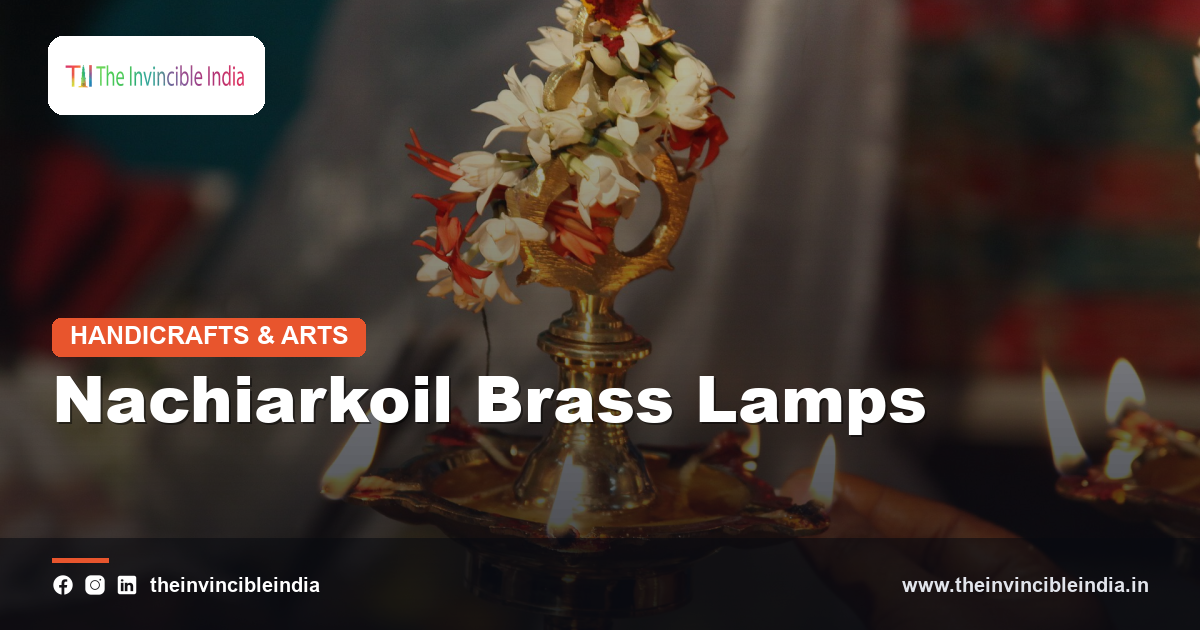
Nachiarkoil brass lamps are among the best known metal crafts of Tamil Nadu, made in a village near Kumbakonam in the Thanjavur region where families have cast and finished lamps for generations. Lit in homes and temples across the state, these lamps combine devotional purpose with sculptural form, and their making belongs to the same heritage of southern metal artistry that gives Tamil Nadu its celebrated bronze and brass traditions, a heritage also seen in the textile and craft cultures described in the guide to Kanjeevaram silk. This guide explores the lamp’s forms, the casting and assembly process, its ritual meaning and the artisan community that sustains it.
Quick Facts
| Detail | Information |
|---|---|
| Craft | Cast and hand-finished brass lamps |
| Region | Near Kumbakonam, Thanjavur district, Tamil Nadu |
| Well-known forms | Kuthuvilakku, Annam and Gajalakshmi lamps |
| Main material | Brass |
| Cultural role | Household worship and temple use |
| Recognition | Associated with Geographical Indication protection |
What Are Nachiarkoil Lamps
Nachiarkoil lamps are traditional brass lamps made in the village of Nachiarkoil in Tamil Nadu, a settlement associated with generations of lamp makers. They are used for lighting in puja rooms, family shrines, temples and festival decorations, where the steady glow of an oil lamp carries deep religious and cultural significance. The lamps range from simple handheld forms to tall standing designs with several tiers and intricate figurative details. What unites them is a combination of strong casting, careful finishing and a recognisable golden lustre. The village name has become shorthand for quality in brass lamp making across southern India. In this way, the Nachiarkoil lamp serves as both a practical object of worship and a celebrated example of Tamil Nadu’s metal craftsmanship.
The Place and Its Setting
Nachiarkoil lies in the Cauvery delta region of Tamil Nadu, close to Kumbakonam, a town long known for its temples, its scholarship and its rich craft traditions. This landscape of rivers, rice fields and temple towns has encouraged the growth of skilled artisan communities who supply the ritual and household needs of the surrounding population. The village is also known for its temple dedicated to Vishnu, associated with a celebrated stone Garuda image, which adds to the religious character of the area. The proximity of temples, festivals and devout households created a steady demand for lamps and ritual metalware. The setting thus explains how a small village developed into a recognised centre of brass lamp making.
Historical Background
The lamp holds a prominent place in Indian religious life, and metalworking traditions in the Tamil country go back many centuries, reaching their well-known height in the famous bronze images of temple workshops. Brass lamp making developed alongside this larger tradition, benefiting from shared knowledge of casting, finishing and design. Nachiarkoil emerged as a specialised centre where lamp making became a hereditary occupation. Families refined their methods and passed them down, building a reputation that extended well beyond the immediate region. The exact early history of individual workshops is difficult to trace precisely, but the continuity of the craft is clear in the forms and methods still in use. This long lineage gives the Nachiarkoil lamp the weight of established tradition.
The Meaning of the Lamp in Tamil Culture
In Tamil homes and temples the lamp is far more than a source of light, serving as a symbol of auspiciousness, knowledge and the presence of the divine. Lighting a lamp marks the beginning of daily worship, festivals, weddings and many other occasions, and the act is often performed with deliberate care. The lamp is associated with dispelling darkness, both literal and spiritual, an idea that runs through much of Indian thought. Because of this meaning, the lamp itself is treated with respect, and a well-made one is regarded as a lasting household treasure. Nachiarkoil lamps respond to this cultural importance by combining graceful form with durable construction, making them suitable for repeated ritual use across many years.
The Kuthuvilakku
The Kuthuvilakku is the classic standing lamp of Tamil Nadu, recognisable by its tall stem and its several levels, with a base that supports a column topped by a bowl for oil and wicks. It is lit during worship, at festivals and on auspicious family occasions, and it often takes pride of place in the puja room or at the entrance of a home. Variations of the form include different heights, ornamental rings and decorative finials that give each lamp its own character. The proportions are carefully judged so that the lamp stands steadily and looks balanced when lit. Nachiarkoil workshops are especially associated with this form, which remains the best known example of the village’s lamp making tradition.
Annam and Gajalakshmi Lamps
Alongside the standing lamp, Nachiarkoil workshops are known for lamps with figurative elements that give the object a sculptural presence. The Annam lamp incorporates the image of a swan, a bird associated in Indian tradition with grace and discernment, while the Gajalakshmi lamp features the goddess Lakshmi with attendant elephants, a motif linked with prosperity and auspiciousness. Such designs turn a functional lamp into a devotional image, joining the artistic traditions of temple sculpture with household ritual. Detailing is usually modelled in the casting and refined by hand, so that faces, ornaments and decorative lines emerge cleanly. These figurative lamps show how Nachiarkoil artisans blend religious iconography with metal craft to create objects of both use and beauty.
Materials Used
Nachiarkoil lamps are made primarily of brass, an alloy generally composed of copper and zinc and widely used in Indian vessels, lamps and ritual objects. Brass is favoured for lamps because it is strong, workable, resistant to heat and able to take a bright, golden polish. It also holds fine casting details well, which is important for the ornamental elements of the larger lamps. The quality of the alloy affects both the appearance and the durability of the finished lamp, so craftspeople pay close attention to the metal they use. A well-chosen material allows a lamp to stay beautiful over decades of regular lighting, cleaning and handling. Material quality is therefore the first foundation on which the reputation of the craft rests.
Mould Making and Casting
The making of a Nachiarkoil lamp begins with the preparation of moulds, into which molten brass is poured to produce the basic components of the lamp. Moulds are crafted by hand and tailored to each part of the design, since taller lamps are typically cast in sections rather than as a single piece. Success depends on temperature, timing and the quality of the mould, as flaws can leave pits or incomplete details in the metal. After the brass cools and hardens, the rough castings are removed and examined carefully. Casting thus provides the raw body of the lamp, to be refined through the later stages of finishing. This stage demands considerable experience, as small errors at the start can affect the entire piece.
Assembly and Joining
Many Nachiarkoil lamps, especially larger standing forms, are assembled from several separately cast elements, such as the base, the stem, the oil bowl and the decorative top. Each element must fit accurately with the others so that the final lamp is stable, aligned and visually harmonious. Joining is carried out with careful fitting and finishing so that seams are neat and secure. The ability to build a complex lamp from simpler parts allows artisans to create tall and elaborate designs while keeping each cast manageable. Assembly requires a keen eye for proportion, since a poorly balanced lamp would be both unattractive and unsafe. The process shows how Nachiarkoil lamp making blends casting skill with the careful craftsmanship of construction.
Finishing and Polishing
Once cast and assembled, a lamp passes through extensive finishing that determines its final beauty. Surfaces are scraped, filed and smoothed to remove casting marks, and decorative details are sharpened by hand. The lamp is then polished until the brass acquires its warm, reflective glow. Good finishing gives the lamp clean lines, crisp ornamental detail and a surface that catches light attractively when lit. It is also a mark of the artisan’s pride in the work, since the finish is the first thing buyers notice. Many families treat this stage as the point at which a lamp truly becomes complete. Polishing therefore transforms a rough metal casting into an object worthy of the shrine or the home.
The Artisan Families
Nachiarkoil lamp making is carried on by families who have worked with brass for generations, inheriting skills, tools and workshop practices from their elders. Knowledge is passed down through hands-on training, with younger members gradually taking on more demanding tasks as they gain experience. Different people may specialise in moulding, casting, assembly or polishing, forming a team whose combined skill produces the finished lamp. The workshop is thus both a place of production and a school of tradition. This pattern of hereditary craft explains the continuity of design and technique over time. Recognising the artisans as living custodians of the tradition is essential to understanding the craft, since the lamp is in many ways the visible result of shared family knowledge.
Recognition and Authenticity
The Nachiarkoil lamp is among the Indian handicrafts associated with Geographical Indication recognition, a system designed to link products with the place and methods that give them their identity. Such protection helps distinguish genuine village-made lamps from imitations and can support the standing of artisans in wider markets. Recognition also draws public attention to the craft, encouraging appreciation of its history and technique. For buyers, it provides some reassurance regarding origin and quality, though careful purchasing remains important. Authenticity in this setting means not only the place of manufacture but also the use of traditional casting and finishing methods. Recognition therefore functions as a useful support for the craft while the continuing skill of its makers remains its true foundation.
Lamps in Festivals and Rituals
Lamps play a central role in Tamil festivals and rituals, from the daily lighting of the household lamp to the celebration of major occasions marked by rows of lights. During festival seasons the demand for lamps rises, as families acquire new pieces or bring out heirloom lamps to be cleaned and lit with care. Lamps are also common gifts at weddings and housewarmings, where they symbolise auspicious beginnings and blessings for the household. In temples, larger lamps contribute to the atmosphere of worship and are often donated as offerings. Nachiarkoil lamps benefit from this deep cultural demand, since their forms are closely tied to the occasions on which light carries symbolic weight. Festive and ritual use thus keeps the craft vital within contemporary Tamil life.
Care and Maintenance
Brass lamps need regular, gentle care to retain their lustre, and traditional households have long-established ways of cleaning them. Used lamps are usually cleaned of old oil and soot after worship, then washed and dried to prevent staining. Periodic polishing restores the golden shine, often using natural cleaning agents such as tamarind or lemon, which are familiar in Indian households. Storing lamps in a dry place helps limit tarnishing. Careful handling is also advised, because decorative details and joined sections can be damaged by rough treatment. With such care a Nachiarkoil lamp can serve a family for many generations, becoming an heirloom that carries memories as well as devotional meaning. Maintenance thus becomes part of the continuing relationship between family and object.
Choosing a Genuine Lamp
Selecting a genuine Nachiarkoil lamp involves attention to weight, finish, symmetry and the clarity of ornamental detail. Hand-cast lamps tend to feel solid and show crisp modelling in the decorative elements, while a stable, well-balanced base indicates careful assembly. Buyers can look for clean joins and an even polish. Purchasing from artisan cooperatives, state emporia and reputable craft outlets helps ensure fair value reaches the makers. It is also helpful to ask about the maker and the workshop, as many artisans are happy to share details of their process. Choosing carefully supports the families who sustain the craft and ensures that the lamp brought home is a true product of the Nachiarkoil tradition rather than a mass-produced imitation.
Challenges and Adaptation
Brass lamp makers face challenges familiar to many traditional crafts, including competition from cheaper machine-made lamps, rising costs of metal and changing consumer habits. Smaller modern homes and electric lighting have reduced some demand for large, elaborate lamps, while younger generations sometimes prefer other careers. In response, artisans have adapted by offering a wider range of sizes, including compact lamps suited to modern homes and gifting. Greater exposure through exhibitions and craft fairs has also helped reach new customers. These adaptations show that the craft is not static but responsive to changing needs while preserving its core methods. Continuing support for fair pricing, training and marketing can help artisans meet present challenges and secure the future of this valued tradition.
Nachiarkoil Lamps Today
Today, Nachiarkoil lamps continue to be made by hand and lit in homes and temples across Tamil Nadu and beyond, carrying a centuries-old devotional tradition into contemporary life. Their forms remain recognisable, yet artisans have also introduced smaller, lighter and more varied designs to meet current tastes. Growing appreciation of hand-made, durable and meaningful objects has helped renew attention to traditional brass work, while recognition and craft promotion have raised awareness of the village’s contribution. The enduring appeal of the lamp lies in its union of light, metal and meaning, qualities that remain valued far from the workshop where it was made. The Nachiarkoil lamp thus endures as a vivid emblem of Tamil Nadu’s living craft and devotional heritage.
Sources & Further Reading
- Ministry of Culture, Government of India (indiaculture.gov.in).
- Development Commissioner (Handicrafts), Ministry of Textiles, Government of India.
Frequently Asked Questions
Where are Nachiarkoil lamps made?
They are made in the village of Nachiarkoil near Kumbakonam in the Thanjavur region of Tamil Nadu. The village is known for hereditary artisan families who specialise in cast brass lamps.
What is a Kuthuvilakku?
The Kuthuvilakku is the traditional standing lamp of Tamil Nadu, with a tall stem, a tiered structure and a bowl for oil and wicks. It is lit during daily worship, festivals and auspicious occasions.
How are Nachiarkoil lamps made?
Molten brass is poured into hand-prepared moulds to cast the components, which are then assembled, scraped, filed and polished by hand. Larger lamps are usually built from several separately cast sections.
What do the lamp designs symbolise?
The lamp itself symbolises auspiciousness and the dispelling of darkness, while figurative designs such as the swan and the goddess Lakshmi with elephants are linked with grace and prosperity.
How should a brass lamp be cleaned?
Clean away old oil and soot after use, then wash and dry the lamp thoroughly. Occasional polishing with natural agents such as tamarind or lemon restores the shine, and dry storage reduces tarnishing.


