

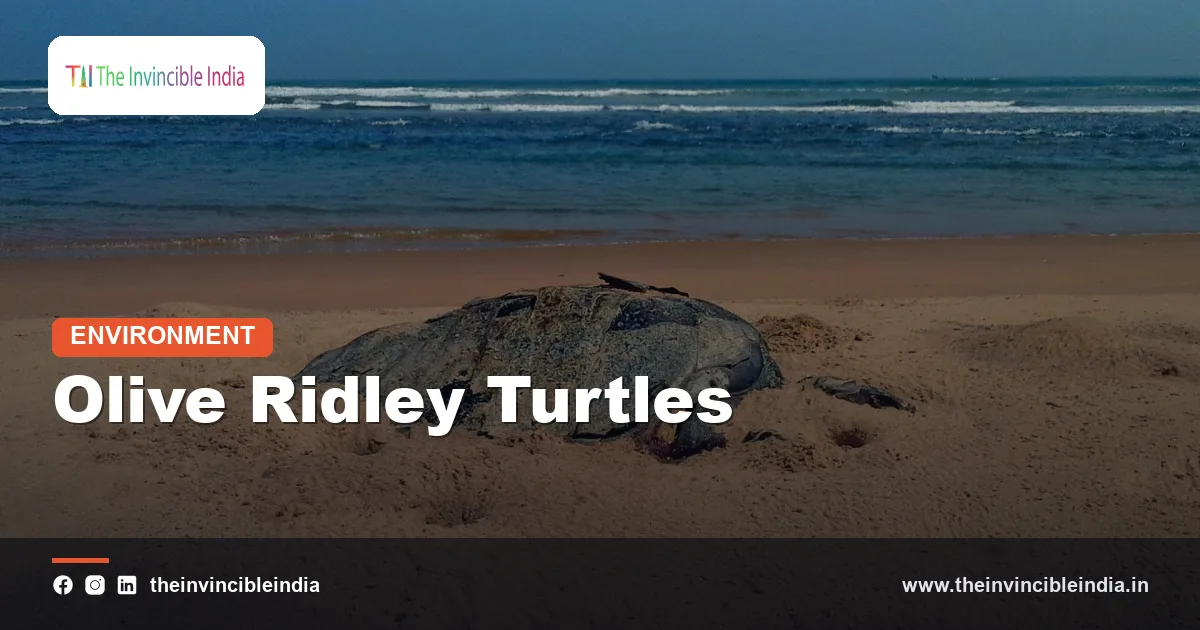
The Olive Ridley turtle (Lepidochelys olivacea) is one of the smallest and most abundant sea turtles in the world, and India hosts one of its most spectacular nesting phenomena. Every year, along the coast of Odisha on the Bay of Bengal, hundreds of thousands of females emerge from the sea together in a mass-nesting event known as an arribada, a Spanish word meaning “arrival”. It is among the great wildlife spectacles of the Indian subcontinent.
Despite their numbers at a few beaches, Olive Ridleys are classified as Vulnerable, and their survival is threatened by fishing nets, coastal development, artificial lighting and predators. This explainer covers their biology, the nesting cycle, the major rookeries of Odisha, the threats they face, the legal protection they enjoy, the use of Turtle Excluder Devices, and Operation Olivia, the annual protection effort by the Indian Coast Guard.
| Fact | Detail |
|---|---|
| Scientific name | Lepidochelys olivacea |
| Named for | The olive-green colour of its heart-shaped shell |
| IUCN status | Vulnerable |
| Indian legal status | Schedule I of the Wildlife (Protection) Act, 1972 |
| Famous behaviour | Mass synchronised nesting, called arribada |
| Major Odisha rookeries | Gahirmatha, Rushikulya and the Devi river mouth |
| Nesting season | Roughly November to April, with mass nesting usually in February-March |
| Egg incubation | About seven weeks |
| Protection drive | Operation Olivia by the Indian Coast Guard |
About the Olive Ridley Turtle
Olive Ridleys are small compared with other sea turtles. An adult usually has a carapace, or upper shell, of well under a metre in length, with a rounded, heart-shaped outline and an olive-grey to greenish colour. They are found in warm waters of the Pacific, Indian and Atlantic oceans, and live mostly in the open sea, feeding on jellyfish, crabs, shrimp, molluscs, algae and other small organisms.
Related species
The Olive Ridley is closely related to the Kemp’s Ridley, which nests mainly on the Gulf of Mexico coast. Together, these two are the only members of their genus and the only sea turtles known for the arribada. India’s coast is visited by several sea turtle species, including the green turtle, hawksbill, leatherback and loggerhead, but none gathers in numbers comparable to those of the Olive Ridley.
Why they are called sea turtles of long journeys
Satellite tracking and tagging studies have shown that Olive Ridleys travel long distances across the Bay of Bengal and the Indian Ocean between feeding and nesting grounds. They spend years at sea before returning to breed, and they are part of a wider marine ecosystem that stretches far beyond the Indian coast.
The Arribada: A Natural Spectacle
An arribada is a mass nesting in which large numbers of females come ashore on the same stretch of beach within a few nights. The reason this evolved is not fully understood, but scientists suggest that synchronised nesting may overwhelm predators, so that a larger share of eggs and hatchlings survive. Other theories include triggers from tides, winds and the lunar cycle.
How an arribada unfolds
In the days before the event, large numbers of turtles gather offshore. Then, usually at night and often around a particular phase of the moon, females begin to crawl up the beach in waves. Each digs a nest chamber in the sand with her hind flippers, deposits her eggs, covers them and returns to the sea. Because so many turtles come ashore, they sometimes disturb earlier nests, which is one natural cause of egg loss.
Solitary nesting
Not all Olive Ridleys nest in arribadas. Many nest individually, in smaller numbers and across longer periods, along coasts in Tamil Nadu, Andhra Pradesh, Kerala and other parts of the peninsula. This scattered nesting, though less dramatic, adds importantly to the total population.
The Nesting Cycle, from Egg to Hatchling
The life cycle of the Olive Ridley follows a pattern that is shared in broad outline by sea turtles worldwide, but each stage faces its own dangers.
Mating and arrival
Mating takes place at sea, in coastal waters near the nesting beaches, before the start of the nesting season. Females are believed to return to the region of their own birth to nest, a behaviour known as natal homing, although the mechanism by which they find their way, possibly involving the Earth’s magnetic field, is still being studied.
Eggs and incubation
A female typically lays about a hundred or more eggs in a nest dug to a depth of around half a metre. The eggs are soft-shelled and round, like ping-pong balls. Incubation takes roughly seven to eight weeks, depending on temperature. As in many reptiles, the temperature of the sand influences the sex of the hatchlings, with warmer nests tending to produce more females and cooler nests more males, a fact that makes climate change a concern for the species.
Hatchlings
Hatchlings emerge together, usually at night, and scurry towards the sea guided mainly by the brighter horizon over the water and the slope of the beach. Reaching the surf is only the first challenge: they face predators in the shallows, and only a very small fraction, commonly said to be about one in a thousand, survives to adulthood.
Timeline of the cycle
- November to December: turtles gather offshore and mating takes place.
- January to March: nesting, with arribadas typically in February and March.
- March to May: hatchlings emerge and make their way to the sea.
- Years later: surviving young mature after many years at sea and return to breed.
Gahirmatha: The World’s Largest Rookery
Gahirmatha beach, in Kendrapara district on the coast of Odisha, is widely regarded as one of the largest known nesting sites for the Olive Ridley in the world. It lies between the Bay of Bengal and the mangrove-rich Bhitarkanika region, a landscape of creeks, forests and mudflats that is also home to saltwater crocodiles and a wealth of birdlife.
Protected status
Bhitarkanika was declared a wildlife sanctuary in 1975 and later given national park status. The marine area off Gahirmatha was notified as the Gahirmatha Marine Sanctuary in 1997, recognising its importance for sea turtles. The wider area also forms part of a Ramsar wetland of international importance.
Features of the site
- A long, undisturbed sandy beach with a gentle slope.
- Nearby offshore waters rich in food.
- Protective mangrove forest behind the shoreline.
- Seasonal restrictions on fishing and human entry in notified zones.
Mass nesting at Gahirmatha is not guaranteed each year. In some seasons, the arribada has been delayed, reduced or missed, which scientists link to factors such as changing sand conditions, tidal patterns and offshore disturbances.
Rushikulya and the Devi River Mouth
Odisha’s coast has three principal mass-nesting sites. Besides Gahirmatha, the other two are the Rushikulya river mouth and the Devi river mouth.
Rushikulya rookery
Rushikulya, in Ganjam district in southern Odisha, was discovered as a mass-nesting site in the early 1990s. Its beach lies near the point where the Rushikulya river meets the Bay of Bengal. Local fishing communities and village volunteers have become active partners in protecting nests, setting up fences, guarding beaches and helping hatchlings reach the sea. The site has also become a popular, if carefully managed, place for visitors to watch the spectacle.
Devi river mouth
The Devi river mouth, on the coast of Puri district, is the third major rookery. Shifts in the river channel and in the beach have meant that the use of this site by the turtles has varied from year to year, and it has seen both strong and weak nesting seasons.
Why three sites matter
Having multiple sites gives the species some protection against a single disaster, such as a cyclone or localised disturbance. Odisha’s coast is exposed to severe storms, and variations in nesting between sites help ensure that not all eggs are at risk at once.
Threat One: Trawler Bycatch and Fishing Nets
The largest human threat to Olive Ridleys in Indian waters is accidental capture in fishing gear. Turtles gather near the coast for mating and nesting, precisely where trawlers, gill nets and other nets operate. A turtle caught in a net cannot reach the surface to breathe and drowns within a short time.
Strandings
In some years, large numbers of dead turtles have washed ashore on the beaches of Odisha during or just before the nesting season, and many of these deaths have been linked to fishing operations. The sight of such strandings has prompted concern, public attention and court-directed measures to regulate fishing near the rookeries.
Regulation of fishing
The Odisha government, drawing on its marine fishing law, has restricted fishing in notified zones near the main rookeries for a period each season, and has required mechanised vessels to avoid sensitive areas. Enforcing these rules is a challenge, because fishing is a vital livelihood for many coastal families and the sea is vast. Dialogue with fishing communities and the provision of alternative support are therefore integral to turtle protection.
Threat Two: Lights, Development and Beach Loss
Sea turtle hatchlings find their way to the ocean by moving towards the brightest, lowest horizon, which on a natural beach is the sea. Artificial lights from roads, ports, hotels, villages and vehicles confuse them, drawing them inland where they may die from exhaustion, dehydration or traffic.
Sources of disturbance
- Port and harbour construction, and related lighting and dredging.
- Roads, buildings and resorts along the shoreline.
- Casuarina and other plantations that alter the beach and block movement.
- Beach erosion, rising sea levels and storm surges.
- Plastic waste and marine debris that can be swallowed or entangle turtles.
Reducing the impact
Measures include switching off or shielding lights near nesting beaches during the season, using low-intensity, turtle-friendly lighting, keeping vehicles off the beach and applying Coastal Regulation Zone rules strictly to restrict construction near the shore. Environmental assessments for coastal projects are expected to consider turtle nesting seasons and routes.
Threat Three: Predation on Eggs and Hatchlings
Predation is a natural part of turtle ecology, but human influence has intensified it. Jackals, wild dogs, hyenas, wild pigs, monitor lizards and crows dig out eggs or attack hatchlings. In the water, fish and seabirds take hatchlings as they enter the sea. Free-ranging dogs near villages have added to the pressure.
Egg collection
Egg poaching has been a historical problem in some regions, where eggs were collected for food. Stronger enforcement and awareness programmes have reduced direct egg collection in the main rookeries, though it still occurs in less-monitored places.
Protecting nests
Wildlife staff and local volunteers in Odisha protect nests by fencing arribada beaches, patrolling at night, relocating eggs from places at risk of flooding to safer ground, and operating hatcheries in some areas. Scientists caution that relocating eggs should be done carefully, since sand temperature affects the sex ratio of hatchlings.
Turtle Excluder Devices
A Turtle Excluder Device, or TED, is a simple but effective piece of equipment fitted inside a trawl net. It consists of a grid of bars with an opening, placed in the neck of the net. Small catch such as shrimp and fish passes through the bars to the end of the net, while larger animals such as turtles are guided by the grid to an escape flap and swim free.
How TEDs help
- They reduce turtle deaths in trawl nets without greatly reducing the catch of target species.
- They are relatively inexpensive and can be built locally.
- They are accepted internationally as a standard measure, and some importing countries require shrimp to come from fisheries that use them.
Adoption in India
The use of TEDs has been promoted by the Indian government and research institutions, with training and demonstration programmes for fishers, and has been made mandatory for mechanised trawlers in Odisha. Fishers sometimes resist them out of fear of losing catch, so ongoing training, field trials and enforcement are important to ensure that devices are fitted correctly and used consistently.
Legal Protection under the Wildlife Protection Act
All sea turtles found in Indian waters, including the Olive Ridley, are listed in Schedule I of the Wildlife (Protection) Act, 1972. This confers the highest level of protection, making it an offence to hunt, harm, trade in or possess turtles, their eggs or products without authorisation. Violations attract penalties of imprisonment and fines.
Other frameworks
- CITES: the species is listed in Appendix I, banning international commercial trade.
- Convention on Migratory Species: it is covered as a migratory species requiring cooperation between countries.
- Coastal Regulation Zone notifications: these restrict development near turtle nesting beaches.
- Marine protected areas: Gahirmatha Marine Sanctuary and Bhitarkanika provide spatial protection.
Role of the courts
Indian courts have intervened on several occasions, directing authorities to enforce fishing restrictions, use TEDs and protect nesting sites. These interventions have strengthened accountability and highlighted the need for balanced approaches that protect both wildlife and fishers’ livelihoods.
Operation Olivia by the Indian Coast Guard
Operation Olivia is an annual initiative of the Indian Coast Guard to protect Olive Ridley turtles during their breeding season. Begun in the early 1980s, it runs roughly from November to May, covering the months when turtles gather and nest along the coast of Odisha and neighbouring areas.
What the operation involves
- Coast Guard ships and aircraft patrol the waters near the rookeries to keep out illegal trawlers.
- Crews watch for vessels fishing in prohibited zones and take action in cooperation with state fisheries authorities.
- Personnel assist forest officials with monitoring, rescue of entangled turtles and awareness activities.
- Information sessions are held for fishing communities about turtle conservation rules and safe fishing practices.
Cooperation with other bodies
The operation works in coordination with the Odisha Forest Department, the Wildlife Institute of India, marine fisheries agencies and non-governmental organisations. Its patrols have been credited with reducing illegal fishing near the nesting beaches, and the name “Olivia” has become well known among fishing communities along the east coast.
Conclusion
The Olive Ridley turtle is a remarkable survivor, with a lineage stretching back millions of years, but modern pressures are formidable. Protecting it involves coastal management, regulated fishing, careful lighting, community participation and the sustained efforts of agencies such as the forest department and the Coast Guard. If India can safeguard the arribadas of Gahirmatha, Rushikulya and the Devi river mouth, it will preserve one of the planet’s great natural spectacles for future generations.
Frequently Asked Questions
What is an arribada?
An arribada is the mass nesting of Olive Ridley turtles, when thousands of females come ashore on the same beach within a few nights to lay eggs. The word comes from Spanish and means “arrival”. In India it is best known from the coast of Odisha.
Where do Olive Ridley turtles nest in India?
The main mass-nesting beaches are Gahirmatha in Kendrapara district, the Rushikulya river mouth in Ganjam district and the Devi river mouth in Puri district, all in Odisha. Smaller numbers nest individually along other parts of the east and west coasts.
When do Olive Ridley turtles nest?
Nesting generally takes place between November and April, with the mass nesting commonly occurring in February and March. The eggs take about seven weeks to hatch.
What is a Turtle Excluder Device?
A Turtle Excluder Device (TED) is a grid with an escape opening fitted inside a trawl net. It lets small fish and shrimp pass into the net while guiding turtles and other large animals out, preventing them from drowning.
What is Operation Olivia?
Operation Olivia is the Indian Coast Guard’s annual operation to protect Olive Ridley turtles during their breeding season, from about November to May. Coast Guard vessels and aircraft patrol the coast to prevent illegal fishing near the rookeries and support conservation work.
Is the Olive Ridley turtle protected by law in India?
Yes. It is listed in Schedule I of the Wildlife (Protection) Act, 1972, which gives it the highest protection, and it is also covered by international agreements such as CITES. Harming turtles or collecting or trading their eggs is a punishable offence.


