

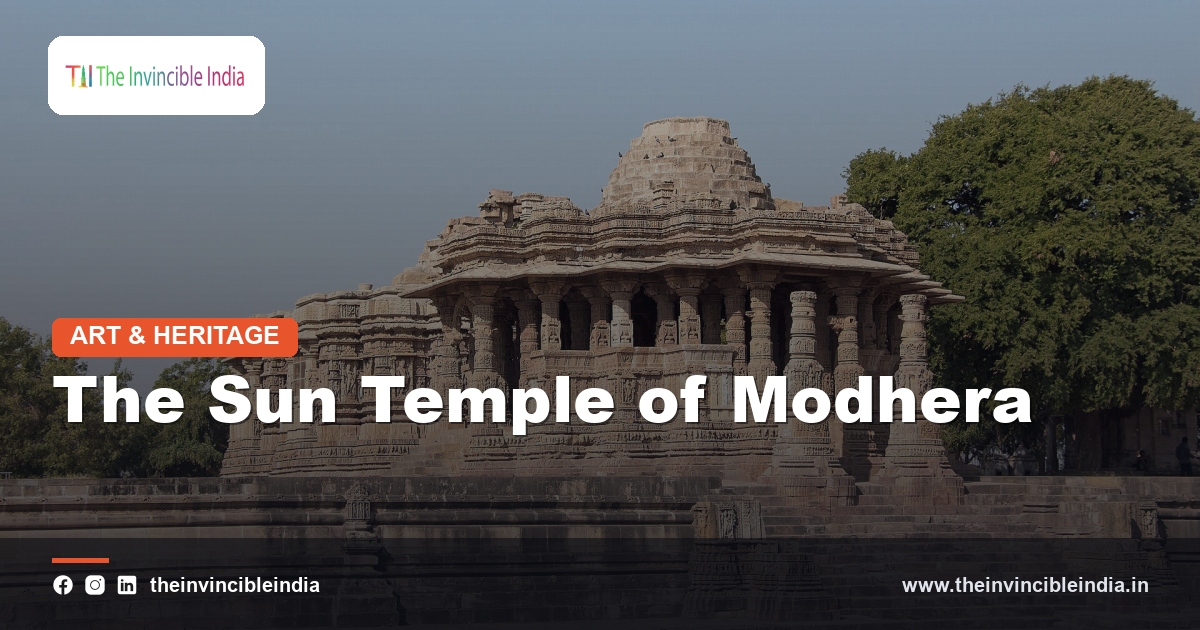
The Sun Temple of Modhera stands on the bank of the river Pushpavati in northern Gujarat, a golden-hued monument dedicated to Surya, the sun god, and built in the age of the Solanki dynasty. Its sandstone halls, richly carved pillars, graceful entrance arch and the great stepped tank in front of it make it one of the most complete temple compositions of western India. Where many ancient shrines survive only in fragments, Modhera still conveys the full plan of a medieval sun sanctuary. Like the monuments introduced in the guide to Indian temple architecture, it shows how devotion, geometry and sculpture were joined into a single sacred design.
Quick Facts
| Detail | Information |
|---|---|
| Location | Modhera, Mehsana district, Gujarat |
| Deity | Surya, the sun god |
| Dynasty | Solanki (Chaulukya) period |
| Style | Maru-Gurjara temple architecture |
| Key parts | Gudhamandapa, Sabhamandapa and Surya Kund |
| Protection | Monument protected by the Archaeological Survey of India |
A Sun Sanctuary on the Pushpavati
The Sun Temple of Modhera rises beside the river Pushpavati in the Mehsana region of Gujarat, in a landscape of open plains that suits a shrine devoted to the sun. Its setting is part of its meaning, because a sanctuary of Surya was traditionally placed where the sky and the rising sun could be experienced without obstruction. The village of Modhera has long been associated with sacred tradition, and the temple compound has become one of the most visited heritage places in the state. The monument is not a single building but a carefully ordered group of structures arranged along an east-west line. Visitors approach through a stepped tank, climb toward the assembly hall and finally reach the sanctum. This sequence of tank, hall and shrine is the key to understanding the temple, which was designed as a ritual journey rather than a simple building.
Surya in the Indian Tradition
Worship of the sun is among the oldest strands of Indian religious life, and Surya appears in the earliest hymns of the Vedic tradition as a source of light, life and moral order. Over the centuries the sun god acquired a distinct iconography, usually shown standing, holding lotus flowers and driving a chariot drawn by horses. Temples to Surya were built in several regions, and communities devoted to the sun god developed their own priesthoods and rituals. In Gujarat, the cult of Surya found strong royal and mercantile support, which helped to produce monuments of real ambition. Modhera belongs to this broad devotional history, and it shares its spiritual theme with other great sun temples of the subcontinent. The shrine therefore stands as one chapter in a long story of sun veneration that connects Vedic hymn to medieval stone.
The Solanki Age in Gujarat
The Modhera temple is a product of the Solanki dynasty, also called the Chaulukyas, who ruled much of Gujarat during the early medieval period. Their reign is remembered as a time of prosperity, trade and religious patronage, when rulers, ministers and wealthy merchants commissioned temples, tanks and stepwells across the region. The capital at Anhilwad Patan became a centre of learning and artistic activity, and the court supported Shaiva, Vaishnava and Jain institutions alike. This broad patronage encouraged skilled workshops of stone carvers to refine a regional architectural language. Modhera is generally dated to the eleventh century, within the most confident phase of Solanki building. Its elegance reflects a period in which royal resources, devotional energy and craft expertise were all at their height, and the result was a temple of unusual refinement.
The Maru-Gurjara Architectural Style
The architecture of Modhera is usually described as belonging to the Maru-Gurjara tradition, a regional style that developed in Gujarat and parts of Rajasthan under Solanki patronage. This style is known for its precise stone masonry, its dense yet balanced ornament and its careful coordination between structure and sculpture. Walls are divided into horizontal bands of figures, mouldings and decorative motifs, while the superstructures are conceived as rising masses of repeated forms. A striking feature of the tradition is the use of carefully dressed stone blocks fitted together without a binding mortar, relying on accurate cutting for stability. The result is a crisp, almost jewel-like surface. Modhera shows this style in its mature form, and it remains a primary reference for understanding how the builders of western India shaped their own distinctive temple vocabulary.
The Three Parts of the Temple Complex
The Modhera complex is organised into three principal components that stand in a straight line. At the front lies the Surya Kund, the great rectangular tank used for ritual purification. Beyond it is the Sabhamandapa, an open assembly hall designed for gatherings, music and ceremony. Behind that rises the Gudhamandapa, the enclosed hall that leads to the sanctum, which once housed the image of the deity. Each part has its own character, yet all share a unified architectural idea. The progression moves from the openness of water and sky, through the semi-open hall of congregation, to the shadowed interior of the shrine. This graduated experience, from public to private and from light to darkness, is a classic principle of Indian temple planning, and Modhera expresses it with remarkable clarity and order.
The Surya Kund and Its Stepped Design
The Surya Kund is one of the most admired features of Modhera, a large rectangular tank whose sides descend in a pattern of stepped terraces. Flights of steps run in several directions, forming repeated geometric patterns that look almost like a carved pyramid inverted into the earth. Set within the terraces are numerous small shrines and niches, many of them containing images of deities. The tank served the practical purpose of ritual bathing before worship, but its design also made it a work of architecture in its own right. When filled with water, the geometry of steps and miniature shrines would have been reflected on the surface. The Surya Kund shows how water architecture in Gujarat, the same tradition that produced the great stepwells, could be elevated into a sacred and aesthetic masterpiece.
The Sabhamandapa and Its Carved Pillars
The Sabhamandapa, or assembly hall, is open on its sides and supported by a forest of richly carved pillars. These supports are shaped in several sections, moving from square bases to octagonal forms and finally to circular shafts, each level adorned with ornament. Brackets and cross-beams carry the weight of the ceiling, which is decorated with intricate patterns. The hall was intended for congregational activities, including recitation, music and dance, so its open design allowed light and air to move freely through it. The pillars frame views toward the sanctum and create a rhythm of vertical lines that draws the eye forward. Every surface seems occupied by carving, yet the overall impression is one of order rather than crowding. The Sabhamandapa is among the most celebrated examples of pillared hall design in the architecture of western India.
The Gudhamandapa and the Sanctum
The Gudhamandapa is the closed hall that connects the assembly space to the sanctum, and it forms the inner core of the temple. Its walls are thick and its interior is shaded, marking a deliberate shift from the airy brightness of the outer hall. The sanctum itself, the garbhagriha, was the home of the sun image, and it is surrounded by a circumambulatory passage that allowed worshippers to walk around the shrine. Although the superstructure of the temple has not survived in its original form, the surviving walls and plan clearly show the logic of the design. The enclosed hall offered a space of quiet preparation before the encounter with the deity. In this way the Gudhamandapa illustrates the Indian idea that sacred space should be approached gradually, with each threshold deepening the sense of reverence.
The Ornamental Entrance Arch
In front of the Sabhamandapa stand a pair of pillars supporting a ceremonial arch known as a torana. This gateway is carved with fine, lace-like ornament and acts as a threshold between the tank and the hall. The torana is a familiar element of Indian sacred architecture, serving both as a symbolic doorway and as a decorative frame. At Modhera its slender columns and curved profile create a striking visual accent against the broad masses of the hall behind it. The carving includes floral designs, geometric patterns and figural details, all executed with great precision. Passing beneath the arch was traditionally an act of transition from the everyday world to a sanctified one. The torana therefore combines beauty with meaning, and its surviving form is one of the most photographed and recognisable images of the temple.
Sculpture on the Walls and Niches
The outer walls of the Modhera temple are crowded with sculpture arranged in orderly registers. Figures of divinities, celestial beings and graceful attendants occupy niches and panels, set among mouldings and floral borders. Representations connected with the sun god and with the guardians of the directions reflect the solar theme of the shrine, while other panels draw on the wider pantheon of Hindu belief. The carving shows careful attention to pose, ornament and proportion, and the figures are often given a lively, flowing quality. Sculpture here is not a separate art laid over architecture but an integral part of the structure, shaping its rhythm and meaning. The result is a wall that tells stories and conveys cosmic order at once. This wealth of carved imagery places Modhera among the leading examples of sculptural richness in Indian temple art.
Orientation and the Light of the Sun
Because the temple honours the sun, its orientation is central to its design. The complex is aligned along an east-facing axis so that the rising sun could meet the sanctuary directly. Tradition holds that the plan was conceived so that the first light of morning would fall upon the sacred image at particular times of the year, linking the architecture to the movement of the sun. Whatever the precise astronomical intention, the idea that a temple should participate in the daily and seasonal rhythm of the sky is deeply rooted in Indian thought. The open hall, the water tank and the carefully placed doorways all allow light to enter and play across carved surfaces. In this sense the temple works as an instrument for experiencing sunlight, turning the natural cycle of dawn into a ritual event.
Damage, Decay and the Loss of the Sanctum Image
Like many medieval temples in India, Modhera did not remain untouched through the centuries. Changing political fortunes, neglect and natural forces all took their toll, and the shrine eventually ceased to function as an active place of worship. The superstructure above the sanctum was lost over time, and the principal image of the deity is no longer in place. For a long period the structures stood partly buried and weathered, with sand and debris gathering around the lower parts of the complex. Yet the strength of the original masonry and the quality of its carving allowed the monument to survive in a remarkably legible state. The story of Modhera is therefore also a story of endurance. The fragments that remain still communicate the grandeur of the original conception, and they invite visitors to imagine the temple at the height of its use.
Rediscovery, Conservation and Protection
In the modern period the Sun Temple of Modhera came under official protection, and conservation work has focused on stabilising its structures and clearing the surroundings. The Archaeological Survey of India oversees the monument, carrying out repair, cleaning and documentation so that the carved surfaces are preserved for the future. Conservation of sandstone is a continuing challenge, as exposure to weather, moisture and salts can slowly erode fine detail. Careful maintenance of the stepped tank and the surrounding grounds has also helped restore the setting in which the temple was meant to be seen. The protection of Modhera reflects a wider recognition that India’s medieval temples are part of a shared cultural inheritance. Continued conservation ensures that future generations can study the monument as both a work of art and a record of regional history.
The Modhera Dance Festival
In recent decades the temple has also become known as a venue for a winter festival of classical dance, held against the backdrop of the illuminated Sabhamandapa. Performers of several classical traditions present their art on a stage set before the carved pillars, reviving the old idea that the temple hall is a place for music and movement. The festival connects the monument to the living performing arts of India, showing how heritage sites can host cultural activity without losing their dignity. The glowing stone, the open hall and the sound of classical music together create an atmosphere that recalls the temple’s original role as a space of devotion and celebration. The festival has helped bring wider public attention to the site, and it stands as an example of how ancient architecture can continue to inspire contemporary artistic expression.
Modhera Among the Sun Temples of India
Modhera is often discussed alongside the other great sun sanctuaries of the subcontinent, including the Martand Sun Temple of Kashmir and the chariot-shaped temple at Konark in Odisha. Each belongs to a different region and a different architectural tradition, yet all express the same devotion to Surya. Comparing them reveals how a single religious idea could be translated into varied stone forms, from the courtyard plan of Kashmir to the chariot concept of the east. Modhera contributes the gentle, carved elegance of the Gujarat school and its integration of a sacred tank into the temple plan. Seen together, these monuments show the geographic breadth of sun worship in India. Within that family, Modhera holds a distinctive place as one of the most graceful and best-preserved expressions of the solar tradition.
The Modhera Sun Temple Today
Today the Sun Temple of Modhera is a protected monument and a leading heritage attraction of Gujarat, visited by students of architecture, pilgrims, photographers and travellers. It is recognised as a masterpiece of Solanki craftsmanship and as a key reference for the study of the Maru-Gurjara style. The monument continues to teach lessons about proportion, ritual planning and the union of sculpture with structure. Its stepped tank, pillared hall and carved arch remain striking even after centuries of change. For those interested in the cultural landscape of western India, Modhera offers a clear and moving encounter with the devotional imagination of its builders. Standing quietly beside the Pushpavati, the temple still honours the sun it was built to celebrate, and it remains a lasting symbol of the artistic achievement of medieval Gujarat.
Sources & Further Reading
- Archaeological Survey of India (asi.nic.in).
- Ministry of Culture, Government of India (indiaculture.gov.in).
Frequently Asked Questions
Where is the Modhera Sun Temple located?
The Modhera Sun Temple is located in the village of Modhera in the Mehsana district of Gujarat, on the bank of the river Pushpavati. It lies in the northern part of the state and is an established heritage destination.
Who built the Modhera Sun Temple?
The temple is associated with the Solanki dynasty, also known as the Chaulukyas, who ruled Gujarat in the early medieval period. It is generally dated to the eleventh century, during the height of Solanki patronage of temple building.
What is the Surya Kund at Modhera?
The Surya Kund is the large stepped rectangular tank in front of the temple. It was used for ritual bathing and is decorated with terraces of steps and many small shrines, making it a notable work of water architecture.
What architectural style is the Modhera temple?
Modhera belongs to the Maru-Gurjara tradition of western India, known for its precise stone masonry and rich carved ornament. The temple is also noted for its pillared assembly hall and ornamental entrance arch.
Is worship still held at the Modhera Sun Temple?
The temple is now a protected monument and is not used as an active place of daily worship. It remains a cultural site that hosts events such as an annual classical dance festival.


