

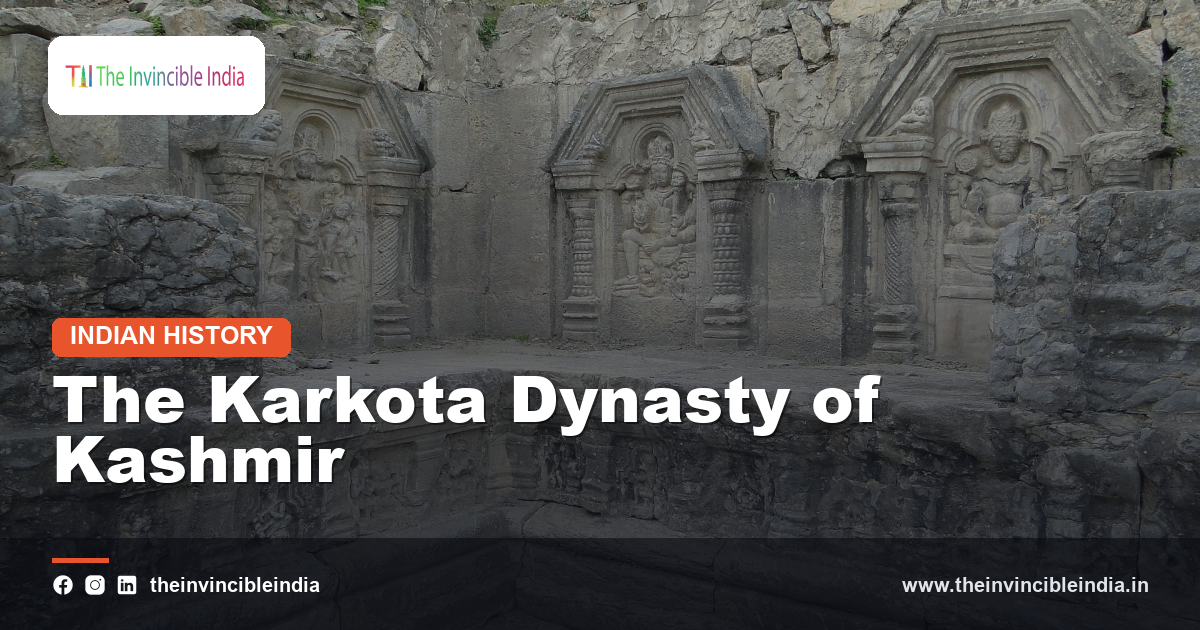
The Karkota dynasty ruled Kashmir during the early medieval centuries and raised the valley from a regional kingdom into a notable political and cultural force of the Himalayan north. Its most celebrated ruler, Lalitaditya Muktapida, is remembered in chronicles as a conqueror and builder, and the great Sun Temple of Martand stands as a monument to the confidence of the age. The dynasty also fostered Sanskrit learning, Shaiva and Buddhist thought and distinctive stone architecture. Readers interested in the broader sweep of classical north Indian power may compare it with our guide to the Gupta empire, while the Karkotas themselves offer a unique Himalayan perspective on Indian history.
Quick Facts
| Detail | Information |
|---|---|
| Dynasty | Karkota, an early medieval line of Kashmir |
| Region | The Kashmir valley and surrounding territories |
| Best-Known Ruler | Lalitaditya Muktapida |
| Principal Source | Kalhana’s Sanskrit chronicle, the Rajatarangini |
| Landmark Monument | The Martand Sun Temple |
| Successors | The Utpala dynasty |
Overview of the Karkota Dynasty
The Karkotas ruled Kashmir at a time when the valley was becoming a leading centre of Sanskrit culture and a significant political player in northern India. Their kingdom lay behind the Pir Panjal mountains, protected by natural barriers yet connected to wider networks of trade, pilgrimage and scholarship that crossed the Himalaya.
Under the dynasty, Kashmir developed a confident royal ideology, an expanding state and a rich artistic life. The Karkota period is often described as the first great age of Kashmiri history, and its legacy of temples, learning and literature shaped the cultural identity of the valley for the centuries that followed.
Kashmir Before the Karkotas
Kashmir had a long history before the Karkotas, with traditions of Buddhism, Shaivism and Sanskrit learning stretching back to ancient times. The valley had been associated with great Buddhist councils and with scholars who travelled to Central Asia and China, and it had been ruled by a number of earlier dynasties, whose stories are preserved in legend and chronicle.
This inheritance gave the Karkotas a rich cultural foundation. The valley already possessed a literate elite, active monasteries and an established tradition of temple building. The dynasty built upon these resources, adding political energy and royal patronage to a society that was ready to flourish.
Durlabhavardhana and the Rise of the Dynasty
According to the traditional chronicle, the dynasty was founded by Durlabhavardhana, who is described as having risen from the service of the previous ruling house to take the throne. The name Karkota is linked with the naga, a serpent deity important in Kashmiri belief, and the family took pride in this association.
Early Karkota rulers consolidated their authority within the valley and established relations with neighbouring powers. The chronicle presents the foundation of the dynasty as a moment of renewal for the kingdom. Whatever the details of its origin, the family succeeded in creating a stable state that grew steadily in strength and reputation.
Kalhana's Rajatarangini as a Source
Much of what is known about the Karkotas comes from the Rajatarangini, a Sanskrit verse chronicle composed by the Kashmiri scholar Kalhana in the twelfth century. Often regarded as one of the most remarkable works of historical writing in classical India, it traces the kings of Kashmir from legendary beginnings down to the author’s own time.
Kalhana mixed myth, tradition and critical judgment, and he sometimes criticised rulers openly, which gives the work a distinctive independence. Because it was written long after the Karkota period, historians read it with care and compare it with other evidence, but it remains an indispensable and fascinating guide to the dynasty and its world.
Lalitaditya Muktapida, the Great Karkota King
Lalitaditya Muktapida is the most celebrated ruler of the dynasty and one of the best-known kings of ancient Kashmir. The chronicle presents him as a vigorous conqueror who led armies far beyond the valley and as a generous patron who raised splendid monuments. His name has become a symbol of Kashmiri greatness.
Modern historians view the more extravagant claims of the chronicle with caution, but they accept that his reign marked a high point of Karkota power. He maintained diplomatic contacts with distant regions, and his reputation spread widely. Lalitaditya remains a central figure in the historical imagination of Kashmir and in the wider story of early medieval India.
Campaigns and Political Reach
The Karkota rulers extended their influence through military expeditions into the plains of northern India and the mountain regions to the north and west. Chronicles describe campaigns against rulers of the Gangetic plain, including a contest involving the kingdom of Kannauj, then one of the leading centres of political power.
The kingdom also had to deal with powers beyond the Himalaya, such as Tibet, and with the Arab presence in the northwest, and diplomacy accompanied conquest. These activities show that Kashmir was not isolated but fully engaged with the strategic politics of its time. The reach of the Karkotas remains a notable chapter in the military history of the Himalayan frontier.
Administration and Royal Authority
The Karkota state was organised around a strong monarchy supported by ministers, military commanders and officials who managed revenue and justice. The valley’s compact geography made it easier to govern than many larger kingdoms, and the court was the focus of political and cultural life.
Royal authority was reinforced through religion, with the king presented as a protector of dharma and a patron of temples and learned institutions. At the same time, powerful court factions and officials sometimes influenced succession, a theme that appears often in the chronicle. The mixture of centralised rule and courtly intrigue is a recurring feature of the dynasty’s history.
Economy, Agriculture and Trade Routes
The fertile Kashmir valley, watered by the Jhelum and its tributaries, produced rice, fruit and other crops that supported a dense and settled population. Skilled artisans worked in textiles, metal and stone, and the region was admired for its fine woollen goods and for the beauty of its crafts.
Trade routes through mountain passes connected Kashmir with the plains of India, Central Asia and Tibet, carrying goods, ideas and pilgrims. Merchants and travellers brought wealth and news, and the court benefited from the commerce that passed through its territory. The economy of the Karkota kingdom was therefore both agrarian and outward-looking, with trade enriching its cultural life.
Religion: Shaivism, Vaishnavism and Buddhism
The Karkota period was religiously diverse. Shaivism, which developed into the sophisticated philosophical tradition now known as Kashmir Shaivism, grew steadily in importance, while Vishnu worship and the cult of the Sun received generous royal patronage. Buddhism also remained active, supported by monasteries and learned monks.
The kings built shrines and viharas for different faiths and appear to have valued the distinct traditions that coexisted in the valley. This pluralism was a defining feature of Kashmir’s cultural character, and it allowed religion, philosophy and art to develop together in a spirit of lively exchange and mutual influence.
The Martand Sun Temple
The most famous monument associated with Lalitaditya is the Martand Sun Temple, built on a plateau overlooking the valley near Anantnag. Dedicated to Surya, the sun deity, it was constructed of grey limestone and set within a large rectangular courtyard surrounded by a colonnade of fluted columns and many small shrines.
The central shrine, once crowned by a steep pyramidal roof, displays sculpted figures and elegant mouldings. Although now in ruins, the temple’s sheer scale and the harmony of its design still impress. Martand is regarded as a masterpiece of Kashmiri architecture and as a powerful symbol of the Karkota era.
Features of Kashmiri Temple Architecture
Temples of the Karkota age introduced a style that drew on several traditions yet remained distinctively Kashmiri. Typical features include steep pyramidal roofs, trefoil arches, pillared peristyle courtyards and fluted columns reminiscent of classical forms. The stone was cut with great precision and fitted without much mortar.
These elements reflect cultural contacts with the Gandharan and wider Himalayan world, combined with local creativity and the demands of a snowy climate. The steep roofs, for example, suited the weather of the valley. This architectural vocabulary became the foundation for later Kashmiri building and remains easy to recognise in surviving ruins.
Parihasapura and Other Foundations
Lalitaditya is credited with founding a new city called Parihasapura, which the chronicle describes as a splendid royal centre adorned with temples and a monastery. Its ruins, on a plateau near present-day Srinagar, include the remains of large platforms, shrines and stupa bases, hinting at the ambitions of the king.
Other Karkota foundations and restorations dotted the valley, creating a landscape of sacred and royal buildings. The planning of such complexes shows how closely kingship and monumental building were connected in the ancient world. Parihasapura stands today as a haunting reminder of the grandeur the dynasty hoped to achieve.
Sanskrit Learning and the Arts
Kashmir under the Karkotas became a magnet for scholars and poets, and the valley later grew into one of the major centres of Sanskrit thought in India. Learned men produced works on poetics, grammar, philosophy and religion, and the royal court supported their efforts with grants and recognition.
The traditions that developed in this period would reach full maturity in later centuries, giving the world influential theories of aesthetics and nondual philosophy. The Karkota rulers laid the foundations by creating conditions of stability and patronage. The intellectual life of Kashmir thus owes a significant debt to the dynasty and its commitment to learning.
Later Karkota Rulers and Decline
After the reign of Lalitaditya, the dynasty faced growing challenges. Later kings, including Jayapida, are described in the chronicle as ambitious and learned but also as rulers whose reigns were troubled by rebellion and the influence of powerful officials and landholders.
Over time the authority of the crown weakened, and conflicts at court led to instability. Eventually the Karkota line came to an end, and a new family, the Utpalas, took power. The decline of the dynasty reflects the common difficulty of maintaining a strong monarchy after a great founder, and it is told with vivid detail in the chronicle.
Legacy in Kashmir and Beyond
The legacy of the Karkotas can be seen in the architecture, literature and historical memory of Kashmir. Their temple style influenced later builders, and the story of Lalitaditya has remained a source of pride in the valley. The dynasty also helped establish Kashmir as a leading centre of Sanskrit civilisation.
Beyond the valley, the Karkotas contributed to the diversity of Indian history by showing how a Himalayan kingdom could play a role in the wider politics and culture of the subcontinent. Their achievements illustrate the creative interaction between mountain and plain, and they continue to attract the interest of historians and travellers alike.
The Karkota Dynasty Today
Today the monuments of the Karkota age are protected by heritage authorities, and the ruins of Martand and Parihasapura are visited by scholars and travellers who value their historical and architectural importance. Photographs, studies and exhibitions help to keep the memory of the dynasty alive for new generations.
The Rajatarangini continues to be read in translation and in the original, and it inspires reflection on how history is written and remembered. The Karkota story endures as an expression of Kashmir’s long and creative past, reminding visitors that the valley has been a meeting place of faiths, arts and ideas for many centuries.
Sources & Further Reading
- Archaeological Survey of India (asi.nic.in).
- Ministry of Culture, Government of India (indiaculture.gov.in).
Frequently Asked Questions
Who were the Karkotas?
The Karkotas were an early medieval dynasty that ruled Kashmir and expanded its influence across parts of northern India and the Himalaya. They are remembered for their strong kings and their cultural achievements.
Who was Lalitaditya Muktapida?
Lalitaditya was the most celebrated Karkota king, described in chronicles as a conqueror and builder. He is associated with the Martand Sun Temple and with the city of Parihasapura.
What is the Martand Sun Temple?
It is a ruined temple dedicated to the sun god Surya, located near Anantnag in Kashmir. It is admired for its limestone construction, colonnaded courtyard and the scale of its design.
What is the Rajatarangini?
The Rajatarangini is a Sanskrit verse chronicle of the kings of Kashmir composed by Kalhana in the twelfth century. It is the main literary source for the Karkota dynasty.
Who succeeded the Karkotas?
The Utpala dynasty took power after the Karkota line ended. Their rule continued the cultural traditions of the valley under a new ruling family.


