

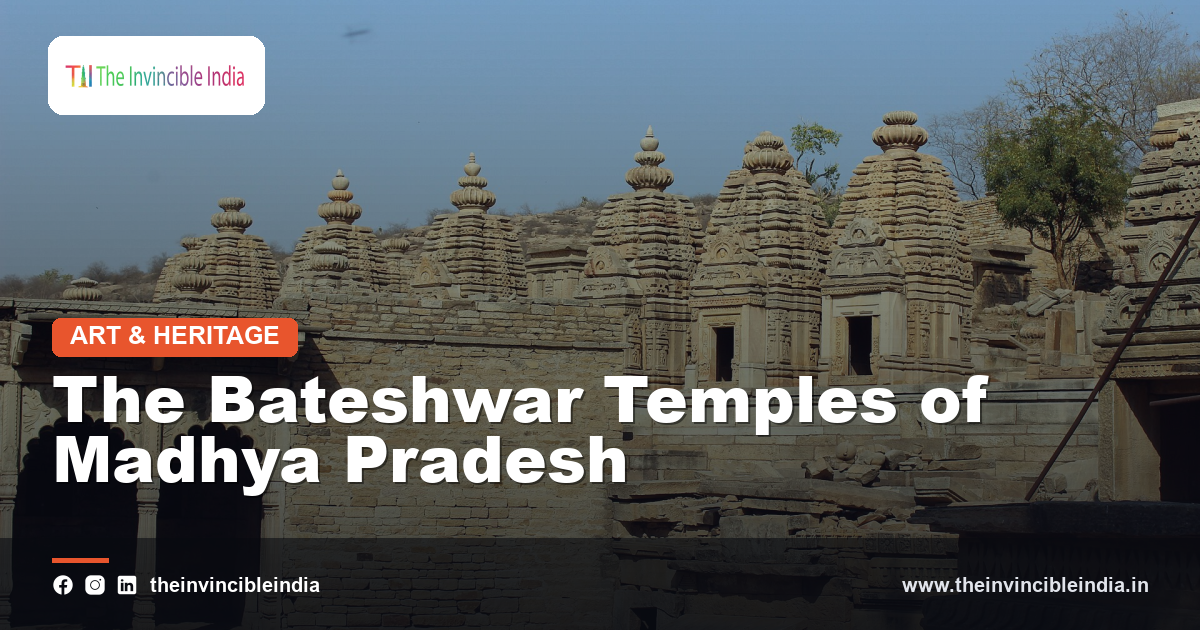
In the rugged ravine country of the Chambal region in northern Madhya Pradesh lies Bateshwar, a vast cluster of sandstone temples that offers a rare glimpse of early medieval devotion and craftsmanship. The shrines, dedicated chiefly to Shiva but also to Vishnu and the goddess, belong to the age of the Gurjara-Pratihara rulers, who patronised temple building across much of northern India. For centuries many of the structures lay collapsed and scattered, hidden among the scrub and ravines. Careful restoration has since brought the complex back to life, reassembling fallen stones into standing temples. Visitors who arrive after studying Indian temple architecture will find at Bateshwar a vivid and intimate example of the northern Nagara tradition in its early flowering.
Quick Facts
| Detail | Information |
|---|---|
| Location | Near Morena, Madhya Pradesh |
| Landscape | Chambal ravine country |
| Period | Early medieval, Gurjara-Pratihara era |
| Style | Nagara temple architecture |
| Material | Local sandstone |
| Dedications | Mainly Shiva, with Vishnu and Shakti shrines |
A Temple Complex in the Chambal Country
The Bateshwar temples lie in the Morena district of northern Madhya Pradesh, in a landscape shaped by the Chambal river and its deeply eroded ravines. This region, with its dry scrub, folded earth, and wide skies, has a stark beauty that contrasts with the ornate stone buildings scattered across it. The temples occupy a gentle slope, with the forms of small and large shrines rising in groups and clusters among the trees. Because the area was long remote and sparsely populated, the monuments were left largely undisturbed, although time and neglect brought many of them down. The site is important not as a single great monument but as an entire sacred landscape, where dozens of temples stand together. Experiencing Bateshwar means walking among many shrines of differing sizes, an experience that conveys the scale of religious activity once centred here more powerfully than any one building could do.
The Gurjara-Pratihara Age
The temples of Bateshwar are generally attributed to the period when the Gurjara-Pratihara dynasty held sway over large parts of northern and central India, roughly between the eighth and tenth centuries. The Pratiharas are remembered as powerful rulers who defended the region and encouraged art, trade, and religion. Under their patronage and that of local chiefs who acknowledged their authority, temple building flourished, producing monuments in many parts of the north. The Bateshwar group is considered one of the notable survivals of this tradition, together with other sites of the same region. While exact dates and patrons of individual shrines are not always known, the broad cultural context is well established. The complex therefore offers a window into a period when strong royal power and religious devotion combined to create a lasting architectural heritage, expressed in sandstone shrines of considerable refinement.
Origins of the Site and Its Sacred Meaning
The name Bateshwar is commonly understood as a reference to Shiva, the lord worshipped at the site, and the location has been regarded as sacred for many centuries. Tradition links the place to the worship of Shiva in his many forms, and the surrounding landscape, with its river and ravines, forms a natural setting for pilgrimage. The choice of site for a group of temples often reflected the presence of a sacred spring, tree, or other feature, and local belief associates Bateshwar with such powers. The temples were built to house images of the deities and to provide places where devotees could gather, offer worship, and take part in festivals. Even in their ruined state, the shrines retained a sense of holiness for local people. The sacred meaning of the site is therefore deeply rooted, giving the complex a significance that goes beyond architecture to the heart of lived faith.
The Nagara Style at Bateshwar
The temples of Bateshwar are built in the northern Nagara style, in which a sanctum is crowned by a tower with a curving profile, known as a shikhara. The towers of the Bateshwar shrines display the early features of this form, with layered projections and a rounded crowning member. Smaller temples have simple, compact outlines, while larger ones show more elaborate arrangements of porch, hall, and sanctum. The proportions are balanced, the lines clear, and the decoration restrained, giving the group a sober and dignified character. Because the temples belong to an early phase of development, they help scholars trace how the Nagara tradition evolved before the great temples of later centuries. Studying Bateshwar offers a lesson in the foundations of a style that would flourish across much of India. Its buildings show that grandeur may lie in clarity of form and harmony of design as much as in abundant ornament.
Sandstone Construction and Craft
The temples at Bateshwar were built of local sandstone, a warm, fine-grained stone that is well suited to carving and that takes on a soft golden tone in the sunlight. Masons cut the blocks with great accuracy, fitting them together without mortar so that the weight of the structure held the stones in place. This dry-stone technique is characteristic of early Indian temple building and demands great skill, particularly in the construction of towers and ceilings. Decorative details were carved directly on the blocks, including mouldings, floral patterns, and figures. The use of a single local material gives the complex a unified appearance, as though the temples grew out of the earth itself. The craftsmanship also explains why so many shrines could later be reassembled, as their carefully shaped stones, even when fallen, retained the marks and forms that allowed them to be returned to their original positions.
The Temple Clusters and Their Layout
The Bateshwar complex consists of numerous temples arranged in groups, some of which stand close together in compact clusters while others are spread across the slope. A temple group of this kind often grew over time, with new shrines added by successive patrons, so that the layout reflects a long period of devotion rather than a single plan. Paths run between the shrines, and several of the temples face one another across open courtyards. Many are small, with a single chamber and a modest tower, while a few are larger and have porches or halls. A lake or tank may once have formed part of the sacred setting, in keeping with the tradition of locating temples near water. The overall arrangement conveys a sense of community, as if the shrines together formed a village of the gods. Wandering among them reveals the density and richness of the religious landscape.
Shiva Temples and the Lingam Sanctums
Most of the temples at Bateshwar are dedicated to Shiva, and their sanctums typically contain a lingam, the aniconic form through which the deity is worshipped. The lingam is placed on a pedestal and often surrounded by a channel that carries away offerings of water and milk. Outside the sanctum, the walls of the temples carry niches that originally held images of Shiva’s various forms and of attendant deities. The entrances are framed by carved doorways, whose lintels sometimes bear the images of deities and auspicious motifs. The simplicity of the interiors invites inward focus and quiet devotion. Because Shiva is revered throughout India, the shrines at Bateshwar connect with a pan-Indian tradition while also expressing a distinct regional style. The dominance of Shiva temples gives the complex a unified spiritual identity, one that continues to attract worshippers who come to offer prayers at the restored shrines.
Vishnu and Shakti Shrines
Although Shiva is the principal deity at Bateshwar, the complex also includes shrines connected with Vishnu and with the goddess, reflecting the pluralism of early medieval Hindu worship. Temples to Vishnu are recognisable by the images placed in their niches and on their doorways, which may show him in various forms and with his attendants. Shrines associated with Shakti honour the divine feminine, a power revered in many guises across India. The presence of these different traditions side by side shows that devotees at the site did not restrict themselves to a single sect. Instead they moved comfortably among shrines, honouring each deity in turn. This inclusive atmosphere is characteristic of Indian religion and of the culture that produced the temples. The coexistence of the three great currents of devotion at Bateshwar adds depth and variety to the complex, making it a useful guide to the religious life of the period.
Sculpture and Ornament
The decoration of the Bateshwar temples is restrained but accomplished, with carving concentrated on doorways, pillars, mouldings, and the faces of the towers. Floral scrolls, geometric bands, and small figures appear in places where the stonework invites ornament, while niches on the outer walls hold images of divinities. The sculptors worked in a style typical of the Pratihara age, with graceful, balanced figures and an emphasis on clear outlines rather than extreme detail. Some temples have more elaborate carving, and these are often the ones that attracted special devotion. The ornament never overwhelms the architecture but supports it, guiding the eye upward along the tower and toward the entrance. Visitors who look carefully will find small details of great charm, from delicate patterns to expressive faces. The sculpture of Bateshwar demonstrates that the early medieval tradition valued harmony and moderation, creating beauty through careful proportion instead of excess.
Collapse and Long Neglect
For many centuries the Bateshwar temples stood in a remote region that experienced periods of unrest and neglect, and over time many of them collapsed. Earthquakes, weathering, and the growth of vegetation took their toll, and some shrines were reduced to heaps of fallen stone. The area also became associated with the ravine country, where access was difficult and conservation work was not easy. Local people continued to regard the site as sacred, but the buildings themselves slowly disappeared beneath scrub and earth. The scattered fragments, however, were not lost, since the carved stones remained in the area, waiting to be recognised and recovered. This long period of decay explains why the site remained little known beyond its region for so long. It also makes the later revival all the more remarkable, since the complex that visitors see today is the result of patient effort to restore what time had scattered.
The Restoration of the Complex
In recent decades the Archaeological Survey of India has carried out an extensive programme to restore the Bateshwar temples, working to identify fallen stones, sort them, and rebuild the shrines. This is a painstaking process, resembling a vast three-dimensional puzzle, in which each block must be matched to its original position through careful study of its shape, decoration, and traces of use. The work has resulted in the reconstruction of a large number of temples, and many now stand once more with their towers rising above the surrounding scrub. The effort has also included clearing the site, strengthening foundations, and improving access for visitors. The restoration is regarded as a significant achievement in the conservation of Indian heritage, showing that even heavily ruined monuments can be recovered through patience and expertise. Thanks to this work, the complex has become a living example of how research and skill can return a lost landscape to public view.
The Wider Group: Padavali and Mitawali
Bateshwar is often visited together with two nearby sites, Padavali and Mitawali, which belong to the same cultural region and period. Padavali preserves the remains of an early temple with fine sculptural fragments and a ruined fort, while Mitawali is celebrated for its circular temple, known as the Chausath Yogini temple, whose plan is thought by many to have inspired architectural ideas in later buildings. Together the three sites form a heritage circuit that gives a fuller understanding of the temple culture of the Chambal country. Each place has its own character, yet they share a common history and artistic language. Visiting them together allows one to see how temple building spread across a region and how different forms, from simple shrines to circular plans, coexisted. The combined experience enriches an appreciation of Bateshwar and shows that it forms part of a broader landscape of early medieval religious and artistic achievement.
Festivals, Fairs, and Local Worship
Bateshwar remains a place of living worship and community gathering, and its temples continue to receive devotees on festival days. The most important occasions follow the Hindu calendar, with Mahashivaratri drawing many pilgrims to offer prayers to Shiva. A well-known annual fair takes place in the region, bringing together villagers and visitors for religious observance, trade, and entertainment, and it forms an important part of local culture. Such fairs keep alive customs that have connected the people of the area to the temples for generations. Songs, rituals, and shared meals strengthen community bonds, and the temples become the centre of social as well as religious life. The continuation of worship gives the restored shrines meaning beyond their architectural value, since they are not merely monuments but places of faith. This living tradition ensures that Bateshwar remains connected to the people whose ancestors built and cherished it.
Landscape, Wildlife, and the Chambal Setting
The surroundings of Bateshwar contribute greatly to the experience of the temples. The Chambal river, known for its clean waters and its protected stretches, flows through a landscape of sandy banks and sculpted ravines that is home to rare wildlife, including river dolphins, gharials, and many birds. The region has a quiet, open character, with wide horizons and soft evening light that falls across the golden sandstone. This natural setting also helps explain why the temples were built here, as the combination of river, rock, and sky has long suggested sacred presence. The history of the region has sometimes been associated with unrest, yet today it is increasingly known for its heritage and natural attractions. Visiting Bateshwar therefore offers a double reward, as one may appreciate both the artistry of the temples and the austere beauty of the landscape that has surrounded them for over a thousand years.
Visiting and Appreciating Bateshwar
A visit to Bateshwar is best planned in the cooler months, when walking among the temples is comfortable and the light is soft. The site is reached by road from Morena and can be combined with a tour of Padavali, Mitawali, and other monuments of the region. Visitors should allow time to wander slowly, observing the different shrines, the details of their carving, and the way the stones fit together. Respect for the temples, including appropriate dress and behaviour in active shrines, is important, since worship continues here. Photography is rewarding, particularly at sunrise and sunset, when the sandstone glows. Local guides and information boards can help in understanding the history and layout of the complex. By approaching the site with patience and curiosity, visitors can gain a deep appreciation of a monument group that was nearly lost and now stands as a testimony to the endurance of Indian culture and devotion.
Bateshwar Today
Today the Bateshwar temples stand as one of the most inspiring examples of heritage recovery in central India, a complex of sandstone shrines that has been returned to the landscape after centuries of ruin. They preserve the architecture and religious spirit of the Gurjara-Pratihara age, offering a clear view of the early Nagara style in its formative period. The shrines to Shiva, Vishnu, and the goddess remind visitors of the diversity and unity of Indian devotion, while the restoration work demonstrates the value of careful scholarship and patience. Together with nearby Padavali and Mitawali, the complex forms a significant heritage circuit in the Chambal region. For students of architecture, pilgrims, and travellers, Bateshwar offers a quiet and rewarding experience. It stands as a lasting reminder that the monuments of India are not only relics of the past but living parts of a continuing cultural story that the present generation is privileged to protect and enjoy.
Sources & Further Reading
- Archaeological Survey of India (asi.nic.in).
- Ministry of Culture, Government of India (indiaculture.gov.in).
Frequently Asked Questions
Where are the Bateshwar temples located?
The Bateshwar temples are located near Morena in northern Madhya Pradesh, in the ravine country of the Chambal region. They should not be confused with other places of the same name elsewhere in India.
Which period do the Bateshwar temples belong to?
They are generally attributed to the early medieval Gurjara-Pratihara period, broadly between the eighth and tenth centuries. The exact dates of individual shrines are not always known.
Which deities are worshipped at Bateshwar?
Most of the temples are dedicated to Shiva, but the complex also includes shrines connected with Vishnu and with the goddess. This reflects the blended devotional traditions of the period.
How were the Bateshwar temples restored?
The Archaeological Survey of India identified and sorted the fallen stones and then reassembled many shrines, matching each block to its original position. The work is considered a major conservation achievement.
What other sites can be visited near Bateshwar?
Visitors often combine Bateshwar with Padavali and Mitawali, which lie in the same region. Mitawali is especially known for its circular Chausath Yogini temple.


