

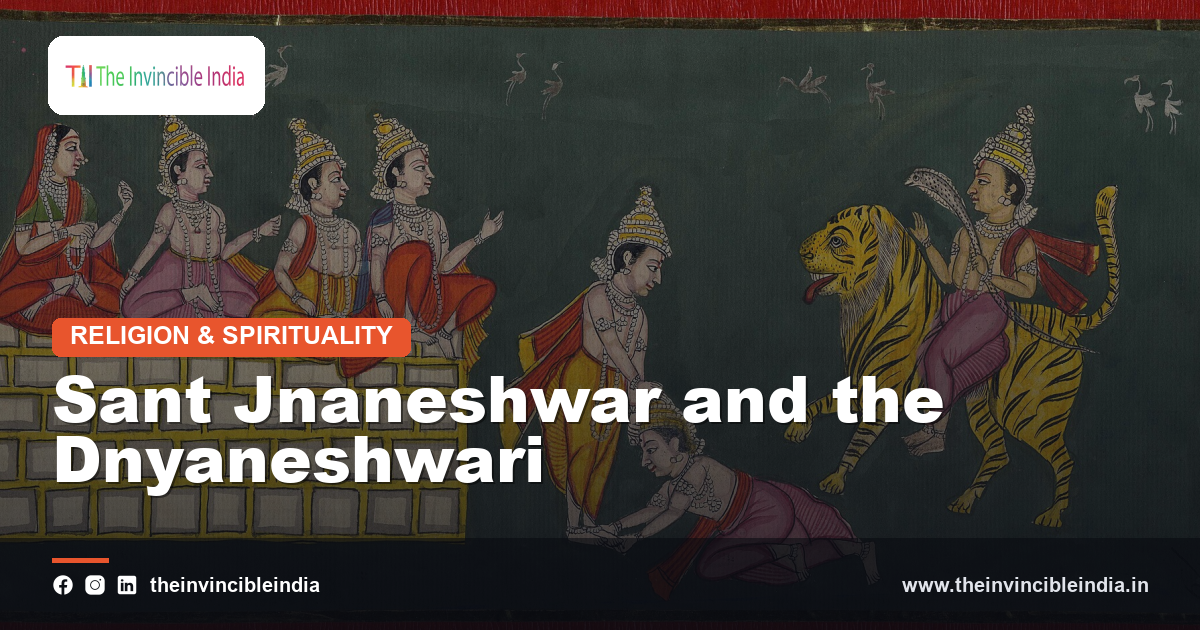
Sant Jnaneshwar, also spelled Dnyaneshwar and affectionately called Mauli or mother by devotees, is one of the most beloved saint-poets of Maharashtra. Living in the thirteenth century, he gave the Marathi language its first great work of spiritual literature by explaining the Bhagavad Gita to ordinary people in their own tongue. His Jnaneshwari became a cornerstone of the Varkari tradition, whose pilgrims walk each year to Pandharpur in honour of Vithoba, and it stands among the glories of the wider Bhakti movement. This guide describes his life as tradition remembers it, his major works, the ideas they express, the Varkari pilgrimage and the enduring place he holds in the spiritual and literary heritage of India.
Quick Facts
| Detail | Information |
|---|---|
| Era | Thirteenth century |
| Region | Maharashtra, Alandi |
| Language | Marathi |
| Major Work | Jnaneshwari (Bhavartha Dipika) |
| Tradition | Varkari and Nath lineages |
| Honorific | Mauli (Mother) |
A Child Saint of Maharashtra
Sant Jnaneshwar is remembered as a young prodigy whose spiritual insight and poetic gifts flowered at an age when most people are only beginning to learn. Tradition places him in the Marathi-speaking region of the Deccan during the thirteenth century, a time when Sanskrit was the language of scholarship and religious learning. Against that background his decision to speak of the highest truths in Marathi was both bold and generous. He is honoured as a saint, a philosopher, a poet and a spiritual teacher, and his short life is regarded as complete in its achievement. Devotees often describe him with the tender title of Mauli, which means mother, expressing the warmth and care they associate with him. The combination of youth, wisdom and compassion gives his story a special appeal. It continues to inspire readers and pilgrims across Maharashtra and well beyond, as a model of spiritual maturity unlimited by age.
Family Background and the Four Siblings
According to tradition, Jnaneshwar was one of four siblings, the others being his elder brother Nivruttinath, his younger brother Sopan and his sister Muktabai, all of whom are honoured as saints in their own right. Their father is remembered as a devout man who had once taken up the life of a renunciate before returning to family life, an act that tradition says brought hardship upon the children from conservative circles of their time. The family’s story is retold as a narrative of endurance in the face of social difficulty, met with dignity and spiritual strength. Accounts differ in detail, and the narratives are best read as devotional tradition rather than strict history. What stands out is the picture of four young people united by faith and sustained by one another. Their shared heritage forms one of the most moving chapters in the story of Maharashtra’s saints.
Nivruttinath and the Nath Lineage
Jnaneshwar is traditionally described as a disciple of his elder brother Nivruttinath, who belonged to the Nath lineage, a spiritual current known for yogic discipline and the pursuit of direct realisation. Through this connection the young saint received initiation into a rigorous inner path that valued meditation, self-knowledge and the mastery of the mind. The Nath tradition has influenced many religious movements in India, and its imprint is visible in the way Jnaneshwar writes about yoga and inner experience. Yet his devotional heart also turned toward the loving worship of God, so that his teaching joins the yogic and the devotional streams. The relationship between teacher and disciple, in this case also between brothers, shows how spiritual knowledge was handed down in personal bonds. It also explains the unusual richness of his thought, which draws on several streams of Indian spirituality at once and fuses them in a single voice.
The Jnaneshwari: A Marathi Gita
The Jnaneshwari, also known by the title Bhavartha Dipika, meaning the lamp that illuminates the meaning, is Jnaneshwar’s celebrated commentary on the Bhagavad Gita. Composed in Marathi, it takes the verses of the Gita, which was traditionally studied in Sanskrit, and explains them in flowing, vivid language. The work is not a literal translation but a creative interpretation, enriched with images, similes and examples drawn from everyday life. Through it, readers who could not read Sanskrit gained access to one of the central texts of Indian philosophy. The Jnaneshwari is admired both as a religious text and as a masterpiece of Marathi literature, and it is often regarded as the founding work of that literary tradition. Its generous spirit of explanation reflects the saint’s belief that the highest knowledge should be shared. Generations of Marathi speakers have grown up listening to its verses and holding them dear.
The Ovi Metre and the Poetry of the Commentary
The Jnaneshwari is composed in a Marathi verse form called the ovi, a flexible, flowing metre well suited to narration and explanation. The ovi allows the poet to build long sequences of connected thought, with each verse leading naturally into the next. Within this form Jnaneshwar achieves a remarkable blend of philosophical depth and poetic beauty. His imagery draws on nature, the household and the human body, bringing abstract ideas to life through concrete pictures. The effect is a commentary that reads as poetry, in which argument and artistry cooperate. Listeners find the sound of the verses appealing, and the text has long been recited aloud in homes and temples. The mastery of the ovi helped to establish Marathi as a language capable of carrying serious philosophical content. It demonstrates how form and meaning can reinforce each other in sacred literature.
Key Ideas of the Jnaneshwari
The Jnaneshwari follows the structure of the Bhagavad Gita and develops its principal themes, including the nature of the self, selfless action, devotion and knowledge. Jnaneshwar emphasises that true spiritual progress depends on performing one’s duties without attachment to their fruits and on cultivating a mind that is calm and clear. He explains that the self is distinct from the body and its changes, and that realisation of this truth brings freedom from sorrow. Devotion to God is presented as a path that unites knowledge and action, and the commentary speaks warmly of the grace of the divine. Throughout, the author invites readers to engage personally with the teachings rather than treat them as abstract doctrine. His interpretation is known for its gentleness and its confidence in the reader. These ideas make the work a living guide to spiritual practice, not merely a scholarly study.
Amrutanubhav: The Nectar of Experience
Alongside the Jnaneshwari, the saint is traditionally credited with another major work, the Amrutanubhav, whose title means the nectar of direct experience. This text is a shorter and more philosophical composition that explores the non-dual nature of reality and the unity of the individual and the divine. It speaks of an experience in which the usual distinctions between knower, known and knowing dissolve. The language is subtle and poetic, and the text is considered one of the most profound statements of Indian non-dualism in a regional language. Where the Jnaneshwari explains an existing scripture, the Amrutanubhav presents the author’s own insight in a more concentrated form. Together the two works show the breadth of his mind, one open to a wide public, the other directed toward seekers. Readers often find that studying both reveals the depth and unity of his vision.
The Haripath and the Abhangas
Jnaneshwar is also remembered for devotional songs known as abhangas, short poems in praise of the divine that are sung by the Varkari community. Among them is the Haripath, a collection of verses that urges devotees to recite the name of Hari as a daily practice. The abhanga form is simple and direct, built for singing in groups with a steady rhythm. These songs express personal devotion, longing and joy in the divine name, and they are easy for ordinary people to learn and repeat. They show a more intimate side of the saint, complementing the philosophical grandeur of the longer works. In the Varkari tradition they are sung during pilgrimage, in temples and in homes. The abhangas keep the saint’s voice present in daily devotional life and demonstrate that profound spirituality can be expressed in the plainest and most singable verses.
The Pasayadan: A Universal Prayer
At the close of the Jnaneshwari stands a prayer known as the Pasayadan, in which the poet asks for the well-being of all beings. It is among the best-loved passages in Marathi literature, and many families recite it as a daily or festive blessing. The prayer wishes that evil may give way to goodness, that darkness may lift and that all creatures may find their desires fulfilled. It does not ask for advantage for any single group but extends its goodwill to the whole world. The tone is humble, and the poet presents the gift as a favour requested from the divine, not claimed as his own. This universal outlook has given the verses a wide appeal across communities. The Pasayadan shows the generous heart behind the learning, and it is often quoted as an expression of the compassion at the centre of the Varkari ideal.
Alandi and the Samadhi
The town of Alandi, on the banks of the Indrayani river near Pune, is the principal place of memory for Jnaneshwar. Tradition holds that the saint chose to enter a state of samadhi there at a very young age, an act regarded by devotees as a conscious and peaceful completion of his earthly mission. The site is marked by a temple complex that draws pilgrims throughout the year and especially during the annual pilgrimage season. Visitors offer prayers at the shrine, walk around the sacred precincts and sit to hear recitations from his works. The atmosphere is one of quiet devotion and gratitude. For Varkaris, Alandi is the spiritual starting point of their journey and a place where the presence of the saint is deeply felt. The shrine anchors the tradition in a specific landscape and gives devotees a tangible focus for their reverence.
The Varkari Tradition and Vithoba
Jnaneshwar is regarded as one of the foundational saints of the Varkari tradition, a devotional movement of Maharashtra centred on the worship of Vithoba, also called Vitthala, at the temple of Pandharpur. The word Varkari refers to those who undertake the regular pilgrimage, the vari, to that sacred town. The tradition is known for its egalitarian spirit, welcoming people of all backgrounds, and for its emphasis on devotion expressed through singing the divine name and living simply. The saints of the movement, including Namdev, Eknath and Tukaram, are honoured alongside Jnaneshwar. His writings supplied the philosophical foundation for the movement, while the songs gave it voice. Together they created a living community of faith that has endured for centuries. The Varkari way remains one of the most vibrant devotional traditions in India.
The Wari Pilgrimage to Pandharpur
Each year, during the month of Ashadha, large processions of devotees walk from Alandi, Dehu and other towns to Pandharpur, carrying the padukas, or sacred footwear symbols, of the saints in decorated palanquins. This pilgrimage is known as the Wari, and it is one of the most remarkable acts of collective devotion in India. Pilgrims walk for many days, singing abhangas, playing cymbals and drums, and sharing food and hospitality along the way. The journey is marked by a spirit of equality, in which differences of rank and wealth are set aside. Villagers along the route welcome the walkers with water, meals and blessings. At Pandharpur the pilgrims gather to worship Vithoba, bringing the journey to a joyful close. The Wari renews the connection between the saints’ teaching and the lives of ordinary people each year.
Namdev, Eknath, Tukaram and the Saint Lineage
Jnaneshwar stands within a long line of Marathi saints who shaped the spiritual life of Maharashtra. Namdev, regarded as a contemporary and companion, composed devotional songs in praise of Vithoba. Eknath, who lived in a later period, wrote commentaries and devotional poems and helped to revive the study of the Jnaneshwari. Tukaram, perhaps the best known of the later poet-saints, expressed deep devotion in abhangas that remain widely sung. Together with other saints, they form a lineage that each generation of Varkaris honours. Their works share common themes of devotion, humility and social inclusiveness, and they have enriched Marathi literature immeasurably. The saints are remembered as a spiritual family, each contributing a distinct voice to a shared chorus. Within this family, Jnaneshwar is often described as the foundation on which the others built.
Language, Literature and Social Impact
By writing in Marathi, Jnaneshwar helped bring spiritual knowledge into a language that ordinary people spoke and understood. This choice had lasting consequences for the literary history of Maharashtra, giving the language a classic that set a standard for later writers. It also had social consequences, since it opened the doors of scriptural understanding to those who had not been educated in Sanskrit. The inclusive character of the Varkari movement, which he helped to inspire, encouraged people of many castes and backgrounds to take part in devotion on equal terms. The saints and their songs gave a sense of shared identity and moral purpose to communities across the region. Their influence is felt in social customs, in festivals and in the cultural memory of Maharashtra. His work thus shaped not only religion and literature but also the way a society understands dignity and belonging.
Sant Jnaneshwar Today
Today Sant Jnaneshwar remains one of the most beloved figures of Maharashtra and an important figure in the wider story of Indian spirituality. The Jnaneshwari continues to be studied, recited and printed in many editions, and scholars value it as a major text of Marathi literature and philosophy. Each year millions of people take part in or follow the Wari pilgrimage that honours him and the other saints. The shrine at Alandi welcomes visitors from all over India and beyond. Schools, cultural groups and devotional organisations teach his songs and stories to young people. For many, his example of wisdom joined with compassion remains a source of encouragement. The saint-poet who spoke of the highest truths in the language of the people continues to speak to a modern audience, reminding readers that spiritual understanding is meant to be shared with all.
Sources & Further Reading
- Sahitya Akademi (sahitya-akademi.gov.in).
- Ministry of Culture, Government of India (indiaculture.gov.in).
Frequently Asked Questions
Who was Sant Jnaneshwar?
Sant Jnaneshwar was a thirteenth-century saint-poet of Maharashtra who wrote in Marathi and is honoured as a founder of the Varkari devotional tradition. He is best known for the Jnaneshwari, a commentary on the Bhagavad Gita. Devotees often call him Mauli, meaning mother.
What is the Jnaneshwari?
The Jnaneshwari, also called Bhavartha Dipika, is his Marathi commentary on the Bhagavad Gita, written in the ovi verse form. It explains the Gita’s teachings through vivid imagery and everyday examples. It is regarded as a foundational work of Marathi literature.
What is the Amrutanubhav?
The Amrutanubhav is a philosophical work traditionally attributed to Jnaneshwar that explores the unity of the self and the divine. Its title means the nectar of experience. It presents his own insight in a compact and poetic form.
Why is Alandi important?
Alandi, near Pune, is the place associated with the samadhi of the saint, and a temple complex there draws pilgrims throughout the year. It is also the starting point of one of the major Wari processions to Pandharpur. For Varkaris it is a deeply sacred town.
What is the Wari?
The Wari is the annual pilgrimage in which Varkari devotees walk to Pandharpur to worship Vithoba, carrying the palanquins of the saints. Pilgrims sing abhangas and share hospitality along the way. It is noted for its spirit of equality and devotion.


