

Purandara Dasa is remembered across South India as a saint, a poet and a musical teacher whose work gave Carnatic music much of its enduring shape. A member of the Haridasa tradition of Karnataka, he sang of the divine in simple Kannada verses meant to be understood and sung by ordinary people, and he also devised graded lessons that are still the first steps of every student of the art. His story is traditionally told as one of renunciation, in which wealth was set aside for devotion, and it forms part of the wider Bhakti movement that carried personal devotion into every region of India. This guide describes his life as tradition remembers it, the Haridasa background, his compositions, his teaching legacy and the continuing reverence in which he is held.
Quick Facts
| Detail | Information |
|---|---|
| Tradition | Haridasa devotional movement |
| Region | Karnataka, Vijayanagara era |
| Language | Kannada |
| Signature | Purandara Vithala |
| Honorific | Father of Carnatic Music |
| Known For | Devotional songs and teaching exercises |
A Saint and Musician of Karnataka
Purandara Dasa holds a rare double distinction in Indian culture, being honoured both as a saint of the devotional tradition and as a foundational figure in classical music. He lived in the Kannada-speaking world during the age of the Vijayanagara Empire, a period when art, learning and religion flourished together under royal patronage. His songs praise the divine in language that carried both profound philosophy and everyday wisdom, which made them equally suitable for temple singing and for the home. At the same time he is credited with organising the manner in which music is taught, so that learners could progress step by step. Because the two roles were joined in one person, devotion and discipline came to be seen as partners in the Carnatic tradition. His name therefore stands at the meeting point of religion and art, and that union remains the most distinctive feature of his reputation.
Historical Setting of the Vijayanagara Era
The world in which Purandara Dasa lived was shaped by the Vijayanagara Empire, whose capital at Hampi became one of the great cultural centres of South India. Rulers of the period supported temples, scholars, poets and musicians, and they encouraged literature in Kannada, Telugu, Tamil and Sanskrit alike. In this environment religious teachers could reach large audiences, and devotional music found both patrons and a receptive public. The Haridasa saints used this climate to spread a message of personal devotion expressed in the language of the people. Court and temple life offered a stage on which music could be refined, taught and preserved. Understanding this setting helps explain how a wandering singer of devotional verse could come to influence the entire structure of a classical tradition. The age provided the institutions, the audiences and the cultural confidence that allowed his work to endure.
The Traditional Account of His Early Life
Tradition remembers Purandara Dasa as having begun life as a prosperous merchant, a man of considerable wealth who was known for his shrewd dealings. According to the familiar account, a turning point in his life led him to give up his possessions and take up the path of devotion, becoming a wandering singer of the divine name. The details differ between tellings, and the exact place of his birth is a subject on which traditions and scholars hold different views, so it is wisest to treat the story as a devotional narrative rather than a precise biography. What remains consistent is its moral shape, in which attachment to riches gives way to a life of simple devotion. This pattern of renunciation is common in the saint traditions of India, and it explains why his story is retold so often. The account continues to teach that true wealth lies in devotion rather than in possessions.
Initiation into the Haridasa Path
Purandara Dasa is traditionally associated with the great teacher Vyasaraya, a scholar-saint connected with the Dvaita school of philosophy and with the court of Vijayanagara. Within that circle he took up the life of a Haridasa, a servant of Hari, committing himself to devotion expressed through song and simple living. The Haridasa path was open to people of many backgrounds, and it valued sincerity of devotion above social status or elaborate ritual. Initiation meant adopting a name that ended in Dasa, signalling humility before the divine. From that point his life was directed toward singing, teaching and travelling in the service of devotion. The relationship between teacher and disciple, as remembered in tradition, provided the spiritual framework within which his creativity unfolded. His initiation thus marks the beginning of the work for which he is most honoured, the transformation of devotional practice into a living musical heritage.
Understanding the Haridasa Tradition
The Haridasa tradition is a devotional current of Karnataka in which saints known as Dasas composed songs in praise of Vishnu, often under the names of Krishna, Vithala or other forms. The movement is connected with the philosophical teachings of Madhvacharya and his emphasis on devotion to a personal God, yet its songs were intended for everyone rather than for scholars alone. Haridasas travelled from place to place, singing in public spaces, temples and homes, and teaching moral values through melody. They used Kannada, the language of the people, instead of relying only on Sanskrit. This choice made spiritual ideas available to listeners who had never studied formal texts. The tradition produced a large body of devotional literature and continues to be honoured in Karnataka today. Within it, Purandara Dasa is regarded as one of the foremost figures, and his work set a standard for those who followed.
The Signature Purandara Vithala
Purandara Dasa signed his compositions with the phrase Purandara Vithala, using a name of the divine associated with the deity Vithala of Pandharpur, a form of Vishnu much loved in the devotional traditions of the Deccan. This signature, known as the mudra, served as a poet’s seal at the end of a song and identified both the composer and the object of devotion. The practice of using a mudra was widespread in South Indian devotional music, and it helped preserve authorship across centuries of oral transmission. In his songs the name appears naturally, as a final turn of address from the singer to the divine. For listeners it became a recognisable mark of his style. The signature also expresses his own spiritual identity, as a humble devotee who offers every song to the deity. It remains a quick way to recognise a composition from his repertoire.
Devaranamas and Other Song Forms
The songs of Purandara Dasa are commonly known as Devaranamas, meaning names or songs of God, and they use several poetic forms that suited different moods and occasions. Among the forms associated with the Haridasa tradition are the pada, the suladi and the ugabhoga. A pada is a lyrical song with a refrain, while the suladi sets verses to a rhythmic cycle and the ugabhoga is a freer, more declamatory piece that often blends song with spoken emphasis. These forms gave the composer room to move from simple devotion to philosophical reflection. Singers still perform them in concerts and in devotional gatherings, and their melodies have been adapted by later musicians. The variety of form shows how thoughtfully the tradition shaped its artistic means. Each type of song allowed the same devotion to be expressed in a different musical manner, enriching the repertoire for generations.
Themes of Devotion and Daily Life
The themes of Purandara Dasa’s songs range from praise of the divine to sharp observations about human behaviour. Many verses celebrate the childhood and playfulness of Krishna, while others describe the greatness of the Lord and the surrender of the devotee. Alongside these devotional subjects, he wrote about ethical conduct, the folly of pride, the emptiness of greed and the value of humility. Everyday images drawn from the market, the household and the village make his meaning easy to grasp. This ability to join lofty ideas with familiar scenes is a hallmark of the Haridasa style. Listeners recognised their own lives in his verses and were gently guided toward reflection. The songs therefore served as both prayer and instruction, which explains their lasting popularity. Their themes remain relevant because they speak to universal human concerns in a plain and memorable voice.
Language, Simplicity and Accessibility
A defining feature of Purandara Dasa’s work is the deliberate use of simple Kannada that could be understood by farmers, traders and homemakers as readily as by learned audiences. Rather than adopting an ornate or difficult style, he chose short lines, clear imagery and a conversational tone. This approach reflected a conviction, shared by many saints of the Bhakti movement, that spiritual truth should not be locked behind a scholarly language. The songs could be remembered easily and passed on by word of mouth, which helped them survive for centuries without relying on written records. Their simplicity also made them ideal for group singing, where a refrain can be repeated by many voices. The result was a body of devotional poetry that belonged to the entire community. His commitment to accessibility remains one of the most admired aspects of his legacy.
A Pioneer of Music Teaching
Beyond his devotional compositions, Purandara Dasa is celebrated as a pioneer in the teaching of music, having arranged a graded method of instruction that students could follow from the very beginning. Before such a system, learning depended largely on individual teachers and loosely organised practice. The methodical approach he introduced moved the student gradually from basic patterns of notes to more complex arrangements, building control of pitch and rhythm along the way. This structure gave teachers a clear framework and gave learners a sense of steady progress. The idea that music could be taught through carefully ordered stages became a lasting principle of the tradition. Teachers across generations have adapted and extended the method, yet its basic outline is still recognisable. It is chiefly for this contribution that he is honoured as the father of Carnatic music, since it shaped how the art is passed on.
Sarali Varisai, Janta Varisai and Alankaras
The practical exercises attributed to Purandara Dasa include the Sarali varisai, the Janta varisai and the alankaras, which together form the earliest lessons in Carnatic music. The Sarali varisai consists of simple ascending and descending patterns of notes sung to a steady beat. The Janta varisai introduces paired notes that train the voice in emphasis and clarity, while the alankaras apply the notes in patterns set to different rhythmic cycles. Students typically practise these exercises in a basic scale that is regarded as a natural starting point for learners. Through daily repetition, the exercises develop the accuracy of pitch, the evenness of voice and the sense of tala on which later artistry depends. Nearly every young Carnatic singer and instrumentalist begins with them even today. Their continuing use is perhaps the clearest evidence of how deeply his teaching method has shaped the living tradition.
Beginner Compositions and the Pillari Geethe
Another stage of the teaching sequence consists of simple compositions called geethes, among which the Pillari Geethe are especially well known. These songs are short, melodically plain and set to straightforward rhythms, which makes them suitable for children and new learners. They introduce the student to the idea of a complete composition after the earlier exercises in note patterns. Many of them are devotional in content, so that even the first songs a student learns carry a prayer. The geethes bridge the gap between mechanical practice and expressive music, helping the learner connect technique with meaning. In traditional teaching, a student moves through these pieces before progressing to more elaborate forms. Their place in the curriculum shows how carefully the early lessons were designed. The geethes remain a familiar part of Carnatic education and keep the memory of the great teacher alive in every classroom.
Influence on Later Carnatic Composers
The reach of Purandara Dasa’s influence extends well beyond the Haridasa tradition into the broader history of Carnatic music. Later composers, including the celebrated figures of the South Indian musical tradition, are remembered as respecting his work and building on the foundations he laid. His songs were absorbed into the standard repertoire, and his teaching method became a shared inheritance of all schools. The idea that devotional song could carry sophisticated musical thought was reinforced by his example. Concert musicians still include his compositions in recitals, often at the lighter or more devotional portion of a programme. Dance performers also use his verses to set expressive items. This continuing presence in many parts of the art world demonstrates the breadth of his impact. He is regarded less as a figure of one period than as a permanent source from which each new generation of musicians draws inspiration.
Places of Memory: Hampi and Beyond
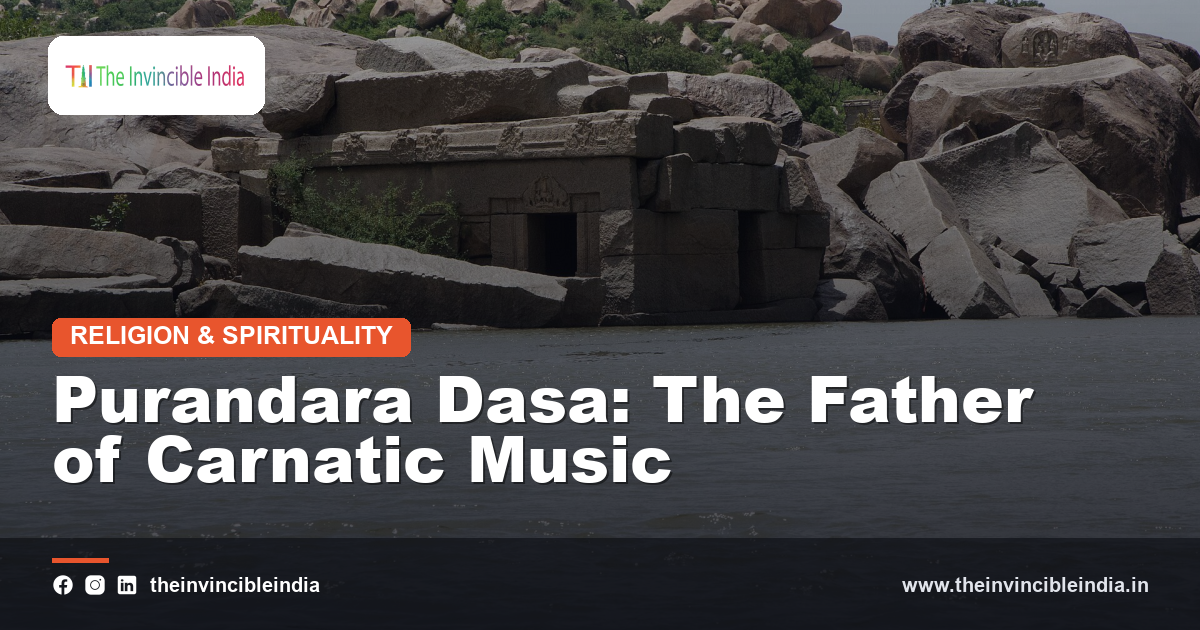
Memory of Purandara Dasa is preserved in several places associated with the Vijayanagara world, above all at Hampi, where a mantapa on the banks of the Tungabhadra river is traditionally linked with his name. Devotees and music lovers visit such sites to pay respects and to reflect on the connection between landscape, devotion and song. Beyond Hampi, communities across Karnataka and neighbouring states observe his memory through festivals and musical gatherings held in his honour. Temples and cultural associations organise performances in which his compositions are sung by students and established artists together. These events keep his story alive for new audiences and encourage young people to take up music. The physical places and the annual observances serve as anchors for a heritage that is otherwise carried mainly in voices. They show that his legacy is not only studied but actively celebrated by the communities that cherish it.
Commemoration and Annual Observances
Each year the memory of Purandara Dasa is marked through observances known as aradhana, in which musicians gather to sing his compositions as an offering of respect. These gatherings are held in temples, music academies and community halls, and they often last several days, bringing together performers of different ages. Programmes may include group renderings of the best-loved songs, discourses on his life and teaching, and recitals by students at the beginning of their training. Such events reflect the distinctive Indian practice of honouring a teacher through the continued practice of his art. They also create a sense of fellowship among the musicians and listeners who take part. In this way commemoration functions as a form of education, since participants learn the repertoire by performing it. The aradhana tradition ensures that gratitude toward the father of Carnatic music is expressed through the very music he helped to organise.
Enduring Lessons from His Life and Music
The life and work of Purandara Dasa offer lessons that reach beyond music and religion. His story suggests that devotion is best expressed through service, and that the arts can serve as a path to spiritual understanding. The decision to renounce material wealth, as tradition describes it, points to values of detachment and humility that people of many faiths respect. His insistence on plain language invites reflection on how knowledge ought to be shared, namely generously and without barriers. His careful design of lessons shows the importance of patience and gradual learning in any discipline. Taken together, these ideas form a coherent outlook in which devotion, art and education support one another. They help to explain why his name is spoken with warmth by musicians and devotees alike. The lessons remain accessible to anyone, whether or not they ever learn a single note of music.
Purandara Dasa Today
Today Purandara Dasa remains a living presence in the cultural life of South India and among Carnatic music lovers around the world. Students begin their training with the exercises that bear his name, and concert halls resonate with his devotional songs. Schools, academies and cultural organisations continue to honour him through festivals, recordings and teaching programmes. Scholars study his compositions as important evidence of the Haridasa tradition and of the social history of the Vijayanagara period. For devotees he is a saint whose simple verses still console and inspire. For musicians he is the great teacher whose method carries the art from one generation to the next. In both roles he represents the unity of devotion and discipline that defines the Indian approach to the arts. His honoured title, father of Carnatic music, captures a legacy that continues to grow with every new learner.
Sources & Further Reading
- Sangeet Natak Akademi, Government of India (sangeetnatak.gov.in).
- Ministry of Culture, Government of India (indiaculture.gov.in).
Frequently Asked Questions
Why is Purandara Dasa called the father of Carnatic music?
He is credited with organising a graded system of teaching, including the basic exercises and early songs that every student still learns. Because this method shaped how the art is passed on, later generations honoured him with the title. The honorific reflects respect for his teaching contribution as much as his compositions.
What is the Haridasa tradition?
The Haridasa tradition is a devotional movement of Karnataka in which saint-singers composed Kannada songs in praise of Vishnu and his forms. It is linked with the teachings of Madhvacharya and emphasises devotion, humility and moral living. Its songs were meant for ordinary people as well as scholars.
What does the signature Purandara Vithala mean?
It is the poetic seal, or mudra, that he placed at the end of his compositions. It joins his own name with Vithala, a form of Vishnu much loved in the Deccan. The signature identifies the composer and shows that each song is offered to the divine.
Which exercises are associated with Purandara Dasa?
The Sarali varisai, the Janta varisai and the alankaras are the beginner exercises traditionally attributed to him. They train pitch, evenness of voice and rhythm. Students usually learn them before moving on to simple songs and later to full compositions.
Are the details of his life historically certain?
Many details come from devotional tradition rather than precise records, and views differ on matters such as his birthplace. The broad outlines are widely accepted, including his Haridasa identity, his Kannada compositions and his role in music teaching. Accounts are best read as traditional narratives.


