

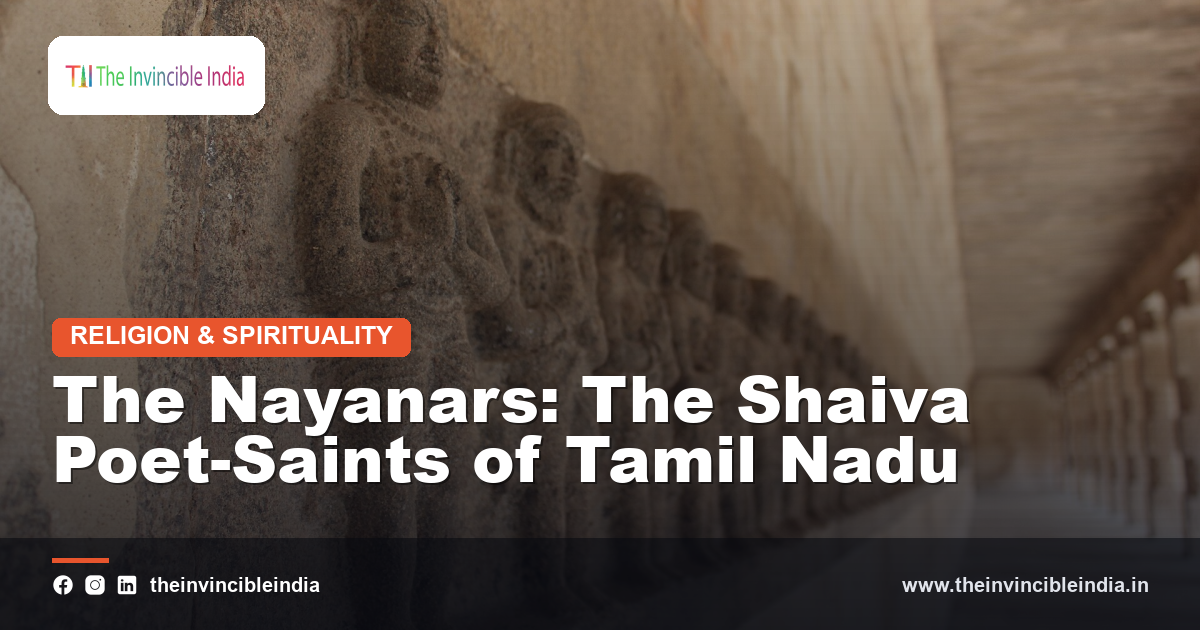
The Nayanars, also written as Nayanmars, are the sixty-three saints of the Tamil Shaiva tradition, devotees of Shiva whose lives and hymns are remembered across Tamil Nadu. Coming from many walks of life, they expressed love for the divine in poetry that was sung in temples and carried from one sacred place to another. Their songs, gathered in the Tirumurai, became the devotional scripture of Tamil Shaivism and a living part of temple worship, closely connected with the wider tradition described in the guide to Shaivism. This article offers a respectful overview of who the Nayanars were, how their hymns were preserved, the leading poets among them, the temples they sang of and the continuing influence of their devotion on Tamil culture.
Quick Facts
| Detail | Information |
|---|---|
| Tradition | Tamil Shaivism |
| Number of Saints | Sixty-three |
| Region | Tamil Nadu |
| Devotional Canon | Tirumurai (twelve books) |
| Chief Hymnists | Appar, Sambandar, Sundarar |
| Biographical Text | Periya Puranam by Sekkizhar |
Who Were the Nayanars
The Nayanars are the sixty-three devotees of Shiva honoured in Tamil tradition as saints of exceptional faith. Their name, associated with a Tamil word meaning leaders or masters, expresses the respect in which they are held. They lived over several centuries in the Tamil-speaking region, and tradition counts among them kings, priests, farmers, craftsmen, merchants and women. What joined them was an unwavering love for Shiva expressed through worship, service and, in several cases, song. Not every Nayanar is remembered for poetry; some are honoured chiefly for a single act of devotion that tradition holds up as a model of faith. Taken together, their stories present a wide picture of devotion in action. The Nayanars occupy a position in Tamil religious culture similar to that of the saints in other devotional movements of India, and they continue to be revered in temples and homes today.
The Historical and Cultural Setting
The Nayanars belong to the great flowering of devotional religion in the Tamil country, a movement that spread during the first millennium and the early centuries that followed. In this period temple worship, vernacular poetry and regional kingdoms developed together. Rulers of the Pallava, Pandya and Chola dynasties built and endowed temples, giving the devotional movement a lasting physical home. The saints travelled between sacred sites, singing of the deity enshrined in each, and their songs linked the geography of Tamil Nadu into a network of holy places. The movement also responded to the presence of other religious traditions in the region, and it helped to renew popular devotion to Shiva. Its use of Tamil rather than only Sanskrit made worship accessible to the whole community. The setting explains how a poetic and spiritual movement came to shape the architecture, art and public religion of an entire land.
Appar: The Saint of Service
Appar, also known by the name Tirunavukkarasar, is one of the three most celebrated Nayanar poets and is remembered as a devotee who was moved by deep spiritual change and who devoted himself to serving Shiva. His hymns are marked by humility, sincerity and a sense of personal surrender, and they often reflect on human frailty before the divine. Tradition also remembers him for the practice of cleaning temple grounds as an act of service, using a tool for removing weeds, which became a symbol of his humble devotion. He travelled widely to temples, singing at each, and his songs form a major portion of the Tevaram. The tone of his poetry is direct and affecting, and many verses are still sung with deep feeling. Through his example, the tradition teaches that devotion finds expression in humble work as well as in poetic song.
Sambandar: The Child Poet
Sambandar, also known as Tirugnana Sambandar, is remembered as a gifted young poet whose hymns delight listeners with their musicality and joyous devotion. Tradition holds that he began composing at a very young age, and his verses are admired for their melodic variety and their celebration of the temples and the deities he visited. He is associated with an extensive journey across Tamil Nadu in the company of musicians, among them a companion who accompanied his songs on the lute. His poems often follow a pattern in which the last verse names the poet and promises blessing to those who sing the hymn. This structure turned each song into a devotional offering with a blessing attached. His work forms a large share of the Tevaram, and the music of his hymns is among the oldest surviving strands of Tamil devotional singing. His songs remain a core part of temple worship.
Sundarar: The Friend of the Lord
Sundarar, also called Sundaramurti Nayanar, is the third of the principal Tevaram poets and is remembered for the intimate, affectionate relationship with Shiva that his songs express. Tradition describes him as a friend of the deity, and his verses speak to the divine with a familiarity that mixes reverence, humour and humility. His life, as the tradition recounts it, included periods of worldly entanglement from which devotion repeatedly drew him back. His hymns visit many of the sacred places of the Tamil country and describe their beauty and holiness. He also composed a short poem that lists the sixty-three Nayanars, which became a basic source for remembering them. His approach to devotion shows that love of God can be playful and personal as well as solemn. His songs complete the trio of poets whose work forms the heart of the Tevaram.
The Tevaram Hymns
The Tevaram is the collection of hymns composed by Appar, Sambandar and Sundarar, and it forms the first seven books of the Tirumurai. The word is often explained as meaning a garland of songs for God. Each hymn is dedicated to Shiva as enshrined in a particular temple, and the verses describe the deity, the place and the devotion of the singer. The hymns are set to musical modes, known as pann, which preserve some of the oldest recorded melodic ideas in the Tamil tradition. They were sung in temples and later preserved by hereditary singers. The Tevaram holds a place of great honour in Tamil Shaiva worship, and its recitation accompanies many rituals. Its blend of poetry, music and devotion makes it a treasure of Tamil literature. The hymns also provide a rich record of the sacred geography of the region.
Manikkavacakar and the Tiruvacakam
Manikkavacakar is another great figure of Tamil Shaivism, although he is traditionally counted separately from the sixty-three Nayanars. His poetry, gathered in the Tiruvacakam, is celebrated for its intense emotional longing and its expression of the soul’s search for union with the divine. Tradition connects him with the royal court of the Pandya kingdom, from which he turned to a life of devotion. The verses of the Tiruvacakam include some of the most moving passages in Tamil devotional literature, speaking of grace, surrender and the joy of divine presence. The work forms the eighth book of the Tirumurai and is sung alongside the Tevaram in temples. Readers admire its personal intensity and its poetic power. Though distinct from the three main hymnists, Manikkavacakar is inseparable from the devotional heritage they represent and is deeply loved in the Tamil Shaiva tradition.
Karaikkal Ammaiyar: A Woman Poet-Saint
Among the Nayanars is the woman saint Karaikkal Ammaiyar, honoured as one of the earliest voices of Tamil devotional poetry and as a pioneer among the women saints of India. Tradition remembers her as a devotee who renounced worldly attachment and gave herself wholly to the worship of Shiva. Her poems are among the early works of the Tamil devotional canon, and they are known for their striking and sometimes austere imagery. She is often depicted in sacred art as a thin ascetic figure, symbolising her complete detachment from ordinary life. Her presence among the sixty-three saints shows that the tradition recognised spiritual accomplishment in women as well as men. Her story is told with great reverence, and her songs are included in the Tirumurai. She stands as an inspiring figure whose voice helped open the way for later women poet-saints.
Kannappa and Stories of Extraordinary Devotion
The stories of several Nayanars illustrate devotion that is wholly sincere even when it is unconventional. Kannappa Nayanar, a hunter by background, is remembered for offering his own eyes to the deity out of love, in a tale that emphasises the value of heartfelt devotion over formal rule. Other saints are honoured for acts such as serving devotees with food, tending temples, supplying fragrant offerings or protecting the worship of the deity. These accounts are not meant to be read as practical models for every believer but as expressions of the single-minded love that the tradition prizes. They also show that people from any social position could attain spiritual greatness. The narratives are retold in festivals, plays and temple art. Their lasting power lies in the way they present faith as a matter of the heart, open to every person.
A Community Beyond Social Boundaries
One of the most notable features of the Nayanar tradition is the diversity of the saints’ backgrounds. The sixty-three include people from royal, priestly, farming, trading and artisan communities, as well as those from groups that held a humble place in the social order of their day. Their inclusion in the list of honoured saints signalled that devotion rather than birth determined spiritual standing. This inclusive outlook is one of the major social contributions of the Bhakti movement as a whole. The Nayanars are commemorated together, in festivals and in the sacred art of temples, as a single company of devotees. Their example has encouraged later reform and has given Tamil Shaivism a tradition of valuing sincere faith above status. This theme continues to resonate in discussions of equality and belonging in religious life.
Compiling the Tirumurai
The hymns of the Shaiva saints were gathered into a canon called the Tirumurai, a collection of twelve books. Tradition credits Nambiyandar Nambi, a temple priest of the Chola period, with the effort of collecting and arranging the earlier hymns under royal encouragement. The collection includes the Tevaram in its first seven books, the Tiruvacakam and the Tirukkovaiyar in the eighth, and further devotional works by other poets in the books that follow. The tenth book contains the Tirumantiram, a philosophical and yogic poem attributed to the saint Tirumular. The twelfth and final book is the Periya Puranam. The compilation gave the Tamil Shaiva tradition a unified body of scripture in the language of the people. It also ensured that the hymns would be preserved, taught and sung for centuries to come, forming the backbone of Tamil Shaiva liturgy.
The Periya Puranam of Sekkizhar
The Periya Puranam, composed by the poet Sekkizhar, is the twelfth book of the Tirumurai and the main narrative source for the lives of the Nayanars. Tradition places its composition in the Chola period and connects Sekkizhar with the royal administration. The work gives a verse account of each of the sixty-three saints, drawing on earlier songs and traditions, and it presents their stories in an elevated poetic style. Because of its literary quality and religious importance, it is often described as a great epic of Tamil Shaivism. It is also valued as a source on the social and cultural life of the region as remembered by later tradition. Readers and listeners have long enjoyed its vivid tales and its celebration of devotion. The Periya Puranam gave the Nayanars a definitive literary form and fixed their stories in the memory of the Tamil people.
Padal Petra Sthalams: Temples Sung by the Saints
The temples that the saints praised in their Tevaram hymns are known as the Paadal Petra Sthalams, meaning the places that received song. Tradition counts a little over two hundred and seventy such sites, most of them in Tamil Nadu, with a few in neighbouring regions. These temples are held especially sacred, and many pilgrims aim to visit as many as they can. Their number includes some of the great temple towns of the Tamil country as well as quiet village shrines. The hymns describe the character of each place, from rivers and groves to the deity’s attributes, and they link devotion to geography. This map of sacred sites gives Tamil Shaivism a pilgrimage dimension, connecting the poetry of the saints with the physical landscape. Devotees who travel from one temple to another follow the very paths the saints walked.
Oduvars, Temple Singing and Festivals
The hymns of the Nayanars are kept alive in temples through the work of singers known as oduvars, who recite the Tevaram and other Tirumurai hymns as part of daily and festival worship. Hereditary and trained singers have maintained the melodies and the words across many generations. Special festivals honour the saints, during which bronze images of the Nayanars are carried in procession through temple streets. Among these, the festival of the sixty-three saints is celebrated in major Shaiva temples with great devotion. The sacred bronzes of the Nayanars, cast in the classical Chola style, show the saints in graceful postures and are important works of Indian art. Hymn singing, procession and image worship together form a rich liturgical culture. The continuing role of the oduvars shows how an oral and musical tradition can be sustained alongside the architecture of devotion.
Philosophy: Shaiva Siddhanta and Devotion
The devotional poetry of the Nayanars provided the spiritual background for the philosophical school known as Shaiva Siddhanta, which became the main theological system of Tamil Shaivism. This school teaches that there are three eternal realities, namely God, the soul and the bonds that restrict the soul, and that divine grace leads the soul to freedom. Later teachers systematised the ideas, drawing on scripture and on the experience expressed in the hymns. The Tirumurai is honoured as a primary devotional source, alongside the Sanskrit Agamas that regulate temple ritual. The meeting of devotional poetry and philosophical reflection gave the tradition both heart and structure. It also shows how the songs of the saints, which began as personal outpourings, grew into the foundation of a complete religious worldview that continues to be studied and practised.
The Nayanars Today
Today the Nayanars continue to occupy a central place in the religious and cultural life of Tamil Nadu. Their hymns are sung in temples every day, their images are worshipped in processions and their stories are retold in books, performances and films. Pilgrims travel to the temples they praised, and scholars study the Tirumurai as a monument of Tamil literature and religious history. The Nayanars are also remembered in discussions of social inclusiveness, as saints who came from many communities and were honoured for devotion. Institutions and music schools preserve the traditional tunes of the Tevaram and teach them to new generations. The tradition shows how poetry, music, architecture and faith can unite in a single heritage. The sixty-three saints remain a living presence, inspiring devotion and pride among the people who inherit their songs.
Sources & Further Reading
- Ministry of Culture, Government of India (indiaculture.gov.in).
- Archaeological Survey of India (asi.nic.in).
Frequently Asked Questions
Who are the Nayanars?
The Nayanars are the sixty-three saints of Tamil Shaivism, devotees of Shiva who lived over several centuries in the Tamil country. They came from many social backgrounds and are honoured for their devotion. Several of them composed hymns that are still sung in temples.
What is the Tevaram?
The Tevaram is the collection of hymns by Appar, Sambandar and Sundarar, the three principal Nayanar poets. It forms the first seven books of the Tirumurai. The hymns praise Shiva at particular temples and are set to traditional musical modes.
What is the Tirumurai?
The Tirumurai is the twelve-book canon of Tamil Shaiva devotional literature. It includes the Tevaram, the Tiruvacakam, the Tirumantiram and the Periya Puranam, among other works. Tradition credits Nambiyandar Nambi with compiling it.
What is the Periya Puranam?
The Periya Puranam is the twelfth book of the Tirumurai, composed by Sekkizhar, and it narrates the lives of the sixty-three Nayanars in verse. It is regarded as a major epic of Tamil Shaivism. It is the principal source for the saints’ traditional biographies.
Are the Nayanars related to the Alvars?
They are parallel traditions of Tamil Nadu: the Nayanars were devotees of Shiva, while the Alvars were devotees of Vishnu. Both movements used Tamil poetry and temple worship to spread devotion. They are often studied together as the twin streams of early Tamil Bhakti.


