

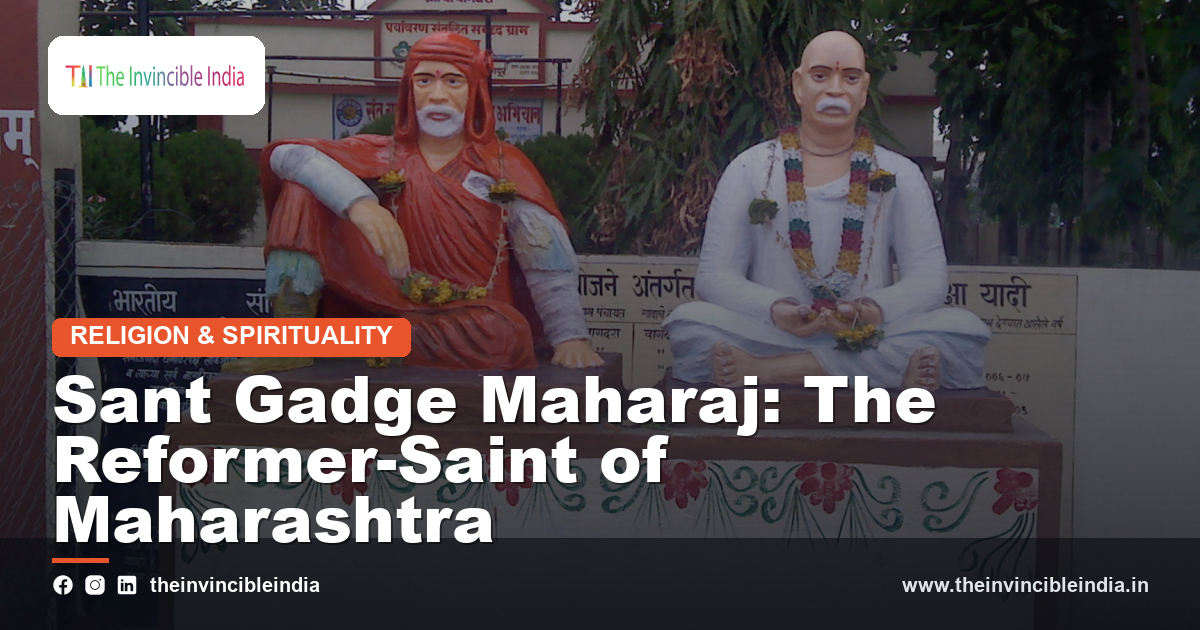
Sant Gadge Maharaj, also affectionately called Gadge Baba, is remembered in Maharashtra as a saint who made service to people the heart of spiritual life. Living from the late nineteenth into the mid-twentieth century, he travelled from village to village with a broom in hand and an earthen pot at his side, sweeping streets, singing devotional kirtans, and urging communities toward cleanliness, education, and compassion. Unlike many saints remembered mainly through poetry, he is celebrated for practical work that improved daily life. His outlook reflects the humane spirit of the Bhakti movement while speaking directly to the social needs of modern times. This guide describes his life and legacy in general, well-known terms.
Quick Facts
| Detail | Information |
|---|---|
| Known as | Sant Gadge Maharaj or Gadge Baba |
| Birth name | Debuji Zingraji Janorkar |
| Period | Late nineteenth to mid-twentieth century |
| Region | Vidarbha and wider Maharashtra |
| Signature symbols | A broom and an earthen pot (gadge) |
| Central themes | Cleanliness, education, and service to the poor |
Who Was Gadge Maharaj
Gadge Maharaj is honoured as a wandering saint and social reformer whose life combined spiritual devotion with tireless public service. Born as Debuji Zingraji Janorkar in a village of the Vidarbha region of Maharashtra, he later became known by the affectionate title Gadge Baba. His name draws attention to the simple earthen vessel he carried, which served as both his bowl and his emblem.
What distinguishes him among saints is the emphasis on action. He taught that serving suffering people is the truest form of worship, and he gave this teaching shape through sweeping village lanes, organising community work, and inspiring others to build institutions. His story therefore sits at the meeting point of religion and reform, and it is widely respected across communities in Maharashtra.
Early Life in Rural Vidarbha
Gadge Maharaj is remembered as having been born into a modest family in a village of the Amravati district, a region of rural Vidarbha. Accounts describe a childhood shaped by labour, simple living, and exposure to the hardships faced by ordinary farmers and workers. These early experiences are often cited as the root of his later concern for the poor.
Exact details of his youth are preserved in popular biographies and local memory, and some episodes are retold in several versions. The general picture, however, is consistent: a thoughtful young man who observed the problems around him, including poverty, illiteracy, and superstition, and who gradually resolved to devote his life to addressing them rather than seeking comfort or position for himself.
The Broom and the Earthen Pot
The image of Gadge Maharaj is inseparable from his two humble possessions. The broom represented his commitment to cleaning both villages and minds, while the gadge, an earthen pot or shard that gave him his popular name, served as his vessel for food and water. He is often pictured in simple patched clothing, carrying these items as he walked.
Through this plain appearance he conveyed a message without words. A holy person, in his view, need not wear elaborate dress or occupy a seat of honour. Dignity lay in work and in simplicity. The broom in particular has become a lasting symbol of his legacy, reminding later generations that cleanliness is a form of respect for community and for the environment.
Cleanliness as a Spiritual Duty
Gadge Maharaj is widely remembered for his insistence on cleanliness. He would reportedly begin his visits to a village by sweeping its streets, and then use the gathering that formed to speak about hygiene, drinking water, and sanitation. For him, a clean surrounding was inseparable from a healthy and dignified life.
This approach linked everyday sanitation with the idea of devotion. Cleaning a public space was an offering to the community as a whole. The lesson was powerful because it was demonstrated rather than preached. In recognition of this legacy, the state of Maharashtra later named a major rural sanitation campaign in his honour, showing how his example continues to guide public thinking about hygiene.
Kirtan as a Teaching Tool
Like many Maharashtrian saints, Gadge Maharaj used kirtan, the devotional discourse with song, to reach audiences. His kirtans combined traditional devotional themes with straightforward advice on daily life. He is remembered for using plain language, humour, and relatable examples so that villagers of every background could understand and remember his message.
Through the familiar form of kirtan, he introduced social lessons into settings where people had gathered for spiritual reasons. Listeners heard about the importance of education, thrift, and honest work along with praise of the divine. This blending of the sacred and the practical is one of his signature contributions, demonstrating how a traditional art form can serve as a vehicle for community improvement.
Opposition to Superstition
A recurring theme in the teaching of Gadge Maharaj is the rejection of harmful superstition and meaningless ritual. He spoke against practices that burdened poor families with expenses, against blind belief that discouraged people from seeking education or medical care, and against customs that caused suffering. His criticism was delivered gently but firmly.
He did not reject faith itself. On the contrary, he held that true devotion should lead to compassion and clear thinking. This balanced position is one reason his message has endured across different communities. It shows a tradition capable of self-reflection, in which a respected saint encourages followers to distinguish between genuine spiritual practice and customs that no longer serve human well-being.
Equality and the Rejection of Discrimination
Gadge Maharaj taught that all human beings deserve equal respect, and he spoke against social discrimination based on birth. In this he followed the humane message of earlier Maharashtra saints, particularly those of the Varkari tradition, whose songs affirmed that devotion belongs to everyone. His own life of simple service gave this principle practical force.
He is remembered for engaging with people of every community and for encouraging institutions that served the poor without distinction. The emphasis on shared dignity became one of the defining qualities of his legacy. For many in Maharashtra, he stands as a link between the old devotional ideal of equality before God and the modern commitment to social justice and equal citizenship.
Education for the Poor
Education held a central place in the vision of Gadge Maharaj. He observed that illiteracy kept many families trapped in poverty and vulnerable to exploitation, and he encouraged communities to establish schools and to send children, including girls, to study. Donations collected during his kirtans were reportedly used for such public purposes.
Educational institutions in Maharashtra were later established with inspiration from his teachings, and a university in Amravati carries his name. These tributes reflect the belief that his true monument is the spread of learning. His conviction that knowledge liberates and uplifts the ordinary person remains a core part of how he is remembered and why his name is invoked in discussions of rural development.
Service Institutions and Dharmashalas
Beyond speeches, Gadge Maharaj is remembered for supporting practical institutions for the needy. These included rest houses known as dharmashalas for pilgrims and travellers, shelters for the poor, facilities for the sick, and shelters for animals. Such works are described as having been funded largely by the contributions of ordinary people moved by his example.
A well-known dharmashala at Pandharpur is associated with his efforts, providing lodging to pilgrims who might otherwise lack shelter on their journey. The pattern of these institutions shows his belief that compassion must take material form. They remain examples of how a saint can inspire community-led charity rather than dependence on a single patron, a model still admired today.
Simplicity and Detachment
Despite the wide reach of his work, Gadge Maharaj lived with extreme simplicity. Accounts say he owned little, travelled mostly on foot, and ate whatever humble food was offered. He is also said to have declined the role of a guru who gathers personal disciples, preferring to direct people toward service and toward the shared teachings of earlier saints.
This detachment strengthened his moral authority. Because he sought neither wealth nor power, people trusted that his advice was sincere. The contrast between his modest lifestyle and his large influence is frequently cited as proof of the integrity of his mission, reinforcing the idea that service performed without self-interest carries a special power to move communities.
Inspiration from Earlier Saints
Gadge Maharaj drew inspiration from the saints of Maharashtra and the broader devotional tradition, especially figures such as Sant Tukaram and Sant Dnyaneshwar, whose verses he often quoted. He regarded their teachings as a living resource rather than as museum pieces, applying them to the problems of his own age.
In this way he acted as a bridge between the medieval devotional heritage and modern reform. He demonstrated that the values of the older saints, such as humility, equality, and compassion, could guide practical work on sanitation, schooling, and social harmony. His example is often used to show how religious traditions can renew themselves by translating timeless ideals into the language of present-day needs.
Relationship to Reform Movements
The period in which Gadge Maharaj lived was one of intense social and political change in India, with many reformers working for education, equality, and national self-respect. His work is often discussed alongside the efforts of other Maharashtra reformers, though he approached change through the idiom of devotion rather than through formal politics or organisation.
This distinct approach allowed him to reach audiences who might have been wary of political messages. By speaking from within the cultural language of kirtan and village gatherings, he made reform feel familiar rather than foreign. His contribution shows that social change can arise from religious and cultural traditions as well as from legislation, and that both pathways can complement one another in a society.
The Way He Taught
The teaching style of Gadge Maharaj was marked by directness and warmth. He is remembered for short, memorable sayings, for repeating simple devotional refrains with large crowds, and for using everyday objects to illustrate lessons. His audiences were often villagers who had never attended a formal lecture, so clarity was essential.
This approach mirrors the long Indian tradition of oral teaching, in which wisdom travels through repetition, rhythm, and shared participation. Because his message was easy to carry in memory, it travelled far beyond the places he visited. Many people in Maharashtra still recall his phrases and stories, which continue to be retold in homes, schools, and community meetings as accessible expressions of practical wisdom.
His Passing and Memorials
Gadge Maharaj passed away in the mid-twentieth century, and his death was mourned across Maharashtra. His memory is honoured at places associated with his life and work, including a memorial near Amravati in the Vidarbha region. Statues and commemorations in towns across the state keep his image before the public.
These memorials often depict him with his broom and earthen pot, the symbols by which he is best known. Gatherings held at such places feature kirtan, discussions of his teachings, and community service activities, reflecting the way he is remembered. The tradition of marking his memory through service rather than ceremony alone is perhaps the most faithful tribute to his life.
Recognition and Public Memory
The public memory of Gadge Maharaj has found expression in institutions, awards, and campaigns. Government programmes in Maharashtra have used his name for rural cleanliness drives, and educational institutions have honoured him as an inspiration for rural uplift. Postal and civic tributes have also kept his image in public view.
Such recognition shows how a saint can enter the shared civic vocabulary of a region. His name is invoked not only in religious contexts but also in discussions of governance, health, and education. This breadth demonstrates the unusual way in which his spiritual reputation and his social contributions reinforced one another, giving him a place in both devotional and civic heritage.
Gadge Maharaj Today
Gadge Maharaj remains one of the most respected figures of modern Maharashtra, and his teachings feel strikingly relevant to contemporary concerns. Cleanliness drives, rural education, and community charity all echo ideas he promoted. His broom has become a lasting symbol of civic responsibility as well as humility.
For readers today, his life offers a clear lesson: spirituality is most meaningful when it serves others. Whether encountered through a kirtan, a school or university bearing his name, or a village cleanliness campaign, his legacy continues to shape how people think about faith and duty. He is remembered as a saint whose greatest sermons were delivered through simple, dedicated action on behalf of the community.
Sources & Further Reading
- Ministry of Culture, Government of India (indiaculture.gov.in).
- Government of Maharashtra (maharashtra.gov.in).
Frequently Asked Questions
Who was Sant Gadge Maharaj?
Sant Gadge Maharaj, born Debuji Zingraji Janorkar, was a wandering saint and social reformer of Maharashtra. He is remembered for promoting cleanliness, education, and compassionate service through kirtan and practical work.
Why is he called Gadge Maharaj?
The name refers to the gadge, an earthen pot or vessel that he carried along with a broom. These simple items became the emblems of his humble way of life.
What did Gadge Maharaj teach?
He taught that service to people is the truest worship, and he spoke against superstition and discrimination. He urged communities toward cleanliness, education, and mutual respect.
How is he remembered today?
A major rural sanitation campaign in Maharashtra and a university in Amravati bear his name. Statues, memorials, and kirtan gatherings also keep his memory alive.
How does he relate to the earlier saints of Maharashtra?
He drew inspiration from Varkari and other devotional saints, often quoting their verses. He applied their ideals of humility and equality to the practical needs of his own time.


