

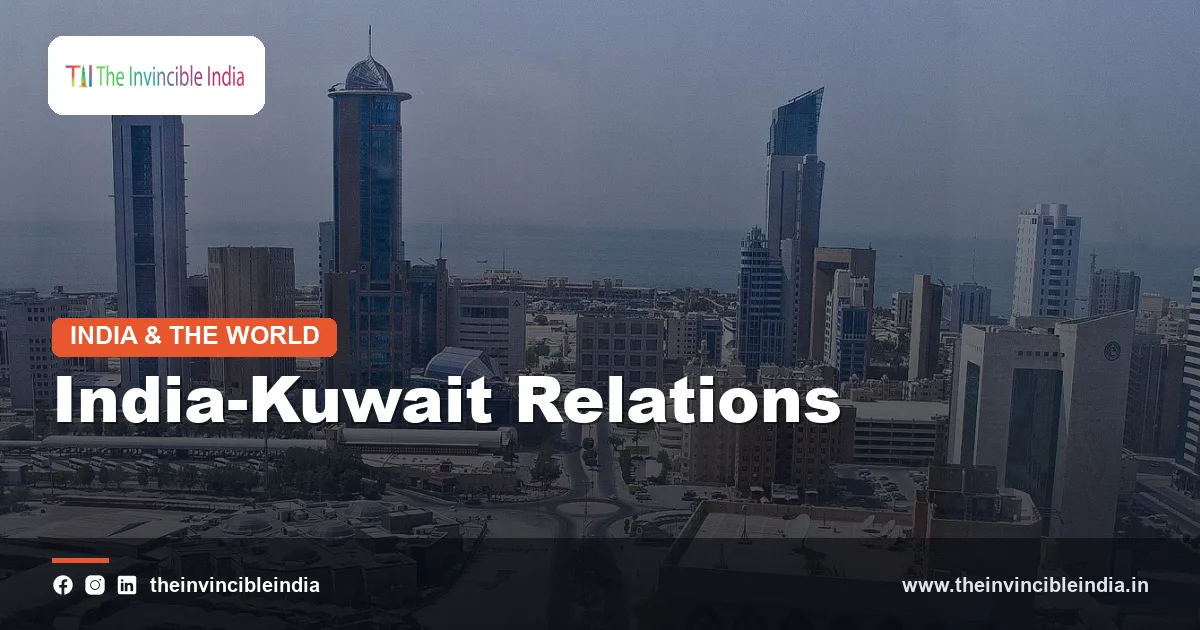
India-Kuwait relations stretch back centuries to the age of the dhow, when wooden sailing vessels carried pearls, dates, horses and timber between the northern tip of the Gulf and the Malabar and Gujarat coasts. The links were so close that the Indian rupee circulated as legal tender in Kuwait until 1961, a fact that captures how deeply the Gulf economy was once tied to the Indian subcontinent.
Today the relationship is built around energy, labour and trust. Kuwait is a long-standing supplier of crude oil and gas to India, Indians form one of the largest expatriate communities in the emirate, and the two states cooperate in the Gulf region on trade, investment, health, education and security. The evacuation of Indians from Kuwait after the 1990 Iraqi invasion remains a defining episode, and high-level visits in recent years have lifted the partnership to a new level. This article explains how the ties developed and where they stand.
Quick Facts
| Aspect | Detail |
|---|---|
| Historical link | Centuries of dhow trade between the Gulf and India’s western coast |
| Currency tie | The rupee remained legal tender in Kuwait until 1961 |
| Kuwait’s independence | 19 June 1961; India recognised it and established ties the same year |
| Energy relationship | Kuwait is a major crude oil and LPG supplier to India |
| Indian community | Among the largest expatriate groups in Kuwait, working in many sectors |
| 1990 airlift | Over a hundred thousand Indians evacuated from Kuwait and Iraq via Amman after the Iraqi invasion |
| Regional grouping | Kuwait is a founding member of the Gulf Cooperation Council (1981) |
| Recent milestone | Elevation of ties to a strategic partnership during a prime ministerial visit in December 2024 |
Centuries of Maritime Trade
Long before oil, the northern Gulf was a hub of commerce. Kuwait’s natural harbour, sheltered by Failaka Island, made it a base for merchants, pearl-divers and shipbuilders. Dhows left the Gulf each winter on the north-east monsoon winds for Indian ports such as Mumbai, Kochi, Mangalore, Kozhikode and Surat, and returned with the summer south-west winds carrying rice, spices, textiles and, in particular, teak from the Malabar coast, which was prized for ship construction.
Goods and people
- From India: rice, spices, textiles, sugar, timber and iron goods.
- From the Gulf: pearls, dates, horses, dried fish and, later, petroleum.
- People: traders, boat-builders, sailors, moneylenders and artisans who moved in both directions, with Indian merchant families settling in coastal Gulf towns.
Trade in the colonial period
Kuwait became a British-protected state under the 1899 agreement with the ruling Al-Sabah family, and Indian administrative and postal systems extended to the Gulf. Indian postal services, the Indian rupee and the Indian civil servants of the British Raj were prominent in the region, which explains why many Kuwaitis, particularly of older generations, still recall India with familiarity. This colonial-era overlap prepared the ground for bilateral ties after both countries became independent.
The Rupee in the Gulf
The use of the Indian rupee in Kuwait is among the most distinctive chapters in the relationship. The rupee was the main currency of the Persian Gulf for decades, in the same way that it circulated in places such as Oman, Bahrain, Qatar and the Trucial States, now the UAE. After India’s independence, a special variant known as the Gulf rupee was issued by the Reserve Bank of India from 1959 for use outside India, partly to prevent the smuggling of gold and to protect India’s foreign exchange.
Transition to the Kuwaiti dinar
With political independence in June 1961 and growing oil revenues, Kuwait established its own monetary authority and introduced the Kuwaiti dinar, which replaced the Indian rupee in that year. The dinar has since become one of the highest-valued currencies in the world per unit. The rupee era is nonetheless a reminder that the two economies were once part of a single monetary and commercial space, and that Indian traders and bankers had a pioneering role in the early commercial life of the Gulf.
Diplomatic Relations Since 1961
Kuwait attained independence from British protection on 19 June 1961, and India was among the first states to establish formal relations. The Indian Embassy in Kuwait was set up soon after, and Kuwait opened its mission in New Delhi in later years. Both countries share a commitment to non-alignment, to the principles of the United Nations Charter and to the peaceful settlement of disputes.
Political support
Over the decades the two countries have found common ground on development issues and on support for multilateral institutions. India, for its part, backed Kuwait’s sovereignty and territorial integrity after the 1990 invasion. In the years since, the two sides have held regular consultations through foreign office meetings and a Joint Commission on Cooperation at ministerial level, supplemented by dialogues on consular affairs, labour and investment.
The Gulf context
India’s wider Gulf policy places Kuwait among the six Gulf Cooperation Council states, which collectively are India’s largest regional trading bloc, its principal source of energy imports and home to millions of Indian workers. Kuwait’s balanced diplomacy, including its reputation for mediation in regional disputes, makes it a respected voice in the Gulf, and India values its stability.
Energy: Kuwait as a Supplier
Energy is the structural pillar of the economic relationship. Kuwait holds one of the world’s larger reserves of crude oil and is a member of OPEC, and India, as one of the world’s largest oil importers, has turned to the Gulf for much of its supply. Kuwait has long been among India’s major sources of crude, and it has also supplied liquefied petroleum gas, which is essential to India’s household cooking fuel network.
From buyer-seller to partners
Beyond simple trade, the two sides have explored long-term arrangements. Kuwaiti and Indian state-owned energy companies have explored long-term supply arrangements, joint investments in refining and petrochemicals, and storage cooperation in line with India’s strategic petroleum reserves programme. Kuwaiti institutions have shown interest in India’s expanding downstream sector and its energy transition.
Towards diversification
While hydrocarbons dominate, both countries now speak of diversification. Kuwait’s economic vision seeks to reduce dependence on oil, and India offers opportunities in renewable energy, infrastructure, digital services and manufacturing. Cooperation in solar energy, in India’s International Solar Alliance framework and in green hydrogen has been floated as a future avenue.
The Indian Community in Kuwait
The human dimension is the largest. Indians constitute one of the biggest expatriate communities in Kuwait, a country where expatriates make up a majority of the population. They work in construction, oil and gas, healthcare, engineering, education, finance, hospitality, retail and domestic services, and their contribution to the day-to-day functioning of the economy is widely acknowledged.
Professions and institutions
- Healthcare: Indian nurses, doctors and technicians form a significant share of the health workforce.
- Education: Indian schools following the CBSE curriculum serve the community, and teachers from India work in local institutions.
- Engineering and business: engineers, accountants, managers and entrepreneurs, many from Kerala, Tamil Nadu, Andhra Pradesh, Telangana, Maharashtra and Gujarat.
- Associations: a network of community organisations, cultural groups and professional bodies, supported by the Indian Embassy.
Welfare and safety
The Indian Embassy in Kuwait provides consular services, runs a helpline and offers assistance to workers in distress. Issues such as wage protection, accommodation standards, workplace safety and recruitment malpractices are regularly raised in bilateral talks. Tragic incidents, including a residential fire in 2024 that claimed the lives of numerous Indian workers, have focused attention on the safety and living conditions of labourers and on the need for stronger oversight.
Remittances and Economic Importance
Money sent home by the diaspora is a vital link. Kuwait is among the notable sources of remittances to India from the Gulf, and these flows support households in states such as Kerala, which has deep historical ties to the Gulf, as well as other parts of the country. Remittances fund education, health, housing and small businesses, and they strengthen India’s external account.
Kuwaiti concerns
Kuwait pursues a policy of “Kuwaitisation”, aimed at increasing the share of nationals in the workforce, and has revised rules on residency, licences and employment in several sectors. These measures can affect Indian workers, and the two governments consult on issues such as skill recognition, qualifications verification and dignified recruitment. India has worked with Kuwait on recruitment through regulated channels, including the e-Migrate system for Indian workers abroad.
Trade and Investment
Bilateral trade is dominated by Indian purchases of Kuwaiti energy, which results in a trade balance in Kuwait’s favour. India’s exports to Kuwait are diverse and growing, helping to narrow the gap over time.
| Direction | Principal items |
|---|---|
| Indian exports to Kuwait | Rice and other foodgrains, vegetables and fruit, textiles and garments, machinery, electrical equipment, vehicles, pharmaceuticals, chemicals, jewellery |
| Indian imports from Kuwait | Crude oil, liquefied petroleum gas, petrochemicals, fertilisers and some chemical products |
Investment flows
The Kuwait Investment Authority, one of the world’s oldest sovereign wealth funds, has invested in Indian markets and companies. Kuwait Fund for Arab Economic Development has historically extended soft loans to developing countries for infrastructure and development projects. Indian companies in construction, engineering and consulting have won contracts in Kuwait, and the two sides have discussed opening up opportunities in infrastructure, health, housing, food security and information technology.
The 1990 Gulf War and the Great Airlift
On 2 August 1990, Iraqi forces invaded Kuwait, plunging the country and its resident population into crisis. At the time, India’s expatriate community in Kuwait and Iraq numbered well over a hundred thousand, and thousands more were stranded in Gulf neighbouring regions. The Indian government faced a delicate task: protecting its citizens without compromising its position on the conflict.
The evacuation
Indian authorities organised a massive airlift over many weeks. Evacuees were trucked overland from Kuwait and Iraq to Amman in Jordan, where Air India and Indian Airlines, with support from chartered aircraft, flew them home in hundreds of flights. The operation is widely described as one of the largest civilian evacuations by air in history and remains a lasting example of state capacity in a crisis. Many returning workers had lost their savings and belongings, and the government arranged relief and rehabilitation measures.
Legacy of the airlift
The airlift shaped India’s later evacuation operations in places such as Lebanon, Libya, Yemen and Ukraine, and it informed the creation of institutional mechanisms for consular crisis response. It also left a lasting memory of solidarity in Kuwait, as many Indian workers later returned to Kuwait to help rebuild its economy after liberation in early 1991.
Defence, Security and Cultural Cooperation
Defence and security ties have grown gradually. A defence cooperation agreement concluded in the early 2000s laid the basis for training exchanges, visits of senior officers, naval port calls and the participation of Indian military experts in capacity-building programmes. The Indian Navy’s presence in the Gulf, including anti-piracy deployments and regular port visits, supports the safety of sea lanes that carry the oil and gas on which both countries depend.
Counter-terrorism and security dialogue
Both sides share concerns about terrorism, extremism and the security of the Gulf region, and they have exchanged information through institutional channels. The Gulf’s maritime security is of strategic importance to India, given that a large share of its energy imports and the safety of its diaspora depend on stability there.
Culture and soft power
Bollywood films, Indian cuisine, yoga and festivals such as Diwali and Eid celebrated by the Indian community are familiar in Kuwait. Indian cultural events, classical music and dance performances, and the observance of International Yoga Day in Kuwait have brought the two societies together, and cricket and badminton are popular among expatriates.
Recent High-Level Engagement
For several decades, high-level visits between the two countries were infrequent. A prime ministerial visit to Kuwait in the early 1980s was followed by a long gap until December 2024, when the Prime Minister of India travelled to Kuwait, the first such visit by an Indian premier in over four decades. The visit included meetings with the Amir, the Crown Prince and the Prime Minister of Kuwait and an interaction with members of the Indian community, including workers.
Strategic partnership
During the visit, the two leaders agreed to elevate the relationship from a bilateral one to a strategic partnership. They identified cooperation in defence, trade, energy, investment, technology, health, culture, sports and people-to-people ties as areas of focus, and agreed to establish or strengthen mechanisms such as joint working groups and dialogues. Kuwait also honoured the Indian leader with a high state decoration, reflecting the warmth of the engagement.
What this means
- A more structured framework for defence dialogue, training and exercises.
- A push for long-term energy supply contracts and joint ventures in the hydrocarbon chain.
- Greater Kuwaiti interest in investment in India’s infrastructure and technology sectors.
- Continuing attention to the welfare, skills and mobility of Indian workers in Kuwait.
Challenges and the Way Forward
The relationship has a strong foundation but also faces challenges. Kuwait’s economy is dependent on oil prices and public-sector employment, and its domestic politics shape labour and residency policy. For India, ensuring the welfare of workers while keeping the remittance flow steady is a perennial concern. Trade is highly concentrated in hydrocarbons, leaving scope for diversification into services, technology and food security.
Opportunities
- Cooperation in renewable energy and the energy transition, in line with Kuwait’s long-term development plans.
- Collaboration in health care, pharmaceuticals and medical education.
- Digital public infrastructure, including payment systems that can reduce remittance costs.
- Skills development and mobility frameworks that link Indian training with Gulf labour demand.
- Joint work on maritime security and counter-piracy in the western Indian Ocean and the Gulf.
Conclusion
From the dhows that once crossed the Arabian Sea to the aircraft that carried Indians home from Amman in 1990, the story of India and Kuwait is one of connection across water and sky. Energy and labour remain the backbone, but the strategic partnership agreed in recent years signals a wish to widen cooperation across defence, technology and investment. If both sides keep investing in the human relationship, the next chapters could be as rich as the old ones.
Frequently Asked Questions
Was the Indian rupee ever used in Kuwait?
Yes. The Indian rupee, and later the Gulf rupee issued by the Reserve Bank of India from 1959, circulated as legal tender in Kuwait until 1961. When Kuwait became independent, it introduced the Kuwaiti dinar as its own currency.
Why is Kuwait important for India’s energy security?
Kuwait is a long-standing supplier of crude oil and liquefied petroleum gas to India, which imports most of its oil requirements. The supply relationship, along with possible joint investments in refining and petrochemicals, makes Kuwait a key part of India’s Gulf energy strategy.
How many Indians live in Kuwait?
Indians form one of the largest expatriate communities in Kuwait, numbering in the hundreds of thousands according to commonly cited estimates. They work in healthcare, engineering, construction, oil and gas, education, business and domestic services, and send home substantial remittances.
What happened to Indians during the 1990 Gulf War?
After Iraq invaded Kuwait on 2 August 1990, India organised a large airlift in which well over a hundred thousand Indians were taken overland to Amman and flown home by Air India and Indian Airlines. It is widely regarded as one of the largest civilian evacuations by air in history.
What is the current status of India-Kuwait ties?
During a visit by the Prime Minister of India to Kuwait in December 2024, the first by an Indian prime minister in more than four decades, the two sides elevated their relationship to a strategic partnership. It covers defence, trade, energy, investment, health, culture and people-to-people links.
What does India export to Kuwait?
India exports rice and other food items, textiles, machinery, electrical goods, vehicles, pharmaceuticals, chemicals and jewellery to Kuwait. In return it imports crude oil, liquefied petroleum gas and petrochemicals, so the trade balance tends to favour Kuwait.
{“@context”:”https://schema.org”,”@graph”:[{“@type”:”FAQPage”,”mainEntity”:[{“@type”:”Question”,”name”:”Was the Indian rupee ever used in Kuwait?”,”acceptedAnswer”:{“@type”:”Answer”,”text”:”Yes. The Indian rupee, and later the Gulf rupee issued by the Reserve Bank of India from 1959, circulated as legal tender in Kuwait until 1961. When Kuwait became independent, it introduced the Kuwaiti dinar as its own currency.”}},{“@type”:”Question”,”name”:”Why is Kuwait important for India’s energy security?”,”acceptedAnswer”:{“@type”:”Answer”,”text”:”Kuwait is a long-standing supplier of crude oil and liquefied petroleum gas to India, which imports most of its oil requirements. The supply relationship, along with possible joint investments in refining and petrochemicals, makes Kuwait a key part of India’s Gulf energy strategy.”}},{“@type”:”Question”,”name”:”How many Indians live in Kuwait?”,”acceptedAnswer”:{“@type”:”Answer”,”text”:”Indians form one of the largest expatriate communities in Kuwait, numbering in the hundreds of thousands according to commonly cited estimates. They work in healthcare, engineering, construction, oil and gas, education, business and domestic services, and send home substantial remittances.”}},{“@type”:”Question”,”name”:”What happened to Indians during the 1990 Gulf War?”,”acceptedAnswer”:{“@type”:”Answer”,”text”:”After Iraq invaded Kuwait on 2 August 1990, India organised a large airlift in which well over a hundred thousand Indians were taken overland to Amman and flown home by Air India and Indian Airlines. It is widely regarded as one of the largest civilian evacuations by air in history.”}},{“@type”:”Question”,”name”:”What is the current status of India-Kuwait ties?”,”acceptedAnswer”:{“@type”:”Answer”,”text”:”During a visit by the Prime Minister of India to Kuwait in December 2024, the first by an Indian prime minister in more than four decades, the two sides elevated their relationship to a strategic partnership. It covers defence, trade, energy, investment, health, culture and people-to-people links.”}},{“@type”:”Question”,”name”:”What does India export to Kuwait?”,”acceptedAnswer”:{“@type”:”Answer”,”text”:”India exports rice and other food items, textiles, machinery, electrical goods, vehicles, pharmaceuticals, chemicals and jewellery to Kuwait. In return it imports crude oil, liquefied petroleum gas and petrochemicals, so the trade balance tends to favour Kuwait.”}}]}]}


