

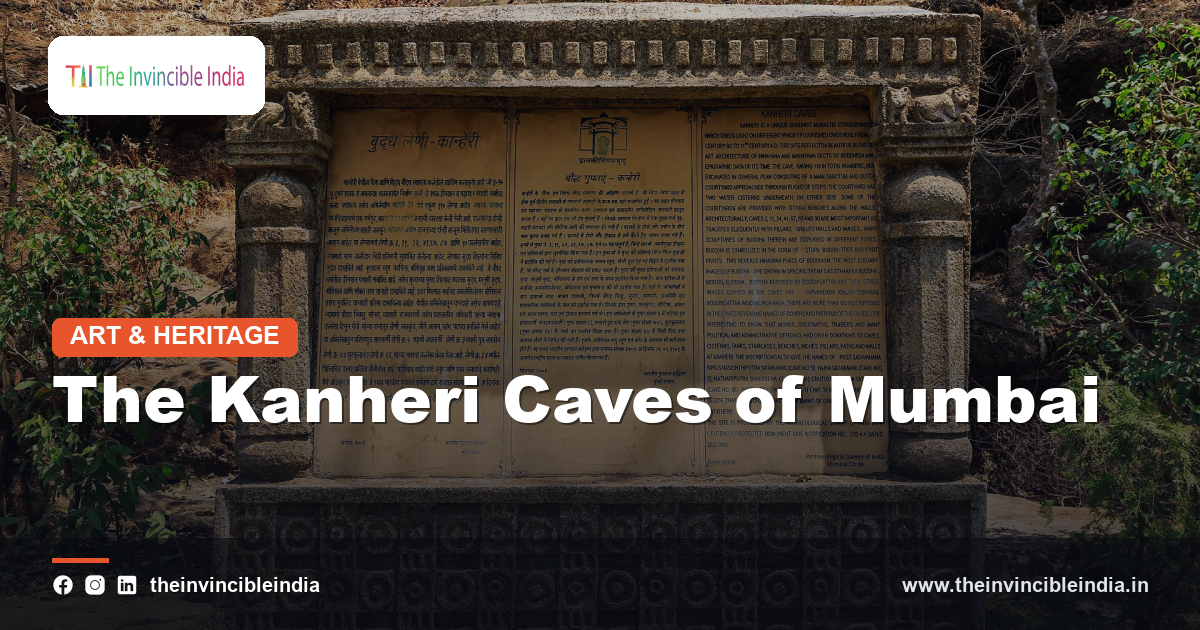
Hidden in the forested hills of Sanjay Gandhi National Park, within the limits of one of the world’s busiest cities, the Kanheri Caves form a monastic complex of extraordinary scale. Carved by hand into a great mass of basalt, more than a hundred cells, halls and shrines were created over many centuries as a home for Buddhist monks. The site belongs to the grand tradition of Indian sculpture and rock-cut art, and it offers a rare chance to see how a living monastic community organised prayer, study, shelter and water supply. This guide explores its history, architecture and lasting significance.
Quick Facts
| Detail | Information |
|---|---|
| Location | Sanjay Gandhi National Park, Borivali, Mumbai |
| Type | Buddhist rock-cut monastic complex |
| Rock | Basalt hillside |
| Number of caves | Over one hundred |
| Active period | From the early centuries BCE across roughly a thousand years |
| Highlights | Chaitya hall, viharas, cisterns and inscriptions |
A Monastery Inside a Metropolis
The Kanheri Caves lie in the northern part of Mumbai, inside the green expanse of Sanjay Gandhi National Park. Visitors leave the noise of traffic behind and climb through woodland to reach a hillside pierced with dark doorways, each leading to a chamber cut straight into the rock. The contrast between the modern city and the ancient monastery is among the most striking experiences in Indian heritage travel.
The complex is one of the largest groups of Buddhist caves in the country and a major site of western India. It preserves a record of religious life that continued for a very long time and attracted support from rulers, merchants and ordinary donors. Kanheri therefore stands as a quiet reminder that Mumbai’s story reaches far deeper than its modern skyline.
Origins of the Name and the Site
The name Kanheri is generally traced to old terms that describe a dark or black hill, a fitting description for the massive basalt outcrop in which the caves are cut. The rock is volcanic in origin and part of the great lava plateau that shapes much of western India. Its hard, even texture made it suitable for sustained excavation by monks and craftsmen.
The hill offered what a monastic community needed: seclusion for meditation, shelter from the monsoon, and access to springs and rain water. At the same time it lay within reach of important trade routes and settlements. This balance of retreat and connection helps explain why Kanheri grew into a major centre. The hill itself, as much as the carving, defines the character of the place.
The Buddhist Monastic Tradition in the West
Buddhism flourished in the Deccan and the western coast during the centuries around the start of the Common Era, supported by kings and wealthy merchants who funded rock-cut monasteries along the trade routes. Sites such as Karla, Bhaja and Ajanta belong to the same broad movement, and Kanheri takes its place among them as a particularly large and long-lived example.
Monastic life was organised around the community of monks who lived, studied and meditated in simple cells and gathered for worship in a hall containing a stupa. Lay supporters provided food, cloth and donations in return for spiritual merit. Kanheri shows the working form of this partnership, in which a monastery was both a spiritual retreat and a respected social institution.
A Long History of Use
One of the remarkable features of Kanheri is the length of time over which it was used. Excavation is understood to have begun in the early centuries BCE and to have continued, with changing styles and beliefs, for roughly a thousand years. Different phases of the Buddhist tradition left their marks on the architecture and sculpture.
This long span allows historians to trace the development of Buddhist art in a single place. Early caves tend to be plain, with simple cells and unadorned halls, while later work is more elaborate and richly decorated with sculpted figures. The site can therefore be read like a book whose chapters were written across many centuries. Kanheri is as valuable for its continuity as for its size.
Trade Routes, Ports and Patronage
The caves were not isolated from the wider world. The hill stands near the coast and near ancient ports and market towns that handled goods moving between the Deccan interior and distant lands across the sea. Merchants, officials and rulers who benefited from this trade were among the patrons who funded the excavation of caves, cisterns and benches.
Many donations are recorded in short inscriptions carved beside the caves. They preserve names and gifts from a variety of donors, including members of different social groups. The pattern of patronage shows that Buddhism in the west rested on broad public support. Kanheri’s growth reflects the prosperity of the region as much as the faith of its monks.
The Chaitya Hall
The principal place of worship at Kanheri is the great chaitya hall, a long vaulted chamber with a row of pillars on each side and a stupa at the far end. The design follows the plan of a Buddhist prayer hall that is also found at sites such as Karla, and it shows the same sense of ordered, sacred space. Worshippers would walk around the stupa as an act of devotion.
The hall is lofty and solemn, with a rhythm of columns leading the eye toward the shrine. Sculpted figures near the entrance and on the pillars add to the dignity of the interior. The chaitya hall is the spiritual centre of the complex, and its architecture shows how stone was shaped to evoke calm, reverence and focus.
The Stupa as Sacred Centre
At the heart of the prayer hall stands the stupa, a solid dome of rock that symbolises the Buddha and his teaching. In the earliest Buddhist art the Buddha was often represented by symbols rather than by a human figure, and the stupa served as the main focus of worship. Devotees circled it, offered flowers and recited prayers.
At Kanheri the stupa is carved from the living rock, rising directly out of the floor of the hall. This method gives the monument a sense of permanence and unity with the hill itself. The stupa reminds visitors that the entire complex was designed around a single idea, the veneration of the Buddha and the path he taught.
Viharas and the Life of the Monks
Most of the caves at Kanheri are viharas, or residences for monks. A typical vihara consists of a central hall surrounded by small cells, each with a stone bed or platform for rest. Some halls have benches along the walls and an entrance veranda with pillars, creating a sheltered space for gatherings and discussion.
These rooms reveal a disciplined and communal way of life. Monks meditated, studied scripture, taught visitors and carried out rituals within a rhythm set by tradition. The plain, practical character of the cells reflects an emphasis on simplicity rather than comfort. Together the viharas form a village of stone, one that tells us how a monastic community lived day by day.
Sculpture and Figures of the Buddha
Sculpture at Kanheri includes large standing and seated figures of the Buddha, attendants and bodhisattvas, many carved beside the entrances to halls and along verandas. The later figures show the Buddha in human form, calm and composed, with graceful posture and carefully shaped robes. Some panels depict compassionate beings associated with the later development of the faith.
The carving varies in quality and style because it was made over many generations, yet the overall effect is one of serenity and devotion. These images link the site with the broader story of Buddhist art in India, from early symbolic representation to the fully developed iconography of later centuries. The sculpture of Kanheri is a gallery of changing artistic ideals within a single hill.
Water Management and Cisterns
A monastery with so many residents needed a dependable supply of water, and the builders of Kanheri solved this problem with considerable skill. Rock-cut cisterns were carved at many points on the hill to collect rain water during the monsoon, and channels are understood to have guided the flow into storage chambers.
This system allowed the community to live on the hill through the dry months and demonstrates practical engineering as well as spiritual purpose. It also shows how closely the monks observed the landscape, using its slopes and fissures to their advantage. The cisterns are a lasting example of sustainable design, and they remain one of the most instructive features of the site for modern visitors.
Inscriptions and the Written Record
Short inscriptions in ancient scripts appear across the caves, usually recording a gift made by a named donor. These texts mention the contribution of a cell, a cistern, a bench or a cave, and they sometimes name the donor’s occupation or place of origin. Because they cover a wide range of periods, they are valuable evidence for scholars of language and history.
The inscriptions bring the human side of the monastery into focus. Behind the stone are individuals who chose to support a religious community and wished that act to be remembered. Epigraphy at Kanheri therefore gives voice to ordinary people as well as rulers, and it enriches our understanding of society in early western India.
Learning and the Wider Buddhist World
Kanheri was more than a place of residence; it was also a centre of study and teaching. Monks copied and discussed texts, taught disciples and exchanged ideas with other monasteries. The site is associated in tradition with scholars and teachers who travelled across the Buddhist world.
The monastery formed part of a network that linked western India with other regions where the faith was practised. Pilgrims, teachers and traders carried knowledge along the same routes that carried goods. Kanheri’s role in this exchange makes it an important chapter in the history of Asian religion and thought, showing how a hillside in western India took part in a truly international movement.
Comparison with Other Rock-Cut Sites
Kanheri is often discussed alongside other great rock-cut complexes of Maharashtra, such as Ajanta, Ellora, Karla and Bhaja. Each has its own character: Ajanta is famed for painting, Ellora for its range of religions, and Karla for a superbly preserved chaitya hall. Kanheri is distinguished by its sheer number of caves and its long period of continuous activity.
Seen together, these sites show how rock-cut architecture developed in the Deccan and how widely it was supported. Their similarities reveal a shared tradition, while their differences reflect local conditions and patrons. Visitors to UNESCO World Heritage Sites in India will recognise the same ideals at Kanheri, expressed in a more intimate, forest-bound setting.
Decline, Abandonment and Rediscovery
As patronage shifted and the Buddhist community in the region declined, activity at Kanheri gradually diminished and the caves were left to the forest. Over time they became known mainly to local people and passing travellers, while the monastic life that had filled them passed into memory.
The site was recorded by European and Indian scholars in later centuries, and its inscriptions and sculpture were studied in detail. This process of documentation revived interest and led to protection of the caves as an important monument. The story of Kanheri after its abandonment is one of rediscovery, in which patient research restored a lost chapter of India’s religious and artistic history.
Visiting the Caves
Reaching Kanheri involves entering the national park and then walking or taking a short ride up the forested road toward the hill. The paths between the caves involve steps and uneven ground, so comfortable footwear is advisable. The monsoon months bring lush greenery and flowing water, while cooler months are generally pleasant for exploring.
A visit rewards slow attention. Pausing in the chaitya hall, looking into the viharas and noticing the cisterns and inscriptions gives a fuller picture of monastic life. Respect for the site, careful treatment of the rock surfaces and awareness of the surrounding wildlife all help to preserve the experience. Kanheri is as much a walk through nature as a lesson in history.
The Kanheri Caves Today
Today the Kanheri Caves are a protected heritage site and a treasured escape for residents of Mumbai and travellers from afar. They appear in studies of Buddhist art and architecture and continue to teach visitors about patronage, monastic discipline and the skill of ancient craftsmen.
The caves also demonstrate that great heritage can survive in the middle of modern growth when it is valued and protected. Linked in memory with other great rock-cut sites and the story of Indian temple architecture, Kanheri enriches the understanding of how sacred space was carved from stone. It remains a place of quiet, depth and enduring cultural meaning.
Sources & Further Reading
- Archaeological Survey of India (asi.nic.in).
- Ministry of Culture, Government of India (indiaculture.gov.in).
Frequently Asked Questions
Where are the Kanheri Caves located?
They are inside Sanjay Gandhi National Park at Borivali in the northern part of Mumbai. The caves are cut into a basalt hill in a forested setting.
What are the Kanheri Caves?
They are a large complex of Buddhist rock-cut caves that served as a monastery, with prayer halls, residences for monks and water cisterns. More than a hundred caves are carved into the hill.
How old are the Kanheri Caves?
Excavation is understood to have started in the early centuries BCE and to have continued for roughly a thousand years. Different caves therefore belong to different phases of Buddhist art.
What is the most important cave at Kanheri?
The great chaitya hall is the main place of worship, with a row of pillars and a stupa at the end. It is considered the spiritual centre of the complex.
Why are there so many water cisterns at the site?
A large monastic community needed a reliable water supply through the dry months. Rock-cut cisterns collected monsoon rain so that the monks could live on the hill throughout the year.


