

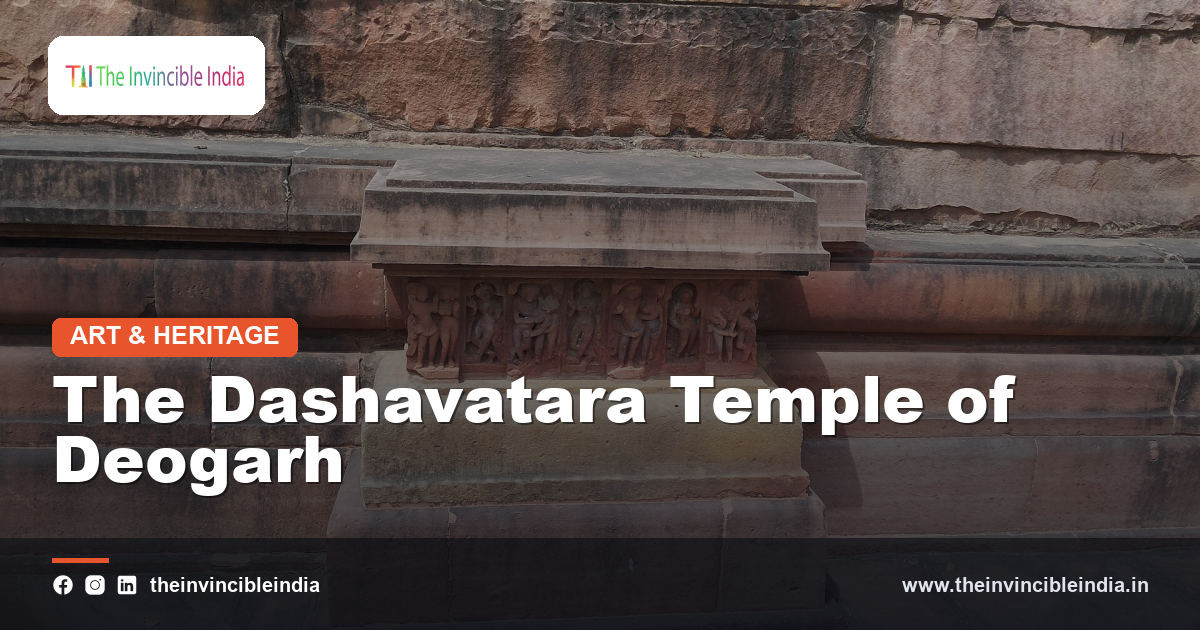
Rising above the wooded bank of the Betwa river in Uttar Pradesh, the Dashavatara temple of Deogarh is one of the most admired monuments of the Gupta age. Despite its name, the shrine is devoted to Vishnu and is celebrated less for a list of incarnations than for the quality of its sculpted panels and the clarity of its architectural idea. Scholars of Indian temple architecture return to Deogarh again and again because it preserves, in sandstone, a moment when the freestanding stone temple was taking its mature form. This guide explains its setting, design, sculpture, history and continuing importance.
Quick Facts
| Detail | Information |
|---|---|
| Location | Deogarh, Lalitpur district, Uttar Pradesh |
| Setting | Bank of the Betwa river |
| Period | Gupta age, generally placed in the early sixth century |
| Dedication | Vishnu |
| Material | Fine-grained sandstone |
| Significance | Early stone temple with surviving sculpted panels |
A Gupta Temple on the Betwa
The Dashavatara temple stands at Deogarh, a quiet village in the Lalitpur district of Uttar Pradesh, close to the Betwa river and a rocky hill that carries later Jain monuments. The monument is generally assigned to the Gupta period, a phase in the first millennium that is often described as a classical age of Indian art. Its setting is part of its appeal, since the temple rises from open ground with the water and the forested ridge behind it, much as worshippers and builders would have known it.
The temple matters because very few shrines of this early date survive in anything like their original character. Deogarh therefore serves as a reference point for the study of early Hindu architecture and sculpture, and its calm, balanced composition continues to attract visitors, photographers and students. In every sense it is a landmark of the Gupta artistic tradition.
Why It Is Called the Dashavatara Temple
The name Dashavatara refers to the ten incarnations of Vishnu, and visitors often expect to find all ten displayed on the walls. In fact the temple carries no such series, and the name is generally regarded as a later popular label rather than an accurate description of the original programme. The shrine was a temple of Vishnu, and its panels draw on episodes connected with him in other ways.
Understanding this point helps to read the monument correctly. The sculptures at Deogarh are narrative and devotional panels about divine order, protection and cosmic rest, not a catalogue of avatars. The name has endured simply because it is familiar, and it should be treated as a historical convenience. The temple’s real meaning lies in the panels that survive and in the way they are arranged around the sanctum.
The Raised Plinth and Overall Plan
The temple is built on a high square plinth, a feature that lifts the sanctum above the ground and gives the whole structure a stately presence. Flights of steps are generally understood to have led up to the platform, and the base itself is part of the architectural statement, setting the sacred space apart from the everyday world. The plan centres on a square sanctum that once held the principal image of the deity.
Scholars have long discussed whether the main shrine was surrounded by smaller subsidiary shrines at the corners of the platform, a layout often described as a five-shrine arrangement. Whatever the final answer, the careful geometry of the plinth and sanctum shows a confident sense of proportion. The plan expresses order and symmetry, qualities that became central to later Indian temple design.
The Sanctum and Its Porch
The heart of the temple is a compact sanctum, entered through a single doorway that faces a projecting porch. On the other sides of the sanctum the walls are not left blank; each carries a large sculpted panel set within a recessed frame. This arrangement turns the exterior of the shrine into a gallery of stories while keeping the interior simple and focused on the image of worship.
The porch once offered a transitional space between the world outside and the dark sanctum within, a principle that runs through nearly every Hindu temple that followed. At Deogarh the transition is handled with restraint and elegance. The relationship between a modest entrance, a plain inner chamber and richly carved outer walls is one of the quiet achievements of the monument.
The Ornamented Doorway
The doorway of the sanctum is among the most admired parts of the temple. Its frame is richly carved with vegetal scrolls, bands of ornament and figures, and the lower sections of the jambs are associated with the river goddesses Ganga and Yamuna, shown with their attendants. Such guardians of the threshold became a standard feature of temple doorways in later centuries.
The carving here is crisp and fluid, with a delicacy that reflects the refinement of Gupta workshops. A worshipper passing through the door would have moved between sculpted rivers, symbols of purity, before reaching the deity inside. The doorway shows how Gupta artists combined decoration and meaning, so that ornament itself became part of the experience of entering sacred space.
Sheshashayi Vishnu: The Cosmic Sleep
The best-known panel at Deogarh shows Vishnu reclining on the coils of the serpent Shesha, whose hoods rise above him like a canopy. This image, called Sheshashayi or Anantashayana, represents the god at rest on the cosmic waters between cycles of creation. Around the central figure are other divine beings and attendants, arranged with a clear sense of rhythm and balance.
The panel is admired for the serenity of the reclining god and for the fluent modelling of the figures. Although it depicts a cosmic moment of immense scale, the mood is gentle and contemplative rather than dramatic. For many viewers it is the defining image of the temple, and it stands as one of the great statements of Gupta sculpture on the theme of divine repose.
Nara-Narayana in Meditation
Another major panel presents Nara and Narayana, the paired sages associated with Vishnu, seated in a landscape of rocks, trees and animals. Narayana is understood as a form of Vishnu, while Nara is his companion, and together they are shown in meditation and austerity. Celestial figures and creatures from the forest appear around them, suggesting a hermitage in the Himalayan region.
The composition is notable for the way the sculptor has integrated nature into the scene, giving the stone a sense of stillness and depth. Rather than a simple icon, the panel reads as a small world of devotion and discipline. It reinforces the idea that Deogarh was designed to teach as well as to inspire, using narrative carving to link philosophy with visual beauty.
Gajendra Moksha and Other Panels
A further panel illustrates the story of Gajendra, the elephant king who calls on Vishnu for deliverance and is rescued from danger. The episode is a classic expression of divine grace and is told here through lively figures and a sense of movement. Additional reliefs on the temple are connected with other episodes of Vishnu and his devotees, and they enrich the programme of the walls.
Taken together, these scenes present Vishnu as preserver, protector and cosmic principle. Each carries a message of refuge and trust, and each is composed to be read at a glance by pilgrims walking around the shrine. The panels show how early temple sculpture turned scripture and legend into accessible visual teaching.
Sandstone and the Craft of Construction
The temple is built of fine sandstone, cut into blocks that are fitted together with great precision. The craftsmanship suggests an established tradition of stone working, with masons who understood both the strength and the carving qualities of their material. Sandstone allowed artists to render soft folds of cloth, delicate jewellery and expressive faces while still supporting the weight of the structure.
Over the centuries the surface has weathered, yet the sharpness of many details remains remarkable. The building shows that stone, which had long been used for caves and sculpture in India, could also be used for a fully freestanding temple with confidence. This marks Deogarh as an important step in the maturing of India’s architectural vocabulary.
The Lost Tower and Early Superstructures
One of the most discussed features of the temple is its superstructure. The sanctum is believed to have carried a tower rising above it, and the surviving evidence suggests that this was a pyramidal form. Today only part of this upper section remains, and much of it has been lost, which leaves the building looking lower than it was designed to be.
Even in its incomplete state, the evidence is valuable. It indicates that the Gupta builders were already thinking about vertical emphasis, an idea that would later flower in the towers of north and south Indian temples. Deogarh therefore records an early moment in a long story of architectural ambition, and it helps historians trace how the tower became the crowning feature of the Hindu shrine.
Place in the Story of Indian Temple Design
The Dashavatara temple is often cited when historians describe the transition from rock-cut and simple structural shrines to the elaborate temples of later periods. Its raised platform, defined sanctum, porch, ornamented doorway and sculpted outer panels all point toward conventions that were developed and enlarged by later dynasties across the subcontinent.
Comparisons with Dravidian temple architecture and with northern traditions show how early ideas diverged and evolved. Deogarh sits near the beginning of that story, offering a compact and elegant statement of principles that were later expanded. For this reason the temple is treated as a foundation stone of temple studies, valued as much for what it anticipated as for its own beauty.
Gupta Art and the Classical Ideal
The Gupta period is remembered for its refined art, literature and learning, and Deogarh captures many of the qualities associated with that age. Figures are modelled with gentle curves and calm expressions, proportions are harmonious, and ornament is controlled rather than crowded. The result is an art of balance and grace that later generations regarded as a classical standard.
This sensibility is visible across the panels and the doorway, where emotion is expressed through poise rather than exaggeration. The sculptors worked within religious themes, yet they achieved a universal clarity that speaks beyond belief. Deogarh remains among the best places to see the Gupta ideal in stone, a monument where devotion and artistic discipline meet in perfect measure.
Rediscovery and Documentation
The temple was brought to wider scholarly attention in the nineteenth century, when early archaeologists and surveyors recorded the monuments of the region. Their descriptions, drawings and photographs introduced the shrine to historians of Indian art, and it soon became a standard example in discussions of Gupta architecture. Later researchers examined the plan, the sculpture and the surrounding remains in greater detail.
Documentation has continued ever since, and the temple is now treated as a protected monument. The work of recording and study has helped to clarify the structure of the shrine, the arrangement of its panels and its relationship to nearby sites. Careful scholarship has turned a rural monument into a well-understood landmark of national heritage.
The Neighbouring Monuments of Deogarh
The Dashavatara temple is not the only attraction at Deogarh. On the adjacent hill stands a group of Jain temples and rock-cut images from a later period, built within a fortified enclosure and still of great interest to visitors. Together with the Gupta shrine they show that the site remained religiously active for many centuries and drew patrons from different traditions.
This layering of monuments gives Deogarh a special character as a place where Hindu and Jain art can be studied side by side. A visit allows a traveller to move from the early classical calm of the Vishnu temple to the dense, devotional world of the hilltop shrines. The combination makes the village a rewarding destination for anyone interested in the sweep of Indian religious art.
Conservation and Protection
Like all ancient stone monuments, the temple faces challenges from weather, vegetation and the passage of time. Its upkeep is entrusted to the national archaeological authorities, who monitor the structure, maintain the surroundings and regulate access. Many of the finest sculptures have also been moved to museums for safekeeping, while the principal panels remain in place on the walls of the shrine.
Protection of this kind balances public access with long-term preservation. Clean grounds, clear interpretation and respectful visitor behaviour all contribute to the temple’s survival. The monument is a shared inheritance, and its continued care ensures that later generations can see Gupta craftsmanship much as earlier scholars first encountered it.
Visiting Deogarh
Deogarh is in a relatively remote part of Uttar Pradesh, which gives a visit a peaceful and unhurried quality. The temple is best appreciated slowly, walking around the plinth to study each panel, then pausing at the doorway to observe its carving. Early morning and late afternoon light bring out the texture of the sandstone and soften the glare on the sculptures.
Travellers often combine the temple with the hilltop Jain monuments and the river views nearby. Comfortable shoes, water and a respectful attitude toward the site make the experience more rewarding. Seen with patience, Deogarh offers one of the most contemplative encounters with early Indian architecture available anywhere in the country.
The Dashavatara Temple Today
Today the Dashavatara temple is valued as a protected monument, a teaching example and a quiet place of beauty. It appears in textbooks, museum catalogues and scholarly studies as a defining work of the Gupta age, and it continues to inspire artists and architects. Its panels remain among the most reproduced images of early Indian sculpture.
For visitors, the temple offers a direct link with the artistic confidence of a distant era. Placed alongside great sites such as the UNESCO World Heritage Sites of India, it shows that important heritage is found in small villages as well as famous cities. Deogarh endures as a reminder that elegance, restraint and devotion can shape a monument for all time.
Sources & Further Reading
- Archaeological Survey of India (asi.nic.in).
- Ministry of Culture, Government of India (indiaculture.gov.in).
Frequently Asked Questions
Why is Deogarh's temple called the Dashavatara temple?
The name refers to the ten incarnations of Vishnu, but the temple does not actually show a full series of avatars. It is generally seen as a later popular label for what is a Vishnu temple of the Gupta period.
Where is the Dashavatara temple located?
It stands at Deogarh in the Lalitpur district of Uttar Pradesh, on the bank of the Betwa river. The site also has a hill with Jain temples from a later era.
What is the most famous sculpture at the temple?
The panel of Vishnu reclining on the serpent Shesha is the best known. It shows the god at rest on the cosmic waters and is regarded as a masterpiece of Gupta sculpture.
Why is the temple important in Indian architecture?
It is one of the earliest surviving stone temples with a raised plinth, defined sanctum, ornamented doorway and sculpted panels. These features anticipate many conventions of later temple design.
Can visitors still see the original panels?
The main panels remain on the walls of the shrine, although some sculptures from the site are now preserved in museums. Visitors can study the temple under the care of the national archaeological authorities.


