

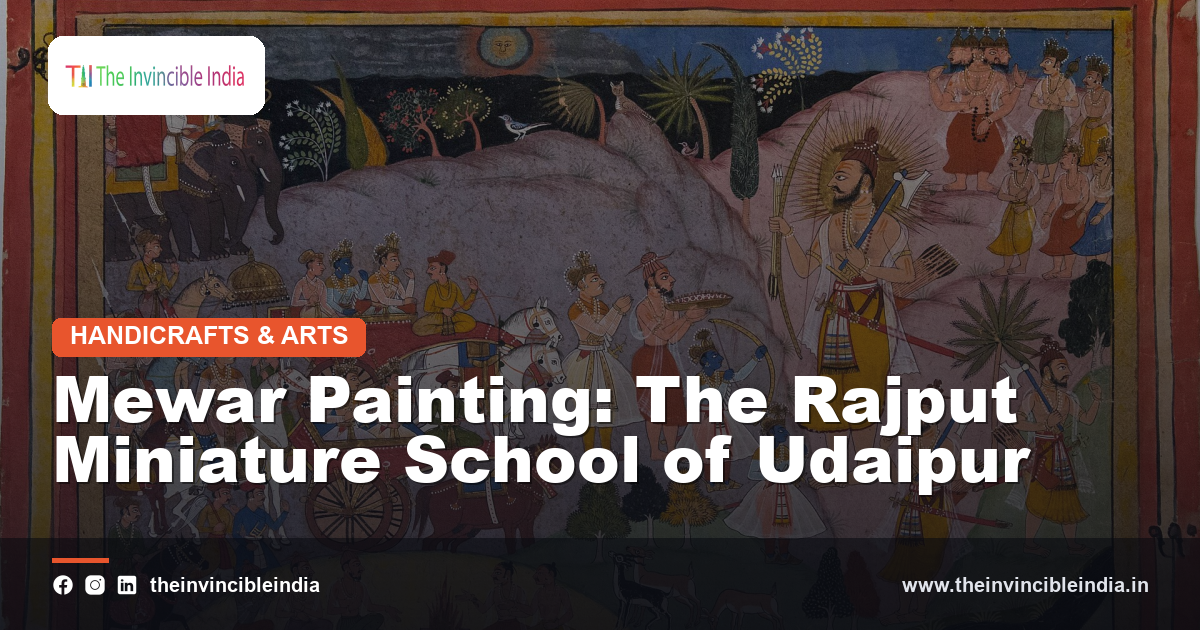
Mewar painting is the vivid and expressive miniature tradition of the Mewar kingdom in southern Rajasthan, centred on the lake city of Udaipur and the older fort capital of Chittor. Emerging within Rajput courts that prized valour, devotion and ceremony, the school developed a bold idiom of saturated colour, flat decorative space and strong narrative energy. Its paintings illustrate epics, devotional poetry, musical modes and the life of the court with unmistakable directness. Where the hill schools such as Kangra painting favour soft lyricism, Mewar art speaks in a confident, rhythmic voice rooted in the desert kingdoms. Studying the school offers a window into the visual culture of Rajput India and the royal workshops that sustained it.
Quick Facts
| Detail | Information |
|---|---|
| Art Form | Rajput miniature painting |
| Primary Region | Udaipur and Chittor, Rajasthan |
| Typical Themes | Epics, Ragamala, court life, devotion |
| Visual Style | Bold colour and flat decorative space |
| Patrons | Rulers of the Mewar kingdom |
| Related Centre | Nathdwara, linked to Pichwai |
The Kingdom of Mewar
Mewar is among the most historic Rajput kingdoms of Rajasthan, remembered for its long ruling lineage and for a tradition of resisting domination while nurturing the arts. Its early capital lay at Chittor, and its later seat was established at Udaipur beside a series of picturesque lakes.
The pride and cultural confidence of the kingdom shaped everything that its workshops produced. Understanding Mewar as a court with a strong sense of identity is the first step toward appreciating its painting, which reflects the values and ceremonies of a ruling house deeply invested in heritage.
Origins of the Mewar School
Painting in the Mewar region has early roots in manuscript illustration, where texts were accompanied by small, vividly coloured pictures. From these beginnings, a recognisable court style gradually took shape as artists were drawn into royal workshops and given regular commissions.
The school matured over time through the work of successive generations of painters. Its development was gradual rather than sudden, a steady refinement of a regional manner that grew in confidence as the Mewar courts offered stable patronage and a growing demand for illustrated manuscripts and portraits.
Chittor to Udaipur
The movement of the Mewar capital from the fort of Chittor to the new city of Udaipur reshaped the environment in which painters worked. Udaipur, with its palaces rising from the waters of its lakes, provided fresh subjects and a refined setting for court art.
Painting continued to flourish in this new capital, and the city became closely associated with the school in popular memory. The relocation of the court illustrates how artistic traditions travel with their patrons and adapt to new surroundings while preserving the essential character of the style.
Royal Patronage and the Court Workshop
The rulers of Mewar maintained workshops where painters produced manuscripts, portraits and ceremonial scenes. Such royal studios provided training, materials and steady work, and they ensured a high standard of craft across generations.
Patronage shaped the subjects of the school, favouring works that glorified the dynasty, honoured its gods and recorded festivals and hunts. The court workshop was therefore both an artistic institution and a cultural archive, preserving the visual memory of the Mewar kingdom in the form of richly coloured miniatures.
Ragamala and Musical Subjects
Ragamala paintings, which give visual form to the moods and melodies of Indian classical music, were an important subject for Mewar painters. Each raga and its family is personified through figures, settings and colours that suggest a particular emotion or time of day.
These series required artists to translate sound into image, an imaginative challenge that suited the poetic temperament of the school. The Ragamala tradition shows how closely painting, music and poetry were intertwined in Rajput court culture, and it remains one of the most admired aspects of Mewar art.
Epics and Devotional Narrative
The Ramayana, the Mahabharata and the Bhagavata Purana provided inexhaustible material for Mewar painters. Illustrated manuscripts of these texts brought sacred stories to life with clear storytelling and dramatic gesture.
Devotion to Krishna and other deities also found expression in the painting of the region. These religious subjects were not merely decorative but served as acts of piety and as means of sharing familiar stories within the royal household, giving Mewar painting a strong spiritual dimension alongside its courtly splendour.
Colour, Pattern and Flat Space
Mewar painting is easily recognised by its bold, saturated colours, particularly strong reds, yellows and deep blues, laid out in flat planes. Backgrounds are often filled with a single vivid hue, while architecture and landscape are arranged in a decorative rather than strictly realistic manner.
This approach gives compositions a rhythmic clarity that reads at a glance. The emphasis on colour and pattern rather than deep perspective is a hallmark of Rajput painting, and in Mewar it produces images of striking directness and expressive power.
Figures, Faces and Gesture
Figures in Mewar painting are typically drawn in profile or three-quarter view, with large expressive eyes, firm outlines and stylised features. Gesture and posture carry much of the narrative, guiding the viewer through each scene.
Rather than seeking portrait-like realism, painters relied on conventions that conveyed status, emotion and role. This vocabulary of gesture and form was understood within the court, and it allowed artists to communicate complex stories with economy, giving the school a recognisable human presence on every page.
Court Life, Festivals and Hunts
Beyond sacred subjects, Mewar painters recorded the life of the court, including processions, festivals, audiences and royal hunts. Large scenes show rulers on horseback or elephants, surrounded by attendants and set against detailed landscapes or palace views.
These works serve as visual records of ceremonial life and as expressions of royal authority. They allow modern viewers to imagine the pageantry of the Udaipur court, while also demonstrating the painters’ ability to organise complex, crowded compositions with clarity and vitality.
Lakes, Palaces and Architecture
The distinctive setting of Udaipur, with its lakes, terraces and palace complexes, appears frequently in Mewar painting. Architecture is depicted with attention to domes, balconies and courtyards, often arranged in a stylised yet recognisable manner.
Painters took pleasure in capturing the beauty of their surroundings, and these views help document the built heritage of the city. The close relationship between painting and place gives the school a strong local identity, rooted in the landscape and architecture of Mewar.
Influences from Mughal and Other Schools
Rajput courts maintained contact with the Mughal empire and with neighbouring painting centres, and ideas moved between them. Mewar artists absorbed elements such as refined portraiture and fine detail while retaining their own preference for bold colour and decorative composition.
This selective borrowing enriched the school without erasing its character. The result is a style that reflects a dialogue with other traditions yet remains unmistakably Rajput, a balance that is one of the most interesting features of Mewar painting for students of Indian art.
Materials and Techniques
Traditional Mewar miniatures were painted on paper using natural pigments derived from minerals and plants, mixed with a binding medium and applied with fine brushes. Gold and silver could be added to enhance jewellery, borders and decorative elements.
The process began with careful drawing and proceeded through layers of colour to final detailing. Such methods demanded patience and discipline, and the durability of the pigments explains why many centuries-old works still retain remarkable brilliance when properly preserved.
Painters and Their Legacy
The Mewar tradition produced skilled painters whose names are remembered in the history of Indian art, along with many anonymous artists who worked in royal studios. Their combined output forms a continuous record of changing taste across successive reigns.
Individual painters contributed distinctive touches, but the school as a whole maintained a recognisable style. This balance between personal skill and shared tradition is characteristic of workshop painting in India and accounts for the cohesive identity of Mewar art.
Nathdwara and the Pichwai Connection
The temple town of Nathdwara in the Mewar region became a centre for devotional painting, especially the large cloth hangings known as Pichwai that adorn the shrine of Shrinathji. Its artists drew on the wider Mewar tradition while developing their own devotional idiom.
The connection shows how court painting and temple art shared techniques and sensibilities in the region. Nathdwara remains a living example of how Mewar’s painterly heritage extended beyond the palace into the religious life of the community.
Museums and Preservation
Important Mewar paintings are kept in museums and royal collections within Udaipur and in institutions across India and the world. The City Palace complex holds material connected to the history of the dynasty and its cultural patronage.
Preserving works on paper requires careful conservation, since light, humidity and handling can cause damage. Public collections and scholarly study help protect these paintings and make them accessible, ensuring that the visual heritage of Mewar can be appreciated by future generations.
Reading a Mewar Miniature
Looking closely at a Mewar miniature rewards patience, since each composition is organised around a clear focal point surrounded by carefully placed secondary elements. The eye is guided by bands of colour, repeated architectural forms and the rhythmic placement of figures across the page.
Inscriptions, borders and small background details often add further layers of meaning. Learning to read these visual cues helps viewers understand how painters balanced story, decoration and symbolism, and it makes each Mewar folio a richer experience than a first glance suggests.
Place Within Rajasthani Painting
Mewar is one of several important schools of Rajasthani painting, alongside the styles associated with Bundi, Kota, Bikaner, Kishangarh and Jaipur. Each centre developed its own character while sharing a common Rajput cultural framework.
Within this family, Mewar is often regarded as an early and foundational voice, notable for its strong colour and narrative directness. Placing the school in this wider context clarifies its importance and shows how regional courts together created one of the richest bodies of miniature painting in the world.
Mewar Painting Today
Mewar painting today is celebrated as a major chapter in Rajput art and as a source of continuing inspiration. Artists in Udaipur and its surroundings still practise miniature painting, producing works for visitors, collectors and cultural institutions.
The vitality of colour, narrative and ornament that defines the school remains widely admired. Whether viewed in a museum, a palace gallery or a contemporary studio, Mewar painting continues to offer a vivid and lasting expression of the cultural world of southern Rajasthan.
Sources & Further Reading
- Ministry of Culture, Government of India (indiaculture.gov.in).
- National Museum, New Delhi (nationalmuseumindia.gov.in).
Frequently Asked Questions
What is Mewar painting?
Mewar painting is a school of Rajput miniature art that developed under the rulers of the Mewar kingdom in Rajasthan, centred on Chittor and later Udaipur. It is known for bold colour, flat decorative space and strong narrative content.
What subjects did Mewar painters depict?
Mewar painters illustrated epics such as the Ramayana and Mahabharata, devotional texts, Ragamala musical series and scenes of court life, festivals and hunts. Portraits and views of palaces and lakes were also popular.
How does Mewar painting differ from Kangra painting?
Mewar painting favours saturated colour, flat planes and bold outlines, while Kangra painting uses a soft palette and lyrical naturalism. The two reflect the different cultural settings of the Rajasthan courts and the Himalayan foothills.
What is the link between Mewar painting and Nathdwara?
Nathdwara, a temple town in the Mewar region, developed a devotional painting tradition, notably Pichwai cloth hangings. Its artists drew on the broader Mewar painterly heritage while serving temple worship.
Where can Mewar paintings be seen?
Mewar paintings can be seen in museums and palace collections in Udaipur and in institutions across India and abroad. Contemporary miniature painters in Udaipur also continue to work in the style.


