

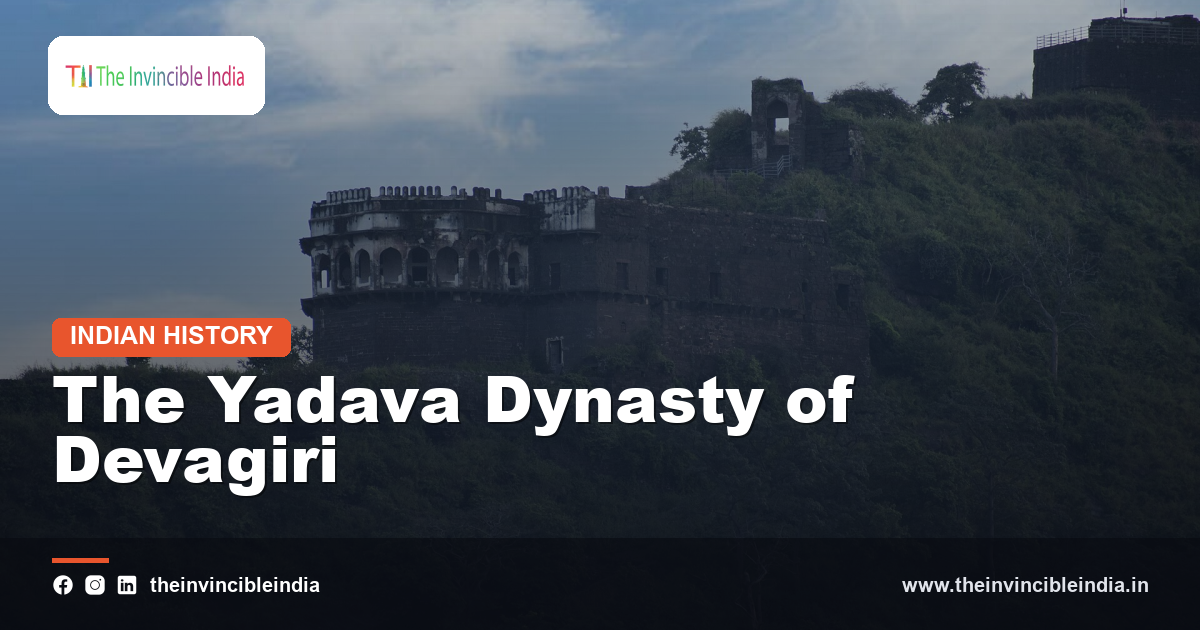
The Yadava dynasty of Devagiri, sometimes called the Seuna dynasty, ruled a large part of the western Deccan in the later medieval period from a formidable hill fortress that still dominates the landscape of Maharashtra. Rising as successors to the power once held by the Chalukyas and the Rashtrakutas in the region, the Yadavas became the leading Deccan kingdom of their day. Their court nurtured Sanskrit scholarship and the early flowering of Marathi, their ministers shaped a distinctive style of temple building, and their fortress capital later gave its name to a new chapter of history. This guide traces their rise, culture, and eventual decline.
Quick Facts
| Detail | Information |
|---|---|
| Dynasty | Yadava, also called Seuna, of Devagiri |
| Capital | Devagiri, later known as Daulatabad |
| Region | Western Deccan, centered on present-day Maharashtra |
| Period | Later medieval era, roughly the twelfth to early fourteenth century |
| Notable Rulers | Bhillama, Singhana, Krishna, Mahadeva, Ramachandra |
| Cultural Legacy | Early Marathi literature, Hemadpanti temples, Sanskrit scholarship |
Origins and Early Rise
The Yadavas of Devagiri began as feudatories in the Deccan before growing into an independent power. Their early chiefs served the Western Chalukyas of Kalyani, governing districts in the northern Deccan and gradually accumulating strength as imperial authority weakened. Like many medieval dynasties, they claimed descent from the legendary Yadava lineage associated with Krishna, a traditional genealogy that gave their rule mythic prestige. Historians treat such claims as part of royal self-presentation rather than literal ancestry, and the precise early chronology is debated. What is clear is that the family used the decline of its overlords to expand its territory and to establish a capital of its own. The steady rise from vassal to sovereign ruler laid the groundwork for the later brilliance of the Yadava kingdom.
Devagiri, the Fortress Capital
Devagiri, the Hill of the Gods, became the political heart of the Yadava realm. The site is a dramatic rock rising from the plateau, naturally defensible and later strengthened with layered walls, moats, and cleverly designed approaches. Its position allowed control of the routes linking northern India with the southern peninsula, giving its rulers strategic influence over trade and movement. The fortress stands today as one of the most impressive medieval military complexes in the country. In later centuries it was renamed Daulatabad, but its earliest identity as a Yadava stronghold remains central to its history. The fort captures both the ambition and the engineering confidence of the dynasty, and it continues to define how the Yadavas are remembered in the landscape of the Deccan.
Bhillama and the Founding of the Imperial Line
Bhillama is traditionally credited with establishing the Yadava dynasty as an independent sovereign house. Taking advantage of the weakening of the Chalukya court at Kalyani, he extended control over a wide area and founded the capital at Devagiri. His reign is associated with military campaigns against neighboring rulers and with the assertion of royal titles that signaled independence. The exact chronology of this early period is a matter for scholarly debate, so it is best described in general terms. What mattered most was the creation of a durable political center that would outlast its founder. Bhillama thus stands as the figure who transformed a regional feudatory family into the ruling house of a major Deccan kingdom.
Singhana and the Zenith of Power
Singhana is generally regarded as the greatest Yadava ruler. Under his leadership the kingdom reached its widest extent, with influence stretching across much of the Deccan and campaigns directed against neighbors in several directions. His court attracted scholars and astronomers, and the dynasty’s prestige was at its height. Rivalries with the Hoysalas to the south, the Paramaras and the rulers of Gujarat to the north and west, and the Kakatiyas to the east formed the diplomatic and military setting of his reign. Specific figures about his campaigns are best left to specialist sources. The reign of Singhana represents the culmination of Yadava expansion, when the kingdom stood among the leading powers of peninsular India and enjoyed a flourishing political and cultural life.
Rivalries with Neighboring Kingdoms
The Yadava kings lived in a crowded political neighborhood. To the south, the Hoysalas competed for control of the borderlands, while to the east the Kakatiyas ruled the Telugu country. To the north and west, the Paramaras of Malwa and the rulers of Gujarat contested the frontier regions. Warfare was frequent, but so were diplomatic marriages and shifting alliances, which meant that fortunes could change quickly. The Yadavas, thanks to their central position and strong fortress, usually held their ground and sometimes pushed outward. These contests shaped the politics of the thirteenth-century Deccan. The pattern of rivalry and balance among several regional kingdoms defined the age, and the Yadavas were one of its principal participants.
Administration and Society
The Yadava state followed administrative patterns familiar from earlier Deccan kingdoms. A king ruled with the help of ministers, military commanders, and provincial governors, while villages served as basic units of revenue and local management. Inscriptions record grants of land and revenue to temples and learned Brahmins, a common way of securing loyalty and supporting religious life. Merchant guilds and craft associations played an important role in towns, linking the kingdom to wider trade networks. Society was organized through established hierarchies, but local customs and village institutions retained considerable influence. The administrative system balanced the authority of the court with the autonomy of local communities. This structure enabled the Yadavas to govern a large and diverse territory with relative stability for a considerable period.
Hemadri and the Hemadpanti Style
Hemadri, known in popular tradition as Hemadpant, served as a high minister at the Yadava court and is associated with a distinctive style of temple architecture. The so-called Hemadpanti temples are typically built of dark local stone, fitted together with remarkable precision and often without mortar. Their forms are restrained, with geometric plans and carefully carved details. Hemadri was also a scholar, and he is credited with a large Sanskrit compendium on religious observance. The attribution of every Hemadpanti structure to him personally is traditional rather than certain, and many temples in this style date to various periods. Nevertheless, his name has become shorthand for a recognizable architectural heritage across Maharashtra. The Hemadpanti tradition remains one of the most visible legacies of the Yadava era.
Temples and Architectural Heritage
Beyond the Hemadpanti style, the Yadava period saw the construction and patronage of numerous temples across the western Deccan. Structures such as the temple at Sinnar, often associated with this era, display the star-shaped plans, layered shrines, and richly carved pillars characteristic of the regional tradition. Stonework from this period combines technical skill with devotional symbolism, reflecting the influence of earlier Chalukyan and Rashtrakuta building practices. Many of these temples were supported by royal, ministerial, and mercantile donors, and they served as centers of worship, learning, and community life. Some survive in good condition, while others are ruined or altered. The temples of the Yadava age connect the dynasty to a long architectural lineage and remain valuable monuments of medieval Maharashtra.
Marathi Literature and the Mahanubhava Movement
The Yadava period is closely associated with the emergence of Marathi as a literary language. Devotional and philosophical writing in the vernacular began to flourish alongside Sanskrit, making religious thought accessible to a wider public. The Mahanubhava sect, founded by Chakradhara, produced early Marathi prose and promoted a message that reached ordinary people. The Warkari tradition, later so central to Maharashtra, also drew on this growing literary culture. The Yadava court did not create these movements, but the stability and patronage of the age helped provide the conditions in which they could grow. The rise of Marathi under Yadava rule marks a turning point in the cultural history of the region, with consequences that continue to shape Maharashtrian identity.
Jnaneshwar and the Jnaneshwari
Among the most beloved figures of the age is the saint-poet Jnaneshwar, who composed a celebrated commentary in Marathi on the Bhagavad Gita, popularly known as the Jnaneshwari. Tradition places him in the later Yadava period, and his work is regarded as a masterpiece of devotional literature. By explaining profound philosophical ideas in the language of the people, he helped democratize spiritual knowledge. His legacy lives on in the Warkari pilgrimage tradition and in the memory of Maharashtra. Details of his biography come largely from tradition, so scholars proceed carefully in distinguishing legend from documented fact. The Jnaneshwari stands as a landmark in Indian literature and a testament to the vibrant intellectual atmosphere that existed in the Deccan under Yadava rule.
Sanskrit Scholarship and Music
Alongside vernacular literature, Sanskrit learning thrived at the Yadava court. Astronomers, grammarians, and commentators found patronage, and scholarly lineages passed knowledge from generation to generation. The renowned treatise on music and dance, the Sangita Ratnakara by Sharngadeva, is traditionally associated with the Yadava court and is a foundational text for the study of Indian musical theory. It discusses melody, rhythm, instruments, and performance in systematic detail and was influential across both northern and southern traditions. The presence of such work shows the breadth of cultural activity under Yadava patronage. Scholarship, music, and the arts together made the Devagiri court a center of intellectual life, enriching the heritage of the Deccan in ways that extended well beyond the borders of the kingdom.
Religion and Patronage
The Yadavas supported a variety of religious traditions, reflecting the pluralistic character of medieval Deccan society. Shaiva and Vaishnava temples received royal grants, and Jain communities also enjoyed patronage and maintained active centers. The cult of Vitthala at Pandharpur, central to the later Warkari movement, grew in importance during this era. Rulers presented themselves as protectors of dharma and endowed shrines, rest houses, and educational institutions. Such patronage strengthened ties between the court, the clergy, and the people. The coexistence of several faiths under Yadava rule contributed to a rich religious landscape and a culture of devotion that shaped regional identity. The religious life of the kingdom was an integral part of its political and social fabric.
Trade, Economy, and Urban Life
The economy of the Yadava kingdom rested on agriculture in the fertile river valleys of the Deccan plateau, supported by trade routes that connected the interior with coastal ports and with northern India. Merchant guilds participated in the exchange of textiles, grain, and other goods, and towns grew around temples, markets, and fortresses. Devagiri’s position on important routes made it a natural hub. Craftsmen, including stone carvers and metalworkers, found employment in the construction of temples and public works. The wealth of the kingdom, which later attracted the attention of northern invaders, was built on this combination of farming, commerce, and skilled labor. The prosperity of the Yadava realm provided the material foundation for its remarkable cultural achievements.
Ramachandra and the Khalji Campaigns
The later Yadava rulers faced a challenge unlike any earlier threat. Forces from the Delhi Sultanate, led by commanders of Alauddin Khalji, marched south into the Deccan and attacked Devagiri. The ruler of the time, Ramachandra, was compelled to acknowledge the overlordship of the sultan and to pay tribute, and his position as a subordinate ruler continued for a period. The campaigns revealed the vulnerability of even a great fortress to determined external force and inaugurated a new era in the relations between north and south. Details of the events vary across sources and are best summarized in broad terms. The encounter with the Khalji armies marked the beginning of the end of Yadava independence and a major turning point in Deccan history.
Decline and the Transformation of Devagiri
Following the Khalji intervention, the Yadava kingdom weakened and its final rulers struggled to maintain autonomy. Eventually the dynasty lost its independent status, and the territory came under the control of the Delhi Sultanate. The fortress of Devagiri remained a place of great importance, and in the following century it was renamed Daulatabad and briefly proposed as a new capital by a later sultan. The Yadava political order thus gave way to new regimes, yet the cultural legacy of the age persisted in literature, architecture, and devotional life. The end of the dynasty did not erase its influence. The decline of the Yadavas closed a distinct chapter of Deccan history while leaving behind a heritage that continued to inspire later generations.
The Yadavas Today
The Yadava dynasty of Devagiri remains an essential subject for understanding the medieval history of Maharashtra and the Deccan. Its great fort draws visitors who walk through gates, passages, and ramparts that speak of defensive ingenuity. Its temples preserve a refined architectural style, while its literary heritage underlies the modern Marathi language and the living Warkari tradition. Scholars continue to refine the chronology of its rulers and to debate details of its administration and conflicts. The dynasty reminds students of history that political power and cultural creativity often grow together. The legacy of the Yadavas endures in stone, in language, and in the collective memory of the region they once governed.
Sources & Further Reading
- Ministry of Culture, Government of India (indiaculture.gov.in).
- Archaeological Survey of India (asi.nic.in).
Frequently Asked Questions
Who were the Yadavas of Devagiri?
The Yadavas, also called the Seuna dynasty, were a medieval ruling family that governed much of the western Deccan from the fortress of Devagiri. They rose from feudatory status under the Western Chalukyas to become a major regional power.
Why is Devagiri important?
Devagiri was the Yadava capital and one of the most formidable hill forts in India. Later renamed Daulatabad, it controlled key routes between northern India and the south and remains a major historical monument.
What are Hemadpanti temples?
Hemadpanti temples are structures built in a distinctive style, often of dark stone fitted together without mortar, traditionally linked with the minister Hemadri. The attribution of individual temples to him is traditional, and many date to different periods.
How did the Yadava dynasty contribute to Marathi culture?
The stability and patronage of the Yadava age coincided with the early growth of Marathi literature, including the Mahanubhava writings and the Jnaneshwari. These works helped establish Marathi as a language of philosophy and devotion.
How did Yadava rule end?
The dynasty lost its independence after campaigns by forces of the Delhi Sultanate under Alauddin Khalji, beginning with the submission of Ramachandra. The kingdom was gradually absorbed into the sultanate, though details vary across sources.


