

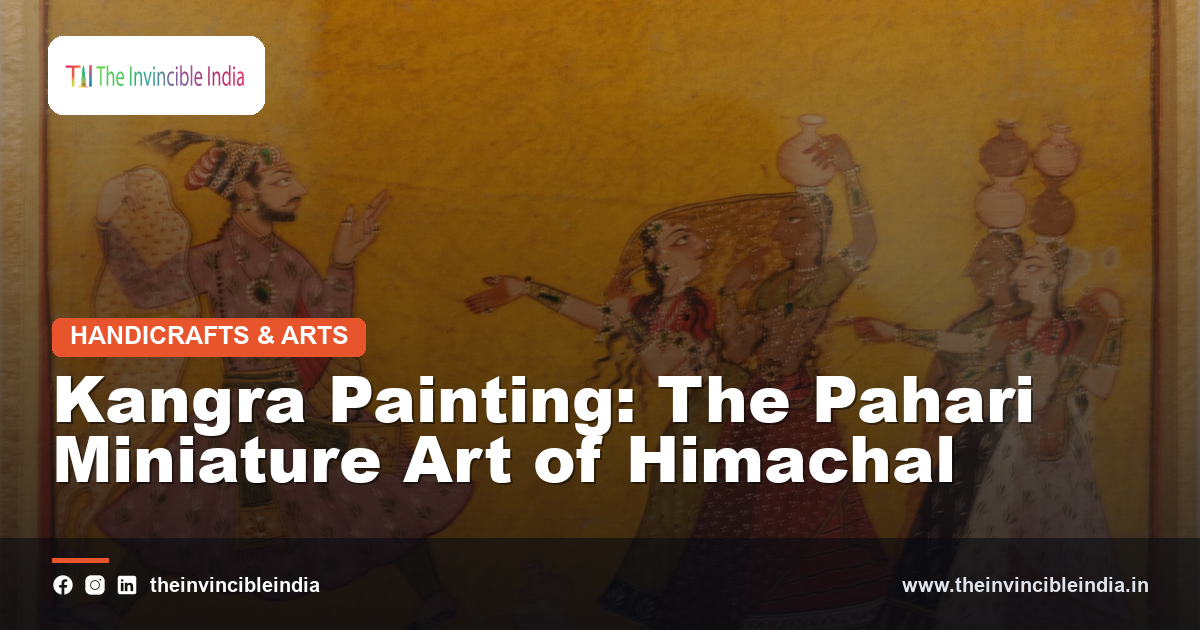
Kangra painting is the most celebrated phase of the Pahari school of miniature art, which flourished in the Himalayan foothills of present-day Himachal Pradesh and neighbouring hill regions. Known for its gentle colours, flowing lines and idealised, tender depictions of devotion and love, the style turned the lives of Radha and Krishna into poetry on paper. It stands in quiet contrast to the bolder, flatter idiom of Rajasthan’s traditional arts, favouring lyrical naturalism over dramatic geometry. Created under the patronage of hill courts, Kangra painting remains one of the clearest expressions of how the mountain kingdoms absorbed outside influences and transformed them into a refined regional language that continues to inspire artists, collectors and museums.
Quick Facts
| Detail | Information |
|---|---|
| Art Form | Pahari miniature painting |
| Primary Region | Kangra Valley, Himachal Pradesh |
| Typical Themes | Krishna lore, love poetry, Hindu epics |
| Colours | Mineral and vegetable pigments |
| Surface | Handmade paper (wasli) |
| Defining Quality | Lyrical naturalism and soft line |
Understanding the Pahari School
The word Pahari simply means of the hills, and the Pahari school describes the family of miniature painting styles that developed in the courts of the Himalayan foothills. These centres, scattered across what is now Himachal Pradesh and nearby regions, each developed their own flavour while sharing a common devotional outlook and a delicate approach to line and colour.
Kangra painting is the best known and most graceful chapter of this wider tradition. Understanding the Pahari school therefore provides the setting in which the Kangra style should be read, as one voice within a larger regional chorus of hill painting that gave Himalayan India a distinctive visual identity.
Origins in the Kangra Valley
The Kangra Valley, with its fertile landscape beneath the snow-covered Dhauladhar range, became an important artistic centre under the rulers of the Kangra kingdom. The style takes its name from this region, though its roots extend into earlier hill painting traditions and into the work of artist families who moved between courts as patronage shifted.
The valley offered both natural beauty and political stability for a time, conditions that allowed painters to refine their craft. The origin of Kangra painting is thus best understood as a gradual maturing of hill artistic practice in a landscape whose own charm shaped the paintings themselves.
Roots in Basohli and Guler
Before the Kangra style emerged, the hill region had already produced the bold and vibrant Basohli manner, marked by strong colour and intense expression. Over time, painters influenced by the more naturalistic work associated with the Guler court began to soften this boldness, moving toward finer line and more refined figures.
This transition from the strong early hill idiom to the gentler Guler and Kangra manner shows how artistic taste evolved within the region. Kangra painting inherited the technical foundations of its predecessors while turning toward grace and lyricism, a shift that defines its character and sets it apart from earlier Pahari work.
Royal Patronage of the Hill Courts
Like most Indian miniature traditions, Kangra painting depended on the support of ruling families who commissioned works for their palaces, collections and devotional use. The courts of the hill kingdoms offered workshops where painters could sustain themselves, train apprentices and develop recognised styles across generations.
Patronage shaped both subject and quality, since commissions often called for scenes from sacred poetry, portraits of rulers and depictions of courtly life. The painting tradition therefore grew alongside the fortunes of the hill courts, and its refinement reflects a cultural environment in which art was valued as a mark of taste, learning and devotion.
The Influence of Mughal Painting
The painting of the Mughal courts had a lasting effect on the miniature traditions of northern India, and the hill schools were no exception. Painters who trained in or were exposed to Mughal workshops carried ideas about portraiture, fine line and naturalistic modelling into the hill kingdoms, where they blended with local sensibilities.
Kangra painting did not copy Mughal art but absorbed its refinements and redirected them toward a gentler, more devotional purpose. The meeting of imperial technique and local spirituality is one of the defining features of the style and helps explain its unusual combination of polish and tenderness.
Radha and Krishna in Kangra Art
Devotion to Krishna, along with the love story of Radha and Krishna, lies at the emotional heart of Kangra painting. Scenes of the divine couple meeting in groves, sharing moments of longing, or taking part in pastoral play translate a rich devotional literature into visual form.
Painters approached these subjects with sensitivity, presenting love as a spiritual metaphor rather than mere romance. The result is an art in which human feeling and religious meaning are inseparable, and in which the figures of Radha and Krishna become symbols of the soul’s yearning for the divine within the soft, luminous world of the paintings.
Poetry and Literary Themes
Kangra painters frequently illustrated works of devotional and courtly poetry, among them the Gita Govinda, the Bhagavata Purana and series devoted to the moods of lovers. These texts offered a ready stock of emotions, seasons and narrative moments that artists could interpret across numerous folios.
Illustrating poetry required painters to capture mood as well as action, translating verses about longing, reunion and the changing seasons into balanced compositions. This close dialogue between poem and picture made Kangra painting a literary art as much as a visual one, bound to the great devotional literatures of India.
Lyrical Naturalism and Line
The most recognisable quality of Kangra painting is its lyrical naturalism, a gentle realism in which figures, trees and flowers are drawn with fluid, delicate line. Faces tend to be idealised, with softly curved features that convey serenity and inner feeling rather than individual portraiture.
This emphasis on rhythmic outline gives the paintings a musical grace, as though the whole composition moves to a quiet tempo. The refined handling of line is what many viewers recall first, and it remains the clearest visual signature of the Kangra school within the wider world of Indian miniature art.
The Soft and Luminous Palette
Where earlier hill painting used strong, saturated colour, Kangra painters favoured a gentler palette of cool greens, pale blues, soft pinks and luminous whites. The colours were applied in thin, even layers that give the surface a glowing, enamel-like quality.
This delicate colouring supports the mood of tenderness that pervades the style. By keeping contrasts subtle and harmonious, painters created images that feel calm and dreamlike, and the palette itself became an expression of the lyrical outlook that distinguishes Kangra painting from other schools.
Landscape as a Living Setting
Landscape plays an active role in Kangra painting rather than serving as a simple backdrop. Flowering trees, meandering streams, distant hills and clouds are rendered with care, and they often echo the emotions of the figures within the scene.
The hills and valleys familiar to the painters shaped this attention to nature, and the surroundings of the Kangra region seem to breathe through the pictures. Landscape thus becomes a partner to the human story, a living setting in which devotion, love and the changing seasons are given visible form.
Materials and Pigments
Traditional miniature painting in the hills relied on natural materials, including pigments prepared from minerals and plants, bound with a gum and applied with extremely fine brushes. The painting surface was typically handmade paper, built up from layers and prepared to a smooth finish.
Gold and other metallic touches might be used to add richness to ornaments and details. This reliance on natural materials contributes to the lasting freshness of old works and links the craft to broader Indian traditions of painting, in which preparation of materials was itself an important part of the painter’s skill.
Workshop Method and Artist Families
Miniature painting was largely a family and workshop craft, with knowledge passed from master to apprentice and across generations. A composition might begin with a careful preliminary drawing, followed by laying in colour areas, refining details and finally adding delicate finishing touches.
Several hands could contribute to a single work, with one artist responsible for the design and others for colouring or finishing. This collective approach ensured consistency of style and allowed techniques to endure, which is why the Kangra manner can be recognised across works made by different painters and over many years.
Costume, Architecture and Details
Close examination of Kangra paintings reveals a wealth of carefully observed detail, from the folds of garments and the patterns of jewellery to the architecture of pavilions and terraces. These elements anchor the idealised scenes in a recognisable cultural world.
Costume and setting provide valuable evidence about the courtly life of the period, and they also show the painter’s pleasure in decoration. The small details that reward patient viewing are an essential part of the charm of the style and invite viewers to linger over each folio.
Collections and Museums
Kangra paintings are preserved today in museums and private collections across India and abroad, and the region itself maintains an art museum devoted in part to the local heritage. These collections allow researchers and visitors to trace the development of the hill schools.
Museum preservation also draws attention to the fragility of works on paper, which require careful handling and controlled conditions. By bringing Kangra painting to public view, collections help secure its place in the shared history of Indian art and make the tradition accessible to new audiences.
Decline and Continuity
As political conditions changed and courtly patronage weakened, the great era of Kangra painting gradually faded. Workshops lost their principal supporters, and the pressures of new artistic fashions reduced demand for traditional miniatures.
Yet the tradition did not vanish entirely. Families of painters and later enthusiasts kept the techniques alive, adapting them to new patrons and new audiences. This continuity demonstrates the resilience of the craft and shows that a refined court art can survive by finding new roles in a changing society.
Revival and Contemporary Practice
In recent decades, artists and institutions in Himachal Pradesh have worked to revive Kangra painting through training, exhibitions and craft promotion. Contemporary painters study old works closely while also creating new compositions for collectors and cultural spaces.
Modern practice often keeps to traditional materials and methods, though subjects may expand beyond classical themes. This renewed attention gives younger artists a path into the tradition and ensures that the knowledge of line, colour and composition continues to be passed on within the region.
Kangra Painting Today
Kangra painting today is valued both as a historical treasure and as a living craft. Its gentle beauty has made it a favourite subject of study in art history and a reference point for those interested in the cultural heritage of the Himalayan foothills.
Whether encountered in a museum gallery, a workshop in Himachal or a carefully made modern painting, the style continues to communicate warmth, devotion and refinement. Its lasting appeal confirms that the quiet lyricism of the hill painters still speaks clearly across the centuries.
Sources & Further Reading
- Ministry of Culture, Government of India (indiaculture.gov.in).
- National Museum, New Delhi (nationalmuseumindia.gov.in).
Frequently Asked Questions
What is Kangra painting?
Kangra painting is a style of Pahari miniature painting that developed in the hill courts of what is now Himachal Pradesh. It is known for its soft colours, graceful line and devotional themes, especially the love of Radha and Krishna.
How is Kangra painting different from Basohli painting?
Basohli painting is marked by bold colour and strong, intense expression, while Kangra painting favours a gentler palette and lyrical naturalism. The Kangra style grew out of earlier hill traditions and moved toward refinement and softness.
What themes do Kangra paintings depict?
Common themes include scenes from the life of Krishna, love poetry, the Bhagavata Purana and portraits of courtly life. Many works illustrate devotional literature and express emotion through gesture, landscape and colour.
What materials are used in traditional Kangra painting?
Traditional works use natural pigments bound with gum, fine brushes and handmade paper prepared to a smooth surface. Metallic touches may be added to highlight ornaments and details.
Where can Kangra paintings be seen?
Kangra paintings are held in museums and private collections in India and abroad, and Himachal Pradesh maintains collections that highlight the local tradition. Exhibitions and craft institutions also showcase contemporary work in the style.


