

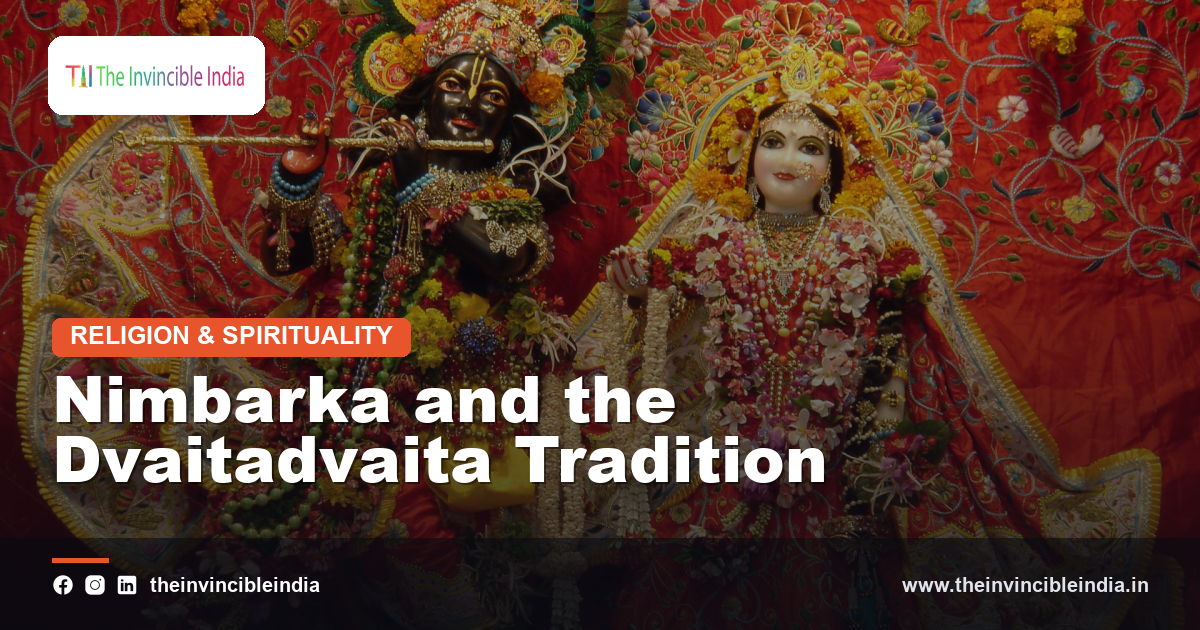
Nimbarka is revered as the teacher behind one of the four classical Vaishnava lineages of India, a tradition that approaches the relationship between the soul and God through the idea of difference and non-difference at once. Known as Dvaitadvaita, this philosophy holds that individual souls and the material world are both distinct from and dependent upon the Supreme, whom devotees worship as Krishna together with Radha. Although the exact details of the teacher’s life are preserved mainly through tradition, his thought has shaped devotional life across the Braj region and beyond. Within the wider current of Vaishnavism, the Nimbarka lineage offers a distinctive balance of philosophical reasoning and tender devotion, and this guide explores its ideas, texts, practices and enduring cultural presence.
Quick Facts
| Detail | Information |
|---|---|
| Tradition | Nimbarka Sampradaya (Sanaka or Kumara lineage) |
| Philosophy | Dvaitadvaita (difference and non-difference) |
| Chief Deities | Radha and Krishna |
| Main Centre | Nimbarkacharya Peeth, Salemabad, Rajasthan |
| Associated Region | Braj, including Vrindavan and Mathura |
| Key Works | Dasasloki and Vedanta Parijata Saurabha |
Who Was Nimbarka?
Nimbarka is remembered as a Vedantic teacher and devotee of Krishna who gave his name to one of the oldest organized Vaishnava lineages. Details of his life are transmitted largely through the tradition itself rather than through detailed contemporary records, and scholars continue to discuss when he lived, although he is generally placed in the medieval period. Tradition associates him with the southern part of the subcontinent and with a later settlement in the north, where his teaching took root among devotees of Krishna. He is honoured by his followers as an acharya, a teacher whose commentary on the Brahma Sutras set out a coherent philosophical vision. Because the historical record is limited, the story of Nimbarka is best understood as a blend of philosophical legacy and devotional memory, in which the lasting influence of his ideas matters more than any single biographical claim.
The Meaning of the Name
The name Nimbarka is commonly explained through a traditional story, and it should be read as tradition rather than as established history. According to the account, the teacher once hosted an ascetic guest who would eat only before sunset, and when dusk approached the teacher is said to have kept the sun visible near a neem tree so that the guest could be fed. The Sanskrit words nimba, meaning neem, and arka, meaning sun, are said to combine into the name by which he is known. Other names such as Niyamananda and Bhaskara are also mentioned in the lineage accounts. Whatever the origin of the story, it conveys the ideal of hospitality, which is treated in Indian culture as a sacred duty. The legend therefore survives as a teaching about generosity and devotion, reinforcing the values that the tradition holds central.
The Four Vaishnava Sampradayas
Nimbarka’s lineage is counted among the four principal Vaishnava sampradayas, alongside the traditions linked with Ramanuja, Madhva and Vallabha. Each of these schools offers its own interpretation of the relationship between the individual soul, the world and the Supreme, and each preserves a line of teachers who transmit the doctrine from guru to disciple. The Nimbarka tradition is often called the Kumara or Sanaka sampradaya because it traces its spiritual descent to the four ancient sage brothers of the Puranic tradition, who are said to have received teaching from the divine. This genealogical claim is a matter of tradition, yet it expresses how seriously the lineage regards continuity of instruction. The presence of four distinct schools shows the richness of devotional thought within Vaishnavism, and the Nimbarka stream remains one of its recognized and respected branches.
Understanding Dvaitadvaita
The term Dvaitadvaita combines dvaita, meaning duality, and advaita, meaning non-duality, and it points to a philosophy in which both are held to be true together. According to this view, the individual soul and the material world are different from the Supreme Being in their nature and attributes, yet they are not separate from the Supreme in their dependence for existence and activity. The relationship is therefore described as one of simultaneous difference and non-difference, which the tradition calls bhedabheda. Followers explain that this avoids both the claim that everything is one undifferentiated reality and the claim that the soul and God are wholly apart. The teaching invites devotion, because a real distinction between worshipper and worshipped makes love possible, while the underlying unity keeps the soul forever dependent on the divine. In this way Dvaitadvaita seeks a middle path between competing Vedantic positions.
Three Realities: Soul, Matter and God
Nimbarka’s system is built on three fundamental realities, which are the individual soul, the world of matter and the Supreme Being. The soul is described as conscious, knowing and an enjoyer of experience, while matter is unconscious and subject to change, and God is the controller who sustains both. Of these, only the Supreme is regarded as fully independent, whereas the soul and the world depend on the divine for their very existence. The tradition teaches that the soul is atomic in size yet capable of devotion and knowledge, and that its true nature is obscured by ignorance and attachment to the world. Liberation is understood as the recovery of the soul’s proper relationship with God rather than its dissolution into an impersonal whole. This threefold scheme gives the tradition a clear framework within which devotion, ethical life and philosophical inquiry can all be placed.
Analogies of Unity and Difference
Teachers of the lineage often use familiar images to explain how difference and non-difference can coexist. A frequent example is the sun and its rays, where the rays are not identical to the sun yet cannot exist apart from it, or the ocean and its waves, which are distinct forms though made of the same water. Another image is that of a serpent and its coils, where the coiled shape can be considered as different in form while remaining one with the animal. These analogies are meant to make an abstract idea accessible to ordinary reflection, and they appear widely in Vedantic commentary across schools. In the Nimbarka tradition they support the claim that the soul is both related to and distinct from God. By using images drawn from nature, the teachers show that profound metaphysics can be communicated through simple and memorable comparisons.
Radha and Krishna as the Divine Pair
A defining feature of the Nimbarka tradition is its joint worship of Radha and Krishna as the supreme divine couple, with Radha honoured as the beloved and eternal companion of Krishna. Many Vaishnava traditions emphasize Krishna alone or with a consort of another form, but the Nimbarka lineage gives Radha a place of lasting devotional importance. Devotees contemplate the pair in the setting of the pastoral Braj country, where the Puranic stories of Krishna’s childhood and youth are set. The image of the couple expresses divine love as the highest reality, and the devotee seeks to share in that love through service and remembrance. Temples associated with the lineage place Radha and Krishna together on the altar, reflecting this theology. The devotion to the divine pair thus gives the Dvaitadvaita philosophy an emotional centre that complements its intellectual structure.
The Dasasloki and Other Works
Tradition attributes to Nimbarka a brief devotional and philosophical text called the Dasasloki, a composition of ten verses that summarizes the essentials of his teaching. Because it is compact, it is easy to memorize and is treated as a core statement of the lineage’s doctrine regarding the soul, God and the path of surrender. The commentary on the Brahma Sutras attributed to him, known as the Vedanta Parijata Saurabha, offers the fuller philosophical argument, interpreting the Vedantic texts in the light of difference and non-difference. Later teachers expanded this base with further commentaries that defended and developed the system. As with many ancient works, questions of authorship and the exact wording of texts are discussed by scholars, but the tradition treats these writings as its foundation. The small number of core texts has helped the lineage remain focused and coherent over the centuries.
Surrender and the Path of Devotion
The Nimbarka tradition teaches that the soul reaches liberation through bhakti, devotion to God expressed as loving surrender, which is often described through the term prapatti. This surrender is not passive resignation but an active offering of one’s will, work and love to the divine, supported by the guidance of a teacher. Practices include the chanting of sacred names, the study of scripture, the worship of the deity in the home and temple, and service to fellow devotees. The tradition values humility and holds that sincere devotion is open to all who approach with faith, though its formal initiation is conferred through the lineage. Knowledge of the three realities supports devotion by clarifying who the devotee is and who God is. In this way the philosophy of the school and its devotional practice are woven into a single path of spiritual life.
Succession of Teachers
As with other sampradayas, the lineage preserves a succession of teachers who carried the doctrine forward after its founder. Tradition names Srinivasacharya as a leading disciple who is associated with a commentary called the Vedanta Kaustubha, which expanded and defended the philosophical position of the school. Later acharyas contributed to the growth of the tradition by composing texts, debating rival schools and guiding communities of devotees. The names of some later figures, including Harivyasa Devacharya, are remembered in connection with the spread of the lineage in the Braj region. Because accounts of the early succession come mainly from the tradition itself, scholars treat the specifics with care, but the principle of an unbroken line of teaching remains central to the school’s identity. The continuity of the guru lineage is what gives the community its sense of authenticity and shared purpose.
Salemabad and the Main Seat
The principal seat of the Nimbarka tradition is the Nimbarkacharya Peeth at Salemabad in Rajasthan, which serves as an important institutional and spiritual centre for the lineage. A peeth in this sense is a seat of religious authority headed by a pontiff who guides the followers and maintains the transmission of teaching. The site draws devotees who come to pay respect to the lineage’s heritage, to attend festivals and to receive instruction. Its location in the western part of the country shows how the tradition spread well beyond its supposed southern origins and found a lasting home among communities of the north. Other temples and monastic centres affiliated with the sampradaya exist in several regions, linked by shared worship and teaching. These institutions help ensure that the doctrine remains a living practice rather than a purely textual inheritance.
Vrindavan, Mathura and the Braj Connection
The Braj region, which includes Mathura and Vrindavan, holds special importance for the Nimbarka tradition because it is the landscape of Krishna’s Puranic life and the setting of devotion to Radha and Krishna. Temples and ashrams linked to the lineage stand in and around these towns, and pilgrims who visit Braj often encounter its rituals and music. The region is shared by several Vaishnava traditions, each of which has its own temples, songs and customs, producing a layered devotional culture. The Nimbarka community contributes to this culture through its worship of the divine pair and its emphasis on scriptural learning. Walking the sacred circuits and visiting the holy sites forms part of a broader pilgrimage tradition in which place and devotion are inseparable. Braj thus functions as both a physical home and a spiritual symbol for the lineage.
Comparison with Other Vedantic Schools
To appreciate Dvaitadvaita it helps to compare it with the other major interpretations of Vedanta. The Advaita of Shankara teaches that the ultimate reality is a single non-dual consciousness and that the world of multiplicity is ultimately not separate from it. Ramanuja’s Vishishtadvaita holds that souls and matter are real but form the body of the Supreme, while Madhva’s Dvaita insists on a fundamental and eternal distinction between God and souls. Nimbarka’s position sits among these views by affirming that difference and non-difference are both real and neither can be reduced to the other. Scholars describe such positions collectively as bhedabheda, and the term reflects a long strand of Indian thought that predates and runs alongside the better-known schools. The existence of these differing readings shows the depth and variety of Vedantic debate, in which each school preserves a distinct way of understanding the same scriptures.
Festivals and Observances
The festival calendar of the Nimbarka tradition follows the broader Vaishnava year while giving special attention to occasions linked with Radha and Krishna. Janmashtami, the celebration of Krishna’s birth, and Radhashtami, which honours Radha, are observed with devotional singing, decoration of the deities and special offerings. The birth anniversary of the lineage’s founder, traditionally observed around the full moon of the month of Kartik, is also marked by the community with worship and reflection on his teachings. Other occasions such as Holi and Sharad Purnima carry meaning in Braj devotion and are celebrated with local customs. Fasting, congregational chanting and the reading of scripture commonly accompany these days. Through the yearly cycle of festivals, the abstract doctrines of the school are experienced as communal joy and shared remembrance, which keeps the tradition vibrant for each new generation.
Temples, Music and Cultural Expression
The devotional life of the Nimbarka tradition finds expression in temple worship, devotional music and the arts of Braj. Daily rituals in affiliated temples include offerings, the singing of hymns and the ceremonial presentation of the deities in decorated attire. Devotional poetry in regional languages, composed by saints of the Braj tradition, praises the beauty and play of the divine pair and is often sung in congregational gatherings. Such music links philosophy and emotion, allowing listeners who may not study the texts to share in their meaning. The visual arts, including paintings and sculptures of Radha and Krishna, likewise draw on the themes that the lineage cherishes. These cultural forms help carry the ideas of the school beyond the circle of scholars and into the wider life of the community, where they continue to shape taste and imagination.
Nimbarka and Dvaitadvaita Today
Today the Nimbarka tradition continues as a living sampradaya, maintained by monastic centres, temples and communities of devotees who study the teachings and observe its worship. Its philosophy of difference and non-difference remains a subject of interest for students of Indian thought, who value it as an example of how Vedanta can accommodate both unity and relationship. The lineage’s emphasis on Radha and Krishna, on surrender and on loving service continues to attract those who seek a devotional path grounded in reasoned doctrine. Pilgrims to Braj and Salemabad encounter a heritage that has been passed down through many generations of teachers. While the precise history of its founder is preserved largely by tradition, the enduring vitality of the school is plain to see. Nimbarka and the Dvaitadvaita tradition thus remain an important and respected strand within the larger story of Indian spirituality.
Sources & Further Reading
- Ministry of Culture, Government of India (indiaculture.gov.in).
- Sahitya Akademi, national academy of letters (sahitya-akademi.gov.in).
Frequently Asked Questions
Who was Nimbarka?
Nimbarka is honoured as a Vaishnava teacher and the founder of the lineage that bears his name. Details of his life are preserved mainly through tradition, and he is generally placed in the medieval period.
What does Dvaitadvaita mean?
Dvaitadvaita means duality and non-duality together, a view in which the soul and the world are both different from and non-different from God. The tradition holds that both aspects are real and neither cancels the other.
Whom does the Nimbarka Sampradaya worship?
The tradition worships Radha and Krishna as the supreme divine couple. Devotees contemplate them especially in the setting of the Braj region.
Where is the main seat of the tradition?
The principal seat is the Nimbarkacharya Peeth at Salemabad in Rajasthan. The lineage also has temples and centres in Braj and other regions.
How does Dvaitadvaita differ from Advaita and Dvaita?
Advaita emphasizes ultimate non-duality, while Dvaita stresses a fundamental distinction between God and souls. Dvaitadvaita holds that difference and non-difference are both true at once.


