

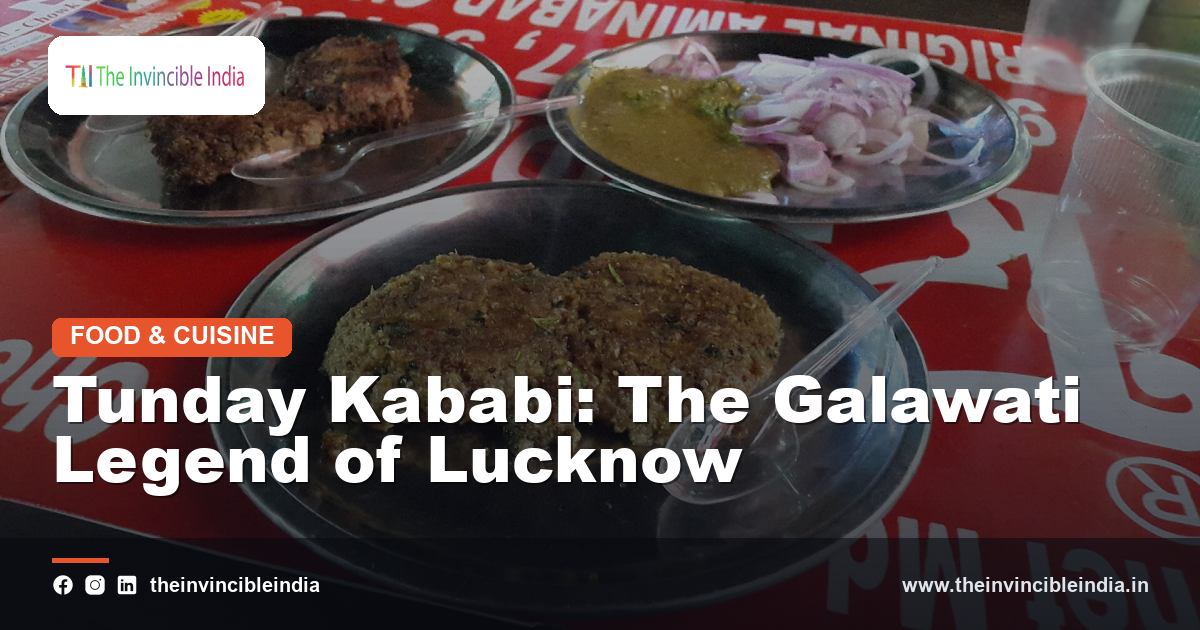
Few dishes carry the reputation of the Tunday kebab, the famous galawati of Lucknow, a patty of finely minced meat so tender that it is said to melt in the mouth before it can be chewed. Born in the kitchens and lanes of the old Awadhi capital, it is the most celebrated expression of a culinary culture that prized softness, aroma and balance above all else. Like the traditions surveyed in the guide to the regional cuisines of India, it is rooted in a particular place and a particular history, and it continues to draw crowds who queue patiently for a taste of that legend.
Quick Facts
| Detail | Information |
|---|---|
| Origin | Lucknow, Uttar Pradesh |
| Cuisine | Awadhi |
| Type | Minced-meat kebab (galawati) |
| Cooked on | Flat griddle (tawa) in ghee |
| Classic pairing | Ulte tawe ka paratha |
| Known for | Melt-in-the-mouth texture |
Lucknow and the Awadhi Table
Lucknow, the capital of the historic region of Awadh, is celebrated across India as a city of courtesy, poetry and refined eating. The cuisine that grew here under the patronage of the Nawabs, known as Awadhi cuisine, favours slow cooking, gentle heat, fragrant spices and an almost obsessive attention to texture. Kebabs, breads, rich curries and fragrant rice dishes all bear this stamp of careful craftsmanship. Within that tradition, the galawati kebab holds a special place because it embodies the Awadhi ideal in its purest form: a humble minced-meat patty elevated, through skill and patience, into something delicate and memorable. To understand the Tunday kebab, therefore, one must first appreciate the culture of the table that produced it, a culture in which food was an art and hospitality a matter of honour.
The Meaning of Tunday
The word tunda in Hindi and Urdu refers to a person with a disabled or missing arm, and the name Tunday Kababi is traditionally explained by a story about the cook who first made these kebabs. According to the popular account, the original cook was a man with only one functioning arm, and the people of Lucknow came to know his stall, and eventually his kebabs, by that affectionate nickname. Whatever the exact details of the tale, the name has endured for generations and has become a brand of unmistakable fame. It is a reminder that many of India’s great food traditions are tied to individual cooks whose names, and sometimes whose personal stories, passed into the language of the city itself. The name Tunday is thus both a title and a piece of living folklore.
The Galawati Legend
The galawati kebab is surrounded by a well-loved legend. In the telling, an elderly Nawab of Awadh, fond of kebabs but troubled by weak teeth, challenged his cooks to prepare a kebab that required no chewing at all. The cooks responded by mincing the meat to an exceptional fineness, softening it with natural tenderisers and enriching it with a fragrant blend of spices, creating a patty that dissolved on the tongue. The story is usually told as a legend rather than documented history, and it is best understood as a charming explanation for a real culinary achievement. Its enduring popularity says something about Awadhi culture, in which royal appetite and cooks’ ingenuity were locked in a friendly contest that produced many of the region’s finest dishes. The legend remains inseparable from the kebab’s identity.
What Galawati Means
The word galawati comes from the Urdu and Hindi word gala, meaning throat, and the name conveys a kebab that slides down the throat almost without effort. The term describes a quality rather than a recipe, and it captures the ambition behind the dish: a texture so smooth and yielding that it feels closer to a pate than to an ordinary grilled patty. Achieving this quality requires fine mincing, careful blending and gentle cooking, since any roughness in the meat or excess handling would spoil the effect. The name is also a quiet tribute to the Awadhi love of paradox, for a dish that appears simple on the plate conceals a remarkable amount of labour. When people speak of galawati today, they refer to this specific promise of softness that the Lucknow tradition made famous.
The Meat and Its Preparation
Traditionally, the Tunday kebab is made from minced buffalo meat, a staple of the street kebab tradition in Lucknow, though other meats are used in many kitchens and restaurants. The meat is minced very finely, often more than once, until it forms a smooth paste with no visible fibre. A tenderising agent, most commonly raw papaya, is used in the Awadhi tradition to soften the protein further, and fat is blended in to ensure moisture and richness. Ginger, garlic and fried onion paste are typically added to build depth. Rest periods are important, allowing the flavours to settle before cooking. The care taken at this stage determines the final texture, which is why experienced kebab makers regard preparation as more important than the actual cooking. The meat, in short, is transformed long before it reaches the griddle.
The Closely Guarded Spice Blend
The fragrance of the Tunday kebab comes from a blend of spices that its makers guard with great secrecy. The blend is popularly described as containing a very large number of ingredients, though the exact composition has never been formally disclosed. In the wider Awadhi tradition, such blends usually draw on whole spices such as cardamom, cloves, cinnamon, mace, nutmeg, black pepper and cumin, balanced with aromatic additions like dried rose petals or vetiver essence in some historic recipes. The aim is never fierce heat but a layered, perfumed warmth that supports the meat rather than overpowering it. This philosophy distinguishes Awadhi cooking from bolder regional styles. The secrecy surrounding the blend has become part of the kebab’s mystique, reinforcing the sense that this is a craft handed down within families rather than a formula available to every kitchen.
Cooking on the Griddle
Galawati kebabs are traditionally cooked on a broad flat griddle called a tawa, using generous quantities of ghee. The patties are small and round, shaped by hand and placed on the hot surface where they are cooked slowly until a delicate golden crust forms outside while the interior stays tender. The cook must handle them gently, because a mixture this soft can easily break, and the heat must be controlled so that the exterior browns without drying the centre. The sizzle of ghee, the aroma of spices and the rhythmic turning of the kebabs are part of the theatre of the Lucknow kebab stall. Watching the kebabs cook is almost as much a part of the experience as eating them. The griddle, in this sense, is both a cooking tool and a stage.
Ulte Tawe Ka Paratha
The classic companion of the Tunday kebab is the ulte tawe ka paratha, a flaky, layered flatbread whose name means the paratha of the inverted griddle. It is traditionally cooked on the underside of a round griddle turned upside down over the fire, which gives it a distinctive texture and slightly different heat. The dough is enriched, rolled and folded to create layers, and the finished bread is soft yet crisp at the edges. Together, the kebab and the paratha form a pairing that is almost inseparable in the memory of anyone who has eaten them in Lucknow. The bread serves as a wrapping, a scoop and a gentle contrast to the richness of the meat. Their partnership shows how Indian food traditions often depend on combinations rather than individual dishes.
Galawati Among the Kebabs of Awadh
Awadh is home to a remarkable family of kebabs, each with its own character. The seekh kebab is moulded on skewers and cooked over open flame, the shami kebab is a patty of meat and lentils bound together and shallow-fried, and the kakori kebab, named after a town near Lucknow, is celebrated for its silky tenderness. The galawati belongs in this company as a shallow-fried patty prized for extreme softness. What separates it from its relatives is the near-total absence of resistance in the bite. Each kebab expresses a different idea of what minced meat can become, and together they illustrate the sophistication of the Awadhi kitchen. Comparing them shows that the galawati is not a single dish but part of a larger conversation about texture and technique.
Nawabi Patronage and Culinary Craft
The kitchens of the Nawabs of Awadh are remembered as laboratories of taste, where cooks competed to impress the court with inventive dishes. Patronage allowed specialist cooks to refine techniques such as slow cooking in sealed pots, the layering of fragrance and the preparation of delicate breads. Many dishes now considered classics of Lucknow originated or matured in this environment, and the galawati is often cited as a prime example. Although the court has long disappeared, its culinary legacy was preserved by families of cooks who continued the craft in the city’s markets and homes. This transfer of knowledge from palace kitchen to public stall helped democratise a refined cuisine. The Tunday kebab therefore stands as a link between aristocratic patronage and the everyday pleasures of the city’s street food culture.
Family Recipes and Inherited Knowledge
Behind famous kebab shops often stands a family that has preserved a recipe over several generations. In the Tunday tradition, the craft is regarded as inherited knowledge, with certain steps and proportions known to only a few trusted members. Such secrecy is common in Indian culinary history, where specialist skills, whether in sweets, kebabs or breads, were treated as valuable heritage. This model has advantages and challenges: it protects authenticity and encourages pride, but it also makes the knowledge vulnerable to disruption if the chain of transmission breaks. The continued success of the Lucknow kebab tradition suggests that the chain has largely held. The story of the galawati is therefore also a story of family continuity, in which each generation takes responsibility for keeping a flavour alive exactly as it was received.
Accompaniments and the Way It Is Eaten
A plate of Tunday kebabs is usually accompanied by simple but carefully chosen extras. Thin rings of raw onion, wedges of lemon and a fresh green chutney of mint and coriander provide sharpness and freshness against the richness of the meat. Some diners also enjoy the kebabs with sheermal, a lightly sweet saffron-scented bread, which is another hallmark of Lucknow’s baking tradition. The kebabs are best eaten hot, straight from the griddle, when the exterior is crisp and the centre is at its softest. Eating them with a torn piece of paratha, picking up a kebab and a little onion together, is the customary method. These small rituals of serving and eating turn a simple street meal into a distinctive cultural experience that visitors remember long after they leave the city.
The Old City and Its Food Lanes
The old quarters of Lucknow, with their narrow lanes, bustling markets and generations-old eateries, form the natural home of the Tunday kebab. Food in this part of the city is not separate from daily life; it is woven into neighbourhood routines, festivals and social gatherings. Kebab stalls, bakeries, sweet shops and biryani kitchens sit side by side, creating a dense culinary landscape that rewards slow exploration. The atmosphere, the smoke of the griddles and the call of vendors are all part of the heritage. Visitors who wish to understand Lucknow often discover that its history is as visible in its food as in its monuments. The galawati, served in this setting, becomes more than a dish: it becomes a way of reading the character of a city that has always valued the pleasures of hospitality.
Evenings, Festivals and Shared Meals
In Lucknow, kebabs are closely associated with evenings, celebrations and the festive season. During Ramadan, for example, the hours after sunset bring crowds to the old city’s food lanes, where kebabs, breads and sweets are enjoyed with family and friends. Weddings, gatherings and religious festivals also create occasions for feasting. The galawati, with its elegant softness, suits these moments of shared enjoyment, and many families treat a visit to a famous kebab stall as a cherished tradition. Food in such settings becomes a language of belonging, connecting generations and communities through common taste. The continued popularity of the Tunday kebab during these seasons demonstrates how deeply it has been absorbed into the social and emotional life of the city, far beyond its role as a simple meal.
Principles for Cooking Galawati at Home
Home cooks who attempt to recreate galawati-style kebabs soon discover that the dish rewards patience. The key principles are very fine mincing, a gentle tenderiser, a well-balanced blend of whole spices and cooking on moderate heat with plenty of ghee. The mixture should be rested so that flavours develop, and the patties shaped lightly to avoid compacting them. Because the texture is so delicate, many cooks chill the mixture briefly before frying so that it holds its form. Though a home kitchen cannot fully reproduce the experience of a famous stall, understanding the principles helps appreciate the skill involved. Attempting the dish also builds respect for the craftsmen who produce it hundreds of times a day with consistent results, a reminder that apparent simplicity often conceals deep expertise.
Tunday Kebab Today
Today the Tunday kebab is recognised as one of the signature foods of Lucknow and a symbol of Awadhi culinary heritage. Its fame extends well beyond Uttar Pradesh, drawing food lovers, travellers and writers who treat a plate of galawati as an essential part of any visit to the city. The legend of the toothless Nawab, the story of the one-armed cook, the secret spice blend and the pairing with the inverted-griddle paratha together form a rich cultural narrative. Preserving that narrative requires continued respect for tradition, careful sourcing and the dedication of cooks who maintain the craft. As India’s food culture evolves, the Tunday kebab stands as proof that a single dish, made with care and surrounded by stories, can carry the identity of an entire city across generations.
Sources & Further Reading
- Ministry of Culture, Government of India (indiaculture.gov.in).
- Ministry of Tourism, Government of India (incredibleindia.gov.in).
Frequently Asked Questions
What is a Tunday kebab?
The Tunday kebab is a famous galawati kebab from Lucknow, made from very finely minced meat blended with spices and shallow-fried on a griddle in ghee. It is celebrated for a texture so soft that it seems to melt in the mouth.
What does galawati mean?
Galawati comes from the word gala, meaning throat, and it describes a kebab that glides down without chewing. The term refers to the extreme softness that defines the dish.
Why is it called Tunday?
The name comes from the word tunda, referring to a person with a disabled arm, and is traditionally linked to the cook who first made the kebabs. The nickname became the name of the famous kebab tradition.
What is the kebab usually served with?
It is traditionally served with ulte tawe ka paratha, a flaky flatbread cooked on an inverted griddle. Onion rings, lemon and green chutney commonly accompany it.
Is the Tunday spice blend publicly known?
The exact blend is closely guarded within the family tradition and has not been formally published. Awadhi kebabs in general use fragrant whole spices balanced for aroma rather than heat.


