

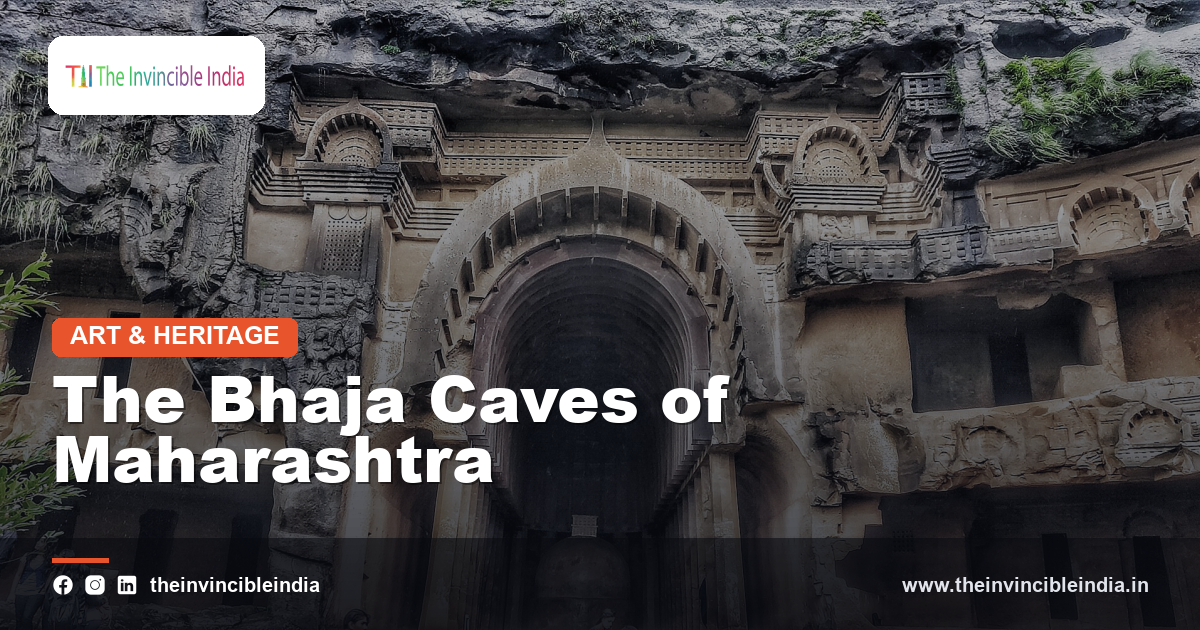
The Bhaja Caves, also spelled Bhaje Caves or called the Bhaja Leni, are a group of ancient Buddhist rock-cut monuments carved into a hillside of the Western Ghats near Lonavala in Maharashtra. Cut by monks and their patrons in the early centuries of Buddhist art in India, they preserve a chaitya hall, monastic cells and a row of memorial stupas in a quiet forest setting. They belong to the great tradition of excavated sanctuaries that began with simple cells and grew into masterpieces of stone, a story that is part of the wider development of Indian temple architecture. This guide explains what the caves are, why they matter and what visitors can see.
Quick answer: The Bhaja Caves are a group of ancient Buddhist rock-cut caves near Lonavala in the Pune district of Maharashtra, carved into the Western Ghats in the early centuries of Buddhist monasticism. They include a large chaitya hall used for worship, several viharas or monastic cells and a cluster of stupas honouring monks. Commonly dated to around the second century BCE, they are among the oldest and most important rock-cut Buddhist sites in western India.
Key Takeaways
- The Bhaja Caves are a cluster of rock-cut Buddhist monuments in the Western Ghats near Lonavala, Maharashtra.
- They are commonly dated to around the second century BCE and are counted among the earliest rock-cut sites of the Deccan.
- The central monument is a chaitya hall, an apsidal prayer hall with a stupa and a horseshoe-shaped facade.
- The chaitya preserves rock-cut ribs and pillars that imitate older timber construction.
- A group of carved stupas stands as a memorial to monks who lived at the site.
- The caves lay beside an ancient trade route linking the Konkan coast to the Deccan plateau.
The sections below describe the caves in turn, from their setting and purpose to their architecture and conservation.
Quick Facts
| Detail | Information |
|---|---|
| Location | Near Lonavala, Pune district, Maharashtra |
| Also spelled | Bhaje Caves, Bhaja Leni |
| Type | Buddhist rock-cut cave complex |
| Era | Early Buddhist period, commonly dated to around the second century BCE |
| Main features | Chaitya hall, viharas, stupa group, carved reliefs |
| Significance | Early example of rock-cut Buddhist architecture in western India |
What Are the Bhaja Caves?
The Bhaja Caves are a series of ancient rock-cut Buddhist caves carved into the face of a basalt hill in the Western Ghats of Maharashtra. They were created as a monastic complex, with a hall for communal worship, living quarters for monks and memorials to teachers of the community. The caves are numbered in the modern documentation of the site, and the group includes a significant chaitya hall that is often singled out as the finest early example in the region. Unlike freestanding temples built stone by stone, these monuments were made by cutting inward into living rock, a technique that demanded careful planning because mistakes could not be corrected. The caves show how early Buddhist communities turned a hillside into a complete religious settlement. Bhaja therefore stands as a foundational site for understanding Buddhist rock-cut art in the Deccan.
Where Are the Bhaja Caves Located?
The Bhaja Caves are located on a hill above the village of Bhaje, close to Lonavala and Malavli in the Pune district of Maharashtra. They lie in the Sahyadri range, as the Western Ghats are known locally, in a landscape of steep slopes and monsoon forest. The site is reached by climbing a flight of stone steps from the base of the hill, and the walk passes through greenery that is particularly lush after the rains. Nearby are other notable monuments, including the Karla Caves, the Bedsa Caves and the hill fort of Lohagad, which make the area a rich zone for heritage exploration. The caves are easily reached from Pune and Mumbai, which has made them a popular day trip. The setting itself, high above the plain and surrounded by forest, is part of the experience.
Why Were the Caves Cut Here?
The caves were cut here because the hill overlooked an important ancient route running from the Konkan coast up through the ghats to the Deccan plateau. Merchants, pilgrims and travellers used such passes to carry goods and ideas, and Buddhist monasteries often grew up beside them. A monastery near a trade route could receive donations from wealthy traders and offer shelter to passing monks and laity. The basalt of the Deccan trap was also well suited to excavation, offering a hard but workable stone that could be carved in large, stable volumes. The combination of patronage, pilgrimage traffic and suitable rock explains the cluster of cave sites along the western ghats. Bhaja is one link in a chain of sanctuaries that stretched along the commercial arteries of early India. Commerce and faith were closely intertwined in its creation.
The Early Buddhist Context
The Bhaja Caves belong to an early phase of Buddhist art in which the Buddha was represented through symbols rather than in human form. The stupa, a solid dome that holds sacred associations, served as the central focus of worship, and monks gathered in halls built around it. Scholars often describe the sect associated with such sites as part of the older Theravada or Hinayana current, in which the Buddha himself was not yet shown in figural images. The monks lived simply in small cells and met for study and ritual in the chaitya hall. This early phase produced the first great rock-cut monuments of western India, and Bhaja is one of the oldest. Understanding this context helps explain why the caves emphasise architecture and symbol rather than statues. The monuments express devotion through structure, space and light, rather than through portraiture of the teacher.
How Old Are the Bhaja Caves?
The Bhaja Caves are commonly dated to around the second century BCE, which places them among the earliest Buddhist rock-cut monuments of the Deccan. Such dating is based on the style of the architecture, the form of the letters in inscriptions and comparison with other early sites, rather than on a single precise record. Some scholars suggest slightly different periods for particular caves, and the group as a whole was probably excavated over a span of time rather than all at once. The caves are often associated broadly with the age of the Satavahana dynasty and the commercial prosperity of the western Deccan, though the exact patrons of each cave are known only partly. The approximate date nonetheless gives the site a very long history, stretching back more than two thousand years. The antiquity of Bhaja is a central reason for its importance in the study of Indian art.
The Chaitya Hall
The chaitya hall is the finest monument at Bhaja, a long apsidal chamber cut deep into the rock to serve as the community’s place of worship. An apsidal plan means that the hall has a rounded end, within which stands a solid stupa, and the plan is shared with later Buddhist halls across India. A row of tall, slightly inward-leaning pillars runs along each side, separating a central nave from narrow aisles, and the vaulted ceiling rises above them. The pillars are plain and octagonal, without the elaborate decoration of later caves, which gives the interior a calm and austere dignity. Worshippers would walk around the stupa in the aisle, a ritual known as circumambulation. The entire space is oriented toward the stupa, so that the eye is drawn to the sacred centre. The chaitya of Bhaja remains a model of early Buddhist sacred design.
The Horseshoe Facade and Timber Imitation
The facade of the chaitya hall is dominated by a large horseshoe-shaped arch, a form that became a hallmark of early Buddhist architecture in India. Above the doorway the arch frames an opening that once admitted light into the hall, and its outline is echoed in carved decoration. One of the most fascinating aspects of the monument is that the carvers reproduced details of wooden construction in stone, including ribs, beams and rafters. These features suggest that the rock-cut halls were modelled on earlier buildings made of timber, bamboo and thatch that have long since vanished. Remains of wooden elements in some early caves strengthen this view. The stone imitation of timber gives modern scholars a rare window into the lost architecture of ancient India. The facade therefore preserves memory of a vanished building tradition inside a durable monument.
The Viharas and Monastic Life
The viharas of Bhaja are the monastic cells in which the monks lived, studied and meditated. A typical vihara consists of a central hall surrounded by small rooms, some of which contain stone benches that served as beds. The rooms are plain and functional, reflecting a life of simplicity and discipline. Through these spaces we gain a sense of how a monastic community was organised, with shared areas for gathering and private cells for rest. Some of the viharas were cut with verandahs and pillared fronts, giving them an architectural presence even when the interiors were modest. The scale of the viharas suggests a small but well supported community of monks. The caves thus preserve not only a place of worship but also a picture of everyday monastic existence in ancient India. They show how architecture and way of life were joined in a single carved space.
The Carved Reliefs of Surya and Indra
One of the most celebrated features of Bhaja is a pair of carved reliefs in one of the viharas, showing a figure in a chariot and another riding an elephant. These are traditionally identified as the sun god Surya driving a chariot and the god Indra mounted on the elephant Airavata. The figures are carved in a lively, energetic style that is quite different from the austerity of the pillared halls, and they have attracted the attention of art historians for generations. Their presence in a Buddhist monastery shows that early Buddhist art drew on a shared stock of popular religious imagery from the wider Indian culture. Interpretations of the exact meaning of the reliefs vary among scholars, and the identification of the figures is generally accepted but not beyond all debate. The sculptures are nonetheless a rare surviving example of early narrative carving in the region. They add human warmth and movement to the monastic complex.
The Stupa Group and Memorials to Monks
At the edge of the cave complex stands a group of small stupas cut from the rock, usually described as memorials to monks who lived and taught at Bhaja. The stupas vary in size and are carved with dome shapes and in some cases with inscriptions naming the departed. Their presence indicates that the site was active for a long period and that its community honoured its senior members in death. Rock-cut stupas of this kind are important evidence of how early Buddhists commemorated their teachers before the practice of image worship developed. They also give the site a gentle, reflective atmosphere, as visitors walk among the quiet domes. The group of stupas is one of the most distinctive sights at Bhaja and is often photographed with the forest as backdrop. It shows that the caves were not only a place of worship but also a place of remembrance.
Inscriptions and Patronage
Short inscriptions in an early script record gifts made to the monastery by donors, and they are valuable evidence of how the caves were supported. Such records usually name the donor and sometimes his or her occupation or village, showing that patronage came from a wide range of the early community, including merchants and craftsmen. The practice of recording donations on stone was common across early Buddhist sites, and it reveals the close link between religious life and commercial prosperity. Readings of individual inscriptions are the work of epigraphists, and some details remain open to interpretation, so general statements are safest. The inscriptions nonetheless show that the creation of the caves was a collective effort rather than the work of a single king. They help us to imagine the network of donors, artisans and monks who made Bhaja possible. The words on the walls are as informative as the sculptures.
How Do the Bhaja Caves Compare with Karla and Bedsa?
The Bhaja Caves are older and simpler than the nearby Karla Caves, which contain a much larger and more elaborate chaitya hall, but they share the same basic plan and purpose. Karla shows how the form evolved, with richer carving and grander proportions, while Bhaja preserves the earlier, more austere stage of the tradition. The Bedsa Caves, also in the same region, have their own early chaitya and are often visited together with the other two sites. Taken together, these caves allow visitors to trace the development of rock-cut architecture in the Western Ghats over time. Comparison also highlights what is special about Bhaja, namely its early date, its simple elegance and its lively reliefs. Each site contributes something different to the picture. Studying them as a group reveals the growth of a major artistic tradition.
The Landscape, Waterfalls and Monsoon Setting
The Bhaja Caves are set in a landscape of forested slopes and open ridges that transforms with the monsoon season. During the rains, streams and waterfalls spring to life on the hillside, and mist drifts across the ledges, giving the caves an almost dreamlike atmosphere. In the dry season the hills are browner and the views across the valley are clearer. A waterfall close to the caves is a popular attraction in the rainy months, though visitors should be careful on wet rocks and steps. The natural setting is not merely a backdrop but an essential part of the monastery’s character, since early Buddhist communities valued quiet and seclusion in nature. The combination of living rock, forest and water creates a place of unusual calm. Bhaja shows how sacred architecture can grow out of a landscape.
Visiting the Bhaja Caves
Visitors reach the Bhaja Caves by a short climb up stone steps from the village below, and the effort is modest for most people. The site is protected as a monument and managed by heritage authorities, and visitors are expected to treat the carvings with respect. The best time to go is generally during or just after the monsoon for greenery, or in the cooler winter months for comfortable walking. Early arrival helps to avoid crowds on weekends. Sensible footwear is important because the steps and rock can be slippery, and visitors should carry water and take care near edges. Entry arrangements and timings can change, so it is wise to check current information before travelling. A visit can be combined easily with Karla, Bedsa and Lohagad. A half day at Bhaja offers an unforgettable encounter with early Buddhist art.
Conservation and Protection
The Bhaja Caves face the familiar challenges of any ancient rock-cut site, including weathering, seepage of water, vegetation growth and the wear caused by visitors. Heritage authorities are responsible for protecting the caves, and their work includes cleaning, structural monitoring and the regulation of access. The monsoon, which makes the site so beautiful, also brings moisture that can damage carvings over time. Careful drainage and regular maintenance help to limit the impact. Visitors can support conservation by avoiding graffiti, refraining from touching delicate surfaces and keeping to marked paths. Good documentation is also important, so that changes to the condition of the caves can be tracked and understood. The survival of Bhaja for more than two thousand years shows the durability of rock-cut architecture, yet continued vigilance is essential to protect it. The caves are a shared inheritance that depends on careful stewardship.
Bhaja Caves Today
The Bhaja Caves today are a cherished heritage site, valued by scholars, pilgrims and travellers for their antiquity and calm beauty. They no longer serve as an active monastery, but they continue to speak powerfully of the early Buddhist presence in western India. The chaitya hall, the viharas, the stupas and the carved reliefs together offer a compact and well preserved picture of a monastic community at work. For students of Indian art the site is a key reference point, showing the beginnings of a tradition that would later produce the glories of Karla, Ajanta and Ellora. For general visitors it offers a rare chance to stand inside a space that has held silence and devotion for over two thousand years. Set among the forests of the Sahyadris, Bhaja remains one of the most atmospheric heritage destinations in Maharashtra. It is a place where ancient faith and living landscape remain in quiet conversation.
Sources & Further Reading
- Archaeological Survey of India (asi.nic.in).
- Maharashtra Tourism, Government of Maharashtra (maharashtratourism.gov.in).
Frequently Asked Questions
What are the Bhaja Caves?
The Bhaja Caves are a group of ancient Buddhist rock-cut caves near Lonavala in Maharashtra. They include a chaitya hall, monastic cells and a group of stupas. They are commonly dated to around the second century BCE.
Where are the Bhaja Caves located?
The Bhaja Caves are located on a hill above the village of Bhaje, near Lonavala and Malavli in the Pune district of Maharashtra. They lie in the Sahyadri range of the Western Ghats. The site is reached by climbing a flight of stone steps.
How old are the Bhaja Caves?
The Bhaja Caves are commonly dated to around the second century BCE, making them among the earliest rock-cut Buddhist sites in the Deccan. The dating rests on architectural style and inscriptions rather than a single exact record. Some caves may have been excavated at different times.
What is special about the chaitya hall at Bhaja?
The chaitya hall at Bhaja is an early apsidal prayer hall with a central stupa and a horseshoe-shaped facade. Its stone ribs and pillars imitate timber construction, offering a glimpse of vanished wooden architecture. It is regarded as a model of early Buddhist sacred design.
Who are the figures carved in the Bhaja reliefs?
The reliefs in one vihara are traditionally identified as the sun god Surya in a chariot and the god Indra on the elephant Airavata. The identification is widely accepted though not entirely beyond debate. They show how early Buddhist art drew on shared Indian religious imagery.
What is the best time to visit the Bhaja Caves?
The best time is generally during or just after the monsoon for lush greenery and waterfalls, or in the cooler winter months for comfortable walking. Early morning visits avoid crowds. Visitors should take care on wet steps and check current entry arrangements.


