

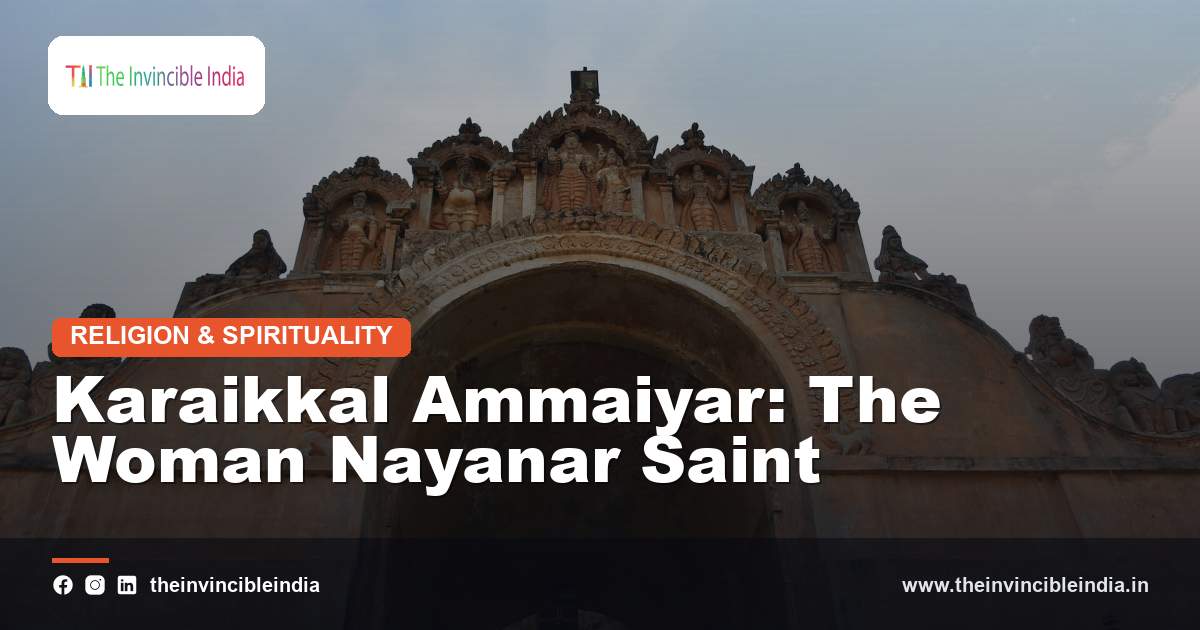
Karaikkal Ammaiyar, also called Punitavati, Karaikkal Pey and Mother of Karaikkal, is one of the sixty-three Nayanars, the Tamil saints who devoted their lives to Shiva. She is remembered as a woman of great devotion and as one of the earliest poets of Tamil Shaivism, whose hymns are preserved in the Shaiva canon. Her story, told in the Periya Puranam, speaks of renunciation, humility and joyful surrender, and it is retold in temple worship and Tamil culture to this day. Her life belongs to the wider Shaiva tradition of the Tamil country. This guide presents her in general terms, noting where accounts belong to devotional tradition.
Quick answer: Karaikkal Ammaiyar is a woman saint of Tamil Shaivism, counted among the sixty-three Nayanars and honoured as one of the earliest Tamil devotional poets. According to tradition she came from Karaikkal, a coastal town in present-day Puducherry, and renounced worldly beauty to live as a devotee of Shiva. Her hymns, composed in Tamil, form part of the eleventh book of the Shaiva canon.
Key Takeaways
- Karaikkal Ammaiyar is one of the sixty-three Nayanars and among the few women counted in that group.
- Tradition names her Punitavati and links her with the coastal town of Karaikkal in present-day Puducherry.
- Her best-known story, the mango tale, is recounted in the Periya Puranam by Sekkizhar.
- Her Tamil poems, including the Arputa Tiruvantati, are included in the eleventh Tirumurai of the Shaiva canon.
- She is traditionally linked with Tiruvalangadu, where devotees remember her watching the cosmic dance of Shiva.
- She is often placed before the Thevaram saints, making her one of the earliest voices of Tamil Shaiva devotion.
The sections below explore her story, her poetry and her cultural legacy in more detail.
Quick Facts
| Detail | Information |
|---|---|
| Also known as | Punitavati, Karaikkal Pey, Ammaiyar |
| Tradition | Tamil Shaivism, one of the sixty-three Nayanars |
| Home town | Karaikkal, in present-day Puducherry |
| Era | Traditionally among the earliest Nayanars, in the early centuries of Tamil devotion |
| Literary work | Arputa Tiruvantati and related hymns in the eleventh Tirumurai |
| Chief source | Periya Puranam of Sekkizhar |
Who Was Karaikkal Ammaiyar?
Karaikkal Ammaiyar was a woman devotee of Shiva who is counted among the sixty-three Nayanars of Tamil Shaivism. The name Ammaiyar means revered mother, and Karaikkal is the town with which tradition connects her. She is remembered for a life of intense devotion, for her willingness to renounce worldly attachments, and for the poetry she left behind.
Because her story reaches us mainly through devotional literature, it is best understood as sacred memory rather than modern biography. What the tradition consistently preserves is the image of a woman who sought nothing but closeness to Shiva. This image has made her an enduring symbol of spiritual courage, especially for women, within the Tamil religious world.
Who Are the Nayanars?
The Nayanars are sixty-three Tamil saints of Shaivism who lived devotion to Shiva in many different walks of life. They include kings, farmers, potters, hunters, merchants and women, which underlines the inclusive spirit of the tradition. Their lives were gathered and retold by the poet Sekkizhar in the Periya Puranam, a major work of Tamil devotional literature.
Karaikkal Ammaiyar holds a special place among them as one of the very few women in the list. The Nayanars are honoured in Shiva temples across Tamil Nadu through images, festivals and recitation. Understanding this wider community helps readers see that her devotion was not an isolated story but part of a rich, living stream of Tamil spiritual life.
Where Is Karaikkal?
Karaikkal is a coastal town on the Bay of Bengal that is today part of the Union Territory of Puducherry, set within the delta of the Kaveri river system. Tradition holds that Ammaiyar was born here into a family of merchants, and the town has long honoured her as its own saint. A temple dedicated to her stands in Karaikkal, drawing devotees especially during her festival.
The Kaveri delta as a whole is rich in Shaiva shrines and in memories of the Nayanars, which makes it a living landscape of devotion. Visiting Karaikkal offers a glimpse of how a local saint becomes the centre of civic and religious pride. The town shows how deeply her memory is woven into regional identity, long after the centuries that separate her from the present.
Her Early Life in Tradition
Tradition names Karaikkal Ammaiyar as Punitavati and describes her as a devout girl, raised in a prosperous merchant household, who loved Shiva from childhood. She is said to have been generous toward devotees and to have shown a deep spiritual sense from an early age. Her family arranged her marriage to a merchant named Paramadatta, and she became a dutiful wife while remaining devoted to Shiva.
These details come from the Periya Puranam and the traditions of the community rather than from independent records, so they are held as devotional narrative. The emphasis is on character: a woman whose household life never dimmed her love of God. This picture sets the stage for the best-known episode of her story, in which devotion and duty meet at a decisive moment.
What Is the Mango Story?
The mango story is the best-known episode of Karaikkal Ammaiyar’s life in tradition. It tells that her husband sent home two mangoes, and when a hungry Shiva devotee arrived, she offered him food together with one of the mangoes. When the husband returned and ate the other, he asked for the second, and Ammaiyar, troubled, prayed to Shiva, who is said to have provided a mango in answer.
The story continues that when the husband asked for another mango, the miraculous fruit vanished, and he came to regard her as a divine being and withdrew from her. This account is a sacred narrative, told in the community to illustrate hospitality to devotees and the power of faith. It is not a historical report, and readers should take it as part of the devotional heritage.
Why Did She Choose Renunciation?
According to tradition, Karaikkal Ammaiyar chose renunciation after her husband left her in awe and distance, and she turned fully toward Shiva. She is said to have asked that the beauty of her form be taken from her so that nothing would stand between her and her devotion. The tradition describes her then taking a spare, ghostlike form, which gave rise to the epithet Karaikkal Pey, meaning the spirit of Karaikkal.
This episode is understood symbolically as a letting go of bodily vanity and worldly attachment in favour of spiritual freedom. Devotees see in it a statement that the highest beauty lies in devotion rather than appearance. The imagery is striking, yet its message is gentle: that love of God can make a person indifferent to the judgements of the world.
The Journey to Mount Kailasa in Tradition
Tradition relates that Karaikkal Ammaiyar travelled to Mount Kailasa, the sacred abode of Shiva in the Himalayas, in order to see her Lord. One famous account says she did not wish to set her feet on the holy mountain and so moved upon her hands. Shiva, seeing her approach, is said to have greeted her with the word Ammaiye, meaning mother, from which her honoured name is derived.
This episode is a cherished part of the devotional narrative, and it is read as a picture of humility and reverence before the sacred. It also emphasises that her relationship with Shiva was one of warm, familial closeness rather than distant awe. Taken as tradition rather than as history, the story captures why her devotion has touched so many hearts.
What Is Tiruvalangadu and Why Is It Linked to Her?
Tiruvalangadu is a Shaiva pilgrimage site in present-day Tamil Nadu that tradition links closely with Karaikkal Ammaiyar. It is known as a place associated with the dance of Shiva as Nataraja, and the temple is famed for a hall connected with the cosmic dance. According to the devotional account, Shiva granted Ammaiyar the boon of witnessing his dance there and of singing at his feet.
The temple keeps her memory alive through images and rituals that show her seated and singing. Her association with this place shows how the Nayanar tradition ties saints to specific sacred landscapes, so that a pilgrimage becomes also a way of remembering a life. For visitors, it offers one of the most evocative links between her story and the architecture of Tamil Shaivism.
The Poetry of Karaikkal Ammaiyar
Karaikkal Ammaiyar is honoured as a poet whose Tamil verses are among the earliest devotional poems of Shaivism. Her works include the Arputa Tiruvantati, the Tiruvirattai Manimalai and two sets of hymns known as the Tiruppatikams. All are preserved in the eleventh book of the Tirumurai, the great collection of Tamil Shaiva sacred writing.
Her poems are marked by direct feeling, vivid images and a close, personal relationship with Shiva. They speak of his matted hair, his dance, and his presence in cremation grounds, and they often express longing and wonder together. Because of their antiquity and their quality, they are valued both as religious texts and as important early examples of Tamil literary achievement.
What Is the Arputa Tiruvantati?
The Arputa Tiruvantati is a Tamil poem of devotion to Shiva composed in the antati form, in which the last word or syllable of one verse becomes the opening of the next. The title means the wondrous antati, and it consists of roughly one hundred verses. The structure gives the poem a flowing, chain-like quality, as if each thought leads naturally into the following one.
The verses praise Shiva with a mix of reverence and intimacy, and they show a mind that finds the divine in every aspect of life. The antati form later became popular in Tamil devotional writing, and Ammaiyar’s use of it is regarded as an early and influential example. The poem thus stands as a milestone in the history of Tamil literature.
Her Image in Temple Art
Karaikkal Ammaiyar is a familiar subject of temple sculpture and bronze casting in Tamil Nadu. She is usually shown as a thin, seated figure, often with small cymbals in her hands, her face turned in devotion toward Shiva. This distinctive image, with its quiet intensity, differs from the more graceful or royal forms used for many other figures.
The bronzes of this kind are admired for their expressive power, and they show how Tamil artists translated spiritual ideas into form. In some Shiva temples she is placed close to Nataraja, reflecting her tradition of watching the cosmic dance. Her image therefore functions as both devotional icon and work of art, linking the worlds of poetry, worship and sculpture.
Festivals and Remembrance
Karaikkal Ammaiyar is remembered through temple festivals, especially at Karaikkal, where an annual celebration recalls the mango story. During this festival, devotional gatherings, processions and traditional rites draw worshippers from the region. Mangoes are associated with the celebration in memory of the central episode of her life.
Beyond Karaikkal, her name is recited among the Nayanars in Shiva temples across Tamil Nadu, and her hymns are sung by devotees and musicians. Such observances show that she is not only a figure from the past but a continuing presence in community life. The festivals offer a way for each generation to connect with her story through shared celebration and song.
Why Does She Matter in the Nayanar Tradition?
Karaikkal Ammaiyar matters because she stands as the foremost woman voice among the Nayanars and as an early pioneer of Tamil devotional poetry. Her life and verses show that spiritual authority in the Tamil Shaiva tradition was not limited by gender or by social position. She is therefore remembered as a figure of courage who followed an inner calling.
Her place in the canon also shows how devotion and literature grew together in the Tamil country. Later poets and saints drew inspiration from the tradition she represents, and her poems preserve an early moment in that story. For readers today, she offers a window into how women contributed to religious creativity in the Indian past.
Women Saints in Indian Devotion
Karaikkal Ammaiyar belongs to a wider tradition of women saints who shaped Indian devotional life. Alongside her stand figures such as Andal in the Tamil Vaishnava tradition, and later women poets in other regions who expressed devotion in their own languages. Each gave voice to spiritual experience with great freedom and personal courage.
Placing Ammaiyar in this larger company clarifies her distinct contribution. She is among the earliest in a long line, and her poems helped to establish that a woman could speak directly to God in her own voice. This broader view shows how Indian devotion has been enriched by the creativity and conviction of women across many centuries.
How Should Her Story Be Read Today?
Her story is best read as sacred tradition that carries moral and spiritual meaning, rather than as strict biography. Episodes such as the miraculous mango, the change of form and the journey to Kailasa are told in the language of devotion, where wonder is a way of expressing truth. Dates and details differ between traditions, and careful writers avoid fixing them too precisely.
At the same time, her poems exist as real texts that can be read and studied. They give firm evidence of an early Tamil devotional voice, whatever one thinks of the legends. Reading the legend and the poetry together lets a student appreciate both the faith of the community and the literary significance of her work.
Karaikkal Ammaiyar Today
Karaikkal Ammaiyar continues to be a cherished figure in Tamil religious and cultural life. Her temple at Karaikkal, her images in Shiva shrines, her hymns in the Tirumurai and the annual remembrance of the mango story keep her presence vivid. For many devotees, she stands as a model of humility, hospitality and uncompromising love of God.
For students of culture, she offers a way into the world of the Nayanars and the beginnings of Tamil devotional poetry. Her story invites reflection on the power of faith to shape art, literature and community identity. Those who wish to learn more can read her verses in translation and visit the Shiva temples that preserve her memory.
Sources & Further Reading
- Ministry of Culture, Government of India (indiaculture.gov.in).
- Archaeological Survey of India (asi.nic.in).
Frequently Asked Questions
Who was Karaikkal Ammaiyar?
Karaikkal Ammaiyar was a woman saint of Tamil Shaivism and one of the sixty-three Nayanars. She is honoured as a devotee of Shiva and as one of the earliest Tamil devotional poets.
Why is she called Ammaiyar?
She is called Ammaiyar because the name means revered mother. Tradition says Shiva himself greeted her as mother when she reached his abode, and the title became her honoured name.
What is the mango story about Karaikkal Ammaiyar?
The mango story is a devotional tale about her hospitality to a Shiva devotee and the miraculous mango that followed. It is told in the Periya Puranam and is understood as sacred tradition rather than historical fact.
What did Karaikkal Ammaiyar write?
Karaikkal Ammaiyar composed Tamil devotional poems to Shiva, including the Arputa Tiruvantati and the Tiruvirattai Manimalai. These works are preserved in the eleventh book of the Tirumurai.
Where is the Karaikkal Ammaiyar temple?
The Karaikkal Ammaiyar temple is in the town of Karaikkal, in the Union Territory of Puducherry. The town honours her with an annual festival connected with the mango story.
How is Karaikkal Ammaiyar depicted in art?
She is usually depicted as a thin, seated figure holding small cymbals, absorbed in devotion to Shiva. Tamil bronze casters and temple sculptors have long portrayed her in this distinctive way.


