

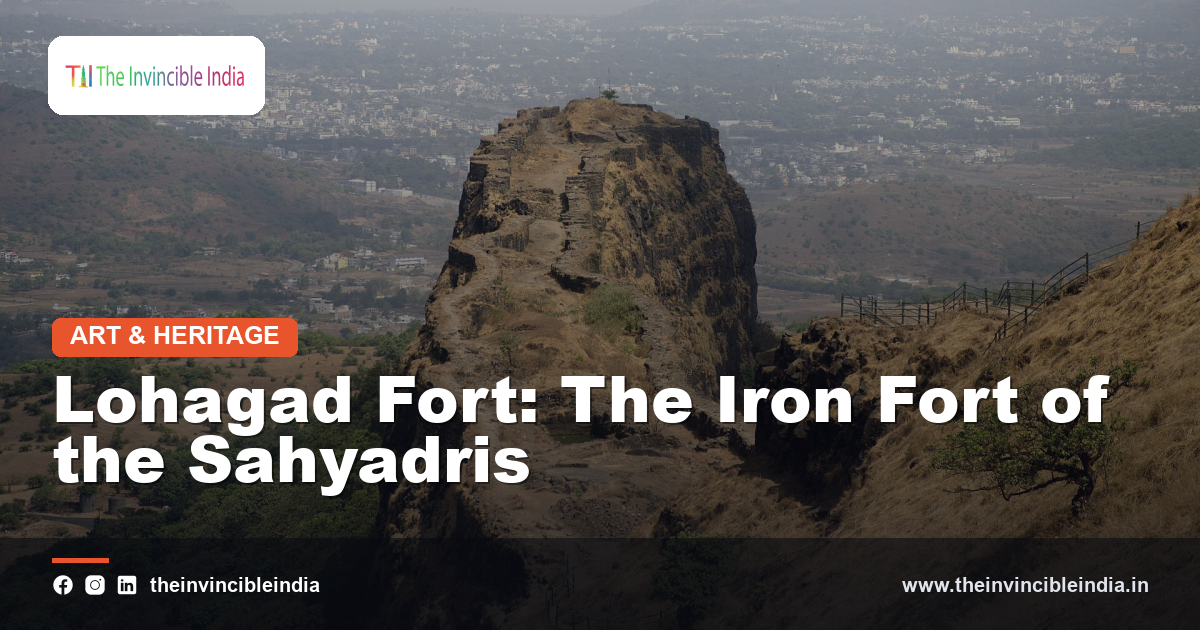
Lohagad Fort, also written Lohagarh or Loh Gad and known as the Iron Fort, rises from a spur of the Sahyadri hills near Lonavala and Malavli in the Pune district of Maharashtra. Its name, its long narrow Vinchu Kada ridge and its four great gateways make it one of the most recognisable hill fortresses of the Western Ghats. Held by many dynasties and closely tied to Maratha history, it belongs among the strongholds surveyed in the guide to the great forts of India. This article explains the fort’s origins, architecture, history and the experience it offers to modern visitors.
Quick answer: Lohagad Fort is a hill fort in the Sahyadri range near Lonavala in the Pune district of Maharashtra, known as the Iron Fort for its strength and its name, which means fort of iron. It was held by many dynasties over the centuries and is closely associated with the Marathas, who used it as a stronghold and treasury. Its four gateways, water tanks and long Vinchu Kada spur make it an outstanding example of Deccan hill-fort architecture.
Key Takeaways
- Lohagad Fort is a hill fort in the Western Ghats near Lonavala, Maharashtra, whose name means the Iron Fort.
- The fort passed through the hands of several dynasties, including the Satavahanas, Chalukyas, Yadavas, Bahmanis, Mughals and Marathas.
- Four main gateways, called the Ganesh, Narayan, Hanuman and Maha Darwaza, guard the long approach to the summit.
- The Vinchu Kada, or scorpion’s tail, is a narrow fortified spur that projects from the main hill.
- Lohagad stands close to Visapur Fort and to the Bhaja and Karla caves, forming a rich heritage zone.
- The fort is a popular monsoon trekking destination and is protected as a heritage monument.
The sections that follow trace the fort from its geography and name to its walls, history and present-day visitors.
Quick Facts
| Detail | Information |
|---|---|
| Location | Near Lonavala and Malavli, Pune district, Maharashtra |
| Also known as | Iron Fort, Lohagarh, Loh Gad |
| Type | Hill fort of the Sahyadri range |
| Main gateways | Ganesh, Narayan, Hanuman and Maha Darwaza |
| Notable feature | Vinchu Kada, the scorpion’s-tail spur |
| Significance | Strategic Deccan stronghold with Maratha associations |
What Is Lohagad Fort?
Lohagad Fort is a historic hill fortress built on a spur of the Sahyadri mountains in the Pune district of Maharashtra. Its name literally means the Iron Fort, a title that conveys both its solidity and the strength of its position. The fort commands a strategic location above the old route running between the Deccan plateau and the Konkan coast, and it was valued by every power that sought to control that corridor. Unlike a palace complex, it is a functional military site, defined by gateways, bastions, water cisterns and long stretches of rampart. The fort is easy to reach from Pune and Mumbai, which has made it one of the best known heritage and trekking sites in the region. Lohagad therefore stands as an accessible introduction to the hill forts that dot the Western Ghats and shaped the history of Maharashtra.
Where Is Lohagad Fort Located?
Lohagad Fort is located near the hill stations of Lonavala and the village of Malavli, in the Maval region of the Pune district. It rises from the Sahyadri range at a point where the ghats form a dramatic edge above the lowlands. The fort looks across the Pavana valley, and the lake created by the Pavana dam spreads out below in the rainy months. Close by stands the twin fort of Visapur, which rises on the neighbouring plateau and is often visited together with Lohagad. The famous Bhaja and Karla caves lie within a short distance, so the area forms a compact zone of cultural interest. The fort can be approached from the village of Lohagadwadi at the base. Its location in the heart of the Maval hills placed it at the centre of the region’s military history.
Why Is It Called the Iron Fort?
The name Lohagad means fort of iron, from the words loha for iron and gad for fort. The name is generally understood to express the fort’s strength, since the walls and the rocky hill beneath them were extremely difficult to attack. Some local traditions suggest additional meanings or associations, but the origin of the name is not documented in a single authoritative source, so the strength explanation is the safest. The iron image also fits the dark basalt of the Deccan trap, which forms the hill and the walls. The title has remained attached to the fort for centuries and has become part of its popular identity. The name evokes an image of an impregnable stronghold standing guard over the ghats. Few fort names in Maharashtra capture the character of their subject as vividly.
Early History and Ancient Associations
Lohagad is believed to be an ancient site, and its history is often traced back through a succession of early dynasties of the Deccan. Tradition associates the hill with the Satavahanas, Chalukyas, Rashtrakutas and Yadavas, each of whom ruled parts of the western Deccan at different times. The nearby Buddhist caves at Bhaja and Karla show that the area was settled and prosperous in very early times, and a fortified hill above them would have been a natural development. Historians caution that direct evidence for the earliest phases of the fort is limited and that many claims rest on tradition. What is clear is that the site was important well before the rise of the Marathas. The long span of dynasties linked to Lohagad shows how valuable the hill was to anyone who held the ghats. The fort’s early story is therefore both attractive and partly shrouded in uncertainty.
Sultanates and the Mughal Era
In the medieval period Lohagad passed through the control of the Deccan sultanates and later the Mughals, as these powers competed for dominance over the western Deccan. The fort is generally remembered as having been held by the Bahmani successor states, including the Nizam Shahi rulers of Ahmednagar, before it was drawn into the wider struggles of the seventeenth century. Each ruler used the fort as a strategic post, a place for storing grain and arms and a refuge in time of danger. The repeated changes of ownership left their mark on the structure, as walls were repaired and gateways modified. The record of this period is fragmentary, and individual dates and events are best treated with caution. The long sequence of rulers nevertheless underlines the fort’s lasting strategic value. Lohagad was a coveted prize in the shifting politics of the medieval Deccan.
Lohagad and the Rise of the Marathas
Lohagad is closely associated with the rise of the Maratha power under Chhatrapati Shivaji Maharaj, who brought the fort under Maratha control in the seventeenth century. For the Marathas, who built their state around a network of hill forts, Lohagad was an important stronghold guarding the approaches to the Maval country. The fort was later surrendered under a treaty with the Mughals and recovered by the Marathas a few years afterward, an episode that illustrates the fluid military situation of the time. Tradition also holds that treasure gathered in the course of Maratha campaigns was stored at the fort, though details of this belong to popular memory rather than precise record. Whatever the exact facts, the association with Shivaji gives Lohagad a powerful place in Maharashtra’s historical imagination. The fort remains a symbol of the Maratha tradition of mountain warfare.
The Peshwa Period and Nana Phadnavis
During the Peshwa period Lohagad continued to serve the Maratha state, and it is also remembered for its association with Nana Phadnavis, the celebrated minister of the Peshwa administration. Nana is said to have used the fort as a place of stay and safekeeping, and he is credited in tradition with building or improving some of its structures, including a stepped well within the fort. The tale reflects the way in which famous figures of Maratha history attached themselves to the sites they used. Details of his activities at Lohagad are best treated as general tradition, since specific claims vary between accounts. The association nonetheless shows that the fort kept its importance into the later eighteenth century. It served as a refuge and a store as well as a military post. Lohagad’s role in the Peshwa age connects it to the administrative history of the Marathas.
What Happened Under the British?
Lohagad came under British control in the early nineteenth century, when the Maratha power was overcome and its forts were taken over one by one. The British occupied the fort in the course of their campaign in the region, and the hill fort then lost its role as an active stronghold. Many Maratha forts were damaged or dismantled after such takeovers, in order to prevent them from being used again as centres of resistance. Lohagad survived in a better state than many, though some structures fell into decay. After this period the fort gradually became a place of historical interest rather than military importance. The transition from garrison to monument is a familiar pattern among Indian hill forts. The British chapter marks the end of Lohagad’s working life and the start of its long afterlife as a heritage site.
The Four Gateways of Lohagad
The approach to the summit of Lohagad is guarded by four successive gateways, known as the Ganesh Darwaza, the Narayan Darwaza, the Hanuman Darwaza and the Maha Darwaza, or Great Gate. The gateways are built with sturdy stone and arranged along the winding route so that anyone approaching must pass through each in turn. This layered defence slowed attackers and allowed defenders to concentrate fire from the walls above. The names of the gates reflect Hindu religious devotion, with the elephant-headed god Ganesha, the deity Narayana and the monkey god Hanuman protecting the way. Carved details and arches add a note of ornament to the otherwise functional design. The Maha Darwaza, the last gate before the summit, is the most imposing. The four gateways form one of the finest sequences of fortified entrances among the hill forts of Maharashtra.
The Vinchu Kada or Scorpion's Tail
One of the most distinctive features of Lohagad is the Vinchu Kada, a long, narrow, fortified ridge that extends from the main hill and curves like the tail of a scorpion, which is the meaning of its name in Marathi. The spur is lined with a wall and bastions, and it was used as a defensive outwork that enabled defenders to watch and fire on enemies who might approach from the side. Its elevated, exposed profile offers some of the most spectacular views in the fort, particularly in monsoon mist. The Vinchu Kada is often photographed and has become the emblem of Lohagad in the popular imagination. Visitors who walk along it should take care, because the ground is uneven and the drops are steep. The scorpion’s tail shows how natural landforms could be incorporated into a fort’s defences. It is a feature that no visitor to Lohagad forgets.
Tanks, Step-Wells and the Summit Plateau
The summit plateau of Lohagad contains a number of water tanks and a stepped well, which supplied the garrison with the water needed to hold out through a long siege. Rock-cut cisterns collected rain from the heavy monsoon, and the supply was stored for use in the dry months. A small shrine, a cave and the remains of buildings are scattered across the top, and a saint’s tomb is also found within the fort, reflecting the layered religious life of the site. The flat, open summit gave space for stores, quarters and drills and offered wide views across the Pavana valley. The management of water on a mountain top was one of the great challenges of fort life, and the tanks of Lohagad show how it was solved. Together these features create a self-sufficient mountain settlement. The plateau is the quiet heart of the fort.
How Does Lohagad Relate to Visapur Fort?
Lohagad has a close companion in Visapur Fort, which rises on a neighbouring plateau and is often described as its twin. The two forts stand at a short distance from one another and together guarded the approaches to the Maval region. Visapur is larger in its summit area and is known for its extensive ruins, rock-cut cisterns and a great gate, while Lohagad is better known for its gateways and the Vinchu Kada. In history the two forts were generally held together, because controlling one without the other would have left a dangerous gap. Many trekkers combine the two forts in a single outing, which gives a fuller sense of the fortified landscape. The pairing is a reminder that hill forts worked as systems rather than as isolated structures. Lohagad and Visapur formed a mutually supporting pair in the defence of the ghats.
What Is the Best Time to Visit Lohagad?
The best time to visit Lohagad is generally during and just after the monsoon, from the rainy months into early winter, when the hills are green and waterfalls tumble down the slopes. The mist that rolls across the ramparts at this time gives the fort an enchanting appearance, though the crowds are also larger. Winter is a pleasant season for walking, with clear skies and moderate temperatures. The summer months are hotter and drier, and the vegetation is less attractive. Visitors should be careful on wet and slippery paths in the rainy season, and local rules sometimes restrict access in conditions of heavy rain, so it is wise to check before travelling. Early starts help to avoid congestion and the midday sun. Choosing the season carefully greatly improves the experience of Lohagad.
Trekking Routes and Practical Advice
Lohagad is among the most accessible forts for beginners, because the path up from the base village follows a well marked track and a series of stone steps. The climb is manageable for most reasonably fit visitors, though the monsoon makes it slippery. Sensible footwear, water, a light rain jacket and sun protection are recommended, and visitors should keep to marked routes. Because the fort is popular, weekends can be very busy, and weekday visits offer a calmer experience. Litter and noise are a concern at crowded heritage sites, and visitors can help by carrying out whatever they bring in. The surrounding area offers other trails and viewpoints for those who want a longer outing. Basic precautions make the visit safe and enjoyable. Preparation allows the fort to be appreciated both as a historical site and as a mountain walk.
Lohagad in the Heritage Landscape of Maval
Lohagad belongs to a landscape rich in heritage, including the Buddhist caves of Bhaja and Karla, the fort of Visapur and several historic temples and villages. The region was a corridor of trade and travel in ancient times and a centre of military struggle in the medieval and early modern periods. The caves reflect the early Buddhist presence, while the forts reflect the later political history, so the area offers a layered view of the past. Visiting these sites together shows how people have shaped and used the same hills over more than two thousand years. The connection between faith, commerce and fortification is clearly visible on the ground. Lohagad is the strongest voice of the military chapter in this heritage landscape. It is best understood as one site among many in a historic ghats region.
Conservation and Preservation
Hill forts like Lohagad face constant threats from weathering, monsoon rain, landslips and the pressure of large numbers of visitors. Heritage authorities and local organisations have worked to repair gateways, clear vegetation and manage access so that the fort can remain open and safe. Voluntary groups of trekkers and history enthusiasts have also contributed through cleaning drives and awareness campaigns. Long-term preservation depends on a balance between access and protection, since heavy footfall can damage fragile stonework. Careful documentation and repair using traditional materials help maintain the fort’s authentic character. Visitors support conservation by respecting signage, avoiding graffiti and leaving the site as they found it. The survival of Lohagad’s gates and walls after so many centuries is a tribute to the quality of their construction. Continued care will keep the fort available for future generations.
Lohagad Fort Today
Lohagad Fort today is a protected heritage site and one of the most visited hill forts in Maharashtra. It no longer houses a garrison, but its gateways, ramparts and the Vinchu Kada still convey the power of an old mountain fortress. The fort connects ancient dynasties, the Deccan sultanates, the Marathas and the British in one continuous story, set in the beautiful landscape of the Sahyadris. For trekkers it is a gentle introduction to the hill-fort tradition, and for students of history it is a living record of the contest for the ghats. The fort also speaks of the way in which communities have honoured their past through the continued care of monuments. Standing on its summit in the mist of the monsoon, a visitor can feel the long memory of the hills. The Iron Fort continues to inspire pride and wonder in all who climb it.
Sources & Further Reading
- Archaeological Survey of India (asi.nic.in).
- Maharashtra Tourism, Government of Maharashtra (maharashtratourism.gov.in).
Frequently Asked Questions
What is Lohagad Fort?
Lohagad Fort is a hill fort in the Sahyadri range near Lonavala in the Pune district of Maharashtra, known as the Iron Fort. It was held by many dynasties and is closely linked with the Marathas. Its four gateways and the Vinchu Kada spur are its best known features.
Why is Lohagad called the Iron Fort?
Lohagad means fort of iron, a name usually explained by the strength and impregnable position of the stronghold. The dark basalt of the hill also suits the image. The exact origin of the name is not documented in a single source.
What is Vinchu Kada at Lohagad?
Vinchu Kada is a long, narrow, fortified spur extending from the main hill of Lohagad. The name means scorpion’s tail in Marathi because of its curved shape. It served as a defensive outwork and offers dramatic views.
How many gates does Lohagad Fort have?
Lohagad has four main gateways called the Ganesh Darwaza, the Narayan Darwaza, the Hanuman Darwaza and the Maha Darwaza. They are arranged in sequence along the approach to the summit. This layered arrangement slowed any attacking force.
What is the best time to visit Lohagad Fort?
The best time is during and just after the monsoon, when the hills are green and waterfalls flow, or in the cooler winter months. The rainy season brings mist but also slippery paths. Visitors should check current access rules before going.
Is Lohagad Fort easy to climb?
Yes, Lohagad is generally regarded as one of the easier hill forts for beginners, with a marked path and stone steps from the base village. The climb is manageable for most reasonably fit people, though the monsoon makes it slippery. Good footwear and water are recommended.


